Part 4: The Broke Widow They Never Knew 039
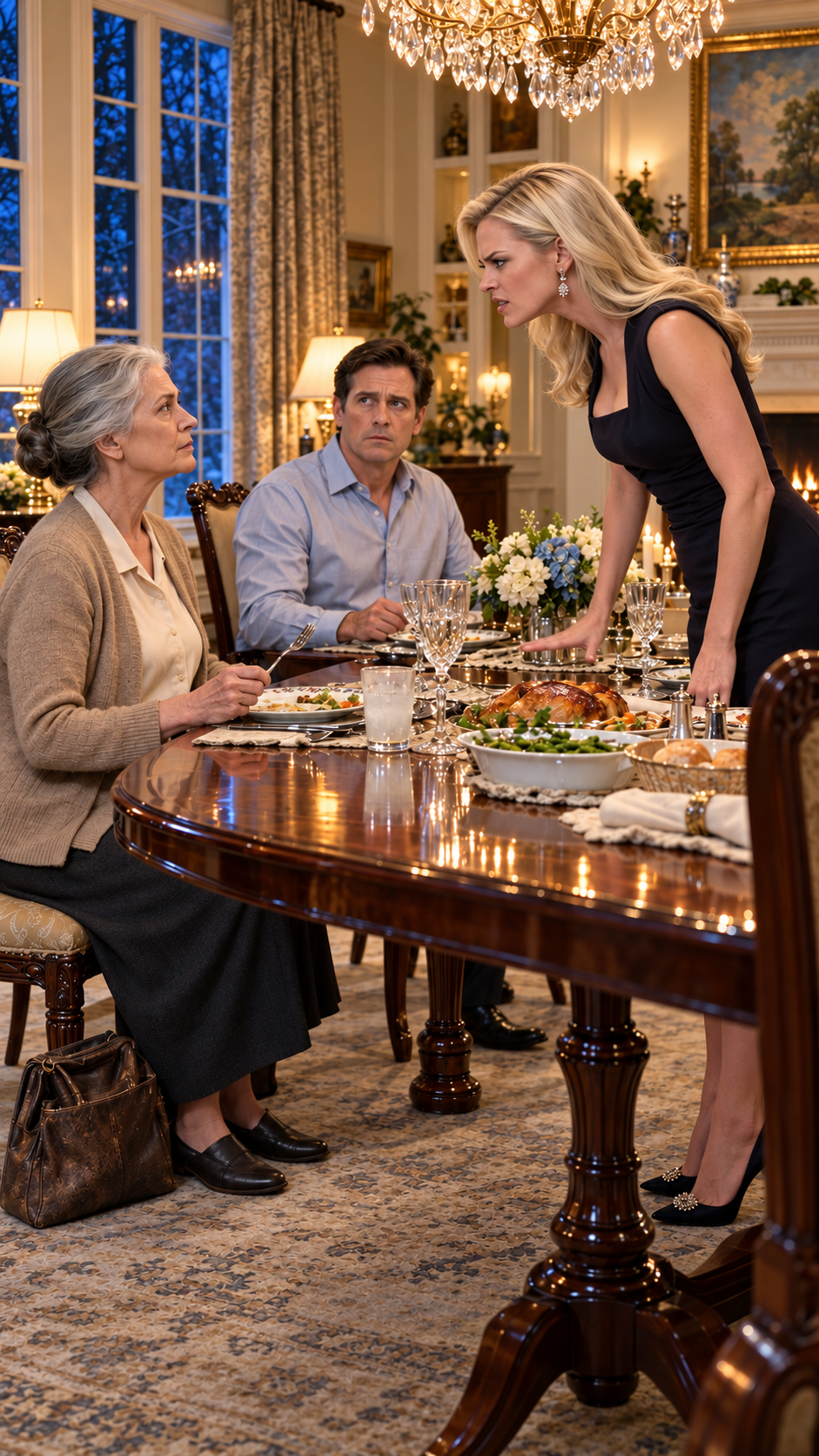
I did not open Harold’s letter that night.
For perhaps the first time in three years, I resisted the urge to turn uncertainty into something I could control immediately.
Darren offered to drive me home.
I accepted.
Thalia stood beside the front door as I put on my old coat.
The expensive dress she had worn to dinner seemed oddly out of place now.
She looked tired.
So did I.
“Eileene.”
I turned.
“I meant what I said.”
“I know.”
“I’m sorry.”
“I know that too.”
She hesitated.
“Will you come back tomorrow?”
There was something almost childlike in the question.
Not helplessness.
Hope.
“Yes.”
She nodded.
Then she looked down at my shoes.
“I also owe you a new dinner plate.”
Despite everything, I smiled.
“Start with a fork.”
That made her laugh.
It was small, but it mattered.
The next morning, I woke before sunrise.
Harold’s scanned letter remained unopened in my email.
I made coffee.
I carried it to the narrow balcony of my apartment.
The city was still gray and quiet.
For three years, I had loved that quiet.
Now I wondered whether I had been hiding inside it.
At nine o’clock, I drove to Darren and Thalia’s house in a rental car.
Thalia opened the door.
Her hair was tied back.
She wore jeans and an old university sweatshirt.
The sight of her dressed so ordinarily made me realize how little I actually knew about the woman my son had married.
We had spent years evaluating one another from opposite sides of polite conversations.
Perhaps that had been our first mistake.
Darren was already in the office.
The mysterious seventy-five-thousand-dollar transfer remained on the screen.
I called Shaw, Whitman and Burke.
A young attorney named Rachel Moreno explained what their archived records showed.
Harold had authorized the transfer eighteen months before his death.
It had not been scheduled to move until a business escrow account matured.
Because the investment instructions had been written years earlier, the money was released automatically after probate.
The strange label was simply the accounting department preserving Harold’s name on the originating trust.
“So Harold invested in Mercer Design?” I asked.
“Technically, no.”
Rachel paused.
“It was a convertible business note.”
Darren frowned.
“A loan?”
“Not exactly.”
Rachel explained that Harold had provided capital with a condition.
If Darren’s company remained profitable for five years, the note would convert into a gift.
If it failed sooner, the remaining business assets would repay only what they reasonably could, with no personal guarantee.
Darren stared at the speakerphone.
“Why would he do that?”
“There’s a letter addressed to you as well.”
Silence filled the office.
“What does it say?” he asked.
“I believe your father intended you to read it with your mother.”
Rachel sent both documents electronically.
The three of us sat around Darren’s desk.
His letter came first.
Son, it began, if you are reading this, then either your company survived long enough for the paperwork to become relevant, or life has finally forced you to examine where its foundation came from.
Darren swallowed.
I kept reading.
Harold wrote that he had watched his son build Mercer Design without asking for family money.
He wrote that he admired Darren’s independence but worried about the pride hidden inside it.
There is a dangerous point, Harold had written, where independence becomes the belief that accepting help makes you smaller.
Darren looked away from the screen.
Harold confessed that he recognized the problem because he had lived with it himself.
Then came a sentence that made me cover my mouth.
Your mother saved me from myself more times than you will ever know.
I looked toward the window.
For a moment, I could almost hear Harold laughing.
The letter continued.
The seventy-five thousand dollars was not meant to make Darren rich.
It was meant to give his work room to breathe.
Harold asked him to build something useful.
He also asked him never to make the mistake of believing that his value as a husband or father depended on appearing invulnerable.
A man who cannot say, “I am afraid,” Harold wrote, eventually makes everyone around him afraid instead.
Darren stopped reading.
His eyes filled.
Thalia placed her hand over his.
He did not pull away.
“I wish he were here,” Darren whispered.
“So do I.”
After several minutes, he finished the letter.
Then it was my turn.
I opened the scanned envelope addressed to me.
My husband’s handwriting appeared across three pages.
Eileene, if you are reading this, I suspect grief has made you hide from the people who love you.
I closed my eyes.
Thalia quietly stood.
“I can leave.”
“No.”
I looked at her.
“Stay.”
She sat again.
I continued.
Harold wrote that he knew me better than anyone.
He knew I had spent my life preparing for disasters before they arrived.
I had kept emergency cash in three different places.
I had maintained lists.
Insurance policies.
Backup plans.
Extra keys.
Copies of everything.
After his first serious illness, I had apparently become even more determined to make myself impossible to surprise.
Harold had noticed.
He had never criticized me for it.
Instead, he had written this.
Money may become your safest hiding place after I am gone.
My throat tightened.
He warned me that wealth could become another locked door.
He knew I might begin questioning people’s motives.
He knew I might confuse caution with wisdom.
Then I reached the sentence that seemed to look directly back at me.
Do not make the people who love you sit examinations they do not know they are taking.
I stopped.
Darren looked at me.
Thalia said nothing.
I read the sentence again.
The room blurred slightly.
My husband had been dead three years, and somehow he had just caught me doing exactly what he feared I would do.
I laughed softly.
“What?” Darren asked.
“Your father was extremely annoying.”
Darren smiled through wet eyes.
“He was usually right.”
“That was the annoying part.”
I continued.
Harold asked me to use what we had built.
Not merely preserve it.
Not merely protect it.
Use it.
He asked me to travel if I wanted to travel.
To give if I wanted to give.
To work again if I missed working.
And most of all, he asked me to tell Darren the truth about who I had been before motherhood and marriage quietly changed the shape of my life.
I froze.
Darren noticed immediately.
“What does that mean?”
I scrolled down.
Harold’s final paragraph mentioned an old photograph stored with his papers.
I knew exactly which photograph he meant.
I had not seen it in more than thirty years.
Rachel Moreno located it in the archived file and emailed the scan.
When it appeared on Darren’s monitor, Thalia leaned forward.
The photograph showed a twenty-eight-year-old woman standing in front of a narrow storefront.
She had thick brown hair, a wide smile, and a pencil tucked behind one ear.
I barely recognized myself.
Above my head was a wooden sign.
MERCER HOME SERVICES.
DESIGN.
REPAIR.
PLANNING.
Thalia looked at me.
“You had a company?”
Darren stared at the image.
“Mom?”
I felt suddenly more exposed than I had when revealing my five-million-dollar net worth.
Money was easy to explain.
A forgotten life was harder.
“Yes.”
Darren turned toward me.
“You owned a business?”
“Half of one.”
“With Dad?”
“At first.”
“What happened?”
I looked at the young woman on the screen.
“She became your mother.”
Darren’s face softened.
“That doesn’t answer the question.”
“No.”
I smiled faintly.
“It doesn’t.”
We spent the rest of the morning examining the old business records Rachel found.
Mercer Home Services had started with Harold doing repair work and me handling schedules, estimates, design plans, and accounts.
Within four years, we had nine employees.
Within six, we had two locations.
Then Darren was born.
We sold the second location.
I reduced my hours.
Eventually, Harold expanded into other investments while I became the person everyone described as “Harold’s wife.”
I had never resented being Darren’s mother.
But somewhere along the way, I had allowed one part of myself to disappear so completely that even my son never knew it had existed.
Thalia kept studying the photograph.
“You designed renovations?”
“Yes.”
“Kitchens?”
“Dozens.”
“Accessibility projects?”
“Quite a few.”
Her eyes brightened.
Darren noticed.
“What?”
She looked at him.
“Your company keeps chasing commercial clients.”
He frowned.
“So?”
“What if that’s the wrong market?”
He stared at her.
Thalia turned the screen toward us.
“People are aging in houses that were never designed for them.”
My attention sharpened.
“Go on.”
“Bathrooms, kitchens, entrances, stairs, lighting, safer layouts.”
Darren leaned back.
“We’ve done some residential adaptation projects.”
“Exactly.”
“Residential margins are smaller.”
“Only if you sell individual repairs.”
She became animated.
“What if you sell complete planning?”
I watched her.
Something had changed in her face.
This was not the woman discussing yoga memberships and designer furniture.
This was someone thinking.
Fast.
Clearly.
“What did you study?” I asked.
She glanced at me.
“Interior architecture.”
I blinked.
Darren looked almost embarrassed.
“She was good.”
“I was very good.”
Thalia corrected him without hesitation.
“Then why did you stop?”
She looked at the table.
“Life.”
I understood that answer immediately.
For the first time, the distance between us felt less like a wall.
By late afternoon, we had covered three sheets of paper with ideas.
No one had solved Darren’s financial crisis.
But for the first time, we were talking about the company as something that could change instead of something that had to be secretly rescued.
Before I left, Thalia touched the old photograph on the screen.
“I want to see the original sometime.”
“I’ll ask Rachel for it.”
“No.”
She smiled.
“I mean the woman.”
I looked at her.
“The woman in the picture.”
Her expression became serious.
“I think she still knows things we need.”
That evening, as I rode the elevator to my apartment, Harold’s letter rested inside my handbag.
The doors opened.
I stepped into the hall.
Then my phone rang.
It was Rachel Moreno.
“Mrs. Mercer, I found one more thing in the old company archive.”
“What?”
“A document your husband never filed.”
My heart shifted.
“What kind of document?”
“A partnership agreement.”
“With whom?”
Rachel hesitated.
“With you.”
I stopped walking.
“That doesn’t make sense.”
“The agreement is for Mercer Home Services.”
“That company hasn’t existed in decades.”
“According to the paperwork,” she said carefully, “that may not be true.”
I tightened my grip on the phone.
“What do you mean?”
Rachel turned a page.
“The company was never dissolved.”
And with those words, a piece of my past that I had thought was gone forever suddenly opened its eyes.
**–END OF PART 4–CLICK “NEXT” AT THE BOTTOM OF THE PAGE TO CONTINUE READING**
✓ Lynn R. Adams
I did not open Harold’s letter that night. For perhaps the first time in three years, I resisted the urge to turn uncertainty into something I could control immediately. Darren offered to drive me h…