PART 4: The Bell Meant Something Else 046
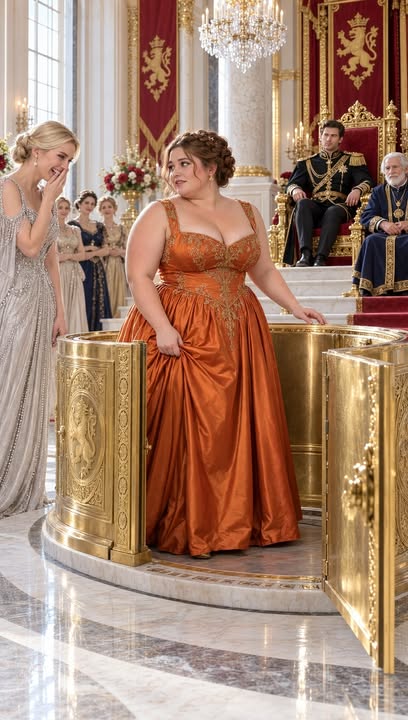
Part 4 – The Meaning Beneath the Gold
Clara held her mother’s letter as if the paper might answer her if she waited long enough.
The final sentence remained clear beneath her eyes.
If my daughter is ever invited to the device, tell her what happened before you tell her what it means.
Adrian had moved closer, but he did not reach for the letter.
“Would you like us to leave you alone with it?” he asked.
Clara looked up at him.
The care in his question steadied her more than any reassurance could have.
“No,” she said. “I think I need to know what happened.”
Lord Vey stood beside the archive table, his hands folded before him.
“I cannot explain the note that says the result was entered as complete,” he said. “I was not the keeper of the records when your mother took the test.”
“But you knew she had been here,” Clara said.
“I knew she had visited the palace. I did not know why.”
“You knew her name was in the old ledger?”
“No.”
Clara watched him carefully.
The advisor looked troubled, but he was not asking her to believe him without question.
That, at least, was different.
Adrian picked up the ledger from which the envelope had been taken and turned it around so the title faced them.
“Could this tell us more?”
“It may,” Lord Vey said. “The entries in this volume are incomplete, but the dates are still legible.”
He opened the book to the pages near the envelope’s place.
The old paper made a dry whisper beneath his fingers.
Clara leaned over the table.
Several lines had been written in a narrow, formal hand, but the ink had faded at the edges.
Beside one entry, a date had been recorded eleven years earlier.
Her mother had died six years ago.
Clara counted backward, trying to place herself in that time.
She would have been eighteen.
Her mother would have been in her early forties.
“She could have taken the test before I was grown,” Clara said.
“Yes,” Lord Vey replied.
Adrian searched the lines.
“There are no names here.”
“There may have been names on the missing pages,” Clara said.
The advisor’s gaze fell to the ledger.
“That is possible.”
It was the same answer he had given them before, but now the uncertainty had a shape and a face.
Clara’s mother had stood inside the golden frame.
She had heard the bell.
Then someone had written down that the result was complete and kept it out of the public register.
“What did the court tell her the result meant?” Adrian asked.
“I don’t know,” Clara said. “She never spoke to me about taking the test.”
“Could she have been invited as a candidate for marriage?”
“Not by the current custom. She was never introduced to the court as a candidate.”
“Perhaps she declined,” Lord Vey said.
“Perhaps,” Clara replied. “But the letter says she asked for the result to be entered accurately, regardless of what the court expected it to mean.”
The words made it difficult to imagine a quiet withdrawal.
Her mother had been asking for something more than privacy.
She had been asking not to have her choice taken from her.
Adrian drew a chair closer to Clara, though he remained standing.
“Do you want to stop?” he asked.
“No.”
“Clara, you don’t have to keep reading.”
“I know.”
She folded the letter once, carefully, then opened it again.
The rest of the page contained no explanation of the test, only a few lines addressed to the keeper of the records.
Her mother had written that she had completed the trial and wanted her response preserved without alteration.
She had also asked that the device’s result not be presented to her family as a promise, a warning, or a claim upon her future.
The last sentence was underlined.
The result belongs to the record.
My life belongs to me.
Clara pressed her lips together.
Her mother had always spoken plainly when someone tried to decide what was best for another person.
Clara had not understood, as a child, how much work it took to hold on to that conviction.
“Could we find her original record?” she asked.
Lord Vey turned several pages.
“If the entry was filed under the date rather than the name, perhaps.”
They searched through the ledger together, comparing dates with the index sheets tucked into its back cover.
Adrian read each reference aloud while Clara followed the ink.
At first, the notes seemed ordinary: equipment checked, room prepared, witnesses present.
Then Lord Vey stopped at a page near the middle.
“This may be it.”
The entry was short.
No candidate name had been recorded, only the date and the words: Response acknowledged.
Beneath that, a clerk had added a line in a different hand.
The subject requested private withdrawal from the proceedings.
“Private withdrawal,” Clara repeated.
“Does that mean she failed?” Adrian asked.
“No,” Lord Vey said. “It means she left the process.”
“Why would anyone record that instead of the result?”
“I cannot tell you.”
Clara looked at the page.
There was a faint indentation beneath the final line, as though something had once been written there and later scraped away.
She angled the paper toward the window light.
A few marks remained, barely visible.
“Can you read it?” Adrian asked.
Lord Vey moved closer.
“Not without risking damage.”
“Could the archive staff examine it?”
“They can use a magnifying lens and angled light.”
“Then we should ask them.”
Clara glanced at the date again.
Her mother had not merely visited the palace.
She had taken the same test and chosen to leave.
The words private withdrawal made the choice sound small, almost procedural.
Her mother’s letter made it clear that it had not been.
“Do you think she was allowed to leave?” Clara asked.
Lord Vey looked at the entry.
“I hope so.”
Clara’s gaze sharpened.
“Did you see the word hope and decide it was enough?”
“No,” he said. “But I should not pretend to know more than I do.”
The admission held no defense, only regret.
Adrian placed his hand beside the page.
“We need the missing ledger pages.”
“And the inscription beneath the platform,” Clara said.
Lord Vey looked up.
“What inscription?”
“Yesterday, when the frame opened, I saw a line beneath the edge of the platform,” she explained. “I could not read it clearly. It was covered by shadow.”
The advisor’s brows drew together.
“I have never seen an inscription there.”
“Then it may not have been meant for the ceremony.”
Adrian turned toward the door.
“Let us look.”
They returned to the testing hall together.
The golden device waited beneath the windows, its panels open and bright in the morning light.
Without the candidates, it seemed less like an instrument of judgment and more like an object assembled by people who had once expected it to be understood.
Clara walked around the platform.
She remembered the first time she had stepped onto it, the silent attention of the room, the hesitation in Adrian’s face, and the clear bell that followed.
The sound had seemed to name her.
Now she wondered if the palace had simply taught everyone to hear it that way.
She crouched beside the platform and looked underneath.
A narrow band of engraved letters ran along the inner edge, partly obscured by the gold frame.
She brushed away a thin film of dust with the side of her hand.
The words appeared gradually.
Adrian knelt beside her.
Lord Vey remained standing, his face taut with concentration.
Clara read the first line aloud.
“Let the answer be kept, not claimed.”
The next line was worn nearly smooth.
Adrian leaned closer.
“Perhaps there is more.”
Lord Vey fetched a small lantern from the wall.
Its light moved over the engraved surface, revealing a second phrase hidden where the platform joined the frame.
“Those who hear the bell,” Clara read, “may continue by their own choosing.”
She stopped.
The words seemed plain.
The palace had turned them into something else.
“May continue to do what?” Adrian asked.
Clara ran her fingers just above the engraved letters without touching them.
“To continue by their own choosing,” she said. “Not to be chosen by the device.”
Lord Vey lowered the lantern.
The light shook slightly in his hand.
“There is another line,” he said.
Near the base of the frame, under a brass plate, a third sentence had been etched in much smaller letters.
Adrian loosened the plate with a tool from the repair cabinet.
The metal came away with a soft click.
Beneath it, the inscription continued.
The measure is not obedience, nor grace, nor birth.
It is the courage to ask what the answer cannot decide.
For a moment, none of them spoke.
The hall seemed to hold the words as carefully as the frame had once held its bell.
Clara read them again, slower.
The measure is not obedience, nor grace, nor birth.
It is the courage to ask what the answer cannot decide.
Adrian stood and looked at the device.
“The test was never meant to select a bride.”
“I don’t think it was,” Clara said.
Lord Vey lowered his eyes.
“The custom took hold generations ago,” he said. “The royal family began presenting the result as evidence of a suitable match.”
“Why?” Adrian asked.
“To strengthen the alliance between the crown and the families invited to the ceremony, I suppose.”
“You suppose,” Clara said.
“I was not there when the tradition changed.”
“But you helped continue it.”
“Yes.”
His answer carried the weight of that truth without asking them to soften it.
Adrian turned toward the tall windows.
“My family took a test about judgment and turned it into a promise of marriage.”
“Perhaps it was easier to claim a simple meaning,” Lord Vey said. “A bell that names a bride is easier to celebrate than a bell that asks the crown to listen.”
Clara looked at the words under the platform.
The test had never said she belonged to Adrian.
It had only said that she could continue.
And her mother, decades earlier, had heard the same bell and refused to let anyone decide what her next step must be.
“What happened to her after she left?” Adrian asked.
“I don’t know,” Clara said.
“She returned home,” Lord Vey offered.
“My mother did return home. But I don’t know what happened in this hall after she left.”
Clara’s thoughts moved to the line in the letter.
If my daughter is ever invited to the device, tell her what happened before you tell her what it means.
Her mother had known the truth had not been preserved.
She had not written down what happened.
Perhaps she had never learned the full story herself.
Perhaps she had known it and hoped the right person would find the records later.
“Could the missing page explain her result?” Clara asked.
Lord Vey glanced back toward the east wing.
“The page I removed may have been connected to the ledger in which your mother’s name appears.”
“Then why was it wrapped around her letter?”
“I do not know.”
“Who wrote the note that said the result was complete?”
“I cannot identify the handwriting.”
“Can anyone?”
“There are samples in the archive.”
Adrian’s expression hardened, though his voice stayed even.
“Then we’ll compare them.”
Lord Vey bowed his head.
“Yes.”
A palace archivist arrived soon afterward, carrying magnifying tools and a padded case.
She examined the old entry under angled light while Clara and Adrian waited beside the table.
At length, she straightened.
“The erased words are not a name,” she said. “The ink was removed carefully, but I can make out part of the phrase.”
“What does it say?” Clara asked.
The archivist consulted her notes.
“‘Recognized the trial, declined the interpretation.’”
Clara felt the words settle inside her.
Her mother had passed.
Then she had declined what the court said her passing meant.
Adrian looked from the entry to Clara.
“She refused to be made into a bride.”
“She refused to let someone else define the result,” Clara said.
The archivist returned to the ledger.
“There is something else.”
She pointed to a faint mark at the bottom of the page.
The date had been written twice, once in the original ink and once in a darker hand.
The second date was five years later.
“Someone returned to this record,” the archivist said. “The later notation reads: ‘Withdrawn from the active register by order of the household.’”
“Who gave the order?” Adrian asked.
“No name is recorded.”
The room went still again.
Clara thought of Lord Vey removing the page from the old ledger, of the missing packet, and of the words on her mother’s letter.
“You said you removed the page because you feared it would be misread,” she said to the advisor.
“Yes.”
“Did you know it concerned my mother?”
“No.”
“Did you know the device was meant to challenge the royal family?”
His face changed.
Not enough to be a confession.
Enough to tell her the question had touched something he recognized.
“I knew there were older interpretations,” he said. “I did not know their full meaning.”
Adrian turned toward him.
“What did you know?”
“That some records described the device as a test of judgment rather than a test of suitability.”
“And you never told me?”
“I thought the wording was ceremonial, not definitive.”
“Because it was inconvenient?”
“Because I did not have the evidence to make that claim.”
Clara stepped away from the platform.
“Or because making that claim would have forced the palace to ask what it had done to people like my mother.”
Lord Vey did not answer.
The silence was its own kind of answer.
Adrian looked down at the engraved words.
“I cannot undo what my family did,” he said. “But I can stop repeating it.”
Clara saw the strain in his face.
He was not asking her to comfort him or absolve the crown.
He was trying to understand the difference between feeling responsible and accepting responsibility.
“That matters,” she said.
“It may not be enough.”
“No,” she replied. “But it matters.”
They returned to the archive to compare the altered notation with samples of handwriting from the royal household.
The archivist found a close match to a clerk who had served under Adrian’s grandfather, but could not be certain without more records.
The person who had ordered the entry removed remained unnamed.
Lord Vey brought them the missing page he had taken from the old ledger.
It had been kept inside a plain envelope at his residence, and he had not opened it since the day he removed it.
The paper bore the same faded ink as the ledger, along with a heading:
PURPOSE OF THE CIRCULAR DEVICE.
Beneath it, in a hand older than the rest, were several lines explaining that the device had been built to recognize a person prepared to question inherited customs when those customs harmed the people they claimed to honor.
It was not a test of obedience.
It was not a measure of grace or birth.
It was intended to reveal a voice that would ask the royal family to change.
Adrian read the passage twice.
“Why would this have been hidden?”
“Because the test would have been difficult to control,” Lord Vey said.
The words were quiet, almost reluctant.
“Someone who passed was not meant to be rewarded with a position beside the throne,” Clara said. “They were meant to challenge the throne.”
“Yes,” Lord Vey replied.
The page named no one as its author.
At the bottom, a note had been added years later.
The meaning must not be turned into an obligation. Those who pass may still refuse.
Clara looked at the sentence until the letters blurred.
Her mother had not been rejected.
She had not failed.
She had passed, understood that the court was trying to translate her result into a marriage claim, and refused that translation.
“What did they do to her?” Adrian asked.
Lord Vey examined the page.
“I cannot say whether anyone pressured her directly. The record shows that she withdrew from the proceedings.”
“But it also shows the court removed her result from the active register,” Clara said.
“Yes.”
“Why?”
“To prevent her result from being used.”
“Or to prevent anyone from learning what the result meant.”
Lord Vey’s eyes lowered.
“I cannot dismiss that possibility.”
Clara felt a sadness she had not expected.
Her mother’s silence had never been indifference.
It might have been the only freedom she had been able to keep.
She had chosen to leave the palace without allowing its story to follow her home.
And still, she had left Clara a warning.
Tell her what happened before you tell her what it means.
Clara folded the letter along its original creases.
“My mother was the person who passed before me,” she said.
The fact changed the room.
Adrian looked at the page, then at her.
“Your family name may have been what brought the device’s old record to light.”
“I don’t know if it recognized my name.”
“It might have recognized the pattern of the response, or something else we haven’t uncovered.”
“Then don’t turn me into another theory before we know.”
“I won’t.”
She believed he meant it.
That did not make the uncertainty easier.
Lord Vey returned the missing page to its envelope.
“I should have told you as soon as I remembered its connection to the old ledger,” he said.
“Why didn’t you?”
“Because I had spent years believing that keeping a secret was the same as keeping the peace.”
He looked at the words beneath the device’s platform, still visible through the open doors of the hall.
“I was wrong.”
Adrian’s face softened, though the hurt remained.
“What happens now?” Clara asked.
“Now we gather every record we can find,” Adrian said. “We make the meaning public, and we make certain no one is told that the device has claimed them.”
“Even if the council objects?”
“Especially then.”
Lord Vey’s expression grew grave.
“Before we do that, there is one more record you should see.”
He led them to the back of the archive, where a narrow cabinet stood beneath a small window.
It had not appeared on the inventory.
Lord Vey unlocked it with a different key.
Inside lay a thin book bound in dark blue cloth.
The title was nearly worn away.
He opened it to the final page.
A handwritten list filled the sheet.
The first entry was dated more than twenty years earlier.
Beside it, the same phrase appeared in a steady hand.
Passed. Declined the interpretation.
The name beside the entry belonged to Clara’s mother.
Below it, another line had been added later, in different ink.
A daughter may be invited when the record is ready to be understood.
Clara stared at the words.
Her mother’s result had not been erased because it was forgotten.
Someone had kept it, hidden but intact, and written that Clara might one day be invited.
Adrian’s voice was barely above a whisper.
“Who wrote that?”
Lord Vey turned the book toward the light.
The signature at the bottom belonged to a former royal advisor.
The same advisor whose portrait hung above the archive door.
Clara looked up at the painted face, then back at the page.
The device had not simply rung for her.
Someone in the palace had known it might.
And if her invitation had been arranged with her mother’s hidden record in mind, then the question was no longer only what the bell meant.
It was who had decided Clara was ready to hear it.
**–END OF PART 4–CLICK “NEXT” AT THE BOTTOM OF THE PAGE TO CONTINUE READING**
* * *
[PREVIOUS: PART 3](https://echoesofstories.idolsgift.com/blog/part-3-the-bell-meant-something-else-046) | [NEXT: PART 5](https://echoesofstories.idolsgift.com/blog/part-5-the-bell-meant-something-else-046)
✓ Lynn R. Adams
Part 4 – The Meaning Beneath the Gold Clara held her mother’s letter as if the paper might answer her if she waited long enough. The final sentence remained clear beneath her eyes. If my daughter i…