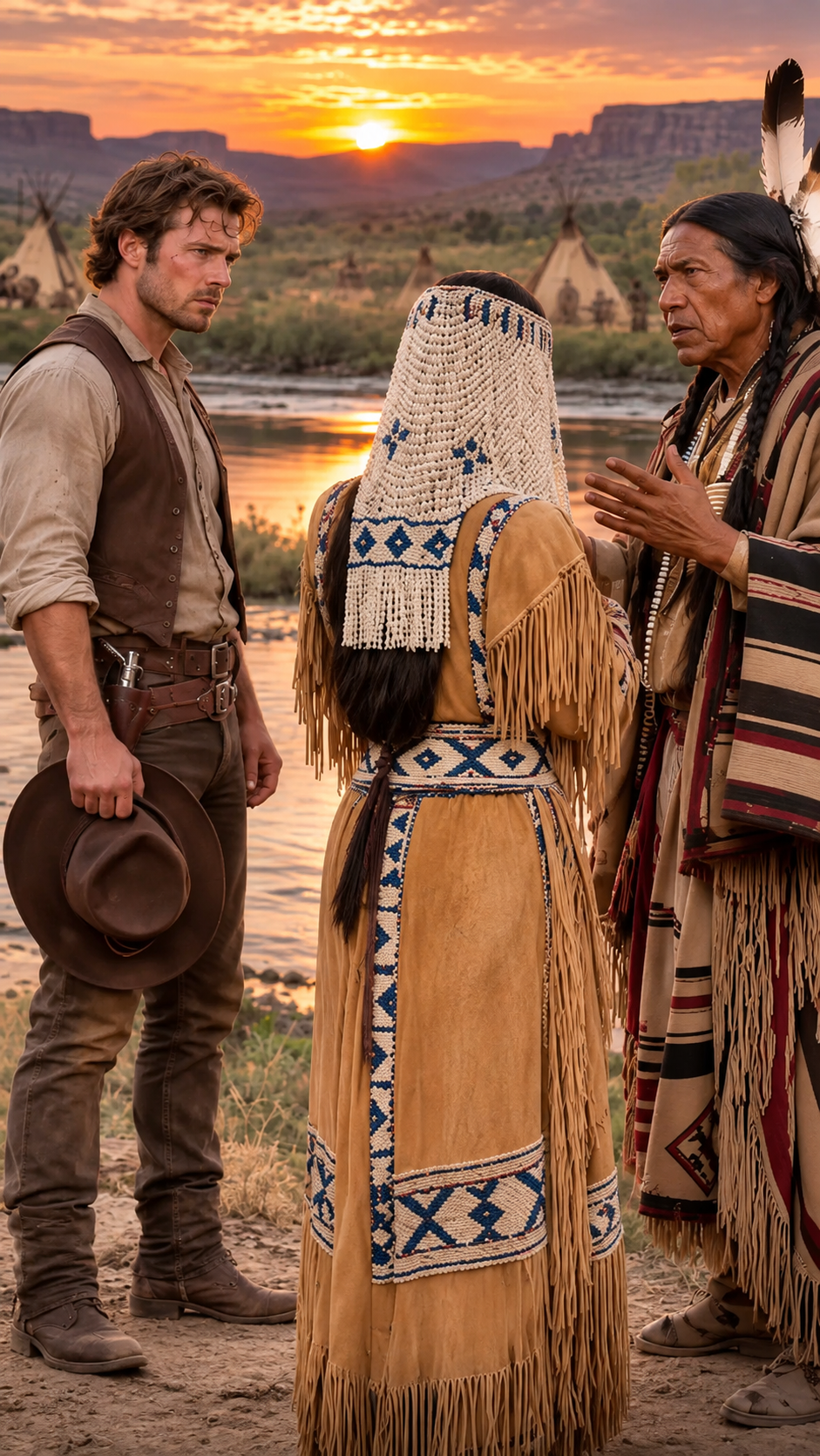
PART 3: “You want me to marry a woman I’ve never seen?” Maverick demanded, staring at the Apache chief.-062
Ayasha did not move.
The silver pendant lay against her palm while the moon illuminated the initials that had been hidden there for most of her life.
C.H.
Clara Hale.
Her mother had possessed a name.
Not merely the distant, unknowable figure Ayasha had imagined as a child, but a woman who had lived, traveled, laughed, grieved, and somehow arrived in this valley carrying a silver crescent identical to the one worn by Maverick’s mother.
Ayasha looked at Lobo Negro.
“You knew her.”
“Yes.”
“You knew her name.”
“Yes.”
“And every time I asked you where I came from, you told me there was nothing to know.”
The chief’s shoulders lowered.
“I told you there was nothing you needed to know.”
“That is not the same thing.”
“No.”
Maverick had expected anger.
Instead, Ayasha’s voice became quieter.
That quietness unsettled him more.
“Why?” she asked.
Lobo Negro looked toward the distant fires.
“Not here.”
Ayasha almost laughed.
“Where, then?”
“There are things you must see.”
The chief began walking toward the northern edge of the settlement.
Ayasha remained where she was.
Maverick stood beside her without touching her.
After a moment, she whispered, “I have wanted this answer since I was old enough to understand that other children looked like their parents.”
Maverick glanced toward Lobo Negro’s retreating figure.
“You do not have to follow him tonight.”
“Yes, I do.”
She started after her father.
Maverick joined her.
Ayasha looked sideways.
“You are coming?”
“My mother’s name is part of this too.”
“That is not the only reason.”
Maverick raised an eyebrow.
“You are very certain for someone who met me today.”
“I watched you argue over the price of flour for twenty minutes yesterday.”
“That merchant was cheating me.”
“He wanted two pennies more.”
“Two dishonest pennies.”
Ayasha almost smiled.
The expression disappeared quickly, but Maverick was beginning to understand that humor was one of the small doors through which she escaped when emotions became too heavy.
He was glad to have found one.
Lobo Negro led them past the last row of shelters toward a low rise overlooking the river.
An old adobe storehouse stood there, partly concealed by cottonwood trees.
The chief produced a key from beneath his shirt.
Maverick frowned.
“You keep it locked?”
“For many years.”
The door opened reluctantly.
Inside were blankets, baskets, tools, and several wooden trunks covered with dust.
Lobo Negro lit a lantern.
Then he approached the smallest trunk.
It was made of cedar.
A faded blue ribbon had been tied around one handle.
Ayasha stopped breathing for a moment.
“Was this hers?”
“Yes.”
Lobo Negro knelt and opened it.
Inside lay a folded dress, a pair of worn boots, several books, and a leather journal.
Ayasha reached toward the journal.
Her hand stopped before touching it.
“Did she write this?”
“Yes.”
“Have you read it?”
“Some of it.”
“Why did you never give it to me?”
The chief stared at the floor.
“Because the last pages frightened me.”
Ayasha slowly picked up the book.
“What could possibly be frightening about words written by a dead woman?”
Lobo Negro looked at Maverick.
“Sometimes words outlive the people who were meant to answer for them.”
Maverick felt an uneasiness he could not explain.
Ayasha opened the journal.
The handwriting had faded but remained readable.
Maverick recognized it instantly.
His mother possessed several old letters written in the same elegant, backward-slanting script.
Clara.
Ayasha traced one sentence without reading it aloud.
Maverick watched her face.
For the first time that evening, her composure broke.
Tears gathered silently in her eyes.
She turned away.
Maverick pretended to examine the contents of the trunk, granting her the privacy of not being watched.
Then Ayasha laughed softly through her tears.
Maverick looked over.
“What?”
“She disliked onions.”
He stared at her.
Ayasha held up the journal.
“She wrote three entire sentences complaining about onions.”
Maverick smiled.
“My mother hated them too.”
Ayasha wiped one cheek.
“Perhaps it runs in the family.”
The words left her mouth naturally.
Then both of them froze.
Family.
They looked at one another.
Maverick’s smile disappeared.
If Clara Hale was Ayasha’s mother, and Elizabeth Hale was Maverick’s mother, then Ayasha was his cousin.
His wife was his cousin.
Ayasha apparently reached the same conclusion.
“Oh.”
“Yes.”
“This is awkward.”
“That is one word for it.”
From behind them, Lobo Negro said, “Clara was not Elizabeth’s sister by blood.”
Maverick turned so quickly he nearly struck the lantern.
“What?”
The chief sighed.
“You both make conclusions too quickly.”
“You might have prevented several conclusions by telling us the truth before the wedding.”
“That,” Lobo Negro admitted, “is fair.”
Ayasha stared at him.
“Explain.”
The chief sat beside the open trunk.
“Clara Hale was adopted into Elizabeth’s family as a child.”
Maverick remembered fragments of stories.
His grandfather had once mentioned another girl in the household, but Maverick had always assumed she was a cousin.
“My mother called her a sister.”
“She loved her as one.”
“Then why were you frightened of the journal?”
Lobo Negro’s gaze moved to the leather book.
“Because Clara came here carrying something besides that necklace.”
“What?”
“A legal claim.”
Maverick frowned.
“To what?”
Lobo Negro pointed through the wall toward the valley.
“The land beside the river.”
Silence settled over the storehouse.
Maverick felt the truth forming before he completely understood it.
“That land belonged to Clara?”
“According to a territorial document signed before she arrived here.”
Ayasha lowered the journal.
“Then why does my father control it?”
Lobo Negro’s expression hardened.
“I do not control it.”
Maverick thought of the deed he had seen beside the chief during their negotiation.
“The agency deed.”
“A provisional deed,” Lobo Negro corrected.
He looked at Ayasha.
“Your mother’s claim could never be completed because she disappeared from government records.”
“She did not disappear,” Ayasha said.
“She remained here.”
“To the government, those were the same thing.”
The sadness in his voice made Maverick look away.
He understood enough about territorial law to know how easily paperwork could erase a human life.
Ayasha opened the journal again.
“Why did she have a claim?”
Lobo Negro nodded toward Maverick.
“Read.”
Maverick took the book.
Several entries described Clara’s journey west.
Others mentioned a man named Thomas Bell, a surveyor employed by a territorial land office.
Maverick turned several pages.
One sentence caught his attention.
Thomas says the river parcel will someday be worth more than anyone believes.
Another entry followed.
Thomas insists that the papers remain in my name until his dispute with the company is resolved.
Maverick frowned.
“Who was Thomas Bell?”
Lobo Negro looked at Ayasha.
“Her father.”
Ayasha closed her eyes.
Another name.
Another piece of herself arriving all at once.
“Did you know him?”
“No.”
“What happened to him?”
“No one here knows.”
Maverick continued reading.
The later entries changed.
Clara wrote of being followed.
Of a land company attempting to purchase claims throughout the valley.
Of papers disappearing from a hotel room.
Of Thomas traveling east to investigate.
Then the entries stopped for several months.
When they resumed, Clara was living with Lobo Negro’s people.
She had been ill.
She had recently given birth.
Ayasha sat beside Maverick.
“Read that part.”
He hesitated.
“It belongs to you.”
“Please.”
Maverick read aloud.
“My daughter sleeps beside me tonight, wrapped in the blanket Sani made for her, and for the first time in many months I am not afraid.”
Ayasha covered her mouth.
Maverick continued.
“I do not know whether Thomas will return, but I know that if he does, he must find the truth before others find us.”
The following entry was shorter.
“Lobo Negro has promised that if anything happens to me, he will protect her as his own.”
Ayasha lowered her head.
Lobo Negro looked away.
Now Maverick understood the grief he had seen beneath the chief’s sternness.
The promise had not been abstract.
It had shaped nearly a quarter century of his life.
Ayasha turned another page.
There were only three entries remaining.
The first spoke of fever.
The second contained instructions concerning the land.
The third consisted of a single sentence.
Ayasha read it aloud.
“If Elizabeth’s son ever comes west, tell him that his mother knew more than she admitted.”
Maverick felt cold.
“My mother?”
Ayasha looked at him.
The journal suddenly seemed heavier in her hands.
Lobo Negro stood.
“That sentence is why I recognized your name.”
Maverick stared at him.
“You knew who I was before I arrived?”
“I suspected.”
“And the marriage?”
The chief did not answer immediately.
Maverick’s temper stirred.
“You arranged this because of something written in that journal?”
“No.”
“Then why?”
Lobo Negro walked toward the door.
“Because Clara’s claim has one final condition.”
Maverick waited.
“The land cannot pass to Ayasha alone.”
Ayasha’s eyes narrowed.
“What does that mean?”
“When Thomas Bell filed the original claim, territorial law required a male co-signatory for certain improvements and water rights.”
Maverick grimaced.
“That sounds exactly like the sort of foolish rule someone would invent behind a desk.”
Lobo Negro almost smiled.
“The provisional agency agreement expires soon.”
“How soon?”
“Thirty days.”
Maverick looked at Ayasha.
“And if it expires?”
“The river parcel becomes available for reassignment.”
“To whom?”
Lobo Negro’s expression darkened.
“A company has already petitioned for it.”
Maverick remembered seeing wagons along the southern road.
Men measuring fences.
Survey markers near the hills.
“Which company?”
“Western Valley Agricultural Company.”
The name meant nothing to Maverick.
Then he noticed Ayasha staring at something inside the trunk.
A folded newspaper clipping had slipped from between the journal pages.
She picked it up.
The paper was yellow with age.
An announced the formation of the Western Valley Agricultural Company.
Beneath the announcement were three names.
Maverick read the first two without recognition.
The third made his stomach drop.
Samuel Hale.
His father.
Maverick stared at the printed letters.
“That cannot be right.”
Ayasha looked at him.
“Was that your father?”
“Yes.”
Maverick took the clipping.
His father had died when Maverick was thirteen.
Samuel Hale had been a difficult man, private about business and rarely home.
Maverick knew he had invested in railroads and cattle.
He had never heard him mention Western Valley Agricultural Company.
Lobo Negro’s voice came quietly.
“Now you understand why Clara wanted Elizabeth’s son to know the truth.”
Maverick shook his head.
“No.”
He looked down at the clipping again.
“No, I understand less than I did ten minutes ago.”
Ayasha turned toward her father.
“If Maverick’s father was connected to the company trying to obtain my mother’s land, why would his mother’s name appear in Clara’s journal?”
“That,” Lobo Negro said, “is the question I have waited twenty-four years for someone else to answer.”
Maverick folded the clipping.
“My mother kept papers.”
“Where?”
“In a bank box in Santa Fe.”
Ayasha looked at him.
“Do you still have access?”
“I think so.”
“Then we go there.”
Maverick blinked.
“We?”
Ayasha closed her mother’s journal.
“You married me for land.”
“I thought we agreed never to say that sentence again.”
“Then consider this your opportunity to improve the story.”
Despite everything, Maverick smiled.
“When do you want to leave?”
“Tomorrow.”
Lobo Negro stepped between them.
“No.”
Ayasha’s expression changed.
“Father.”
“There is something else.”
Maverick sighed.
“There is always something else.”
The chief crossed the room and lifted the cedar trunk’s false bottom.
Beneath it lay a rolled survey map.
Maverick spread it across the floor.
Several parcels were marked in red.
The river land was only one of them.
A dotted line continued north through the valley and ended at an abandoned mission.
Beside it, Clara had written three words.
Thomas hid proof.
Ayasha leaned closer.
“Proof of what?”
Lobo Negro shook his head.
“No one knows.”
Maverick studied the map.
A symbol had been drawn beside the mission.
A crescent moon.
The same symbol as their pendants.
Then Ayasha noticed another detail.
A date.
September 14.
Maverick’s pulse quickened.
“That was the day my mother died.”
Ayasha looked at him.
“What year?”
He told her.
Lobo Negro went pale.
“That cannot be.”
Maverick turned.
“Why?”
The chief stared at the date.
“Because Clara died on September 14 as well.”
No one spoke.
Two women.
Two sisters in every way except blood.
Hundreds of miles apart.
Dead on the same day.
Maverick slowly turned the map over.
Something had been written on the back in Elizabeth Hale’s handwriting.
He knew the script immediately.
There were only seven words.
Maverick read them twice before he could make himself speak.
“Samuel must never learn that Thomas survived.”
Ayasha looked up sharply.
Maverick’s hand tightened around the map.
His mother had known Ayasha’s father was alive.
And for reasons buried somewhere in their shared past, she had been hiding him from her own husband.
**–END OF PART 3–CLICK “NEXT” AT THE BOTTOM OF THE PAGE TO CONTINUE READING**
✓ Lynn R. Adams
Ayasha did not move. The silver pendant lay against her palm while the moon illuminated the initials that had been hidden there for most of her life. C.H. Clara Hale. Her mother had possessed a na…