Part 3 – Twenty Glasses and Thirty Steps-069
### Part 3 – The Twentieth Glass
**Part 3**
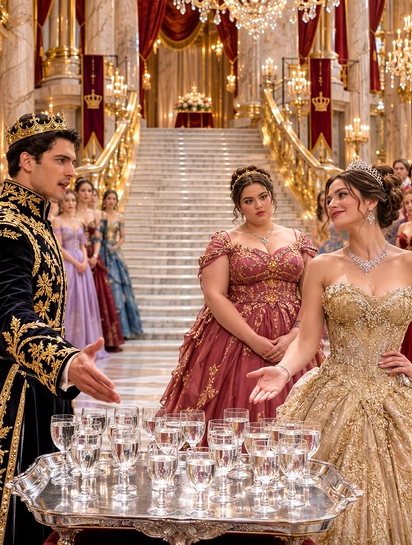
The twentieth glass seemed ordinary until Alexander lifted it toward the chandelier.
Then the engraving appeared.
A silver rose.
Tiny.
Delicate.
Almost invisible unless light struck the base from exactly the right angle.
Emma stared.
“I didn’t see that.”
“No one did,” Alexander said.
Queen Helena stood beside them.
Her earlier composure had returned, but something remained unsettled in her expression.
Victoria approached cautiously.
“What does the rose mean?”
No one answered.
Alexander turned the glass.
A second engraving appeared beneath the flower.
Two initials.
**E.R.**
King Edmund slowly descended from the dais.
“Where was the note found?”
“Fixed beneath the tray with wax,” the steward said.
“Recently?”
The steward shook his head.
“The wax was dry and brittle. It could have been there for decades.”
Alexander looked at his mother.
“You recognize the handwriting.”
Helena nodded.
“My mother’s.”
Emma knew enough royal history to understand immediately.
Queen Eleanor.
Alexander’s maternal grandmother.
The former queen consort had died eleven years earlier.
She had been remembered publicly as elegant, quiet, and almost impossibly disciplined.
Privately, apparently, she had hidden messages beneath serving trays.
Alexander read the note again.
“Why would Grandmother say not to ask the winner to marry me?”
King Edmund smiled.
“Perhaps she knew you would make ridiculous announcements.”
Alexander gave him a look.
Emma covered a laugh.
Helena remained serious.
“Eleanor created the original water challenge.”
Alexander looked at her.
“You told me it was an old palace tradition.”
“It was.”
“You left out the part where your mother invented it?”
“I left out several things.”
Emma sensed that the story had changed.
The challenge was no longer entertainment.
It was connected to something Helena had deliberately avoided discussing.
Alexander seemed to understand too.
“Mother.”
The queen looked toward the guests.
“This should not happen in the ballroom.”
She asked the steward to escort the remaining spectators to lunch.
No dramatic announcement followed.
No public scene.
Within twenty minutes, the ballroom emptied.
Only the royal family, Emma, Victoria, and the four senior palace officials remained.
Victoria looked confused.
“Why am I still here?”
Helena’s gaze moved toward her.
“Because you were one of the finalists when the challenge was arranged.”
“I failed on the first step.”
“That does not make you irrelevant.”
Victoria appeared unsure whether she had just been complimented.
Emma smiled faintly.
The queen led them into a smaller morning room overlooking the palace gardens.
Tea arrived.
Nobody drank it.
Alexander placed the engraved glass in the center of the table.
“Tell us.”
Helena folded her hands.
“My mother did not create the challenge to select a bride.”
Emma leaned forward.
“What was it for?”
“To select a steward.”
Victoria frowned.
“A servant?”
“No.”
Helena looked toward the palace windows.
“Someone who could be trusted with responsibility.”
Decades earlier, before Helena married King Edmund, Queen Eleanor had overseen a group of charities attached to the royal household.
One of them funded hospitals, schools, village libraries, and emergency support for families in remote regions.
“The Rose Fund,” Alexander said.
Helena nodded.
Emma recognized the name.
The Rose Fund still existed, although it operated largely outside public attention.
“My mother believed money was the easiest part of charitable work,” Helena continued. “Judgment was harder.”
Victoria looked toward the glass.
“So she made people carry water?”
“Once.”
Helena almost smiled.
“She disliked interviews.”
Emma understood immediately.
“The challenge showed how people approached a problem.”
“Yes.”
“Whether they rushed.”
“Yes.”
“Whether they noticed the environment.”
Helena nodded.
“Whether they asked questions. Whether they adapted. Whether they thought only about finishing or about understanding what they were carrying.”
Alexander looked at Emma.
She felt strangely self-conscious.
“And the marriage announcement?” Victoria asked.
King Edmund cleared his throat.
“That was mine.”
Helena closed her eyes.
Victoria stared.
“You invented it?”
“I wanted people to take the event seriously.”
Alexander looked horrified.
“You told me it was traditional.”
“It became traditional this morning.”
Emma laughed despite herself.
The king smiled.
“See? Effective.”
“No,” Alexander said.
“Very effective.”
“No.”
Queen Helena ignored both men.
“The important part is the twentieth glass.”
She lifted it carefully.
“Eleanor had this made forty years ago.”
“What does E.R. mean?” Emma asked.
Helena turned the glass in her hands.
“Evelyn Rowan.”
The name seemed unfamiliar to everyone except the king.
Edmund looked down.
Alexander noticed.
“Father?”
The king sighed.
“I met her once.”
“Who was she?”
Helena answered.
“My mother’s closest friend.”
Evelyn had not been noble.
She had been the daughter of a palace housekeeper.
She and Eleanor had grown up within the same palace walls, though on opposite sides of the social order.
One was taught diplomacy, history, languages, etiquette.
The other helped her mother polish silver and organize linen cupboards.
Yet the two girls became inseparable.
“When Eleanor married into the royal family,” Helena said, “Evelyn came with her as a private secretary.”
Victoria smiled faintly.
“That sounds romantic.”
“It became complicated.”
“How?”
Helena’s gaze fell toward the engraved glass.
“The Rose Fund was Eleanor’s idea. But Evelyn built it.”
Emma understood.
“Then why isn’t she in its history?”
The queen did not answer immediately.
“Because she left.”
“Why?”
“No one ever told me the whole story.”
Alexander looked frustrated.
“How can that be?”
“My mother refused to discuss it.”
“Did they argue?”
“Yes.”
“About the fund?”
“I believe so.”
“And the glass?”
Helena shook her head.
“I have never seen it.”
Alexander looked toward the old note.
“Grandmother expected someone to find it.”
Emma said softly, “Not just find it.”
Everyone looked toward her.
“She said, _Ask her why the twentieth glass is different._”
Alexander nodded.
“So?”
Emma reached for the glass.
“It probably isn’t different only because of the engraving.”
She examined it more closely.
The others watched.
At first nothing stood out.
Same height.
Same rim.
Same cut crystal pattern.
Then Emma placed it beside another glass.
“Water.”
Alexander understood.
He poured equal amounts into both.
Emma crouched until her eyes were level with the rims.
The surface of the water in Evelyn’s glass appeared lower.
Victoria noticed.
“That one holds more.”
Emma nodded.
The twentieth glass was slightly thicker at the base but wider through the bowl.
It carried perhaps two tablespoons more water than the others.
Alexander stared.
“So the tray was not balanced.”
Emma looked at him.
“Not perfectly.”
The difference was small.
But multiplied across movement, especially when the glass sat near an edge, the extra weight mattered.
Victoria sat back.
“That explains why every contestant had trouble.”
“Partly,” Emma said.
“Then you had an advantage because you moved it?”
“I didn’t know which one it was.”
“But you accidentally placed it near the center.”
Emma remembered arranging the glasses.
She had grouped them according to spacing and apparent fullness.
The heavier glass had felt subtly different.
Without realizing why, she had moved it closer to the center.
Alexander saw the significance.
“You noticed the weight.”
“Not consciously.”
“Your hands did.”
Emma smiled.
“I suppose.”
Helena looked emotional now.
“That was Eleanor’s point.”
“What?” Alexander asked.
“The challenge wasn’t supposed to test perfection.”
She touched the glass.
“It tested whether someone noticed that equal-looking things were not always equal.”
The room became quiet.
Emma looked toward the old engraved initials.
Evelyn Rowan.
A woman apparently erased from the history of a foundation she had helped build.
Perhaps the glass had always represented more than balance.
Alexander leaned back.
“We find Evelyn.”
Helena’s face changed.
“She may be dead.”
“Then we find what happened to her.”
Victoria surprised everyone.
“I can help.”
Alexander looked at her.
“How?”
“My family archives.”
Victoria sat straighter.
“My grandfather served on the Rose Fund’s first board.”
Helena remembered.
“Lord Ashbourne.”
“Yes.”
“He may have records.”
Alexander nodded.
“Search them.”
Victoria looked surprised by the immediate trust.
Then pleased.
Emma watched her.
Failure on one staircase step had humiliated Victoria because she had built too much of herself around appearing flawless.
Now, given something useful to do, her entire posture changed.
She looked less like a contestant.
More like a person.
The formal bride-selection event quietly ended that afternoon.
Alexander made an announcement stating only that the challenge had identified qualities worth exploring but that no marriage would be decided by a competition.
Several newspapers complained.
Most of the public seemed amused.
Emma prepared to return home.
She had packed half her suitcase when a knock came at her guest-room door.
Alexander stood outside.
Without uniform.
Without crown.
A simple dark suit made him look younger.
Almost ordinary.
“Leaving?”
“I assumed the challenge was over.”
“It is.”
“Then yes.”
He hesitated.
“Would you stay?”
Emma looked at him.
“For what?”
He seemed to appreciate the question.
“To help me understand the Rose Fund.”
“Why me?”
“Because you solved the tray.”
“Partly.”
“And because my mother trusted you enough to tell you about Evelyn.”
“She told Victoria too.”
“Victoria is staying.”
Emma blinked.
“She is?”
“She discovered three boxes of her grandfather’s papers an hour ago.”
Emma smiled.
“Of course she did.”
Alexander placed one hand into his pocket.
“There is also another reason.”
“What?”
“I would like to know you when no one is promising marriage at the top of a staircase.”
Emma laughed.
“That does sound healthier.”
“Is that a yes?”
“For a week.”
“Only a week?”
“I have a life.”
“What do you do?”
Alexander looked embarrassed immediately.
“You don’t know?”
“No.”
He had apparently read the official contestant biographies no more carefully than necessary.
Emma folded her arms.
“I run a bookshop.”
The prince stared.
“A bookshop?”
“My aunt owns it. I manage it.”
“Which one?”
“Harbour & Hart.”
His eyebrows lifted.
“In Bellhaven?”
“You know it?”
“My grandmother bought books there.”
Emma stared.
“Queen Eleanor?”
“Yes.”
That changed everything again.
“Did she go herself?”
“Sometimes.”
“When?”
“After Evelyn left.”
Emma suddenly remembered something.
The bookshop had belonged to her aunt for only fifteen years.
Before that, it had been owned by an elderly woman named Mrs. Rowan.
Emma’s breath caught.
Alexander noticed.
“What?”
“My aunt bought Harbour & Hart from a woman called Margaret Rowan.”
Alexander became very still.
“Rowan?”
“Yes.”
“Related to Evelyn?”
“I don’t know.”
Emma was already reaching for her phone.
Her aunt answered on the fourth ring.
“Aunt Lydia?”
“Emma? Have you married the prince?”
Emma closed her eyes.
Alexander turned away, shoulders shaking.
“No.”
“Shame. Your uncle owes me twenty pounds.”
“Aunt Lydia.”
“Yes?”
“Who owned the shop before you?”
“Margaret Rowan.”
“Did she have a sister?”
Silence.
Then:
“Yes.”
Emma gripped the phone.
“What was her name?”
Another pause.
“Evelyn.”
Alexander looked at Emma.
She put the call on speaker.
Aunt Lydia continued.
“Why?”
Emma swallowed.
“Is Evelyn still alive?”
“Oh, yes.”
Everyone in the room seemed to stop breathing.
“Where?”
“She lives above the shop.”
Emma stared at Alexander.
“What?”
“She’s ninety-one. Stubborn as a locked door. Still comes downstairs every morning and rearranges the poetry shelf.”
Emma could barely speak.
“Why have I never met her?”
“You have.”
“I have?”
“Mrs. Vale.”
Emma sat down.
The elderly woman who came into Harbour & Hart almost every Wednesday.
The one who wore violet scarves.
The one who insisted Emma save damaged books because “something being imperfect doesn’t make it useless.”
Mrs. Vale.
Not Rowan.
Evelyn had been in Emma’s life for years.
Alexander crouched beside her.
“Ask why she changed her name.”
Emma did.
Aunt Lydia was quiet.
“She never told us.”
Then, after several seconds:
“But there is something strange.”
“What?”
“When she heard about the royal challenge on television this morning, she asked me who the final contestant was.”
Emma felt cold.
“What did you tell her?”
“Your name.”
“And?”
Aunt Lydia hesitated.
“She started crying.”
Emma closed her eyes.
Alexander looked stunned.
Her aunt continued.
“Then she gave me an envelope.”
Emma whispered:
“For whom?”
“For you.”
The room seemed to narrow around her.
“What does it say?”
“I didn’t open it.”
“Aunt Lydia—”
“It has your name on the front.”
Emma looked toward Alexander.
Twenty glasses.
One hidden engraving.
A bookshop once owned by a Rowan.
And an elderly woman Emma had known casually for years.
Her aunt spoke again.
“There is something written beneath your name.”
Emma’s heart beat faster.
“What?”
Lydia read it aloud.
**For Emma Harcourt, granddaughter of the woman who should have carried the twentieth glass.**
Emma went completely still.
Alexander whispered:
“Your grandmother?”
Emma could only stare at the phone.
Her grandmother had died before Emma was born.
And until that moment, Emma had never known she had any connection whatsoever to the palace.
**–END OF PART 3–CLICK “NEXT” AT THE BOTTOM OF THE PAGE TO CONTINUE READING**
✓ Lynn R. Adams
### Part 3 – The Twentieth Glass **Part 3** The twentieth glass seemed ordinary until Alexander lifted it toward the chandelier. Then the engraving appeared. A silver rose. Tiny. Delicate. Almo…