PART 3: The Word That Changed Everything 027
Part 3 – The Shadow on the Recording
“I think he was trying to say ‘Mother.’”
Rosalind’s voice held the same careful uncertainty as before, but her hand had tightened around the edge of the paper.
I looked at the faint, uneven line printed across it.
“Did Gwen hear it, too?”
“She saw his lips move,” Rosalind said. “She couldn’t make out a word.”
“Then it could have been anything.”
“Yes.”
She did not argue, and that honesty kept me from dismissing her hope.
For a while, neither of us spoke.
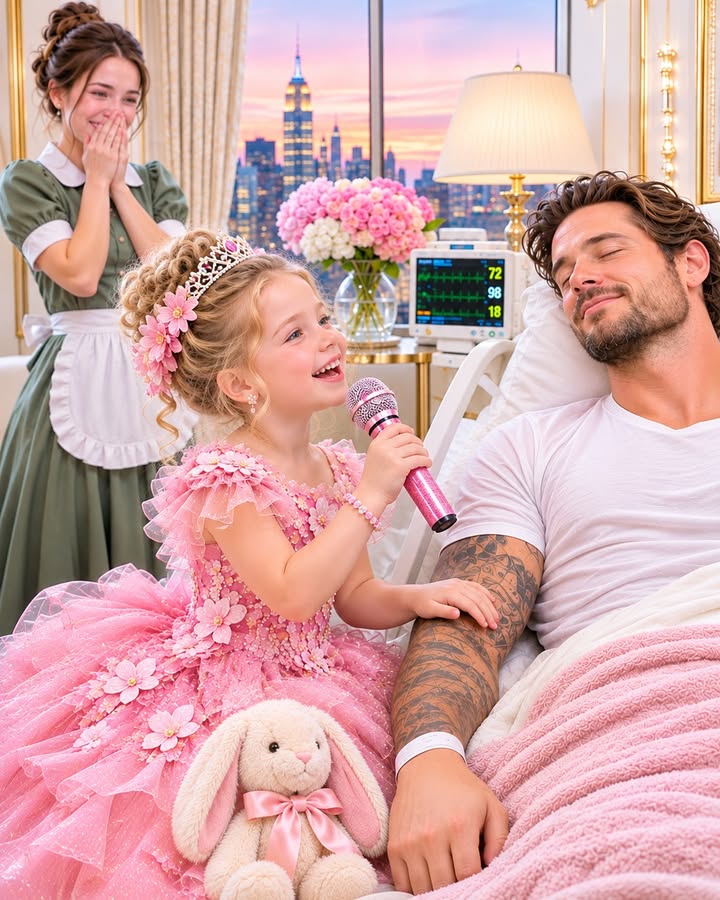
Beyond the half-open door, Poppy slept with her rabbit tucked beneath her chin, one small hand curled around its worn ear.
Rosalind followed my gaze.
“She shouldn’t have to carry this,” she said.
“She won’t.”
“I meant what I told you earlier.”
“I know.”
“She isn’t responsible for what happens to Matthew.”
“I know that, too.”
I wanted Rosalind to understand that I believed her, even if I was not sure she understood how easily hope could become a burden.
“Tomorrow, I’ll speak to the doctor,” she continued. “We’ll make sure every response is documented, but no one will ask Poppy to do anything.”
“That’s what I need.”
Rosalind nodded.
Then she carefully slid the paper back into its folder, as if even the thin sheet could be harmed by handling it too roughly.
“I should let you rest,” she said.
At the door, she paused.
“Nell, I’m sorry I locked you in my office this morning.”
The apology surprised me.
“You were frightened.”
“That doesn’t make it right.”
“No,” I said. “But it helps me understand.”
She held my gaze for a moment, then left without asking me to forgive her.
The next morning, I woke to the sound of Poppy talking to Bunny.
She was sitting on the bed, her hair tangled from sleep, explaining that the sleepy man had a mother who had finally held his hand.
“Do you think he heard her?” she asked when she noticed me watching.
“I don’t know, sweetheart.”
“Maybe he did.”
“Maybe.”
She considered this, then pressed Bunny’s nose to her own.
“If I’m asleep and you say my name, I can hear you sometimes.”
“That’s true.”
“But Matthew is sleeping a different way.”
“Yes,” I said. “The doctors are helping him, and they know much more about that kind of sleep than we do.”
Poppy accepted the answer without disappointment.
She climbed down and came to me for a hug, carrying Bunny beneath her arm.
“I don’t have to sing today,” she said.
“No, you don’t.”
“Can I if I want?”
“If the doctor says it’s all right, and if you still want to.”
She nodded, apparently satisfied.
I dressed her for breakfast and tried not to think about the private weight Rosalind’s apology had lifted from the room.
It did not make the Sterlings’ estate less strange or less intimidating.
It did make it possible to imagine that we might be more than a frightened employee and a family waiting for a miracle.
At breakfast, Rosalind was already seated at the long dining table, a cup of tea untouched beside her.
She looked tired, but she greeted Poppy with a warmth I had not seen before.
“Good morning, Poppy.”
“Good morning.”
“Did Bunny sleep well?”
“He did.”
Poppy placed the rabbit on the chair beside her and climbed onto the seat I pulled out.
Rosalind glanced at me.
“The doctor will be here at ten. He has agreed to explain what the readings do and don’t tell us.”
“That would be helpful.”
“He also asked that we keep visits short and avoid treating every change as a sign.”
“I agree with him.”
Rosalind’s mouth softened.
“I thought you would.”
Breakfast was quiet but not uncomfortable.
Poppy told Rosalind that Bunny had once lost an ear, then explained how I had mended it with thread left over from a hem.
Rosalind listened as if this small history mattered.
When Poppy asked whether Matthew had a favorite toy, Rosalind set down her spoon.
“He used to have a wooden sailboat,” she said. “His father gave it to him when he was about your age.”
“Where is it?”
“I don’t know.”
The answer seemed to surprise her.
“I suppose it’s somewhere in the house.”
“Maybe we could find it,” Poppy said. “Then he could know it’s here.”
Rosalind looked toward the windows.
“Perhaps.”
The doctor arrived shortly before ten.
He introduced himself as Dr. Ravi Sen, and he spoke with the steady patience of someone who had learned that people heard only half of what they were told when they were afraid.
He sat with Rosalind and me in the small consultation room beside Matthew’s bedroom, while Poppy colored at the other end of the table under Gwen’s watchful eye.
“His condition remains stable,” Dr. Sen said. “There have been small variations in his pulse and breathing during the visits, but variations alone don’t demonstrate awareness.”
“Could he have heard the singing?” I asked.
“It’s possible. Some patients who appear unresponsive may still process sound, but we can’t infer that from a monitor reading.”
“And the mouth movements?” Rosalind asked.
“They may be reflexive, or they may be purposeful. At present, we don’t have enough evidence to know.”
Rosalind folded her hands together.
“Would another visit be harmful?”
“Not if it remains calm and brief, and if everyone understands that it isn’t treatment.”
“I do,” I said.
“I do, too,” Rosalind replied.
Dr. Sen looked between us.
“Then we can allow occasional visits, with nursing staff present. We’ll continue assessing Matthew through established clinical measures, not through the presence or absence of a particular person.”
His phrasing was gentle, but firm.
I felt grateful for it.
After he left, Poppy came over with a picture of a brown boat floating beneath a yellow sun.
“Is this Matthew’s boat?” she asked Rosalind.
“It could be.”
“Then we should look.”
Rosalind studied the drawing.
“Would you like to help me search for it?”
Poppy turned to me.
“Can I?”
“If Mrs. Sterling is all right with it, and we stay in the rooms we’re allowed to enter.”
“Of course,” Rosalind said. “We’ll stay downstairs.”
We spent the next hour in a long sitting room lined with books and old family photographs.
The estate seemed different when we were looking for a toy rather than passing through it on the way to a forbidden door.
Poppy moved slowly along the shelves, scanning every cabinet and table.
Rosalind found a box of childhood keepsakes in a storage room off the main hall.
Inside were school ribbons, a chipped marble, a small brass compass, and a wooden sailboat with one broken mast.
“There it is,” Poppy announced.
Rosalind lifted it from the box.
For an instant, the woman’s guarded expression fell away.
She held the boat in both hands, her thumb brushing over the worn blue paint.
“Matthew used to carry it everywhere,” she said. “He would tell anyone who asked that he was taking it to sea.”
“Can we put it by his bed?”
Rosalind looked toward the corridor leading upstairs.
“We should ask the doctor.”
Poppy nodded.
“Then let’s ask.”
Dr. Sen approved the boat after Gwen checked that it was clean and safe to keep in the room.
That afternoon, Rosalind carried it upstairs herself.
I stayed close beside Poppy as we entered Matthew’s room.
His face seemed no different from the day before, and the machines continued their measured rhythm.
Rosalind placed the boat on a shelf where he could see it if his eyes opened.
“Matthew,” she said quietly, “I found your boat.”
She stood beside it, her shoulders tense.
Poppy held Bunny against her chest.
“Did you want to tell him something?” I asked her.
“I want to say good afternoon.”
She moved to the chair but did not climb until I helped her.
“Good afternoon, mister.”
She did not sing.
Instead, she told him about breakfast, about the boat, and how Bunny had once lost an ear.
She did not ask whether he could hear.
When she finished, she asked if she could leave a picture of the sailboat on the bedside table.
Gwen said it was all right.
Poppy placed the drawing beside Matthew’s hand, then turned toward the door.
“Goodbye for now,” she said.
Rosalind remained by the bed after we left.
On our way downstairs, I heard her say Matthew’s name once more, so softly that I could not tell whether she was speaking to him or to herself.
For the next few days, the visits followed the same careful pattern.
Poppy went when she asked to go, and she left whenever she wanted.
Sometimes she sang.
Sometimes she talked about ordinary things, like the rain on the windows or the shape of a cloud above the garden.
Once, she simply sat beside me while Rosalind spoke to her son about the old sailboat and the summers they had spent near the shore.
Matthew’s responses remained small and inconsistent.
His pulse rose on one visit and barely changed on another.
On the fourth day, his fingers shifted against the sheet, though Dr. Sen warned us that a movement like that could have many explanations.
Rosalind listened, then thanked him for being clear.
She did not ask Poppy to return the same day.
It was in those quiet intervals that I began to see how much of the estate’s order was built around fear.
Rosalind kept Matthew’s door closed when no medical staff were present.
She asked Gwen for updates but rarely went in alone.
When she did enter, she stood near the foot of the bed for a few minutes and left before her face could betray how much it hurt.
One afternoon, I found her in the small garden outside the conservatory, sitting on a stone bench with Matthew’s old sailboat in her lap.
Poppy was asleep in our room, worn out from playing.
I had gone outside to clear my head before the next visit.
“Is it all right if I sit?” I asked.
Rosalind shifted to make room.
“Of course.”
She held the boat by its remaining mast.
“I used to think that if I kept everything orderly, nothing could surprise me.”
“I think a lot of people do.”
“I was good at it.”
“You still are.”
She gave a sad little smile.
“Not where it matters.”
I sat with a respectful space between us.
“Matthew called you the night of the accident?”
She nodded.
“He had called several times that month. We were arguing about a business matter, and I assumed the next call would be another argument.”
“Did he leave a message?”
“Yes.”
“Have you listened to it again?”
Her fingers went still against the boat.
“Many times.”
She looked toward the bare hedges, where a few brown leaves clung to the branches.
“I thought I understood what he was saying the first time.”
“And now?”
“Now I hear things I didn’t hear before.”
I wanted to ask what the message contained, but something in her expression made me stop.
She was not avoiding the truth so much as trying to find a way to approach it without being undone.
“Perhaps he’ll be able to tell you himself,” I said.
“Perhaps.”
She set the sailboat beside her.
“Thank you for not asking me to explain.”
“I know what it’s like to have a memory you can’t yet put into words.”
Rosalind turned toward me.
I could see that she understood the difference between being offered comfort and being asked to give it.
Before she could answer, the conservatory door opened.
Victor stepped into the garden.
I had seen him around the estate, though we had never spoken for more than a few words.
He was broad-shouldered, in his late fifties, with silver at his temples and an expression that made him seem perpetually attentive.
He had been the Sterlings’ security chief for years, Rosalind had told me once.
“Mrs. Sterling,” he said. “May I speak with you?”
Rosalind stood.
“Of course.”
His gaze moved briefly to me.
“Nell.”
“Victor.”
He waited until I had turned toward the house with the sailboat in my hands.
I had taken only a few steps when I heard Rosalind’s voice behind me.
“Is this about the medical wing?”
“Yes,” Victor said. “I’d prefer to discuss it privately.”
Something in his careful tone made me pause.
“I’m going inside,” I told them.
Rosalind gave me a brief nod.
I continued toward the door, but it was partly open, and the garden was quiet enough for their voices to carry.
“I reviewed the access log,” Victor said. “There was an entry into the medical wing on the night Matthew was brought home.”
Rosalind answered after a moment.
“Medical staff were in and out.”
“Not this entry.”
A pause followed.
“Who was it?” she asked.
“The camera failed to capture a face. The person was inside for less than two minutes.”
“Could it have been a nurse?”
“The roster doesn’t show anyone assigned at that time.”
“Then why am I hearing about it now?”
“The system flagged the gap in the recording during a routine review. I’ve been checking the backup files.”
There was a rustle, perhaps of papers.
“What did you find?”
“Not enough to identify the person.”
Victor’s voice remained calm, but it had acquired a sharper edge.
“There’s a damaged section in the recording. Most of the image is gone, but a shadow crosses the hall before the camera cuts out.”
“Why wasn’t this reported to me?”
“I wanted to know whether it was a technical fault before I raised an alarm.”
“Matthew’s room is not a place for unreported access.”
“I agree.”
I stepped farther into the house, uneasy about listening.
Then Victor said, “The timing also concerns me. The first unusual response happened after Poppy entered the room.”
I stopped.
“That doesn’t mean her visit caused the response,” Rosalind said.
“I didn’t say it did.”
“Then what are you saying?”
“I’m saying we should be careful. A child was able to enter a secured wing without authorization. Someone else may have been in there, too.”
Rosalind’s voice lowered.
“Nell was with her.”
“The child went in alone.”
“She’s three.”
“Exactly.”
“I will not have her treated like a suspect.”
“Neither will I,” Victor said. “But we have to consider every possibility, especially now.”
The garden door clicked behind me as it closed.
I stood alone in the hall, still holding the little sailboat.
My first impulse was to keep walking.
My second was to go back and tell Rosalind she had nothing to fear from me.
I did neither.
I carried the boat upstairs and placed it in the room where Poppy was sleeping.
She had curled herself around Bunny, her mouth relaxed in the soft way it only became when she felt safe.
I watched her for a moment, then went to find Rosalind.
She was in the sitting room with Victor and Gwen.
A small tablet lay open on the table.
When I entered, the conversation stopped.
“I’m sorry,” I said. “I didn’t mean to listen, but I heard enough to know someone may have entered the wing.”
Rosalind came toward me.
“I’m sorry you heard it that way.”
“Was it the night Poppy went in?”
“Yes.”
“Do you think she could have seen someone?”
“I don’t know.”
“Could someone have been there before she arrived?”
Victor answered before Rosalind could.
“The recording isn’t clear enough to establish the precise sequence.”
His tone was professional, but his eyes remained on me.
I felt the old fear of losing my job rise in my chest.
“If you believe I let someone in, I didn’t.”
“I haven’t said that you did.”
“But you’ve been watching me.”
“I’m responsible for the security of this house.”
“And I’m responsible for my daughter.”
Rosalind stepped between us, not as a barrier but as a quiet reminder that we were all in the same room.
“Victor is investigating a security concern,” she said. “He is not accusing you.”
“Can I see the recording?”
Victor’s eyebrows lifted slightly.
“It’s incomplete.”
“I know. But if Poppy might have been in danger, I want to know what happened.”
Rosalind looked at Victor.
“Show her what you have.”
He did not argue.
On the tablet, the hallway appeared in gray and blue tones, the image grainy with poor light.
The clock in the corner showed a time shortly after one in the morning.
A uniformed nurse passed the far end of the corridor, then vanished from view.
The image held steady for several seconds.
Then the screen distorted.
A black band flickered across the picture.
When the image returned, something dark moved near the door to Matthew’s room.
It was little more than a shape.
A shoulder, perhaps.
The edge of a sleeve.
Then the recording broke apart again, leaving the hallway empty.
“Could that be a coat hanging near the doorway?” I asked.
“It could,” Victor said.
“Could it be a person?”
“It could.”
The answer was no help at all, but it was honest.
“Why would anyone go in there?”
“We don’t know,” he said.
“Did they take anything?”
“Nothing obvious.”
“Did they touch Matthew?”
“The recording can’t show us.”
Rosalind leaned over the tablet, her hand braced on the table.
“Can the missing section be recovered?”
“We’re having a technician examine the storage drive,” Victor said. “There may be fragments in the backup.”
“Then we wait for facts,” Rosalind replied. “No accusations based on a shadow.”
Victor gave a restrained nod.
“Agreed.”
He turned toward me.
“Nell, I’d like to ask you a few questions about the time Poppy went upstairs.”
“I’ll answer them.”
“Where were you when you realized she was gone?”
“On the ground floor, near the cleaning closet.”
“Did you see anyone else on the stairs?”
“No.”
“Did anyone ask you to bring her to the medical wing?”
“No.”
“Did you know how she got past the secured door?”
“She found it open. I assume a staff member had just gone through.”
He noted something on the tablet.
“I understand.”
His questions were reasonable, but the way he watched me made me feel as though each answer had another meaning hidden beneath it.
When he finished, Rosalind walked me back toward the hall.
“I’m sorry,” she said.
“You don’t have to apologize for investigating.”
“I do have to apologize if you feel you’re being blamed.”
“I do feel that.”
“I’ll make sure Victor understands the difference between caution and suspicion.”
I looked at her.
“Do you trust him?”
Her answer did not come quickly.
“I have trusted him for many years.”
“That wasn’t quite what I asked.”
“No,” she said quietly. “It wasn’t.”
I thought of the recording, the shadow, and the time stamp.
Then I thought of the way Victor had looked at Poppy’s visit as if kindness itself were something to inspect.
“I don’t want to cause trouble for your family,” I said.
“You didn’t create this problem.”
“Poppy may have wandered into the room, but she didn’t bring whoever that was.”
“No,” Rosalind said. “She didn’t.”
That afternoon, I decided not to take Poppy to visit Matthew.
I told her we would stay downstairs, and she accepted it without a complaint.
We sat together in the staff room while rain tapped gently against the windows.
She made the gray rabbit a paper bed, then asked whether the sleepy man had seen the boat.
“I don’t know,” I said.
“Maybe he likes boats.”
“I think he used to.”
“Then it’s good we found it.”
“Yes,” I said. “It is.”
A little later, Gwen came to the room.
“Dr. Sen has reviewed the latest readings,” she said. “He says Matthew’s condition is unchanged, but he’d like to keep observing the small movements.”
“Will there be another visit?”
“Only if you and Poppy want one. There’s no medical requirement.”
I appreciated her saying it that way.
“Thank you.”
Gwen hesitated.
“Nell, I should tell you something else. Victor asked for the access log from the night Poppy entered the room.”
“I know about the recording.”
“He asked for it before Rosalind told him that Poppy had been there.”
That made me look up.
“Why?”
“I don’t know.”
“Did he find anything?”
“Not at first. The damaged clip came from an earlier review of the security system.”
Gwen kept her voice low.
“I don’t want to make more of it than we know, but the timing unsettled Rosalind.”
“Did it unsettle you?”
“Yes.”
She sat across from me.
“I’ve worked with Matthew for years. He could be difficult, but he never made people guess where they stood with him. The last few weeks have made every small thing feel uncertain.”
“Are you afraid someone hurt him?”
“I’m afraid of what we don’t know.”
She looked toward the hall, where the upstairs rooms remained out of sight.
“I should get back.”
After Gwen left, I took Poppy for a walk through the covered passage between the main house and the garden.
We were halfway past the library when two security officers came from the opposite direction carrying a small evidence envelope.
I could not see what was inside it.
Victor walked behind them, his expression composed.
He slowed when he saw us.
“Poppy,” he said. “How are you?”
“Fine.”
She clutched Bunny closer.
Victor’s gaze dropped to the rabbit.
“Does he come everywhere with you?”
“Most places,” she said.
“He’s a good companion.”
“He helps when I miss my daddy.”
A silence fell over the passage.
Victor’s expression changed, briefly and almost imperceptibly.
“I’m sorry,” he said.
Poppy nodded.
“Thank you.”
The officers continued toward the security office.
Victor followed them, but not before glancing once at the envelope in one officer’s hand.
That night, I heard raised voices from the lower hall.
Not shouting, exactly.
More the sound of people trying to keep their words contained and failing.
I went to the doorway of our room.
Poppy was asleep.
Rosalind stood near the stairs, speaking to Victor.
“I won’t have the staff questioned in front of my son,” she said.
“I haven’t questioned anyone in front of him.”
“You questioned Nell in a room where she could see you looking at her as if she were responsible.”
“I asked routine questions.”
“She answered them.”
“And there’s a reason to look again.”
“Which is?”
Victor paused.
Then he said, “We found something in Matthew’s car.”
The words seemed to change the air around them.
“What did you find?” Rosalind asked.
“A damaged cufflink.”
“I don’t understand.”
“It was wedged beneath the passenger seat.”
“Whose cufflink?”
“We don’t know yet.”
“Why wasn’t it reported with the car?”
“The underside was missed during the first inspection. The vehicle has been examined again as part of the accident review.”
Rosalind’s voice dropped.
“Does it match anything?”
“We’re checking.”
“Then don’t draw conclusions before you know.”
“I haven’t.”
“Good.”
Their footsteps moved away from the stairs.
I remained in the doorway, unable to decide whether I had heard enough or too much.
The next morning, Victor was absent from the breakfast room.
Rosalind came in late, carrying a folder and wearing a face that revealed nothing.
“Has there been news?” I asked when Poppy had been taken to the playroom with Gwen.
Rosalind closed the door behind her.
“The cufflink has a distinctive pattern on the back.”
“What kind of pattern?”
“A small engraved star.”
I thought of the security officers carrying the evidence envelope.
“Does it belong to Matthew?”
“No. His cufflinks have a plain gold setting.”
“Do you know whose it is?”
Rosalind’s eyes dropped to the folder.
“Victor wears a pair with the same engraving.”
The room seemed to tilt, though nothing had moved.
“Could it be a similar pair?”
“That’s what I asked.”
“And?”
“Victor says he lost one cufflink months ago.”
“Does he know how it could have ended up in Matthew’s car?”
“He says he doesn’t.”
“What does the police investigator say?”
“Nothing yet. The object is being examined, and the crash investigation is still active.”
Rosalind’s composure had begun to fray around the edges.
She sat down at the table without opening the folder.
“Victor has worked for this family for twenty years,” she said. “He was with Matthew through every difficult season of his life.”
“Does that mean he couldn’t have done something wrong?”
“No.”
She pressed her hands together.
“It means I don’t know how to look at him and separate the man I trusted from the possibility in front of me.”
I understood that uncertainty too well.
When someone failed you, the memory of every kindness became part of the question.
“Could someone have stolen his cufflink?”
“Yes.”
“Could it have fallen off months ago and ended up in the car for some unrelated reason?”
“Yes.”
“Then you don’t know.”
“No.”
Rosalind stared at the unopened folder.
“I want to believe there’s a simple explanation.”
I wanted to say there was one.
Instead, I said, “You shouldn’t have to decide what you believe before the facts are clear.”
She looked up at me.
“I’m trying to remember that.”
A soft knock came from the hall.
Victor stood outside the door.
Rosalind’s back straightened.
“I need to speak with you,” he said.
“About the cufflink?” she asked.
“About Matthew, and about the security review.”
“Come in.”
He entered, holding a second tablet.
His eyes passed over me, then settled on Rosalind.
“The technician recovered a fragment from the damaged recording.”
She stood.
“Can you identify the person?”
“No.”
“Then what did you recover?”
Victor placed the tablet on the table and tapped the screen.
A frozen image appeared.
The
**–END OF PART 3–CLICK “NEXT” AT THE BOTTOM OF THE PAGE TO CONTINUE READING**
* * *
[PREVIOUS: PART 2](https://puretales.idolsgift.com/blog/part-2-the-word-that-changed-everything-027) | [NEXT: PART 4](https://puretales.idolsgift.com/blog/part-4-the-word-that-changed-everything-027)
✓ Lynn R. Adams
Part 3 – The Shadow on the Recording “I think he was trying to say ‘Mother.’” Rosalind’s voice held the same careful uncertainty as before, but her hand had tightened around the edge of the paper. …