PART 3: The Wall David Wanted to Save 029
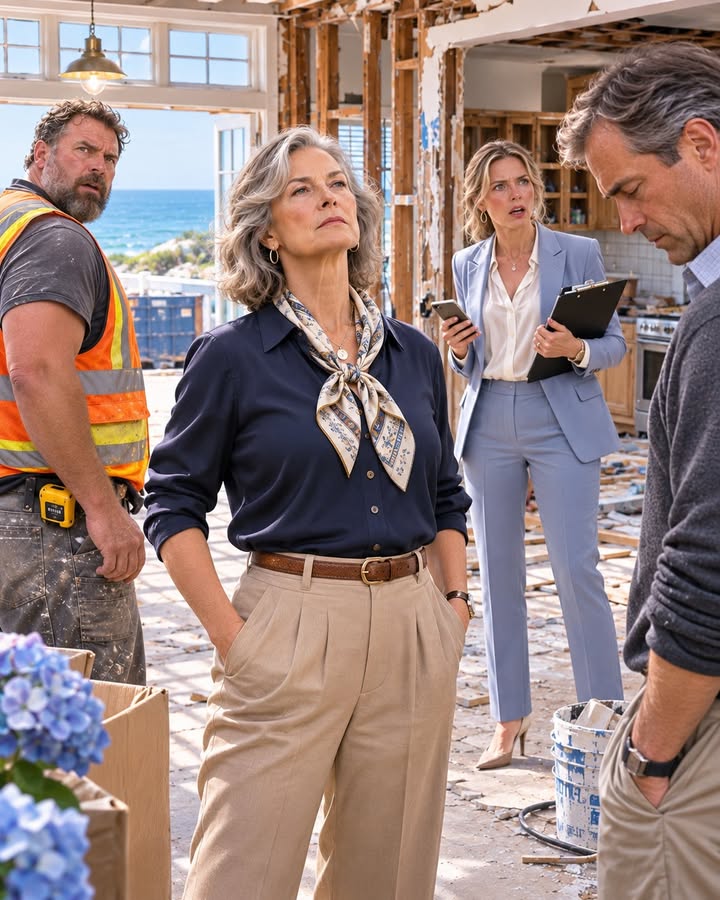
Part 3 – Behind the Cabinet
For the rest of the morning, I tried not to look at the cabinet.
I watched Greg’s crew load their tools into the trucks, listened as Sarah canceled the next delivery, and gathered the scraps of my life that had been scattered across the little guest room.
Every task gave my hands something to do.
None of them gave my thoughts anywhere to go.
David left with Sarah to speak to the supplier and work out what could be returned.
Before he went, he asked if I wanted him to stay.
“I want you to tell me the truth,” I said.
He nodded, but neither of us seemed to know what else to say.
Then he followed Sarah out.
I heard their car pull away, and the quiet that settled over the house felt less like peace than a pause.
Greg stayed behind to finish reviewing the contract and document the work already done.
He walked through each room with a small notebook, making careful notes about the removed cabinets, the exposed walls, and the carpet that had been pulled up.
“I’ll send you and the two people who signed the agreement a full account,” he said. “No one should have to guess what’s been done or what it costs.”
“Thank you.”
He glanced toward the master bedroom.
“David was very specific about that built-in,” he said. “He asked twice that we keep it.”
“Did he explain why?”
“Not really. Just said it was original and worth preserving.”
I looked toward the hallway.
“Did Sarah agree?”
“She said it could stay for now, but she wanted the wall opened up around it.”
He shut his notebook.
“I’m glad we stopped before the crew got that far.”
“So am I.”
There was a brief silence.
I could hear the ocean beyond the houses, faint and steady, as if it were keeping time for a day that had gone entirely out of rhythm.
Greg looked at me with the careful kindness of someone who had spent years arriving at homes when something had gone wrong.
“I’m sorry this happened, Ms. Wells.”
“So am I.”
He lowered his voice.
“I don’t think David meant for it to get this far.”
“That doesn’t make it less far.”
“No,” he said. “It doesn’t.”
He did not offer to take sides, and I was grateful for that.
When he had gone, I returned to the bedroom and opened the cabinet again.
The seam at the back still showed, a hairline break between two pieces of wood.
I pressed it gently.
Nothing shifted.
I tried the opposite side, then the shelf, but the cabinet remained still.
It might have been an ordinary join in old carpentry.
It might have been a repair David’s father had made years earlier.
Or it might have been nothing at all.
I closed the door.
The house had always seemed to me like a place of open windows and simple rooms, somewhere my husband and I could have spent long afternoons without needing to fill the hours.
I had never thought of it as a place that kept secrets.
By early afternoon, Sarah had sent me a message.
She asked whether she could come by the next day to collect a folder she had left in the living room and to talk about what happened.
I read the message twice before replying.
“You may come for the folder. We can talk when you’re ready to do so honestly.”
Her response came a few minutes later.
“I understand. I’m sorry, Hannah.”
I did not answer.
An apology could be sincere and still not be enough.
It could be the beginning of something without being the thing itself.
I spent the afternoon trying to restore the living room to a recognizable shape.
The sofa was still there, though someone had pushed it against the far wall to make room for the work crew.
The framed photographs had been placed in two boxes, their corners protected with folded packing paper.
I found one of David and his father on the porch, both of them squinting into the sun.
David was about twelve, with his hair sticking up at the crown.
His father had an arm around him, and both of them were holding the same fishing rod as if they had just landed something enormous.
I could remember the day.
They had caught nothing.
We had eaten sandwiches from a paper bag and laughed about the bait sliding off the hook.
I set the photograph on the mantel, then moved it back into the box.
The room did not yet feel ready for it.
I had just finished sorting the boxes when my phone rang.
It was David.
“Mom, I’m on my way back,” he said. “Sarah’s still with her parents. She asked me to bring the folder she needs.”
“Is she going to tell them what happened?”
There was a pause.
“I think so.”
“That isn’t the same as knowing.”
“I know.”
His voice sounded tired, though I did not know if he had slept much the night before.
“Are you coming alone?”
“Yes.”
“Then come.”
He arrived about twenty minutes later, carrying a paper bag from a bakery near the road.
“I didn’t know if you’d eaten,” he said, placing it on the table.
“I had coffee.”
“That doesn’t count.”
“It counts as something.”
He smiled faintly, but the expression disappeared almost at once.
“I found the folder Sarah was looking for.”
He set it beside the bag.
The folder was blue, with a loose elastic band around it.
I opened it to make sure it contained no paperwork I needed.
The contract was there, along with the contractor’s estimate and several printouts of cabinets and countertops.
The renovation plans had been drawn up in careful detail.
A widened bathroom.
A new closet.
A large bed positioned beneath the windows.
A pale green vanity with brass fixtures.
Sarah’s notes filled the margins in neat handwriting.
I did not feel angry at the color or the vanity.
I felt the old ache of seeing my house imagined as someone else’s future without my consent.
David watched me close the folder.
“I’m not asking you to approve any of it.”
“Good.”
“I’m going to tell Sarah’s parents what I told you.”
“That you promised them the house?”
“That I promised them they could move here. And that I had no right to.”
“You should tell them the whole truth.”
“I will.”
“Not just the version that makes you sound foolish but well-intentioned.”
He looked at me with a small, grateful sadness.
“Okay.”
I sat down at the kitchen table.
He remained standing, one hand resting on the chair opposite me.
“Did you talk to the contractor about the cabinet because of your father?”
“Maybe.”
“What does that mean?”
“I remember coming here with Dad after the storm, years ago. He repaired something in the bedroom.”
“The cabinet?”
“I think so. I was young. He had the door off, and I remember him telling me to keep my hands away from the hinge.”
A fragment of memory moved through my mind.
My husband standing in the bedroom with a screwdriver tucked into his back pocket.
David at his side, watching him work.
I had been in the kitchen, making tea.
“Did he say anything else?”
“Not that I remember.”
“Was the cabinet empty then?”
“I don’t know.”
He touched the edge of the folder.
“Why does it matter so much?”
“I don’t know yet.”
He sat across from me.
“I should have told you about the promise before I let any of this happen.”
“Yes.”
“I know I can’t make that right with one conversation.”
“No.”
He turned his palms upward on the table, an open gesture I recognized from the years when he was a boy trying to explain how a mistake had happened.
“Will you let me help repair the house?”
“That depends what you mean by help.”
“Whatever you decide. I won’t make decisions for you.”
I looked at him.
“I need you to understand that this is not only about the walls.”
“I do.”
“I don’t think you do yet.”
He lowered his eyes.
“Maybe I don’t.”
I wished he had argued.
I wished he had insisted he understood, so I could tell him exactly why he did not.
Instead, he left the space between us open, and that was harder to push against.
When he went, I watched his car travel down the road until it disappeared behind the pines.
Then I took the blue folder to the small bedroom and placed it beside the boxes of my clothes.
I stayed away from the master bedroom until dusk.
By then, the light had softened through the windows, and the exposed plywood seemed less like damage and more like an unfinished promise.
I stood at the doorway.
The narrow built-in cabinet waited in its place.
Its brass knob caught the last of the day’s light.
I stepped inside and opened it once more.
The shelves were dusty, but otherwise bare.
I ran my fingertips along the back panel until I found the seam.
This time, I pressed with my thumb at the place where the wood seemed to give.
A small section moved inward.
I froze.
The shift was slight, no more than the width of a fingernail.
Still, I had felt it.
I pressed again.
A soft click came from behind the panel.
The sound was so quiet that I might have imagined it, but a narrow piece of wood eased outward from the side.
I stepped back and stared at it.
It was not a door, exactly.
It was a hidden catch, concealed beneath the cabinet’s rear trim.
I tried to pull it open, but it would not move.
The old wood felt delicate, and I could not bear the thought of breaking something my husband had taken such care to preserve.
I left it alone.
The next morning, I called Greg.
He listened as I described the cabinet.
“I can come by,” he said. “I don’t want you forcing anything.”
He arrived before noon, carrying a small tool case.
He examined the seam, tested the panel with the light touch of a carpenter who knew how to tell the difference between stubbornness and fragility, then nodded.
“There’s a false back,” he said. “Someone built a little compartment behind it.”
“Can you open it without damaging the cabinet?”
“I think so.”
He worked slowly, removing a narrow piece of trim and easing the panel free.
The opening behind it was shallow, no larger than a document box.
A sealed envelope rested inside.
The paper had browned at the edges, but it was dry and intact.
My hands went cold.
I knew my husband’s handwriting before I touched the envelope.
The letters leaned slightly forward, each one shaped with patient care.
“Hannah Wells,” Greg read softly.
I reached for it.
My name seemed to belong to another time.
My husband had been dead for six years, yet the sight of his handwriting placed him in the room so vividly that I had to hold on to the cabinet for balance.
I turned the envelope over.
It was sealed.
There was no date on the outside.
“Do you want me to wait?” Greg asked.
“Yes,” I said, though I was not sure what I wanted him to wait for.
He rested the removed panel against the wall.
“I can give you a few minutes.”
I held the envelope with both hands.
The paper was lighter than I expected.
I could feel the shape of a folded letter inside.
I did not open it.
Not alone.
I called David.
He answered on the second ring.
“Mom?”
“I found something in the cabinet.”
“What?”
“A letter. Your father’s handwriting is on the envelope.”
There was a pause long enough for me to hear his breathing change.
“I’m coming.”
“You don’t have to.”
“I want to.”
I looked at the sealed flap.
“Come carefully,” I said.
He arrived less than half an hour later.
The drive from our town was long enough that he must have left almost immediately.
He came through the front door without knocking, then stopped when he saw Greg standing in the bedroom doorway.
“Is it really Dad’s?” he asked.
I held the envelope out.
David stared at the handwriting.
His face had changed.
All the defensive tightness that had followed him since the previous morning gave way to something more vulnerable.
He took the envelope but did not open it.
“It is,” he said. “I’d know it anywhere.”
“Have you seen this before?”
“No.”
“Are you sure?”
He ran his thumb lightly over his father’s name.
“I’m sure.”
Greg stepped into the hall.
“I’ll leave you two alone.”
“Thank you,” I said.
When he had gone, David sat on the edge of the stripped floor where the bed had been.
I remained standing.
The room seemed too bare to hold the years suddenly crowded into it.
I thought of my husband’s hands fixing the cabinet, of the small repairs I had forgotten, of the way he had always tucked things safely out of sight when he meant to come back to them.
“Should we open it?” David asked.
“I don’t know.”
“He wrote it to you.”
“That doesn’t mean I know what it says.”
His eyes went to the envelope.
“Maybe he meant for you to find it.”
“Maybe.”
I sat beside him, leaving a small space between us.
For a moment, neither of us moved.
The envelope rested across David’s open hands.
Outside, a gull cried over the dunes.
Then David’s phone rang.
He glanced at the screen and let out a slow breath.
“It’s Sarah.”
“Answer it.”
He stepped toward the window.
“Hello?”
I watched his face as he listened.
His expression shifted from concern to surprise, then to something almost like shame.
“What do you mean, you gave notice?”
He turned away from me.
“Sarah, when did they do that?”
There was a brief silence.
“Before the contractors came?”
David closed his eyes.
“I told them I would take care of it. I didn’t tell them it was settled.”
He listened again, his shoulders rigid.
“No, I know what I said. I’m saying I didn’t have the right to say it.”
Another pause.
“Are they still at the apartment?”
He looked toward the window, but the view was only the side yard and the line of trees beyond it.
“Okay. Don’t tell them anything else until I get there.”
He ended the call and lowered the phone.
“What happened?” I asked.
“Sarah’s parents gave notice on their rental.”
“When?”
“Last week.”
The words landed with a weight that felt different from the contractor’s bill.
“Before you came here?”
“Yes.”
“They gave notice because you promised them they could live in my house?”
David nodded.
“They believed me.”
I looked at the letter in his hands.
The small paper envelope seemed to hold a life I had not yet read, while David’s promise had already altered the lives around us.
“Are they moving out this week?” I asked.
“The landlord agreed to let them stay through the end of the month. But they can’t afford the new rent after that.”
“Did Sarah tell you this?”
“She said they had been talking about it. I thought they were waiting to decide.”
His voice faltered.
“I should have asked.”
“Yes.”
“I should have told you.”
“Yes.”
He looked down at the envelope.
“I thought I could give them an answer before I gave you a problem.”
“You gave me the problem anyway.”
“I know.”
I wanted to comfort him.
The impulse rose before I could stop it, built from decades of mothering and the old habit of believing that if I could soften his guilt, I could somehow keep him from hurting himself with it.
But comforting him now would not undo what he had done.
It might even let him mistake my tenderness for permission to avoid the truth.
“Your father’s letter can wait,” I said.
David looked at me.
“Are you sure?”
“No.”
I took the envelope from him and set it carefully on the windowsill.
“Nothing about this is simple anymore.”
He nodded, his eyes fixed on the paper.
“Sarah’s parents trusted me.”
“They did.”
“I don’t know how to face them.”
“You tell them what you told me.”
“That I gave them my word.”
“And that you had no authority to make the promise.”
He swallowed.
“Then what?”
“Then you listen.”
He looked as if the answer offered no shelter, and I understood that it did not.
I had no ready solution to give him.
I did not know whether I could help Sarah’s parents without entangling myself further.
I did not know whether the house could still become the refuge I had bought it to be.
I did not even know what my husband had written.
The envelope sat between us, unopened.
David reached toward it, then stopped himself.
“Mom, if that letter is about the house…”
“I don’t know what it’s about.”
“But if he wanted us to keep it…”
I looked at him.
“Your father’s wishes don’t give you permission to make choices for me.”
“I know.”
“Do you?”
He drew his hand back.
“I’m trying to.”
I believed that he was trying.
I also knew that trying would have to become something more than a feeling.
His phone rang again.
This time, he did not answer immediately.
The name on the screen was Sarah’s mother.
He looked at me, uncertain.
“Pick up,” I said.
He answered and put it on speaker when she asked whether I was there.
“Hannah?” she said, her voice careful. “I’m so sorry to call like this.”
“You don’t need to apologize for asking what’s happening.”
“I’m afraid we may have misunderstood.”
There was a quiet rustle on the other end of the call.
Sarah’s father must have been nearby.
“We gave our notice because David said the beach house was available,” she continued. “He said you were happy to let us stay there.”
David lowered his eyes.
I felt the sealed letter on the windowsill behind me.
It was one thing to learn that he had made a promise.
It was another to hear the people who had trusted it speaking to me as though it were mine.
“I’m sorry you were told that,” I said. “I never agreed to it.”
“I understand.”
Her reply came quickly, but it sounded unsteady.
“We don’t want to be caught in the middle of a family disagreement.”
“You aren’t responsible for the way this happened.”
“Still, we made plans.”
“Yes,” I said. “And now we need to decide what can be done honestly.”
There was a pause.
Then she said, “David told us he would call tonight with a proper explanation.”
I turned to my son.
He looked frightened, but he did not turn away.
“I’ll call you,” he said. “I’ll tell you everything.”
“Thank you,” she replied.
After the call ended, the room felt smaller.
David stood beside the bed frame, staring at the bare floor.
“I’ll go to them tonight,” he said.
“You should.”
“I’ll tell them I was wrong.”
“You should.”
“I don’t expect you to fix this.”
“Good.”
He glanced toward the letter.
“Would you like me to stay while you open it?”
I considered the question.
The handwriting belonged to both of us, but the letter had been addressed to me.
“I think I need to read it alone.”
He nodded.
“All right.”
He made no attempt to take the envelope.
As he left the room, he paused at the doorway.
“I’m sorry, Mom.”
“I know.”
This time, I did not tell him that I forgave him.
He seemed to understand why.
When the front door closed, the house settled around me.
I picked up the envelope and turned it over in my hands.
The paper was warm now from the sun.
I could feel the slight ridge where the letter had been folded inside.
My husband had hidden it behind a cabinet he had asked us to preserve, and I had no idea what he had wanted to say or when he had meant me to find it.
I sat on the bare floor beside the wall.
For a long while, I listened to the ocean.
Then I looked again at the front of the envelope.
Under my name, almost too faint to see, was a date.
It was from the last month of my husband’s life.
**–END OF PART 3–CLICK “NEXT” AT THE BOTTOM OF THE PAGE TO CONTINUE READING**
* * *
[PREVIOUS: PART 2](https://puretales.idolsgift.com/blog/part-2-the-wall-david-wanted-to-save-029) | [NEXT: PART 4](https://puretales.idolsgift.com/blog/part-4-the-wall-david-wanted-to-save-029)
✓ Lynn R. Adams
Part 3 – Behind the Cabinet For the rest of the morning, I tried not to look at the cabinet. I watched Greg’s crew load their tools into the trucks, listened as Sarah canceled the next delivery, and…