PART 3: The Voice That Wouldn’t Hang Up5 025
Part 3 – What the Cameras Remembered
The officer’s words remained between us long after he had finished speaking.
An old company record.
A call I could not remember.
A warning my father had received before my wedding, from someone who had never given a name.
The pieces were too small to form a picture, but together they made the past feel less settled than I had believed.
“Can you tell what number it came from?” Dad asked.
The officer checked his notes.
“The records team is still working on that. The call history may be recoverable, but the device is damaged, and we don’t want to promise more than we know.”
I nodded, though my thoughts had already begun racing ahead.
Three weeks before my wedding, someone had called my phone from a number connected to Carter’s company.
Had they been trying to warn me?
Or had the connection been incidental, one more detail that seemed important only because of what had happened tonight?
My father seemed to sense the question taking shape.
“We’ll wait for evidence before we decide what it means,” he said.
I looked at him.
“Is that what you told yourself about the warning?”
His eyes lowered briefly.
“Yes.”
There was no defense in his answer, only a kind of regret he was still trying to understand.
“I don’t know whether I would have listened,” I said.
“Neither do I.”
Sarah stayed quiet beside the bed, her hand resting near mine without holding it.
I wondered whether she was thinking about the questions she had raised before my wedding, and the way I had brushed them aside.
I wondered whether she was still angry with Dad for not pushing harder, or with me for making it so difficult to stay close.
The monitor gave its steady rhythm.
For the moment, the baby was still there, still holding on, and that was the only certainty I could bear.
The nurse came in to check my blood pressure and adjust the blanket beneath my arm.
She told us the doctors wanted me to rest, though she knew sleep would be difficult.
Dad thanked her, then stepped into the hallway to speak with the hospital’s patient advocate.
Sarah remained in the room.
For several minutes, she watched the monitor instead of looking at me.
“Do you remember the afternoon before your wedding?” she asked at last.
“I remember you bringing me coffee.”
“I also remember telling you I didn’t know Carter well enough to trust him.”
I swallowed.
“You said his answers changed depending on who was asking the questions.”
“I said that because I thought he was trying too hard to impress Dad.”
“He was trying too hard to impress everyone,” Sarah said. “But I couldn’t prove anything, and you were happy.”
“I thought you were trying to talk me out of marrying him.”
“I was trying to make sure you had room to think.”
Her voice was careful, which made me hear the pain underneath it.
“I thought you believed I was being foolish.”
“I thought you were in love,” she replied. “I didn’t want to turn my worry into another order from our family.”
The word family carried more history than the room could hold.
I had left home believing that my independence required distance.
Sarah had respected that distance, even when she thought I was making a mistake.
Now, lying in a hospital bed, I could see how easily respect could become absence when neither person knew how to ask for something different.
“I’m sorry I made it hard for you to be my sister,” I said.
Sarah’s eyes shone, but she did not look away.
“You didn’t make it hard,” she said. “You made a choice, and I was afraid that if I kept pushing, you would stop telling me anything at all.”
“Then I did.”
“Yes.”
She drew a slow breath.
“I’m sorry I let that happen without finding another way to reach you.”
I turned my hand palm-up on the blanket.
Sarah placed hers over it.
The small gesture did not erase two years of missed calls and careful holiday conversations.
It did, however, make space for what might come next.
Dad returned carrying a cup of coffee he had not touched.
“The doctors are satisfied with the readings for now,” he said. “They’re continuing to monitor you.”
“Did you hear anything about the call?”
“Not yet.”
He set the coffee down and looked at Sarah.
For a moment, I thought he might return to the conversation about the warning, but he did not.
Instead, he pulled a chair close to the bed.
“I can sit here as long as you want,” he said.
“I want you both here.”
Sarah’s thumb moved once across my knuckles.
Dad gave a quiet nod and settled into the chair.
The night stretched on with its own strange measure of time, marked by vital checks, questions from staff, and the heartbeat that kept returning through the monitor.
I slept in brief intervals.
Each time I woke, I expected to see Carter standing in the doorway, as if my mind had not yet accepted that I had asked for him to stay away.
He never came.
By morning, the bleeding had lessened, though the doctors still wanted to keep me under observation.
The baby’s heartbeat remained steady.
I clung to those words while the hospital social worker helped me understand the steps ahead: documenting what I remembered, deciding who could receive information about my care, and arranging a safe place to stay when I was released.
My first thought was that I should return to the estate for my clothes.
My second was that I could not imagine walking into that kitchen again.
“Your sister and I can bring you whatever you need,” Dad said when I mentioned it.
“Not yet,” the social worker advised. “Let the investigators handle the house and any belongings that might be relevant.”
I felt ashamed of how quickly I had begun thinking about ordinary things.
My work uniform was still in the laundry room.
My prenatal vitamins were in the bathroom cabinet.
There were baby clothes folded in a drawer upstairs, small soft things I had bought one by one without telling Carter how much I cared about choosing them.
The future had been made of such simple plans.
Now even the thought of a drawer felt far away.
Sarah seemed to read my expression.
“We’ll get what matters when it’s safe,” she said. “You don’t have to decide today.”
I nodded.
Later that morning, a detective came to speak with me.
She introduced herself as Detective Alvarez and asked whether I felt well enough to answer some questions.
The doctor said we could stop at any time.
I agreed.
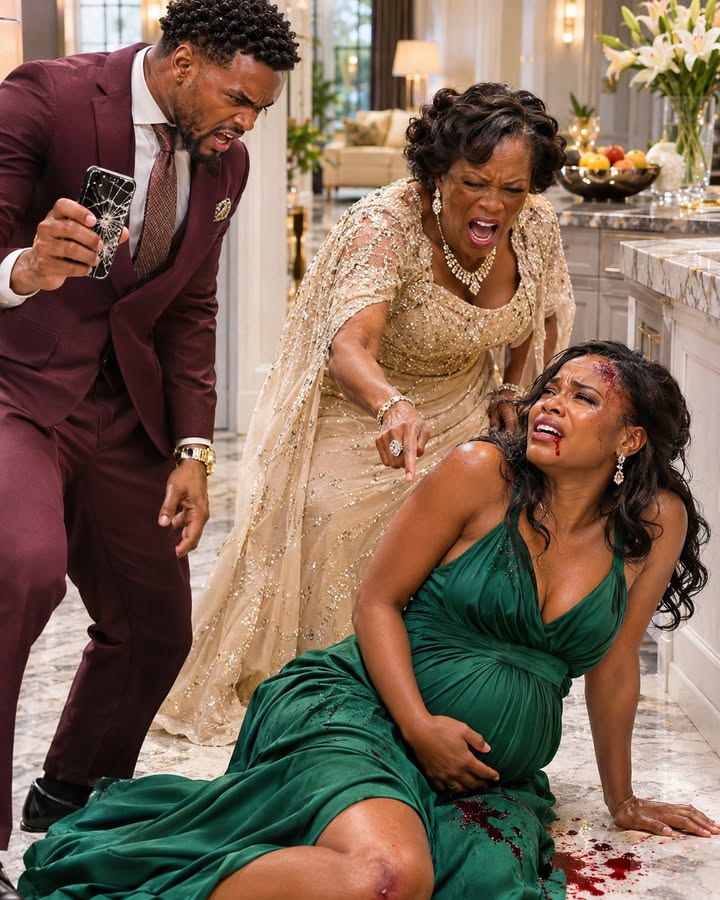
The detective spoke gently and took notes while I described the argument, Eleanor’s shove, the countertop, and Carter breaking my phone.
She asked me to repeat the sequence once more, not because she doubted me, she explained, but because clear timing could help them compare accounts and physical evidence.
I did my best.
When she asked whether Carter had ever hurt me before, I hesitated.
“No,” I said. “Not like that.”
“Has he frightened you before?”
I looked at my father, who remained silent near the window.
“Sometimes,” I answered. “Mostly with his voice. Or by deciding what I was allowed to know.”
The detective did not press me to define it.
She asked whether he had ever kept me from contacting anyone.
“Not exactly.”
I remembered him discouraging calls with Sarah, then saying he missed me when I made plans without him.
I remembered how he had spoken about my father’s questions, calling them interference.
I remembered how quickly I had learned to keep the peace by keeping my life small.
“I’m not sure,” I admitted.
“That’s all right,” she said. “You don’t have to fit everything into a category today.”
She explained that the police had obtained the relevant records from the estate and were working with the hospital to preserve the medical documentation.
The phone fragments had been recovered, but it would take time to determine what could be retrieved from them.
“Is there a camera in the kitchen?” I asked.
The detective looked at her notes.
“There is a security system at the property. We’re requesting access to any footage, along with recordings from nearby homes if they might show the driveway or entrance.”
I remembered the small black camera above the back door.
Carter had told me it was part of the estate’s security system.
He had said it was mostly for monitoring deliveries and keeping track of the household staff.
I had never thought about what it might have recorded.
“Would it have been on?” I asked.
“I don’t know yet,” the detective said. “We’ll find out.”
After she left, I stared at the blanket across my knees.
The room was quiet except for the soft equipment sounds and Sarah turning pages in a notebook where she had written down what the doctors said.
Dad sat beside the window, holding his phone without using it.
“You don’t need to look after everyone,” I told him.
He glanced up.
“I’m not.”
“You’ve been trying to keep the police, the hospital, the lawyer, and Sarah from worrying.”
“That sounds like a full-time assignment.”
“I’m serious.”
“So am I,” he said. “They’re all grown people. They can worry without my managing it.”
The answer made me smile faintly, which surprised me.
It was the first time since the kitchen that my face had moved without pain or effort.
Dad saw it and smiled too.
For a little while, we were simply father and daughter in a hospital room, with no old secrets between us that needed immediate solving.
Then Sarah’s phone rang.
She looked at the screen, frowned, and stepped into the hallway to answer.
When she came back, she seemed unsettled.
“What is it?” I asked.
“The detective called,” she said. “They’ve found security footage from the estate.”
Dad stood.
“What does it show?”
“The kitchen camera captured the argument,” Sarah said. “The recording is clear enough to show Eleanor pushing Emily.”
My throat tightened.
The fact that a camera had seen what happened should have brought relief.
Instead, I felt something close to disbelief.
For months, I had wondered whether a hurtful moment was really as bad as I remembered, whether Carter meant what he said, whether Eleanor’s criticism was simply how she treated everyone.
Now a silent witness had been watching.
“Did they arrest her?” I asked.
“She and Carter were already being held for questioning,” Sarah replied. “The detective said the footage gives them a clearer basis to continue.”
I turned my face toward Dad.
“And Carter?”
“The kitchen footage doesn’t show the phone,” Sarah said. “The angle is limited.”
The answer left a familiar unease in its place.
Carter could still tell his own version of what had happened.
He could still say I had dropped the phone or that it had been damaged before the argument.
The detective returned an hour later, this time with an update.
A neighbor’s doorbell camera had recorded part of the evening from across the drive.
It showed Carter carrying my phone out of the kitchen and striking it against the wall near the side entrance.
The recording did not show his face clearly, but the detective said the time stamp and clothing matched his account of the night.
The broken phone was no longer a matter of his word against mine.
I shut my eyes.
For the first time since the incident, I felt the shape of the truth becoming something sturdier than my fear.
The detective was careful not to describe the evidence as a guarantee.
She said the case would take time, that the people involved would be interviewed, and that the prosecutor’s office would review the findings.
I understood that justice was not a single door opening.
It was a long corridor, with many doors and no promise that each one would be easy to pass through.
Still, I was grateful that the first steps had begun.
The next surprise came late that afternoon, when a nurse asked if I had ever volunteered at a prenatal clinic in Petersburg.
I looked at her, confused.
“Yes,” I said. “Before I took my hospital job.”
“A woman from the clinic called the patient advocate. She recognized your name and wanted to make sure you knew someone there was thinking of you.”
For a moment, I could not remember which woman it might be.
Then I pictured the small clinic, the waiting room painted pale yellow, and the table where we kept donated blankets and bottles.
I had volunteered there during my first year after moving to Richmond.
The clinic had served women who could not easily get appointments elsewhere, and I had spent Saturday mornings helping with intake forms and making tea.
“Did she say who it was?” I asked.
The nurse checked the message.
“Marisol Vega. She said she remembers you helping her organize a prenatal supply drive.”
I remembered Marisol.
She had been a quiet, tired woman with two little girls and a habit of apologizing whenever she asked for anything.
I had helped her make a list of donated supplies and had sat with her while she waited for an appointment.
“It’s kind of her to call.”
The nurse smiled.
“She also said there’s a note in the clinic’s old volunteer ledger about a donor who supported their prenatal program.”
I did not understand why she had mentioned that.
“What does that have to do with me?”
“She said the donor asked that the gift remain anonymous, but the clinic can share the note with you if you want.”
I looked toward my father.
He lifted his eyebrows, equally uncertain.
The nurse told me the clinic’s director had found a record that might be relevant, although she did not know whether it had anything to do with my case.
I felt an unexpected pull of curiosity.
“Could she send it to the hospital?”
“She offered to bring it herself, but I told her to wait until you agreed.”
I nodded.
“Let her come tomorrow, if I’m still here.”
The nurse said she would arrange it.
After she left, Sarah sat down beside me.
“You used to love that clinic,” she said.
“I did.”
“You never told me much about it.”
“I don’t think I told anyone much about those years.”
I had wanted my work and my marriage to belong to me, away from my father’s name and away from the assumptions that followed it.
I had not realized how often I had made the people who loved me stand outside the door.
Dad’s phone rang again.
He stepped into the hallway to answer it.
I watched him go, then looked at Sarah.
“Do you remember telling me that Carter had a business connection to the clinic?”
She shook her head.
“No.”
“I don’t remember anything like that either.”
The memory was vague, but a small fragment surfaced: Carter mentioning a donation to a women’s health organization at a dinner, months after we were married.
I had been proud of him.
He had dismissed it as a modest gift and asked me not to make a fuss.
I had not asked which organization.
Perhaps it had been the clinic.
Perhaps I had mistaken one conversation for another.
The next day, Marisol arrived carrying a slim folder and a paper bag of fruit she had bought from the hospital café.
She looked just as I remembered, though her hair was shorter, and her two daughters were now old enough to wait outside the examination room with coloring books.
“I’m sorry to come during such a difficult time,” she said.
“You didn’t have to bring anything.”
“I know,” she replied. “I wanted to.”
She set the bag down and introduced herself to Sarah and Dad before pulling a chair beside my bed.
The folder held a photocopy from the clinic’s old ledger.
Near the bottom of a page, someone had written the name of a small charitable foundation that had donated money for prenatal visits and emergency transportation.
The date was almost two years earlier.
The donor entry was anonymous, but the foundation’s name stood out.
It was associated with Carter’s real estate company.
I read the line twice.
“He made the donation?” I asked.
Marisol nodded.
“That’s what the director believes. The foundation contacted the clinic through his company.”
I looked at the small note again.
The contribution had paid for a number of prenatal appointments and helped cover transportation for patients who would otherwise have missed them.
A separate message from the foundation had asked the clinic to keep the gift out of publicity materials.
“What was the amount?” Sarah asked.
Marisol told us.
It was generous, though not remarkable for a company of Carter’s size.
The clinic had used it well.
A few women had received care they could not otherwise afford.
I remembered working there in the weeks after the donation arrived.
I had seen the new appointment slots on the schedule, the extra bus vouchers, the boxes of vitamins delivered to the supply room.
I had never known who had paid for them.
For a moment, the memory softened something inside me.
Not forgiveness.
Not even a reason to trust him again.
Only a recollection of an act that had helped people, including patients I had cared about.
“Did you know about this?” I asked Dad.
“No.”
“Sarah?”
“No,” she said.
Marisol looked uncomfortable.
“I thought you might want to know because you worked there and because people said the donor had been very considerate.”
I ran my thumb along the edge of the photocopy.
“Thank you for bringing it.”
After Marisol left, the room settled into a different kind of quiet.
I looked again at the donation record.
How could a man choose to help strangers and still leave me so alone in our own home?
How could the same person offer something generous in one part of his life and cause harm in another?
I did not want to use one kind act to excuse what he had done.
But I also did not want to pretend that the past had been made of nothing but cruelty, because that was not how I remembered it.
“He did help them,” I said.
Sarah looked toward the page.
“Yes.”
“It mattered to those women.”
“Yes.”
“And it doesn’t change what happened to me.”
“No,” she said. “It doesn’t.”
Her answer was gentle, not dismissive.
Dad leaned forward in his chair.
“People can do good things and still be responsible for the harm they cause,” he said. “One truth doesn’t cancel another.”
I knew he was right.
Still, the discovery pulled at the part of me that had once loved Carter.
It reminded me that there had been moments when he listened to my stories about the clinic, when he asked how the patients were doing, when he seemed interested in the work I cared about.
I could not tell whether those moments had been sincere.
Perhaps some of them had been.
Perhaps he had simply learned how to make sincerity look like care.
The detectives’ evidence continued to develop over the next two days.
The kitchen footage showed Eleanor moving toward me before I hit the counter.
The neighbor’s recording showed Carter breaking my phone.
My medical records documented the injuries, and the doctors kept monitoring the baby’s heartbeat.
Carter’s account, the detective said, differed from Eleanor’s.
He claimed she had acted without his knowledge.
Eleanor told investigators he had been the one who ordered her to “teach Emily a lesson.”
When the detective shared that with me, I felt no relief in knowing they were blaming one another.
It only showed how quickly each had begun trying to separate their actions from the other’s.
“Do you believe either of them?” Sarah asked after the detective left.
“I believe they both want to protect themselves.”
Dad looked at me with sadness.
“You don’t have to decide what you feel about either of them today.”
“I’m not sure I know how I feel.”
“That’s allowed,” he said.
The baby remained steady, and the doctors decided I could be discharged with follow-up care and a plan for where I would stay.
I went home with Sarah to her quiet house, not the estate.
Dad helped arrange the practical details, but he did not decide where I should go or who should come inside.
Before we left the hospital, I asked whether there had been any more news about the unknown call.
The investigator said the records team had not yet recovered the full call data.
She did, however, have another update.
The number connected to the old company record belonged to a business phone that had once been used by an executive in Carter’s firm.
The account had been closed shortly before my wedding.
“Do they know who used it?” I asked.
“Not yet,” she replied. “We’re checking the archived records.”
My father listened without interrupting.
When the investigator stepped away, he looked at me.
“I’m sorry this is bringing more questions than answers.”
“I think the questions were there before,” I said. “I just didn’t know where to look.”
Sarah helped me into the passenger seat for the ride to her house.
She kept one hand on the door until I was settled, then waited while Dad secured the small bag of clothes beside me.
As she closed the door, I noticed a paper folded in the outside pocket.
“What’s that?” I asked.
Sarah glanced down.
“Something the investigator left for Dad. She said it was a preliminary summary, nothing we needed to discuss until you were ready.”
“Can I see it?”
Dad paused, then handed it to me.
The sheet contained a short list of recovered records, most of which meant little to me.
Near the bottom, one line had been underlined.
A message from the company phone, sent several days before the wedding, had been preserved in an archived account.
The sender’s identity was still being verified.
The message was brief.
It read: “She still believes he doesn’t know who her father is.”
I read the sentence once.
Then I read it again, the paper trembling in my hands.
The words did not explain who had written them, or who they meant by “he.”
They did not prove Carter had known anything about my family.
But they made the unknown call feel less like a stray detail and more like a door that had been closed before I ever knew it was there.
“Dad,” I whispered. “Who were they talking about?”
He looked at the line, then at me.
“I don’t know.”
But the way he said it told me he had begun to fear that he did.
**–END OF PART 3–CLICK “NEXT” AT THE BOTTOM OF THE PAGE TO CONTINUE READING**
* * *
[PREVIOUS: PART 2](https://puretales.idolsgift.com/blog/part-2-the-voice-that-wouldn-t-hang-up5-025) | [NEXT: PART 4](https://puretales.idolsgift.com/blog/part-4-the-voice-that-wouldn-t-hang-up5-025)
✓ Lynn R. Adams
Part 3 – What the Cameras Remembered The officer’s words remained between us long after he had finished speaking. An old company record. A call I could not remember. A warning my father had receiv…