PART 3: The Voice in the Crystal 052
Part 3 – Clues in the Palace
Emily stared at her mother’s sentence until the ink seemed to shift beneath her gaze.
“Find the place where the vine is broken.”
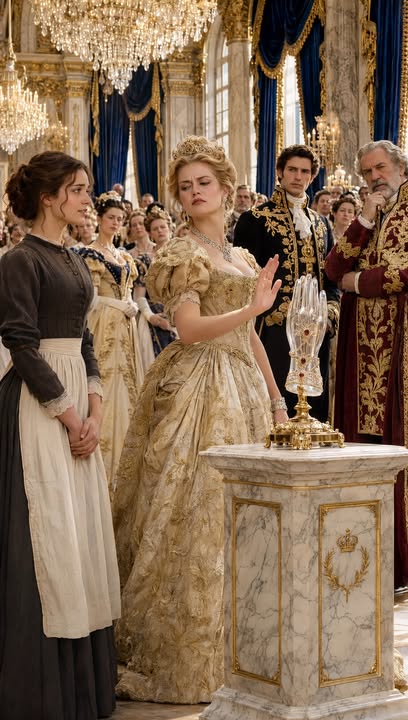
The drawing showed the crystal glove atop its marble pedestal, but the tiny image was blurred where the golden vine curled around the base.
She leaned closer to the paper, searching for a mark she might have overlooked.
There was no explanation, no name, and no hint of what her mother had wanted her to find.
Only the glove, the vine, and the small break in its pattern.
Emily folded the paper again, more carefully than before, and slipped it back into the pendant.
She had spent years believing the keepsake held nothing but memory.
Now it seemed to contain a question her mother had carried to her grave.
The next morning, Emily waited until the servant corridors were busy before seeking out Prince Alexander.
She had no wish to attract notice, but the secret had grown too heavy to keep entirely to herself.
When she found him in the palace library, he was standing beside a tall shelf of royal histories, a book open in his hands.
He looked up as she entered, and the warmth in his expression was quickly replaced by concern.
“Is something wrong?”
“I found something in my mother’s pendant,” Emily said.
Alexander closed the book without marking his place.
“May I see it?”
Emily hesitated.
The pendant had been hers since childhood, and the paper inside it was the last message her mother had left.
She did not want it handled carelessly, or turned into another matter of royal importance.
“I’ll show you the writing,” she said, “but I would rather keep the pendant with me.”
“Of course.”
She drew the pendant from beneath her collar and opened its hidden seam.
Alexander bent close enough to read the note without touching it.
His brow furrowed as he studied the small drawing.
“Your mother knew the glove existed.”
“She must have.”
“And she wanted you to find a break in the vine.”
Emily nodded.
“Do you know where the glove is now?”
“In the west vault, or so I was told.”
Alexander’s gaze lifted from the note to her face.
“My father ordered it sealed away after the ball.”
“Then we should not go there.”
“I agree,” he said, though the disappointment in his voice suggested he had hoped for a different answer.
Emily closed the pendant.
“If we begin searching without permission, it will become another reason for the court to say I am trying to gain something.”
“You’re right.”
“I don’t want people thinking I made the glove shine because I wanted to marry you.”
His expression changed, and for a moment he seemed to be choosing his words with care.
“Neither do I.”
“I know you don’t,” Emily said. “But they may decide that for us.”
Alexander set the history book aside.
“Then we should be careful not to give them a story they can twist.”
“I want to understand what my mother knew,” Emily replied. “I don’t want the glove to decide my life.”
“It should never have been asked to.”
The answer came quietly, but with such certainty that Emily felt herself loosen slightly.
Alexander had grown up surrounded by rules that treated marriage as a matter of succession.
Yet he spoke as if the rule itself could be questioned.
She wondered whether he had always felt this way, or whether the events of the ball had changed something in him.
“I may be able to find old records about the glove,” he said. “If there is a description of the pedestal, it might tell us where the vine is broken.”
“Your father told us not to discuss the incident.”
“He told you not to discuss it with the servants or guests.”
“That sounds like a distinction you made for yourself.”
A rueful smile touched his mouth.
“It does.”
Emily could not help smiling back.
“If we do this, we do it quietly,” she said. “And if it starts to feel as though you are deciding for me, I will leave.”
“I would expect nothing less.”
The warmth between them lingered for a moment, then footsteps sounded in the corridor beyond the library.
Emily returned the pendant beneath her dress.
Alexander opened the book again, and she crossed toward a table as if she had come to consult a volume of her own.
Lady Victoria entered with two young noblewomen at her side.
Her gaze moved from Alexander to Emily, then to the open books.
“What a scholarly morning,” she said, her smile bright enough to conceal its edge. “I had no idea the library had become so popular among the staff.”
Emily’s cheeks warmed.
“I was looking for a book on household accounts,” she answered.
“Of course.”
Lady Victoria’s attention shifted to Alexander.
“Your Highness, I was hoping to speak with you about the ball.”
“Then perhaps we can speak later,” he said.
“I would not want to interrupt.”
“Then you are fortunate.”
The two ladies accompanying Victoria exchanged startled glances.
Victoria held her smile, but her eyes had hardened.
“Certainly,” she said. “Later, then.”
She turned and swept out of the library, her companions following.
Emily waited until the doorway was empty.
“She knows there is more between us than books,” she murmured.
“Does she?”
“She knows enough to look for it.”
Alexander shut the volume again.
“Then we should be more careful.”
Emily was not sure whether he meant their investigation, their conversations, or the growing ease she felt whenever he was near.
She left the library first, carrying an account ledger she did not need.
For the next several days, she and Alexander searched for answers without appearing to search at all.
He consulted the palace librarian about the history of the glove, while Emily asked the housekeeper whether any old royal inventory books had been sent to the linen rooms for repair.
Their questions were small and reasonable.
Still, the palace was a place where small questions rarely stayed small.
By the end of the week, Emily noticed that conversations stopped when she entered a room.
A footman who had once greeted her cheerfully now looked away.
One afternoon, she passed Lady Victoria in the gallery and heard her say, “A little attention can make a person forget where she belongs.”
The words were not loud, nor were they addressed to Emily.
That made them harder to answer.
Emily kept walking, though the familiar ache of humiliation followed her down the corridor.
She began to wonder whether Alexander’s kindness was the reason she had become a subject of gossip.
Or whether she had misread it and the court simply saw her as an opportunity to be watched.
The thought unsettled her more than she wanted to admit.
That evening, Alexander found her in the palace garden, where she was gathering fallen leaves from the path.
He had changed out of his formal coat and carried no papers or books.
“I heard what Victoria said,” he told her.
Emily did not look up from the leaves.
“She did not say anything that was untrue.”
“I doubt she knows enough to say what is true.”
“She knows I am a servant and that you are a prince.”
“That is not the whole truth.”
“It is the part everyone can see.”
Alexander paused beside the low stone wall.
“Do you think I have been kind to you because of the glove?”
Emily’s hands stopped moving.
“I don’t know.”
He looked pained, but he did not protest.
“I don’t want you to feel that you owe me trust because I defended you once.”
“I don’t.”
“Good.”
Emily placed the gathered leaves in her basket.
“But I do wonder whether you would have noticed me if I had not touched the glove.”
The question remained between them, more vulnerable than she had meant it to be.
Alexander glanced across the garden, where late-season roses clung stubbornly to the trellis.
“I noticed that you were treated unfairly before the glove ever shone,” he said. “But I cannot claim I understood you.”
“That is not the same as knowing me.”
“No,” he answered. “It isn’t.”
He did not try to make the truth easier.
Somehow, that mattered more than a comforting promise would have.
Emily looked up at last.
“I don’t want to be someone’s answer to a problem they have not even explained.”
“I would never ask you to be.”
“You might not ask. The court might.”
“Then I will tell the court no.”
His words were sincere, but they could not yet quiet her fears.
Before she could reply, the garden door opened.
Lady Victoria stepped outside, her pace measured and unhurried.
She had evidently seen them together.
“Your Highness,” she said, bowing just enough to show that she knew the proper form. “The king is asking for you.”
Alexander’s expression cooled.
“Did he say it was urgent?”
“He asked that you come now.”
He looked toward Emily, but she had already lifted her basket.
“I should return to the kitchens,” she said.
“I’ll speak with you later,” Alexander replied.
“If it is sensible.”
The words were meant for both of them.
Lady Victoria watched Emily go, her face as composed as a painted portrait.
“Do you believe I am trying to harm her?” Alexander asked.
Victoria’s eyes widened with practiced innocence.
“Why would I?”
“Because you keep appearing wherever she is.”
“I live here,” Victoria said. “As you do.”
“That is not an answer.”
For the first time, her smile faltered.
“I am concerned for you,” she said. “And for the kingdom.”
“Emily is not a threat to either.”
“I hope you are right.”
Alexander looked at her carefully.
“So do I.”
He left the garden without waiting for her reply.
That night, the palace archivist sent a message to the prince’s rooms.
A retired clerk named Mr. Finch had found a reference to the glove in an old inventory, but he needed help locating the volume.
Alexander asked him to bring the record to the library the next morning.
Emily was not included in the request.
Still, when she brought a tray of tea to the library, Mr. Finch was already there, surrounded by dust-covered ledgers.
He was a careful, soft-spoken man with silver hair and ink stains on his cuffs.
“Your Highness,” he said, pushing a narrow book across the table. “I believe this is what you asked for.”
Alexander glanced at Emily.
“She may stay, if you don’t mind.”
Mr. Finch looked at her with mild curiosity.
“Not at all.”
Emily set down the tray.
The book’s cover bore the year 1779 in faded gold lettering.
Inside, lines of careful script recorded the furnishings and objects kept in the old royal chapel.
Alexander turned the pages slowly until Mr. Finch pointed to an entry in the margin.
“The glove was first brought into the palace during Queen Eleanor’s reign,” the archivist said. “The pedestal is described here.”
He read aloud.
“A square of pale marble, set with a single gold vine encircling the base, broken at the eastern side to admit a key.”
Emily’s hand went to the pendant beneath her collar.
The vine was broken.
“What sort of key?” Alexander asked.
“The record does not say.”
“Could the pedestal itself still be in the west vault?”
“Possibly,” Mr. Finch replied. “The inventory lists it separately from the glove, though later records become unclear.”
Alexander looked at Emily.
“Your mother’s note may refer to the pedestal.”
“It sounds as though it does.”
Mr. Finch leaned closer to the book.
“There is one other entry, from a much later inventory. The pedestal was moved from the chapel to the ballroom during the restoration of 1792. The description mentions a shallow recess beneath the eastern vine.”
“Could the pendant fit in it?” Alexander asked.
“We would have to see the pedestal.”
The archivist closed the ledger.
“I can request permission to examine the vault records, but not the vault itself.”
“Please do,” Alexander said.
Emily felt the plan taking shape, but with it came a renewed unease.
If the pendant belonged to the pedestal, then her mother had known something about the palace’s private history.
Why had she never told Emily more?
The answer might have been hidden in the palace for years, while the court had lived above it without noticing.
After Mr. Finch left, Alexander walked with Emily as far as the servants’ stair.
“Do you want to go on?” he asked.
“I want to know what my mother meant.”
“That is not the same as wanting to know everything the palace might uncover.”
“No,” Emily said. “It isn’t.”
She looked down at the stone steps.
“If the answer changes how people see me, I need to be ready for that.”
“Then we will not rush.”
Emily met his gaze.
“We?”
“If you want me beside you.”
For a moment, she could not find a reply.
It was not a grand declaration, and it did not ask her to trust him blindly.
It was simply an offer.
“Yes,” she said at last. “For now.”
The next afternoon, Mr. Finch returned with a narrow folder.
His expression was troubled.
“The inventory records are incomplete,” he told Alexander. “But I found something else.”
He opened the folder to reveal a thin sheet of paper, its edges browned with age.
“This is a service list from the winter of 1792. It names the attendants who were present during the restoration.”
He placed the page beside the old ledger.
Emily recognized the name at once.
Anne.
The ink was faded, but the letters were clear.
“Was my mother employed here?” she asked.
Mr. Finch peered at the page.
“It appears so.”
“Under what name?”
“Anne Bell,” he said. “She was listed among the household attendants for several years.”
Emily felt the room tilt slightly.
Her mother had told her little about her life before Emily was born.
She had said only that she had worked in several households and had once lived near the coast.
“Could it be another Anne?” Emily asked.
“Certainly,” Mr. Finch replied. “It is not an uncommon name.”
The caution in his voice should have comforted her.
Instead, it made the discovery feel more ominous.
Alexander studied the page.
“Is there any record of when she left?”
Mr. Finch searched the folder and found another narrow entry.
“Her service ended abruptly in the spring of 1798. No reason was given.”
Emily’s throat tightened.
She had never known that her mother had served at court.
If Anne had worked in the palace, she might have seen the glove, learned its history, and copied the design into Emily’s pendant.
But why had she hidden all of it?
A quiet knock sounded at the library door.
Lady Victoria entered without waiting for an invitation.
Her gaze settled on the paper before Mr. Finch could cover it.
“Anne Bell,” she read. “How curious.”
Alexander stood.
“This is a private archive.”
“I did not realize names in an old service list were private.”
“They are when they concern Emily’s family.”
Victoria glanced at Emily, and for once her composure seemed less certain.
“I did not know your mother had served here.”
“Neither did I,” Emily said.
Victoria’s eyes lingered on the drawing of the glove.
“You see, this is precisely what I feared.”
“What do you mean?” Alexander asked.
“I mean that there is clearly a connection between Emily’s family and the glove, and no one knows what it is.”
“That does not make her dishonest,” Alexander replied.
“I did not say it did.”
“You suggested as much in the garden.”
Victoria looked down at the record.
“I suggested only that the court should be careful.”
Emily felt her face warm.
“Careful of what?”
Victoria’s expression softened, though Emily could not tell whether the change was sincere.
“Of turning you into something you are not. The nobles will see a possible bride, a possible claimant, perhaps even a convenient answer to some old royal difficulty. They will ask you to stand where they place you.”
“And you think I am trying to get there?” Emily asked.
“I think you may not understand what is being set in motion.”
For a moment, Emily saw not triumph in Victoria’s face, but worry.
It did not excuse her earlier remarks, yet it made the woman harder to dismiss as merely cruel.
“I don’t want a place anyone else has chosen for me,” Emily said.
Victoria held her gaze.
“Then I hope you remember that when the palace begins offering one.”
She turned to Alexander.
“Your father is waiting for you.”
Alexander’s jaw tightened.
“Did he send you?”
“No,” Victoria said. “I came to find you.”
She left without another word.
The library seemed quieter after she was gone.
Alexander looked as though he wanted to follow her, or perhaps to argue with the warning she had left behind.
Emily turned back to the service list.
Her mother’s name sat among the records of the palace as if it had been waiting there all along.
“Mr. Finch,” she said, “could you search for other entries under Anne Bell?”
“I can try.”
“And if there are none?”
“Then we may have to look for records filed under another name.”
Alexander’s attention sharpened.
“Why another name?”
Mr. Finch hesitated.
“Household servants were sometimes recorded under a shortened surname, especially if they transferred from another estate.”
Emily folded her hands to keep them from trembling.
“Would there be a reason to change a name?”
“Many reasons,” Mr. Finch replied. “Marriage, travel, family circumstances. Or simple clerical error.”
He spoke as if trying to reassure her, but his eyes had already returned to the page.
Alexander stood beside her, close but not touching.
“Whatever we find, it does not change who your mother was to you,” he said.
Emily wanted to believe that.
She wanted the past to remain something she could carry without it becoming a claim, a scandal, or a question of blood.
Yet the palace had begun answering questions she had never known to ask.
Before Mr. Finch could gather the papers, the library door opened once more.
This time, the visitor was King Edward.
His gaze moved from the records to the pendant hidden beneath Emily’s collar, as if he could somehow see the drawing inside it.
“Mr. Finch,” he said, “leave us.”
The archivist bowed and gathered his folders.
Alexander stepped forward.
“Father, Emily has a right to know what these records say.”
“I am aware of what she has a right to know.”
“Then why have you forbidden the search?”
King Edward’s eyes rested on the old service list.
“Because some doors were closed for reasons that have not disappeared.”
Emily felt the words like a chill.
“Did you know my mother worked here?” she asked.
The king was silent for long enough to make the answer plain.
“I knew of an attendant named Anne.”
“Was she the same woman?”
“I cannot tell you that.”
“Can you not, or will you not?”
Alexander looked sharply at Emily, but King Edward did not rebuke her.
Instead, he seemed suddenly older than he had in the ballroom.
“I will not pretend that the past is harmless,” he said. “You must stop looking into it.”
Emily thought of her mother’s note.
Find the place where the vine is broken.
She thought of the words glowing in the glove, and of Alexander’s promise that she would not be forced into an answer chosen by the court.
“I can’t stop,” she said quietly. “Not while my mother’s name is part of it.”
King Edward’s face tightened.
For the first time, Emily saw not anger in him, but fear.
“Then you should ask yourself,” he said, “whether the truth you seek is worth what it may ask of you.”
He turned toward the door.
Before he left, his eyes met Alexander’s.
“Do not help her find what I have spent years trying to keep buried.”
The door closed behind him.
Emily looked down at the service list, where her mother’s name remained in faded ink.
Beside it, Mr. Finch had left a single reference number, meant to point to another volume.
The archivist returned at a quick step, his face pale with discovery.
“Your Highness,” he said, laying a second record on the table. “I found the transfer entry.”
Alexander opened the book.
The name Anne Bell appeared again, followed by a note written in a different hand.
Emily leaned close enough to read it.
“Removed from household service by order of the Queen,” she whispered.
Beneath the sentence, someone had added a name in the margin.
Not Bell.
Not Anne.
A royal name, written in full.
“Princess Anne Eleanor.”
**–END OF PART 3–CLICK “NEXT” AT THE BOTTOM OF THE PAGE TO CONTINUE READING**
* * *
[PREVIOUS: PART 2](https://storyly.idolsgift.com/blog/part-2-the-voice-in-the-crystal-052) | [NEXT: PART 4](https://storyly.idolsgift.com/blog/part-4-the-voice-in-the-crystal-052)
✓ Lynn R. Adams
Part 3 – Clues in the Palace Emily stared at her mother’s sentence until the ink seemed to shift beneath her gaze. “Find the place where the vine is broken.” The drawing showed the crystal glove at…