PART 3: The Village Beneath the Paper 056
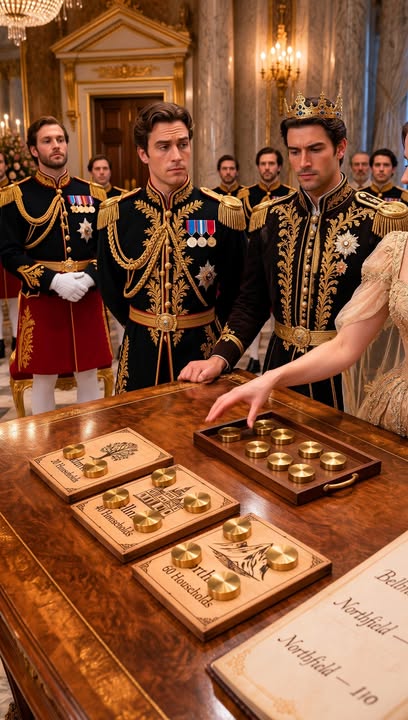
Part 3 – The Names on the Receipt
The word boundary rested between them like a line drawn across the table.
For several moments, no one in the chamber spoke.
Then Prince Adrian folded the old folder closed, gently, as if the paper might bruise beneath his fingers.
“Mr. Vale,” he said, “you told us you did not know why Reedbank had been removed.”
“I told you I did not know who removed it, Your Highness.”
The steward’s careful distinction made the protagonist look up.
Adrian’s expression tightened, though his voice remained calm.
“Did you know the village had been removed?”
The steward’s eyes moved briefly to the faded ledger.
“I knew the name had disappeared from the current records.”
“That is not the same answer.”
“No,” Mr. Vale said. “It isn’t.”
The answer carried no defiance, only the fatigue of someone who had been holding a truth in an awkward place for too long.
The noblewoman stepped away from the map.
“Then why did you say you could not recall?”
“Because I could not recall when I had first seen the name,” the steward replied. “Not because I had never seen it.”
The protagonist felt the room’s attention shift toward him.
“Had you seen it in the old register?” she asked.
“Years ago, while checking boundary accounts.”
“Did you know Reedbank was a village?”
“I knew it had been called one.”
The words were measured, but their meaning was not.
Adrian’s hand rested on the closed folder.
“And you did not think the council should know?”
“I thought the matter had been settled before my appointment.”
“Settled by whom?”
Mr. Vale looked down.
“I cannot say with certainty.”
The prince seemed to take in the answer, then the hesitation that had shaped it.
“You may go,” he said. “But I will ask you to bring every boundary record you can find in the morning.”
The steward bowed.
“I will do so.”
He turned toward the doors, then paused.
“Your Highness, the old account may have been separated for a reason that was not improper.”
“I hope that is true,” Adrian replied.
Mr. Vale left without another word.
The room felt larger after he was gone, though nothing in it had moved.
The noblewoman stood with her hands clasped before her, her attention fixed on the map’s pale northern margin.
“I thought the land was empty,” she said.
“You said that before,” the protagonist replied.
“I know.”
The woman’s voice had lost its earlier polish.
She looked at the blank stretch of map, then at the faded note.
“My family has kept boundary papers for generations. The northern plots were often discussed in connection with the river flood.”
“Discussed how?” Adrian asked.
“Usually as a question of where the river had moved and which fields remained usable.”
“And Reedbank?”
“I don’t remember hearing that name.”
The protagonist watched her face.
The noblewoman did not appear to be choosing a convenient answer.
She looked unsettled by her own uncertainty.
“If the people left, my family believed they had gone east,” she added. “There are old records of households seeking work near the stone road.”
“Did anyone confirm they had all left?” the protagonist asked.
“No.”
The quiet admission seemed to surprise the noblewoman as much as it did the others.
She drew a breath and smoothed one gloved hand over the side of her gown.
“I was taught that the settlement did not survive the flood,” she said. “I never thought to ask who had taught it to me.”
“Beliefs can become records when no one questions them,” Adrian said.
She turned toward him.
“And records can become beliefs.”
For a moment, the two of them regarded each other without the old certainty that had defined their exchange earlier.
The protagonist understood that neither had been born knowing what the map concealed.
Yet knowledge, once discovered, would make a different demand of each of them.
The noblewoman’s family held land near the disputed border.
The prince’s family had maintained the royal records.
And the protagonist stood between them with no title to protect her from either history.
A knock sounded at the chamber door.
The chief clerk entered with a short stack of papers and a breathless look.
“Your Highness, the first carts are being prepared,” he said. “The storehouse can send blankets to the three villages before sunrise.”
“Good,” Adrian replied. “Have the village heads identify households with the most urgent need, and send the riders north as soon as the road is safe.”
“The road may be passable by dawn.”
“Then they leave at dawn.”
The clerk nodded and placed the papers on the table.
Among them was a list of available supplies and a copy of the first delivery order.
The protagonist studied the order.
It divided the blankets among the three villages according to immediate need rather than household totals, with a reserve set aside for the missing settlement.
It was not the neat answer the contest had demanded.
It was a beginning.
“Could the riders carry extra blankets?” she asked.
“They can take a small bundle,” the clerk said. “More than that would slow them on the northern road.”
“Then send enough for the first families they find,” she said. “If Reedbank is there, the people should not have to wait for another message from the palace before receiving anything.”
Adrian looked over the order.
“Make it so.”
The clerk added the instruction in the margin.
The noblewoman watched him write.
“Are you certain the old road is safe enough?” she asked.
“No,” Adrian said. “That is why the riders will travel first and the carts will wait for their report.”
The answer was practical, but his eyes had returned to the seal on his mother’s letter.
He seemed caught between the confidence of a prince accustomed to giving instructions and the unease of a son who had found an unfinished promise among his mother’s papers.
The protagonist wanted to tell him that a careful first step was still a step.
Instead, she gathered the loose sheets before the candle’s heat could curl their edges.
A second knock came, softer than the first.
A palace attendant entered carrying a narrow wooden box.
“Your Highness,” she said, “this was found in the late queen’s winter accounts cupboard. The archivist thought you might wish to see it.”
The box was plain oak, with a small brass clasp darkened by age.
Adrian’s attention sharpened.
“Was it locked?”
“No, Your Highness.”
The attendant placed it on the table and withdrew.
Inside lay several packets of correspondence, tied with faded blue thread.
The prince touched the top packet but did not untie it at once.
The protagonist noticed the pause.
“You needn’t read everything tonight,” she said.
“I know.”
His hand remained on the thread.
“I’m not sure I know what I’m looking for.”
“Then perhaps begin with what she wanted remembered.”
He looked at her, and the tension in his shoulders eased a little.
Together, they opened the first packet.
It contained notes from the queen’s household concerning provisions after the flood.
There were lists of blankets, flour, lamp oil, and medicines.
Several pages mentioned families living near the river, though none named Reedbank directly.
The noblewoman leaned in to examine a small notation in the margin.
“This says the north crossing was unusable,” she said. “The date matches the flood season.”
“Could the crossing have been the reason the settlement vanished from the map?” the protagonist asked.
“It could explain why people moved,” Adrian said. “It does not explain why the name was crossed out.”
He opened another packet.
The documents inside were mostly receipts and household accounts, each marked with dates and sums.
The protagonist helped sort them into piles while the noblewoman read the older place names aloud.
It was quiet, methodical work, but the papers began to tell a scattered story.
A shipment had gone north after the river rose.
A local carpenter had been paid to repair a footbridge.
A physician had been sent to treat families with fever.
The queen’s office had continued to send supplies for months after the flood.
Then the entries stopped.
The prince held the last receipt in the stack.
“Here,” he said. “There’s a final delivery listed at the end of winter.”
The paper was creased down the middle and stained at one corner.
It named bundles of blankets and sacks of flour, then gave a total cost.
At the bottom, a signature had been written in a narrow, sloping hand.
The protagonist looked at it once, then again.
Her breath caught.
The name was her mother’s.
For a heartbeat, the chamber disappeared around her.
She saw instead the little kitchen where she had grown up, her mother’s hands folded over a cup of tea, the old travel case beneath the bed with its broken clasp.
She remembered being told that the journeys north had been to help a cousin after the flood.
The memory had always seemed too small to ask about.
“What is it?” Adrian asked.
The protagonist could not answer immediately.
She reached for the receipt, then stopped before touching it.
“That’s my mother’s signature.”
The prince’s expression softened.
“Are you sure?”
“Yes.”
Her voice sounded distant to her own ears.
She had seen the signature on birthday cards, school forms, and letters tucked away after her mother died.
There was no mistaking the long sweep of the first letter or the small mark beneath the final one.
The noblewoman leaned closer, then drew back as if she had intruded on something private.
“You knew she went north?” Adrian asked gently.
“No. I knew she traveled after the flood, but I thought it was to visit family.”
The prince studied the paper.
“Do you know why she might have signed a royal receipt?”
“No.”
She pressed her fingertips together.
Her mother had spoken of the flood sometimes, but never as a story of heroism or secret work.
She remembered only practical details: the mud, the ruined pantry, the way the river sounded at night.
Her mother had never told her that she had carried supplies for a village the palace would later stop counting.
The protagonist felt pride rise beside grief, and neither feeling had room to settle.
“I wish I’d asked her,” she said.
“Perhaps she had reasons for not telling you,” Adrian replied. “Or perhaps she thought there would be time.”
The words were kind, and they made her chest ache more sharply.
The noblewoman had gone very still.
“Your mother carried supplies to Reedbank?” she asked.
The protagonist looked at the receipt again.
“It says the delivery went north after the flood. It doesn’t name the village.”
“But the notation is beside the same account.”
“The connection is likely,” Adrian said. “It is not yet certain.”
The careful distinction steadied her.
She was grateful he did not turn her mother’s signature into proof before they knew what it meant.
The noblewoman’s fingers curled around the edge of the table.
“My family’s estate lies near the old northern boundary,” she said. “If the delivery route crossed our land, someone there might have known.”
“Would they have recorded it?” Adrian asked.
“They should have.”
“Should have is not the same as did.”
“No,” she said. “It isn’t.”
She lowered her gaze to the receipt.
“I’ve spent years hearing that people beyond Northfield abandoned the valley. I never wondered who had helped them leave, or whether they had wanted to.”
The protagonist looked at her.
The noblewoman did not meet her eyes.
The old sharpness between them had thinned, but it had not disappeared.
Perhaps it was not possible to set aside an insult merely because its speaker had begun to doubt herself.
The woman seemed to understand that.
“I was wrong to speak to you as I did,” she said. “About your appearance. And about assuming the answer before we had looked.”
The protagonist let the apology stand between them for a moment.
“I heard what you said.”
“I know.”
“I won’t pretend it didn’t matter.”
The noblewoman swallowed.
“I would not ask you to.”
The honesty in that answer changed the silence.
The protagonist glanced toward the prince.
He had not intervened or softened her words on her behalf.
Instead, he watched the noblewoman as if he understood that an apology mattered most when no one was forced to accept it.
The protagonist looked back at the woman.
“Then ask better questions now,” she said.
The noblewoman nodded.
“I will try.”
It was not forgiveness.
It was a door left unlatched.
Adrian placed the receipt beside his mother’s letter.
“Your mother may have known where the supplies went,” he said. “Is there anyone in your family who might have kept her papers?”
“Her sister may have a box of them,” the protagonist replied. “I can write to her.”
“Do you remember your mother mentioning Reedbank?”
“No. But she might have used another name.”
“Could the receipt tell us more if we compare its marks to the ledger?” the noblewoman asked.
The protagonist leaned over the page.
A faint line of numbers ran along one edge, partly obscured by a fold.
“R.B.—thirty,” Adrian read. “The same notation as the earlier slip.”
She looked carefully at the signature.
Beside it, a small initial had been added in darker ink.
“Could that be the person who received the delivery?” she asked.
The noblewoman bent closer.
“It looks like an M.”
“Or an N,” said Adrian.
The protagonist turned the paper slightly to catch the light.
A second letter emerged after it, faint but distinct.
“V,” she said.
The prince’s eyes moved to the two letters.
“MV?”
The noblewoman’s composure changed.
Not dramatically, but enough for the protagonist to notice: her mouth parted, and her gaze shifted from the receipt to the old map.
“My family’s boundary records were kept by a surveyor named Martin Voss,” she said. “He worked for my grandfather after the flood.”
The prince glanced at her.
“Could he have received the delivery?”
“I don’t know. He was not a village official.”
The noblewoman looked again at the initials.
“But he was sent to mark the new river line.”
The phrase new river line seemed to bring the map into sharper focus.
The protagonist thought of the empty space north of Northfield, the old road that no longer appeared on the current chart, and the words pressed into the folder flap.
Keep the northern account separate until the boundary is settled.
“Was Martin Voss involved in the boundary dispute?” she asked.
“He prepared a survey for my grandfather,” the noblewoman said. “I have seen his name on estate copies.”
“Do you know what the survey concluded?”
“No. Only that the boundary was revised.”
The prince’s attention remained on the initials.
“Do you have copies of those records?”
“Some are at our house. Others are held in the estate office.”
“Could you request them?”
The noblewoman’s gaze dropped to the map.
“I can.”
The word was simple, but the difficulty beneath it was not.
Her family’s papers might reveal that Reedbank stood on land they now claimed.
If she asked to see them, she might uncover a reason her relatives had kept the old story intact.
“If the records contradict what my family believes,” she said, “I will need to read them before I can say what they prove.”
“That is fair,” Adrian replied.
She looked at him, perhaps expecting pressure.
He gave her none.
“I will write tonight,” she said. “I can ask for the old survey and the correspondence surrounding it.”
The protagonist felt a flicker of respect for her.
The woman was not yet ready to condemn her family, and perhaps no one should have demanded that she do so on the strength of two letters.
But she had agreed to look.
That mattered.
The chief clerk returned with a message from the storehouse.
The carts were packed, the first blankets ready to depart at dawn, and the riders had been found.
Adrian signed the order.
When the clerk left, the protagonist gathered the papers for safekeeping.
The receipt stayed on the table.
She read her mother’s signature again, slower now, as though the shape of it might answer a question.
“I used to think she kept those journeys from me because she was protecting me from worry,” she said.
“Perhaps she was,” Adrian replied.
“Or perhaps she thought the work was too ordinary to mention.”
The prince considered that.
“Sometimes the things that matter most look ordinary while we are doing them.”
She looked at him.
The queen’s small promise, made in a note about blankets, had survived while the village itself had disappeared from the public account.
Her mother’s signature had survived on a receipt no one had looked at in years.
History had not been preserved in a grand hall.
It had been held together by the hands of people who carried supplies, folded paper, and wrote down a name.
The noblewoman gathered her gloves from the table.
“I should send my message to the estate office before the household closes for the night.”
The prince nodded.
“Ask them to send the records as soon as they can. We will make copies and return the originals.”
“I will.”
She turned to the protagonist.
“I’m sorry,” she said again, quieter than before. “Not because the prince corrected me, and not because the room was watching. I should have known better than to measure you by an appearance.”
The protagonist met her gaze.
“Then don’t do it again.”
“I won’t.”
The noblewoman left with her shoulders no longer held quite so rigidly.
Adrian watched the door close.
“She has not decided what her family’s papers mean,” he said.
“She may be afraid of what they mean.”
“So are you.”
The observation caught her off guard.
She looked down at her mother’s signature.
“Yes,” she said. “I am.”
The prince did not tell her there was nothing to fear.
Instead, he moved the receipt nearer to her, careful not to cover the name.
“You don’t have to make sense of it tonight.”
“I know.”
“But you may ask me to help.”
She looked up at him.
There was no formal charm in his face, no courtly performance.
Only an invitation offered without expectation.
“Thank you,” she said.
He gave a small nod and turned toward the windows, where the snow continued to blur the gardens.
The protagonist began gathering the documents for the archive clerk.
As she lifted the old survey note from the folder, something slipped from its folded edge and landed against the table.
It was a narrow strip of paper, almost transparent with age.
The prince turned at the sound.
“What is it?”
She opened the strip carefully.
A line of writing had been penned across it in a hand different from the queen’s.
The ink had faded, but the words remained clear enough to read.
“Boundary witness: Martin Voss.”
Beneath the name was a second entry, written in a sharper hand.
“Households removed from public roll pending settlement.”
The protagonist’s breath stalled.
The prince came closer, his face suddenly intent.
“Removed by whose order?”
The strip had been torn just below the final line.
Where the signature should have been, only the ragged edge remained.
**–END OF PART 3–CLICK “NEXT” AT THE BOTTOM OF THE PAGE TO CONTINUE READING**
* * *
[PREVIOUS: PART 2](https://storyly.idolsgift.com/blog/part-2-the-village-beneath-the-paper-056) | [NEXT: PART 4](https://storyly.idolsgift.com/blog/part-4-the-village-beneath-the-paper-056)
✓ Lynn R. Adams
Part 3 – The Names on the Receipt The word boundary rested between them like a line drawn across the table. For several moments, no one in the chamber spoke. Then Prince Adrian folded the old folde…