PART 3: The Truth He Couldn’t Outrun 056
Part 3 – The Missing Page
“I’m listening,” I said.
On the other end of the line, Luis took a slow breath.
“I don’t know what was on that page,” he said. “Elena drew all the time. Maybe she tore it out herself.”
“Did she ever do that?”
“When she was unhappy with a picture, yes. She’d crumple it up and start again.” His voice softened. “But this time, the edge was clean. It looked as if someone had removed it carefully.”
I looked at the account book open on my desk.
“Did the police see the sketchbook?”
“They looked through her things. I told them it was there, but I didn’t notice the missing page until later. I didn’t think it mattered.”
“It matters now.”
“Maybe.” He paused. “I don’t want you to turn this into something it isn’t.”
“I won’t.”
“You have a way of making everything into business.”
The words weren’t meant to wound, but they found a tender place.
“I know,” I said.
“I’m not asking you to find someone to blame. Marco has already told us what he did.”
“I understand.”
“Do you?” Luis asked, then seemed to regret it. “I’m sorry. I haven’t slept much.”
“You don’t need to apologize.”
He was quiet for a moment.
“I’ll bring the sketchbook to the police tomorrow,” he said. “I should have done it sooner.”
“I’ll make sure they know you’re coming.”
“No.” His answer came quickly. “I can speak to them myself.”
“All right.”
The line stayed open a few seconds longer, filled only by the faint sound of his breathing.
Then he said, “Good night.”
“Good night, Luis.”
When the call ended, I left the receiver in its cradle and sat still beneath the desk lamp.
The missing page might have been nothing. A child’s discarded drawing, lost between a schoolbag and a funeral home, could become a mystery simply because everyone was desperate to find something they could understand.
But Luis had said the edge was clean.
I closed the account book and carried it into the hall.
Tony was standing by the kitchen doorway, listening to the house settle around us.
“Marco asleep?” I asked.
“He’s in the guest room. I don’t think he’s sleeping.”
“Did he say anything about the sketchbook?”
Tony shook his head.
“Did you know he was driving that night?”
“No.”
His answer came without hesitation, but his face held the strain of the day.
I had known him nearly as long as I had known Marco. He had helped me through years when every decision seemed to carry a second decision beneath it. He had watched friendships become obligations and obligations become habits.
I trusted him, but trust had changed shape since the chapel.
“Do you think Marco took the page?” I asked.
“I don’t know.”
“Would he have kept something from the scene?”
Tony glanced toward the closed guest-room door.
“Maybe he couldn’t bear to throw it away.”
“That doesn’t make it right.”
“No.”
Tony’s agreement was quiet and tired.
A few minutes later, I heard a door open at the end of the hall.
Marco appeared, dressed in the same dark clothes he had worn to the funeral, his face drawn from sleeplessness.
“Can I speak to you?”
I nodded toward the kitchen.
Tony stayed where he was, but Marco looked at him.
“Alone, if that’s all right.”
Tony studied him, then turned toward the living room without comment.
Marco sat at the table. I poured him a glass of water, and this time he drank.
“Luis called,” I said.
Marco’s shoulders tightened.
“He told you?”
“He told me Elena had a sketchbook. One page is missing.”
Marco lowered the glass.
“Did the police take it?”
“They saw the book. Luis is bringing it to them tomorrow.”
Marco rubbed his thumb along a small crease in the tablecloth.
“Do you know anything about the missing page?”
“No.”
He answered too quickly, then looked at me as if he had heard it himself.
“I mean, I didn’t take it.”
I held his gaze.
“Were you aware it was missing?”
“No.”
The silence after that answer was longer.
Marco seemed to be waiting for me to challenge him, and I was waiting to decide whether I believed him.
At last, he looked down at his hands.
“I should have stopped,” he said.
“You’ve said that.”
“I keep thinking that if I say it enough times, maybe it’ll begin to mean something.”
“It means what you do next.”
He nodded, but his face remained fixed in its sorrow.
“Will you tell the police the whole truth?”
“Yes.”
“Even if it brings them to the rest of our business?”
His eyes lifted.
“I don’t know what else to do.”
“Then you do know.”
He looked away.
For years, Marco had known how to find the path through a room without leaving a mark. He knew which doors to open and which names not to mention. Now every answer seemed to leave him with less ground to stand on.
“I’m not asking you to protect me,” he said. “I’m asking you to protect my wife and my boy.”
“I heard you.”
“I know what I did. I’m not asking you to make it disappear.”
“Your family won’t be harmed by anyone in my organization.”
He let out a breath that sounded almost like a laugh, though there was no humor in it.
“You can’t promise what other people will do.”
“I can promise what I will do.”
“That’s not the same.”
“No,” I said. “It isn’t.”
He stared at the untouched glass.
“They didn’t choose this life,” he said. “My son thinks I work in construction. My wife knows I’ve done things I won’t tell her, but she still believes I can keep the worst of it away from them.”
“You can’t keep consequences from them by keeping the truth from them.”
“I know that now.”
The words came with a weariness deeper than regret.
I thought of Luis’s question from earlier: Do you?
I was beginning to understand that there was no clean answer to it.
“Your wife should hear from you before she hears from someone else,” I said.
Marco’s face tightened.
“I don’t know how to tell her.”
“You start with the truth.”
He looked at me, almost pleading.
“Will you let me call her?”
“After the lawyer speaks with you.”
“I don’t want her to think I’m trying to protect myself.”
“Then don’t.”
He nodded and stood.
At the door, he paused.
“Do you remember the first time you met Elena?”
The question caught me off guard.
“I met her once at the restaurant.”
“More than once, I think.”
I searched my memory and found a blur of the small dining room, Luis behind the counter, a child’s purple shoes beneath a table, a drawing held up with proud hands.
“Maybe,” I said.
Marco gave a small, troubled nod.
“She was a good kid.”
“Yes.”
He looked as if he wanted to say more, but the words did not come.
Then he returned to the guest room and closed the door.
The next morning, I woke before the house was fully lit.
I called the lawyer, who told me he would be there by nine. Then I called the precinct and asked to speak with the detective handling Elena’s case. I gave her Luis’s name and told her he was bringing the sketchbook.
She asked whether Marco would be surrendering.
“He will,” I said.
“Today?”
“When his counsel arrives.”
There was a pause on the line.
“Mr. Moretti, I want to be clear that your assistance doesn’t change what we’ll investigate.”
“It shouldn’t.”
“Your organization may come up.”
“I understand.”
She sounded surprised, though she tried not to show it.
“I’ll speak with Mr. Vasquez when he arrives,” she said. “If there’s a missing page, we’ll document the sketchbook properly.”
“Thank you.”
After I hung up, I went downstairs.
Tony was already in the kitchen, making coffee.
“Luis is coming in this morning,” I told him.
“He said he didn’t want your help.”
“He doesn’t need to come here. He’s meeting the detective.”
“That seems sensible.”
Tony passed me a cup.
Outside the window, the last of the night’s rain slid down the glass. The city looked washed clean, though the streets below remained crowded and gray.
“Do you think the page is connected to Marco?” Tony asked.
“I don’t know.”
“Wouldn’t it be easier if it were?”
I looked at him.
He gave a faint shrug.
“If it’s Marco’s, then the mystery has one answer. If it isn’t, we have to ask who else was there.”
“Someone heard another car,” I said.
Tony’s expression sharpened.
“Who?”
“I haven’t confirmed it yet. I asked a neighborhood contact to find out whether anyone saw anything.”
He frowned.
“You should tell the detective.”
“I will, once I know what the witness actually heard.”
“That’s the kind of judgment that gets mistaken for hiding things.”
He didn’t say it as an accusation. That made it harder to dismiss.
I set down my cup.
“Then I’ll call her now.”
The detective answered on the second ring. I told her I had been informed that a shopkeeper near the collision had heard a second vehicle brake shortly afterward.
“That could mean anything,” she said.
“I know.”
“Do you have a name?”
“Not yet.”
“Get it to me when you do. Don’t question the witness yourself.”
“I won’t.”
The call ended with no warmth, but there had been no hostility in her voice either.
The lawyer arrived shortly before nine. He sat with Marco in the study while Tony and I waited in the hall.
At the end of their conversation, Marco came out looking pale and exhausted.
He had agreed to surrender, though the lawyer had been careful to explain what that meant and what it did not guarantee.
Marco’s wife was on her way to the house.
He stood by the window, watching the driveway.
“She’s going to hate me,” he said.
“She may be angry.”
“I can live with that.”
“Don’t decide what she feels before she tells you.”
He turned from the glass.
“You always think there’s a right way to say things.”
“I think there’s a wrong way to avoid them.”
He gave a small nod.
The knock at the front door came a few minutes later.
Marco’s wife entered slowly, her face pale beneath her coat. She looked first at her husband, then at the lawyer, then at me.
“What happened?” she asked.
Marco took one step toward her.
“I need to tell you something.”
Her eyes settled on him.
“Is this about the trouble you mentioned?”
“Yes.”
“Is our son safe?”
“He is.”
“Is that because you know it, or because you hope it?”
Marco’s expression faltered.
“I’ll do everything I can to keep him safe.”
“That isn’t an answer.”
“No,” he said. “It isn’t.”
She glanced at me.
I could see the question in her face, and I could also see that she did not want me to answer it for him.
The lawyer quietly asked whether she would like to speak privately with Marco.
She nodded, and they went into the study.
Tony waited until the door closed.
“You really believe he can keep his family safe?” he asked.
“I believe he can stop making decisions that put them at greater risk.”
“That’s not quite the same.”
“No.”
The morning passed in careful, uneasy pieces.
The detective arrived with another officer to speak with Marco. The lawyer remained beside him. I answered their questions about when I had learned of his confession and what I knew of his whereabouts before that.
They did not ask me about the organization yet.
They would.
Before noon, Luis called to say he was on his way to the precinct with the sketchbook.
“I can meet you there,” I offered.
“I’m going alone.”
“All right.”
“I don’t want this to become something you manage.”
“I understand.”
“Do you?”
I was silent for a moment.
“I’m trying to.”
His breath came through the phone, weary but not unkind.
“Then let me do this myself.”
“I will.”
He hung up.
I stood for a while by the front window after the call, watching the road.
Bruno came to rest beside me. He had been quiet since the funeral, moving from room to room without his usual restless energy.
When I bent to scratch his neck, he leaned into my hand.
“You haven’t solved anything, have you?” I murmured.
His tail moved once against the floor.
At the precinct, Luis gave the sketchbook to the detective and waited while an officer photographed its pages. He told me this later, after he had called to say the police were keeping it for examination.
“They asked me whether Elena had said anything about the night she died,” he said.
“What did you tell them?”
“Nothing. She didn’t get the chance.”
His voice caught, and I heard him steady himself before continuing.
“I know they have to ask. Still, every question feels like a door closing.”
“I’m sorry.”
“Don’t be sorry for asking what happened. Just don’t ask me to make it easier.”
“I won’t.”
He told me the detective had taken his statement about the missing page and had promised to follow up with the shopkeeper. Luis had also asked for a copy of the report so he could keep track of what was happening.
“I want to know what they find,” he said. “I don’t want anyone deciding I’m too upset to hear it.”
“No one should decide that for you.”
There was a brief silence.
“Marco is there?”
“He’s speaking with the police.”
“Does he know I’m at the precinct?”
“No.”
“Good.”
The call ended gently, but the distance between us remained.
That afternoon, the shopkeeper’s name came through the neighborhood contact.
His name was Peter, and his store stood on the corner near where Elena had been struck. He had told one of the detectives that he heard a car brake, then a second, sharper squeal a few seconds later.
I called the detective and gave her his name and number.
She thanked me, then said, “You should have reported this sooner.”
“I only heard about it this morning.”
“From whom?”
“Someone who knows the neighborhood.”
“Mr. Moretti, I need you to understand that anything affecting this investigation should come directly to us.”
“I understand.”
She paused, then added, “I’m not assuming you’re withholding anything. But there’s already enough for everyone to be careful.”
“I agree.”
The call left me staring at the phone after it ended.
I had spent years believing that if I spoke plainly enough, people would hear exactly what I meant. But plain words carried the weight of the person saying them. A statement from me could sound like pressure even when it was only information.
Tony found me in the study.
“News from the shopkeeper?”
“I gave his name to the detective. He remembers a second car braking.”
“Maybe the driver stopped.”
“Maybe.”
“Or maybe they were on the same street.”
“Maybe.”
Tony crossed his arms.
“You’re trying not to make a story out of a sound.”
“I’m trying not to decide what it means before the police do.”
“Good.”
He sat in the chair opposite mine.
For a time, neither of us spoke.
Then he said, “I used to think there was a difference between the things we did and the people we were.”
“Did?”
“I still do, some days.”
I looked at him.
“Marco’s confession has made it harder?”
“Everything has.” He studied the edge of the desk. “I knew what our work could do to a family. I just kept telling myself that the damage belonged to the people who chose it.”
“And now?”
“Now Luis is sitting in a restaurant that might close, trying to bury his daughter and pay off a debt he never should have carried.”
The words landed between us with a quiet weight.
“I suspended the debt.”
“I know.”
“Offered to cover the funeral.”
“I know.”
“He refused.”
“Of course he did.”
Tony looked up.
“You can’t make a kindness feel like kindness if the person receiving it doesn’t trust where it came from.”
I leaned back in my chair.
“Is that what you think this is?”
“I think it could be. I also think you’re trying to find a way to do something that can’t be fixed.”
Outside, the rain had returned, tapping lightly at the window.
“I don’t know what else to do,” I said.
“Maybe that’s the first honest answer.”
For a while, we listened to the rain.
Near evening, Luis called again.
This time, his voice was different—still tired, but steadier.
“I went to the restaurant,” he said. “I wanted to see if the place was all right.”
“How was it?”
“Exactly as I left it. The chairs were stacked. The lights were off. A neighbor had brought over soup, which I didn’t eat.”
“Have you been able to rest?”
“No.”
“Have you eaten?”
“Some bread.”
I knew better than to tell him what he needed to do.
Instead I asked, “What can I do?”
He let the question sit.
“I’m not ready to answer.”
“All right.”
“But I might call when I am.”
“I’ll be here.”
He drew a breath.
“Bruno was there at the funeral?”
“Yes.”
“I saw him.”
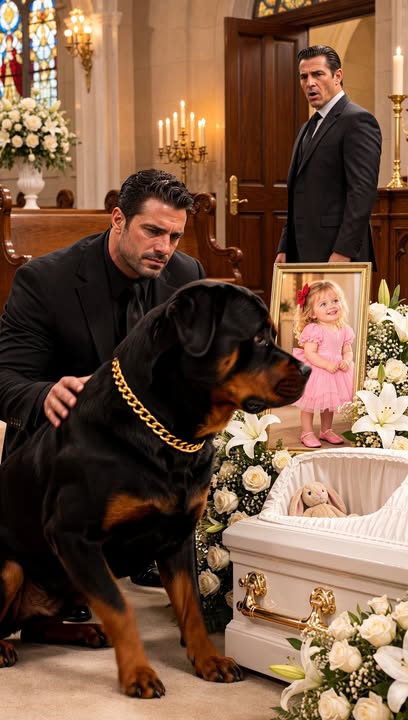
The memory returned to me: Luis kneeling beside the coffin, Bruno curled near the polished wood, his eyes open and watchful.
“He was very quiet after you left,” I said.
“I used to give him scraps when Elena came with me to the restaurant.”
I sat straighter.
“You know Bruno?”
“I don’t know him the way you do. But he used to wait outside the kitchen door. Elena was afraid of him at first because he was so big. Then she decided he looked like a bear who had gotten lost.”
Despite everything, I smiled.
“That sounds like her.”
“She drew him once.” Luis’s voice softened. “I think she had the picture in her sketchbook.”
I glanced toward the window.
“Did she ever show it to you?”
“No. She showed me plenty of drawings, but there were always more. I never knew which ones she kept.”
His pause stretched.
“Maybe it was the missing page,” I said.
“Maybe.”
Neither of us spoke for a few seconds.
Then Luis said, “The police told me they would call if they found something.”
“I’m glad.”
“I don’t know what I want them to find.”
The honesty in his voice seemed to open a space between us, not comfort but something less guarded.
“Neither do I,” I said.
After the call, I went downstairs to find Bruno.
He was in the kitchen, lying near the back door with his chin on his paws. When he saw me, he rose and followed as I crossed to the hall.
Marco’s wife sat alone in the small sitting room. Her eyes were red, but her posture had gone rigid with effort.
“Is he with the police?” she asked.
“Yes.”
“What happens now?”
“They decide what happens to him.”
“And what happens to us?”
I pulled a chair several feet away from hers and sat.
“I don’t know.”
She looked at me with a mixture of anger and fear.
“Marco said you wouldn’t let your men come after us.”
“I won’t.”
“That’s not the same as being safe.”
“No.”
She let out a breath.
“You’re being honest with me, at least.”
“I should have been honest sooner.”
She watched me carefully.
“Did you know about the car?”
“No.”
“Did you know he was capable of leaving someone there?”
I thought of all the years I had worked beside Marco, all the times I had trusted him to make a decision without asking what it cost someone else.
“I didn’t think he was capable of this.”
“That isn’t what I asked.”
“No,” I said. “I didn’t know.”
She looked down at her hands.
“He told me he came home after midnight because he’d had a bad night. I was angry that he had lied, but I didn’t ask more. I thought he was hiding some foolish business mistake.”
“Did he say anything about Elena?”
“No.”
Her voice thinned.
“He came home and kissed our son good night.”
She turned away, and the room went quiet.
I had no answer that would not sound like a defense of Marco or an accusation against him.
After a time, she asked, “Will our boy find out from the police?”
“I don’t know.”
“Will you help us tell him?”
“If you want me to.”
“I don’t know what I want.”
“That’s all right.”
She closed her eyes briefly.
“Everyone keeps asking me to decide what happens next. I don’t even know what happened first.”
I understood then that she was not waiting for me to solve anything. She was trying to find a place to stand while the truth shifted around her.
“You don’t have to decide tonight,” I said.
She nodded, though it did not look like relief.
Later, the detective called with an update.
Peter, the shopkeeper, had confirmed that he heard two braking sounds. He had not seen the vehicles, and he could not say whether the second belonged to another car or to someone turning into the street nearby.
“It doesn’t change what Mr. Ricci confessed,” she said. “But we’ll follow it up.”
“Of course.”
“Mr. Vasquez is aware?”
“He knows someone heard another vehicle. I haven’t told him what the witness said.”
“I’ll speak with him.”
“Thank you.”
The detective paused.
“Mr. Moretti, the sketchbook is still being reviewed. The pages are intact except for the one Mr. Vasquez described.”
“Did the missing page tear out cleanly?”
“Yes. It was removed along the perforation.”
“So it could have been taken by anyone who handled it.”
“That’s right.”
I thanked her and ended the call.
The thought followed me down the hall.
The page could have been removed by Elena herself. It could have fallen away before the collision. It could have been taken by a stranger, by a paramedic, by someone in the street, or by the person who struck her.
The sketchbook did not accuse anyone.
Neither did Bruno.
I had to keep reminding myself of that.
The next morning, I visited Luis’s restaurant.
I went alone and left Bruno at home. The front windows were dim, and a handwritten note on the door said the restaurant was closed until further notice.
Luis was inside, sitting at a table near the front with a notebook open before him.
He looked up when I knocked.
“I didn’t ask you to come.”
“No,” I said. “I should have called.”
He seemed to consider sending me away, then moved his hand toward the empty chair across from him.
“Sit.”
I took the chair but did not remove my coat.
The restaurant smelled faintly of coffee and lemon cleaner. A stack of folded napkins stood near the till. On the wall behind Luis, a row of framed photographs showed the dining room in better days, crowded with families and warm with light.
“How are you holding up?” I asked.
“I’m here.”
“That’s something.”
“It’s what I have.”
He shut the notebook.
I noticed a column of figures on the page.
“Are you working on the bills?”
“I’m checking what can wait and what can’t.”
“You don’t have to do that today.”
“Today is the day I have.”
I nodded.
“I won’t interfere.”
“I know you mean that.”
He looked at the front window.
“Do you remember when Elena came here with the purple shoes?”
“I remember the shoes.”
“She hated taking them off. She said they made her run faster.”
A faint smile crossed his face, then vanished.
“She drew everything,” he continued. “The fruit baskets, the old espresso machine, the customers when they weren’t looking. She said she wanted to be an artist, but then she said she might be a veterinarian because she liked animals.”
“She could have done both.”
“I told her that too.”
He tapped the notebook once with his finger.
“I thought there would be more time to tell her things.”
I had heard men speak of regret after losses, but the words still felt new in this small room.
“I’m sorry,” I said.
Luis held my gaze.
“I know.”
He did not soften the answer, but neither did he send me away.
After a moment, he said, “The detective called. They’re asking around about the second car.”
“Good.”
“They asked whether Marco had enemies.”
“I don’t know.”
“Does he?”
“Not in any way that helps answer what happened.”
Luis leaned back.
“You still protect him.”
“I’m not protecting him. I’m trying not to invent a motive.”
“People around you have motives all the time.”
“That’s true.”
“Then why are you so careful now?”
Because I had spent too much of my life finding motives where I wanted them and ignoring what was plainly in front of me.
Because Bruno had growled, and I had nearly let that become a verdict.
Because Marco had confessed, and I had still wanted to believe there was some explanation that might return the man I had trusted.
“I’m trying to let the facts be enough,” I said.
Luis gave a small, weary nod.
“That’s new for you.”
“Yes.”
He looked toward the dark kitchen.
“I don’t know if I’ll reopen.”
“You don’t need to decide yet.”
“I may lose the place if I wait too long.”
“If there are bills you can’t cover, tell me.”
“Not a loan.”
“Not a loan.”
“Not a favor I’ll owe you.”
“Nothing owed.”
He watched me, testing the words as if they were a bridge that might not hold.
“I’ll think about it,” he said.
“That’s all I’m asking.”
The door chime sounded behind me.
A young woman stood in the entrance, carrying a paper bag and a folded umbrella. She looked embarrassed to have interrupted.
“Sorry,” she said. “I thought you’d be open.”
Luis rose.
“Maribel, it’s all right.”
She set the bag on the counter.
“I brought food. My mother says you haven’t been eating.”
“I’ve
**–END OF PART 3–CLICK “NEXT” AT THE BOTTOM OF THE PAGE TO CONTINUE READING**
* * *
[PREVIOUS: PART 2](https://storyly.idolsgift.com/blog/part-2-the-truth-he-couldn-t-outrun-056) | [NEXT: PART 4](https://storyly.idolsgift.com/blog/part-4-the-truth-he-couldn-t-outrun-056)
✓ Lynn R. Adams
Part 3 – The Missing Page “I’m listening,” I said. On the other end of the line, Luis took a slow breath. “I don’t know what was on that page,” he said. “Elena drew all the time. Maybe she tore it …