PART 3: The Truth Between Us: A Marriage, a Hidden Secret, and the Choice That Changed a Family_063
## Part 3 – The Blue Envelope
The house looked exactly the same.
That felt offensive somehow.
The porch light was still on from the night before. A newspaper rested against the flowerpot beside the door. Through the front window, I could see the lamp Marissa had insisted we buy because she said the living room needed “something warm.”
Nothing in the house knew our marriage had changed.
I unlocked the door.
Inside, the faint smell of cinnamon hung in the air from a candle she had burned the previous evening.
Her shoes were beside the stairs.
Her scarf lay over the back of a chair.
Our life was everywhere.
That was the strange thing about a marriage in trouble.
The objects never knew.
They stayed loyal to routine.
I went upstairs.
My office occupied the smallest bedroom. Marissa had painted it dark green two summers earlier after declaring my original beige walls “an administrative cry for help.”
I almost smiled remembering it.
Then I saw the desk.
Bottom drawer.
Tax folders.
Blue envelope.
I sat down.
For nearly a minute, I did not touch anything.
Part of me wanted to call Elise.
Part of me wanted to call Marissa.
A larger part wanted one thing that had become increasingly rare.
An answer that arrived before an explanation.
I opened the drawer.
The envelope was there.
Pale blue.
My name written across the front in Marissa’s handwriting.
**Clay.**
Nothing else.
I opened it.
Inside were three pages.
The first was a copy of the report from Tuesday’s appointment.
Most of the medical language meant nothing to me, but several lines had been highlighted.
Estimated gestational age.
Revised expected date.
Possible conception window.
I read the dates twice.
Then a third time.
The weekend Marissa and I had spent together appeared squarely inside the range.
So did several days afterward.
Days when Nolan had apparently reentered her life.
The truth was not a straight road.
It was an overlap.
I turned the page.
The second sheet was a brochure from a laboratory offering prenatal paternity testing.
My stomach tightened.
Then I saw the third sheet.
A consent form.
Mother: **Marissa Hale.**
Possible biological father:
**Clay Hale.**
My name.
Not Nolan’s.
Mine.
I stared at it until the letters blurred.
The form had been dated Wednesday.
One day before Marissa texted me asking to meet somewhere neutral.
She had known enough to put my name on a paternity form.
Then she had sat across from me and said:
_I’m pregnant with his child._
I stood so abruptly the chair rolled backward into the wall.
My phone was already in my hand when it rang.
Marissa.
I watched her name flash.
Once.
Twice.
Three times.
I answered.
“Did Elise tell you?”
No greeting.
No pretense.
“Yes.”
A breath left her.
“Did you find it?”
“I’m holding it.”
Silence.
“Why is my name on this?”
“Because the clinic needed one name to start the paperwork.”
“Then why wasn’t Nolan’s?”
Another silence.
This one longer.
“Marissa.”
“Because I wanted it to be you.”
The sentence was so quiet I almost missed it.
I sat down.
“That is not an answer.”
“I know.”
“Where are you?”
“At Elise’s.”
“Come home.”
She hesitated.
“Are you sure?”
“No.”
“But come anyway.”
She arrived twenty-seven minutes later.
I knew because I watched the clock.
At 10:14, I heard her key in the lock.
At 10:15, her footsteps reached the stairs.
At 10:16, she stood in the doorway of my office.
She had removed her makeup.
Or cried it away.
Her eyes were red, and her hair was pulled into a loose knot.
She looked tired.
Not tragic.
Not destroyed.
Just tired.
Human tired.
The kind that comes when pretending finally becomes harder than telling the truth.
I held up the consent form.
“Start at the beginning.”
She sat on the chair opposite my desk.
For once, she did.
Three months earlier, she told me, she had begun wondering whether our marriage was ending.
Not because she hated me.
Not because she had stopped caring.
Because the distance between us had become normal.
“We were polite,” she said.
“That’s apparently a crime now?”
“No. But we were polite in the way people are polite when they’re afraid anything honest might start a fight.”
I knew what she meant.
We discussed bills.
Groceries.
Work.
Whether the furnace sounded strange.
We did not discuss how she sometimes cried in the shower.
Or how I stayed late at work because home felt like a room where I had forgotten the lines to a play.
Then Nolan contacted her.
Not dramatically.
No declaration.
He sent a photograph of a lake where they used to go in high school.
**Drove past this today. Thought of you. Hope you’re doing well.**
She answered.
One message became several.
Several became conversations.
She hid them from me.
That mattered.
She did not minimize it.
“It felt good to talk to someone who remembered me before I became someone’s wife,” she said.
I stiffened.
She noticed.
“I know how that sounds.”
“How does it sound?”
“Selfish.”
“Yes.”
“I was.”
She looked at her hands.
“But it was also true.”
Eventually, she met Nolan for coffee.
Then again.
The boundary between memory and betrayal grew blurry.
One evening, it disappeared.
She did not describe the details.
I did not ask.
There are truths a person needs.
There are other truths they only use to hurt themselves.
“When did you know you were pregnant?”
“Three weeks ago.”
“When did you tell Nolan?”
“The next day.”
“When did you tell me?”
“Today.”
Her shame was visible.
I did not rescue her from it.
“Why?”
“Because Nolan and I had been together closer to when I thought it happened.”
“Thought.”
“Yes.”
“And Tuesday?”
“The doctor said the earlier estimate was probably off.”
She looked at the papers.
“The window shifted.”
“To include me.”
“Yes.”
I leaned back.
“Then you filled out this form.”
“Yes.”
“But didn’t tell me.”
“No.”
“Why?”
She rubbed her forehead.
“Because I was terrified.”
“Of me?”
“No.”
“Then of what?”
“Of hoping.”
That word again.
She looked directly at me.
“If I told you there was a chance the baby was yours, I knew what would happen.”
“What?”
“You would stay.”
“You don’t know that.”
“I know you.”
The unfairness of it made me angry.
“You don’t get to use knowing me as an excuse for lying to me.”
“I know.”
“Stop saying you know.”
She closed her eyes.
“Okay.”
The room fell quiet.
Downstairs, the refrigerator motor clicked on.
Rain began tapping against the window.
Marissa finally said, “If the baby was yours, I thought you would stay because you felt responsible.”
“And if it was Nolan’s?”
“I thought you might still stay because you’re Clay.”
I stared at her.
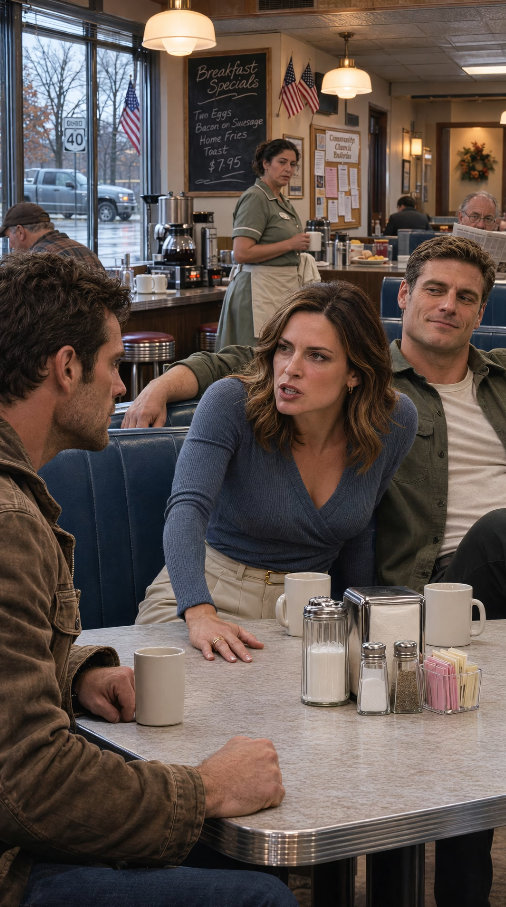
“That diner speech.”
She winced.
“Yes.”
“That wasn’t about stability.”
“Not entirely.”
“What was it about?”
She looked toward the window.
“I didn’t want to lose you.”
The answer should have pleased some wounded part of me.
It did not.
“You were willing to ask me to raise another man’s child rather than tell me there was a chance the baby was mine?”
“I was trying to control the outcome.”
“That is one way to describe it.”
“I thought if I could make everyone agree to a plan, nobody would leave.”
“Nobody?”
“My parents. Nolan. You.”
“Marissa, those aren’t pieces on a board.”
“I know.”
She caught herself.
Then almost laughed through her tears.
“Sorry.”
I nearly laughed too.
It lasted half a second.
But it mattered.
Because underneath everything, we still recognized each other.
I looked at the consent form.
“Why hide this in my desk?”
“I was going to tell you.”
“When?”
“Tonight.”
“After the diner?”
“Yes.”
“So what exactly was supposed to happen?”
She stared at the floor.
“You were supposed to say no.”
That surprised me.
“What?”
“I knew you’d say no.”
“To raising Nolan’s baby?”
“Yes.”
“You seemed pretty confident I should.”
“I needed you to refuse.”
“Why?”
“Because I needed to hear you say you wouldn’t let everyone else decide your life.”
I stared at her.
Even now, some part of me wanted to understand.
Another part wanted to throw the entire explanation out the window.
“You created a ridiculous situation to test whether I would stand up for myself?”
“When you say it like that—”
“How else is there to say it?”
“There isn’t.”
She covered her face briefly.
“I kept making worse decisions because every new decision was trying to fix the one before it.”
That, at least, sounded true.
I looked at the blue envelope.
“Why did Elise know?”
“She drove me to the clinic.”
“She knew there was a chance I was the father?”
“Yes.”
“And your parents?”
Marissa hesitated.
There it was.
Another closed door.
“What?”
“My mother knew.”
“Your father?”
“No.”
“You told me your parents already knew.”
“He knows I’m pregnant.”
“Does he think Nolan is the father?”
“Yes.”
I laughed without humor.
“Wonderful.”
“My mother wanted me to tell you before the diner.”
“Your mother and I suddenly agree on something.”
“She also wanted me to show you something else.”
My attention sharpened.
“What?”
Marissa stood.
“Wait here.”
She left the room.
I heard her walk downstairs.
A cabinet opened.
Then closed.
She returned carrying a white envelope.
Unlike the blue one, it had no name on it.
“What is that?”
“My mother gave it to me yesterday.”
She placed it on the desk.
“She said if I went through with the diner meeting without telling you everything, I had to give you this.”
My hand hovered over it.
“What’s inside?”
“I don’t know.”
“You didn’t open it?”
“It’s addressed to you inside.”
I pulled the flap open.
There was a single folded page.
The handwriting belonged to Marissa’s mother, Caroline.
I had seen it on birthday cards for nearly nine years.
I unfolded the page.
Clay,
If you are reading this, then my daughter has probably made an enormous mess of something she should have handled with honesty from the beginning.
I paused.
Despite myself, I almost smiled.
That sounded exactly like Caroline.
I continued.
I will not excuse her.
I will only tell you something she does not know I know.
Three weeks ago, the morning after she learned she was pregnant, Marissa came to my kitchen.
She did not say Nolan’s name first.
She said yours.
She said, “Mom, if there is any chance this baby is Clay’s, I don’t know whether that makes everything better or much worse.”
Please do not let biology make a decision your heart and judgment have not made.
But please do not let anger make it either.
There is one other thing you deserve to know.
Nolan came to see us before Marissa told him she was pregnant.
I stopped.
Read that line again.
Then the next.
He came two days earlier.
And he asked my husband for money.
I lowered the letter.
Marissa frowned.
“What?”
I handed it to her.
She read.
Her face changed.
“What money?”
“I thought you knew.”
“No.”
She kept reading.
According to Caroline, Nolan had approached Marissa’s father with a business proposal.
He wanted help opening a small outdoor-equipment shop with a friend outside Columbus.
Marissa’s father refused.
At the time, Nolan had apparently said something strange.
**Marissa always believed Clay would take care of everybody. Maybe she was right.**
Marissa sat down.
“He never told me.”
“Apparently not.”
She stared at the page.
“When was this?”
“Two days before you told him you were pregnant.”
She whispered, “Then why was he talking to Dad?”
I had no answer.
Her phone rang.
She glanced at the screen.
Nolan.
Neither of us moved.
It stopped.
Then mine rang.
Nolan.
I answered.
“What?”
His voice was strained.
“Clay, I need to tell you something before Marissa’s father does.”
Marissa watched me.
“What?”
Nolan exhaled.
“The reason I went to see him wasn’t the business.”
My grip tightened on the phone.
“Then what was it?”
A pause.
“I went there to ask whether Marissa was still trying to save your marriage.”
I looked at her.
She could hear Nolan faintly through the phone.
Her expression changed.
Nolan continued.
“Because she sent me a message that morning.”
Marissa went completely still.
I asked, “What message?”
Nolan answered.
“She told me goodbye.”
**–END OF PART 3–CLICK “NEXT” AT THE BOTTOM OF THE PAGE TO CONTINUE READING**
✓ Lynn R. Adams
## Part 3 – The Blue Envelope The house looked exactly the same. That felt offensive somehow. The porch light was still on from the night before. A newspaper rested against the flowerpot beside the…