PART 3: The Sound He Wasn’t Supposed to Hear 061
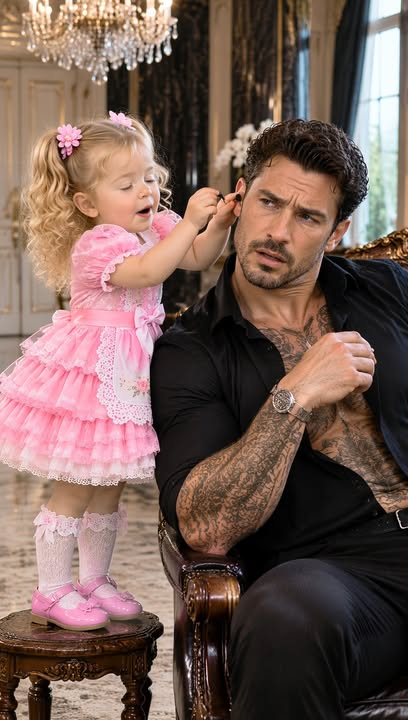
Part 3 – The Photograph in the Drawer
“It said there might be a way to hear again.”
Dominic’s words stayed with me long after I turned away from the office door.
I had not meant to overhear him and Dr. Hale, but the hall was quiet, and the sentence seemed to follow me through every corridor of the estate.
That evening, I expected the matter to disappear behind the same polished doors that kept everything else private.
Instead, Dominic sent for me.
When I entered his office, he sat behind a wide desk with Dr. Hale’s folder open beside him.
The letter inside was old enough that its edges had softened, though the paper had been kept carefully in a clear sleeve.
Dr. Hale stood near the window, his hands folded over the top of his medical case.
“Mr. Cray asked me to explain what the letter means,” he said.
Dominic looked up from the page.
“I asked you to explain what it doesn’t mean.”
Dr. Hale gave a small nod.
“That, too.”
I paused near the door, suddenly aware that I had no right to be part of a private medical conversation.
“I can leave,” I said.
“You can stay,” Dominic replied.
He did not sound warm, but he did not sound reluctant either.
Dr. Hale turned the letter toward him.
“The specialist who wrote this believed there could be some remaining function in the auditory pathway on your right side,” he explained. “The tests were incomplete because your condition was unstable at the time.”
Dominic’s gaze stayed on the page.
“He said the procedure might help.”
“He said further testing might show whether treatment was worth considering,” Dr. Hale corrected gently. “That is not the same thing as promising a result.”
“I know.”
“You were offered surgery then?”
“I was offered a procedure that could reduce pressure and possibly improve sound conduction.”
“And you declined.”
Dominic’s thumb moved over the margin of the letter.
“I had just survived an explosion. I was still waking up with the ringing in my head and the feeling that the room was moving.”
I looked at him, trying to imagine that kind of uncertainty, the world reduced to a body that no longer obeyed its familiar rules.
“They couldn’t tell me how much hearing would return,” he continued. “They couldn’t tell me what else I might lose.”
Dr. Hale’s voice softened.
“That was a reasonable fear.”
“Everyone called it a decision.”
“Fear can be part of a decision without being the whole of you.”
Dominic gave him a look that suggested he did not care for comforting phrases.
Dr. Hale accepted it without argument.
“The specialist is still practicing,” he said. “He’s agreed to review the old scans and arrange current tests. You can decide what comes after that.”
Dominic closed the sleeve around the letter.
“I’ll go.”
The words were plain, but something in the room shifted when he said them.
Dr. Hale nodded.
“I’ll arrange it.”
After the doctor left, Dominic remained seated, one hand resting on the folder.
I was still near the door.
“You wanted me to stay for this?” I asked.
“I wanted you to hear what he told me.”
“Why?”
He looked toward the window, where the evening light lay in pale bands over the garden.
“Because you were there when I heard Lily.”
It was an answer, though not one that explained much.
I thought of my daughter’s small voice in the conservatory, and how his expression had changed when he realized the sound was real.
“I hope the tests help,” I said.
“So do I.”
The quiet that followed did not feel awkward.
It felt like the first time neither of us was trying to escape it.
The next week, Dominic began traveling to the city for appointments.
He kept the schedule private, though the staff soon understood that his mornings were no longer his own.
Dr. Hale accompanied him the first time, and afterward a specialist named Dr. Levin arranged a series of tests.
Dominic returned each afternoon with the same controlled expression he carried into every room, but I noticed he held himself differently.
He was listening for things he could not yet hear.
A chair scraping behind him.
A kettle beginning to boil.
The soft clink of a spoon against a cup.
The tests did not bring a sudden answer.
They brought more questions.
Some sounds reached him through his left ear if the room was quiet.
Others disappeared before he could place them.
The specialist said the old injury was complicated, and that any treatment would have to be gradual.
Dominic listened to each explanation without interruption, then asked precise questions about risks, recovery, and what might happen if he waited.
He never asked whether he would hear normally again.
I began to understand that he was learning how to live with uncertainty before he could decide what to do with it.
A few days after his first appointment, I was asked to bring a tray to the conservatory.
Dominic sat in his usual chair, a small hearing device resting beside him on the table.
He had been instructed to use it briefly in quiet settings, though Dr. Levin had warned that it might amplify sounds unevenly.
A book lay open across his lap.
He was not reading.
His eyes were fixed on the glass doors.
“Is it uncomfortable?” I asked.
He turned toward my voice.
“I can hear the leaves.”
I followed his gaze to the broad palm fronds shifting lightly in the air from the ventilation system.
“Do they sound different from what you expected?”
“More like paper being folded than leaves.”
He listened again, his brow drawn.
“It’s difficult to tell what I’m hearing and what I’m imagining.”
“That sounds tiring.”
“It is.”
I set the tray down on the side table.
He had not asked for tea, but I had brought it because the kitchen had made too much.
“Dr. Levin said not to push through if the sounds become overwhelming,” I said.
“I know.”
“Knowing and doing are different things.”
His eyes moved to me, and for a moment I wondered whether I had said too much.
Then he looked back at the leaves.
“That sounds like something you tell yourself.”
“Most days.”
A faint smile appeared at the corner of his mouth.
It vanished quickly, but I saw it.
My daughter, Lily, had started asking about Dominic whenever I returned from work.
She wanted to know whether his ear felt better, whether he had heard anything new, and whether he still kept her picture.
I had answered as honestly as I could.
“He still has it,” I told her one night.
She considered that while drawing at our kitchen table.
“Then I should make him another one.”
“You can, if he wants one.”
“He wanted the first.”
The next afternoon, I brought a small sheet of paper to the conservatory.
Lily had drawn a yellow sun, a green tree, and three people standing beneath it.
This time, she had taken care to give all three figures hands.
Dominic had the paper from me and studied it for a long moment.
“Does she think I’m part of the family?” he asked.
The question caught me off guard.
“She thinks you’re someone she likes.”
“That’s not the same thing.”
“No,” I said. “It isn’t.”
He placed the picture beside the first.
“I’ll keep it.”
A quiet settled between us.
Then he looked at me.
“Does she ask about me at home?”
“Every day.”
“Why?”
“Because she’s three. She asks about everything that interests her.”
He accepted that, though it did not seem to satisfy him.
I sat in the chair across from his.
“You don’t have to make this mean more than it does,” I said.
“I wasn’t.”
“You asked if she thinks you’re family.”
“I asked a question.”
“That’s what you do when you want to know something.”
He regarded me with the same steady attention he gave people who came to negotiate with him.
“I’m trying to understand how children decide who belongs.”
“Usually, they don’t make a decision. They just make room.”
He looked down at the drawings.
“Adults make it harder.”
“Usually.”
Over the following weeks, the small rituals between us began to take shape.
Dominic’s appointments continued, and the hearing device helped him distinguish certain sounds when the room was quiet.
He could make out the click of a door latch from his left side.
He could hear me if I stood close enough and spoke slowly.
He still missed much of what people said in a crowded room, especially when several voices overlapped.
At the dinner table, he began choosing a seat where he could see everyone’s face.
When a conversation moved too quickly, he sometimes asked for it to be repeated.
The first time he did, the table went silent.
Everyone looked at him.
He glanced around and said, “I heard the question. I didn’t understand the answer.”
The moment passed, though not without some of the guests pretending they had not noticed.
Afterward, he asked me how to follow a conversation when the room grew loud.
I showed him the simple things I used with Lily when she became overwhelmed.
Look at the person speaking.
Notice when their expression changes.
Ask them to repeat the part that matters, rather than pretending you understood all of it.
He listened carefully.
“I’ve spent three years trying not to ask anyone for repetition,” he said.
“People ask each other to repeat things all the time.”
“Not in my world.”
“Then your world needs better manners.”
This time, he did laugh, though the sound was brief and rough with disuse.
It startled both of us.
I smiled before I could stop myself.
He looked at me as if he had not expected me to be pleased.
That was when I began to understand how much of his life had been built around not being surprised.
The closeness between us did not come quickly.
It gathered in quiet moments, shaped by boundaries neither of us wanted to cross.
I remained an employee, and he remained the man whose name affected every decision made within the estate.
But he began asking me to stay during his appointments with Dr. Hale, not because I could contribute medically, but because I had learned how to describe the difference between a sound that was merely loud and one that had meaning.
Sometimes he wanted me to help him practice recognizing voices.
Sometimes he simply wanted someone present who did not confuse his silence with anger.
And I began to see the person beneath the rumors.
Dominic was cautious, not cold.
He disliked being fussed over and was quietly embarrassed when he could not follow an ordinary exchange.
When a staff member spoke behind him, he did not pretend to understand.
He turned around and asked them to say it again.
Each time he did, the room became a little less careful around him.
Victor did not seem pleased.
He never openly objected to Dominic’s appointments or the time I spent assisting him.
But he watched more closely than before.
One afternoon, he found me leaving the conservatory with a stack of children’s drawings beneath my arm.
“Is that becoming part of your work now?” he asked.
“Mr. Cray asked me to take the pictures to the office so they wouldn’t get bent.”
“Your duties are in the kitchen and dining rooms.”
“I know.”
“Then it may be best to keep the arrangement clear.”
His words were mild, but the meaning was not.
I held the drawings more firmly.
“Mr. Cray asked me to help him follow conversations during dinner. Dr. Hale knows about it.”
“Doctor Hale is not responsible for staff assignments.”
“No, but Mr. Cray is.”
Victor’s mouth tightened.
“Be careful that a kindness does not become an expectation.”
I could not tell whether he was warning me or trying to make sure I understood my place.
Before I could answer, Dominic appeared in the doorway behind him.
“Victor.”
Victor turned.
“I was explaining the staffing arrangement.”
“You were questioning a decision I made.”
“I was making sure there was no misunderstanding.”
“There isn’t.”
Victor inclined his head.
“Understood.”
Dominic’s gaze shifted to the drawings in my arms.
“Lily has been working on a new one.”
“Yes.”
“Bring it to the conservatory when you have time.”
Victor said nothing.
I passed him in the corridor, feeling the warmth of his attention on my back until I reached the kitchen.
The picture was a careful drawing of a house with a blue roof.
Lily had added three small figures in front of it, each holding one another’s hands.
Dominic studied it that evening.
“Does she know what she’s drawing?” he asked.
“I think so.”
“Does she know you’re staying late?”
“She knows I work here.”
“That wasn’t what I asked.”
I looked at the picture.
“I don’t think she understands what my job means yet.”
“Then she understands more than most people.”
I thought of Victor’s warning, of the line between kindness and expectation, and of the long list of things I could not afford to misunderstand.
“Mr. Cray,” I said, “I’m grateful you protected my job. But I don’t want Lily to become another reason people question what I’m doing here.”
“I won’t ask her to be.”
“And I don’t want your hearing treatment to become something I’m responsible for.”
“It isn’t.”
“Good.”
He nodded.
For a moment, neither of us spoke.
Then he said, “You can tell me when I cross a line.”
“That assumes I’ll know where it is.”
“Then tell me when you think I’m near one.”
His honesty unsettled me more than a promise would have.
“I will,” I said.
That evening, I took the bus home instead of accepting the estate driver’s offer.
The ride was longer, but I needed the time to think.
A week later, Dr. Hale brought Dominic a new set of test results.
I was helping arrange books in the small sitting room outside his office when I heard the doctor say, “The specialist wants to compare these with the original records.”
“What about the old file?” Dominic asked.
“Some of it is missing.”
A silence followed.
“What do you mean, missing?”
“I mean there’s no complete record of the vehicle or the exact circumstances of the explosion.”
“Those were kept by the family’s security office.”
“Then someone may have moved them years ago.”
I placed a book on the shelf and stood still.
Dominic’s voice was low.
“I was told the records were destroyed.”
“So was I.”
Dr. Hale did not say anything else, but the silence between his words felt heavy.
The next morning, Dominic asked me to come to his office.
He had a photograph on his desk, partly hidden beneath a folder.
“You said your father was a mechanic,” he began.
“Yes.”
“What kind of work did he do?”
“Mostly engines and electrical systems. He could fix almost anything if you gave him enough time.”
“Where did he work?”
“His own workshop in Albany. He took jobs from different people, including some of the estate staff.”
Dominic’s hand rested beside the photograph.
“Did he ever tell you he worked for the Crays?”
“He said he’d been called to inspect a vehicle once. I was young. He never explained much.”
“Do you know when?”
“No.”
I had thought of my father as a private man, a steady presence who came home smelling of oil and soap.
He had been dead for years, and the details of his last months had grown indistinct around the edges.
A workshop accident, my mother had told me.
A fire started by faulty wiring.
No one had found anything suspicious in it.
“What does my father have to do with the missing records?” I asked.
“I don’t know yet.”
His answer was careful.
He pushed the photograph toward me.
It showed a younger Dominic standing beside a dark vehicle with one arm in a sling.
He looked thinner, almost boyish, though his eyes already carried the weight of someone who had learned not to trust a room.
A man in work clothes stood beside him, one hand resting on the open hood.
I recognized the shape of my father’s shoulders before I recognized his face.
My breath caught.
“That’s him.”
Dominic leaned forward.
“You’re sure?”
“I’m sure.”
The photograph had been taken in the estate garage, perhaps weeks before the explosion.
My father looked directly at the camera, with the same half-smile he used whenever he knew someone was taking a picture but had no intention of posing.
I touched the edge of the photograph.
“Why do you have this?”
“It was in a box of old household records.”
“Was this the vehicle from the night you were injured?”
“I don’t know.”
The uncertainty in his voice sounded different from the uncertainty about his hearing.
This one had a sharper edge.
“I was told the explosion came from an attack on the family,” he said. “That was the only explanation I was given.”
I looked at my father’s face.
The old memory of his funeral came back in pieces: the rain against the chapel windows, my mother’s red eyes, the smell of damp wool on my coat.
He had died months before Dominic’s explosion.
I had never connected the two events.
“Could he have been working on that car?” I asked.
“Possibly.”
“Was he there the night you were hurt?”
“I don’t know.”
Dominic’s gaze remained on the picture.
“Dr. Hale says the records are incomplete. If your father worked on the vehicle, his name might be in the missing file.”
My mouth had gone dry.
“My mother told me he died in a workshop accident.”
“I’m not saying that was connected.”
“But you’re wondering.”
“Yes.”
The word sat between us with the weight of a door neither of us knew how to open.
I took the photograph and looked at it more closely.
There was a faint mark on the back, written in a narrow hand.
A date.
And beneath it, a short note I had never seen before.
“Inspection complete,” I read aloud.
The name below it was my father’s.
Dominic looked at the writing.
“Is that his signature?”
“It looks like it.”
I turned the photograph over again.
The date was three days before the explosion.
My father had never told me he was working for the Crays that week.
For years, I had believed his death was a terrible accident unrelated to anyone beyond his workshop.
Now I was looking at his name beside the vehicle that might have changed Dominic’s life.
Dominic’s hand tightened against the desk.
“Your father may have known something about that car.”
The words were quiet.
I stared at the date until the ink blurred.
Then I looked up at him.
“What if he knew why it was dangerous?”
**–END OF PART 3–CLICK “NEXT” AT THE BOTTOM OF THE PAGE TO CONTINUE READING**
* * *
[PREVIOUS: PART 2](https://storyly.idolsgift.com/blog/part-2-the-sound-he-wasn-t-supposed-to-hear-061) | [NEXT: PART 4](https://storyly.idolsgift.com/blog/part-4-the-sound-he-wasn-t-supposed-to-hear-061)
✓ Lynn R. Adams
Part 3 – The Photograph in the Drawer “It said there might be a way to hear again.” Dominic’s words stayed with me long after I turned away from the office door. I had not meant to overhear him and…