PART 3: The Song Elena Couldn’t Finish 008
Part 3 – The Cost of Concern
Roman’s gaze remained fixed on the paper.
“I’ve seen it before,” he repeated, as if saying the words aloud might bring the memory closer.
I looked toward the music room door.
“Elena should know you found it.”
“She will.”
“Before you ask anyone else to look at it.”
He folded the copy with care, then stopped, seeming to reconsider the gesture.
“You’re right,” he said.
The admission took me by surprise.
“Would you like me to tell her?”
“No,” I said. “I think she deserves to hear it from you.”
He nodded and walked toward the music room.
I stayed in the hall, listening to the quiet behind the closed door.
A few moments later, Elena spoke, too softly for me to make out the words.
Roman answered.
Then came another silence, longer than the first.
When he stepped out again, the folded paper was still in his hand.
“She asked me not to bring it up today,” he said.
“Then don’t.”
“I won’t.”
He looked toward the door, his expression caught between worry and restraint.
I recognized the feeling.
Wanting to help, and not knowing whether help would feel like another intrusion.
“She’ll tell you when she’s ready,” I said.
“I hope she does.”
For the next few days, we did not discuss the note.
Elena kept the old sheet music in the piano drawer, and neither she nor I opened it.
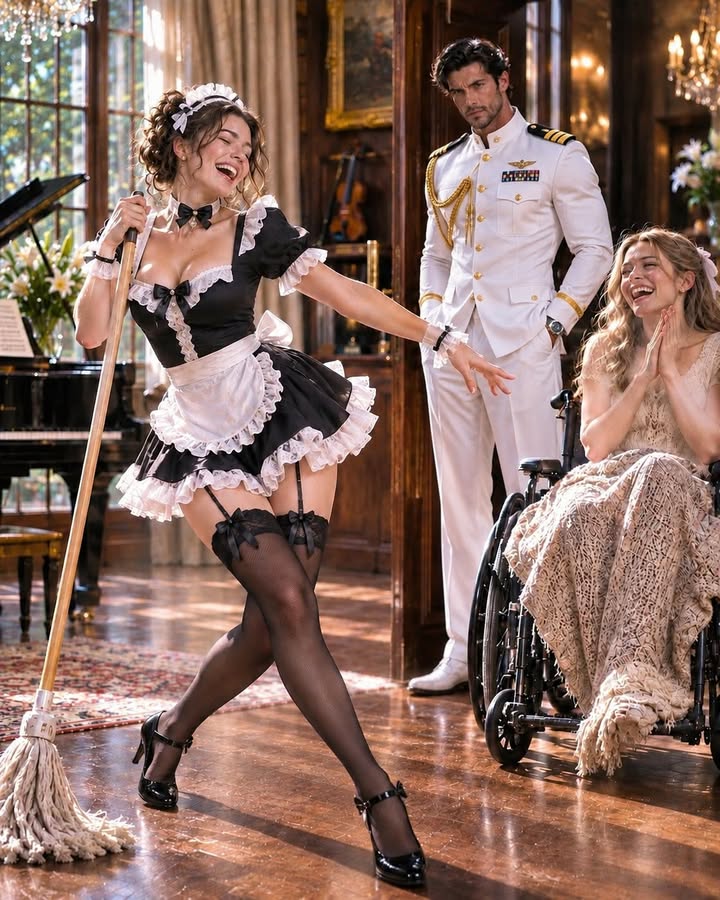
We talked about ordinary things instead: the gardenias someone had sent to the house, the neighbor’s dog that barked at the delivery van, and whether the mop had finally learned to keep time.
Roman made a visible effort not to turn every quiet moment into a question.
He still noticed when I favored my left leg.
He simply stopped mentioning it.
I thought that meant he had heard me.
Then, on Thursday morning, a woman in a navy coat arrived at the mansion carrying a medical bag.
I was in the back hall, sorting clean linens, when I heard the front door open and Roman’s voice.
“Thank you for coming, Doctor.”
I knew the woman’s name from the staff schedule.
Dr. Patel had treated Elena before, though she had not been to the house in months.
I set the linens down and stepped into the hall.
Roman was speaking to her quietly beside the staircase.
He had arranged the visit without telling Elena—or me.
The understanding came before he saw me.
“Doctor,” I said.
Dr. Patel turned with a polite smile.
“Maya.”
Roman’s face gave away nothing.
“How’s your knee?” he asked.
I looked at the medical bag.
“Fine.”
“I’ve arranged for Dr. Patel to take a look.”
“You arranged that without asking.”
“I thought it would be easier to have someone come here.”
“For whom?”
His gaze shifted toward the open doorway to the sitting room.
“For you.”
I felt the old instinct rise in me, hard and swift.
The instinct to become smaller before someone could make a decision for me.
“I didn’t ask you to do this.”
“I know.”
“Then why did you?”
“Because you’re in pain.”
“That doesn’t mean you can decide what happens to me.”
Dr. Patel glanced from Roman to me, then quietly set her bag on a nearby table.
“I’m happy to leave if this isn’t a good time,” she said.
I appreciated that she had not reached for her instruments or tried to reassure me into agreeing.
Roman drew a breath.
“I thought I was making it easier.”
“You keep thinking that,” I said. “That if you remove the inconvenience, you’ve done something kind.”
His expression tightened.
“I’m not trying to control you.”
“You don’t have to intend it for that to be how it feels.”
The hall had gone quiet around us.
I heard a door close somewhere at the back of the house.
Then Elena’s voice came from the top of the stairs.
“What’s going on?”
She had brought her chair to the landing, one hand on the rail, and her eyes were fixed on the doctor’s bag.
Roman looked up.
“I asked Dr. Patel to examine Maya’s knee.”
“Did Maya ask you to?”
“No.”
Elena’s expression grew still.
“Then why is the doctor here?”
“I was concerned.”
“That isn’t an answer.”
“It was a way to help.”
“Without asking.”
Roman glanced at me.
I held his gaze.
Elena moved her chair slightly, as if she wanted to come down, then changed her mind.
“I thought you understood,” she said.
“I do.”
“Do you?”
No anger sharpened her voice, which made the disappointment in it harder to bear.
Roman lowered his eyes for a moment.
“I should have asked.”
“Yes,” Elena said. “You should have.”
Dr. Patel stepped away from the table.
“I can come back another day,” she said. “Or not at all.”
“Thank you,” I said.
“I’m sorry,” Roman replied.
The apology came quickly, but it did not erase the decision he had made.
I picked up the linens I had set down and carried them toward the laundry room.
“Maya,” Roman called.
I stopped at the doorway.
“I’m not going to force you to see her.”
“I know.”
“Then—”
“I know you won’t force me,” I said. “That doesn’t mean this didn’t happen.”
His hands fell to his sides.
“I’m sorry.”
I believed that he meant it.
I also knew that belief did not make me feel safe.
“I need to think about whether this job still works for me,” I said.
Elena’s face went pale.
Roman remained completely still.
“Maya, you don’t have to leave,” he said.
“That isn’t your decision either.”
He looked as if he wanted to answer, but nothing came.
I continued down the hall.
Dr. Patel gathered her bag and left without making a sound.
By lunch, the staff had heard enough to understand there had been a disagreement, though no one asked me to explain it.
I spent the afternoon in the laundry room folding towels that were already folded.
Every time I stopped, I could feel my knee aching beneath the fabric of my trousers.
Every time I moved, the ache sharpened.
The part of me that needed the money told me to keep working.
The part of me that had survived this long by refusing to be cornered told me to leave before the mansion became another place where gratitude was expected in exchange for obedience.
Both parts had good arguments.
Near the end of the day, Elena came to find me.
She waited outside the laundry room until I looked up.
“Can I come in?” she asked.
“Of course.”
She entered and parked beside the folding table.
“I’m sorry,” she said.
“You didn’t arrange the appointment.”
“No, but I know what it feels like when he decides he knows what you need.”
I smoothed the edge of a towel.
“Does he do that often?”
“He used to do it more.”
“Why did he stop?”
“I made him understand that protection isn’t the same as trust.”
I sat down on the stool.
“Do you think he understands now?”
“I think he wants to.”
“That isn’t the same thing.”
“No,” Elena said. “It isn’t.”
For a while, she watched my hands fold the towel.
Then she said, “I don’t want you to quit because of him.”
“I haven’t decided.”
“I know.”
“I don’t want to make your life harder.”
“My life is already mine to manage.”
The certainty in her voice made me look at her.
She gave me a small, tired smile.
“You don’t have to stay to keep me company,” she said. “But I’d miss you.”
I felt the words reach somewhere I had kept carefully guarded.
“I’d miss you too.”
Elena nodded, accepting the answer without trying to turn it into a promise.
When she returned to the music room, I stayed in the laundry room until the house grew quiet.
Roman did not come looking for me.
That evening, I found a note outside my room.
Dr. Patel’s number was written at the bottom, along with a message in Roman’s careful handwriting.
I should have asked.
The choice is yours.
I stood in the narrow hallway for a long time, holding the paper.
It did not undo what he had done.
Still, it was the first time he had left me room to decide what came next.
I put the note on the table and took out my phone.
Dr. Patel answered on the second ring.
She did not ask why I had changed my mind.
She offered to see me at her clinic the next afternoon, where I could speak with her privately and decide whether I wanted an examination.
I told her I would come.
When I arrived, the clinic was quiet and smelled faintly of coffee and disinfectant.
Dr. Patel listened while I explained the injury.
She did not make me feel foolish for having worked through it.
She did not ask questions about Roman or the mansion.
After examining my knee, she said the swelling and stiffness were consistent with an injury that needed rest and proper treatment, though she could not tell exactly how long it would take to heal without further imaging.
“You’ve been compensating for it,” she said. “That can create pain elsewhere.”
“I know.”
“Do you have a brace?”
“I do.”
“Have you been wearing it?”
“Not at work.”
She lifted her eyebrows slightly.
I sighed.
“Some uniforms don’t make it easy.”
“We can talk about ways to keep it supported without making your day harder.”
The phrase was so different from Roman’s version of help that I felt my shoulders loosen.
Before I left, Dr. Patel gave me a referral for imaging and a list of exercises to avoid until we knew more.
She made it clear that I did not need to agree to any treatment before I understood the options.
I carried the papers home in my coat pocket.
The next morning, I found Roman outside the kitchen.
He did not ask whether I had seen the doctor.
He waited until I looked at him.
“How is your knee?”
“I went to the clinic.”
He nodded once.
“Good.”
“I went because I decided to, not because you arranged it.”
“I understand.”
“I hope you do.”
“I’m trying to.”
The answer did not fix everything, but it sounded less like a defense than the things he had said before.
“I’m sorry for taking the choice away from you,” he added. “Even for a moment.”
“Thank you.”
He seemed to want to say more.
Instead, he stepped aside and let me pass.
That afternoon, I found Elena in the music room with the old sheet music on her lap.
She was not looking at the notes.
She had turned the page over and was studying the pale indentation across its back.
“I thought you wanted to leave it alone,” I said.
“I did.”
“Did something change?”
“I wanted to see if the writing continued on this side.”
She angled the page toward me.
There were no words, only a few pressure marks where someone had written on a sheet above it.
“I can’t read them,” she said.
“Neither can I.”
Elena set the paper on the piano.
“Roman found the same thing.”
“Did he tell you what he remembered?”
“He said the handwriting looks familiar.”
“Does he know why?”
“No.”
She traced the edge of the paper, stopping before she reached the faded note.
“I’m not ready to play,” she said.
“You don’t have to.”
“I know.”
She looked at me, and the steadiness in her expression made me smile.
For a moment, we sat without speaking.
Then a housekeeper appeared at the doorway.
“Miss DeLuca,” she said, “Mr. Roman asked whether you’d both be willing to join him in the library.”
Elena looked at me.
“Both of us?”
“He said it was about the envelope.”
I felt the old tightness return to my stomach.
I could have refused.
I almost did.
Elena noticed the change in my face.
“We can go,” she said. “And we can leave whenever we want.”
I nodded.
In the library, Roman had laid the envelope on the desk beside a magnifying glass and several sheets of paper.
A man I had not met before sat across from him, his gray hair neatly parted and a pair of reading glasses in his hand.
“This is Mr. Bell,” Roman said. “He worked with our family’s records for years.”
Mr. Bell stood and offered me a polite nod.
“I asked him to look at the envelope,” Roman continued. “I should have asked you first.”
“Yes,” I said.
“I’m asking now. Would you like to know what he noticed?”
The question, asked too late to erase the earlier decisions, still mattered.
I looked at the envelope.
Then I nodded.
Mr. Bell examined the paper without touching the money.
“The stock is older than most stationery you’d find in a shop today,” he said. “It was made by a mill that closed nearly fifteen years ago.”
“Do you know who bought it?” I asked.
“Not from the paper alone.”
He turned the envelope slightly beneath the light.
“The handwriting is more interesting.”
Roman leaned forward.
“You recognize it?”
Mr. Bell studied the address, then the short line beneath it.
“I don’t want to say I recognize it until I’m certain.”
“What does that mean?” Elena asked.
“There are similarities to notes kept with Mrs. DeLuca’s personal papers,” he said. “The same looping capital letters. The same pressure on the final strokes.”
Elena’s fingers closed around the arms of her chair.
“My mother’s?”
“It could be someone imitating her,” Mr. Bell said carefully. “Or it could be her hand. I would need to compare it with a verified sample.”
Roman looked toward the envelope.
“I’ve seen that writing before,” he murmured.
“When?” I asked.
He did not answer.
The familiar quiet came over him, but this time it did not seem like suspicion.
It seemed like fear of finding a memory he had buried without meaning to.
Mr. Bell removed his glasses.
“If you have an old note or card with her handwriting, it might help.”
Elena looked toward the music room.
“The song page has a note on it.”
“Would you like to bring it here?” I asked.
She shook her head.
“Not yet.”
“All right.”
Roman closed the folder on the desk.
“We’ll wait.”
I looked at him, wondering whether the effort it took to wait had changed anything in him.
Then my phone rang.
The sound startled all of us.
I recognized the number and felt my blood go cold.
It was the office where I worked before taking the job at the mansion, the place that still handled my payroll and tax records.
I answered.
“Maya Turner.”
The caller identified herself as the office manager.
She sounded apologetic, but the words came quickly.
“Someone called asking us to confirm your employment history and current address,” she said. “They said it was about a debt in your name.”
I gripped the phone.
“What did you tell them?”
“Nothing beyond confirming that you work here. I asked for their information, but they wouldn’t provide a full name.”
“Did they leave a number?”
“They gave a callback line.”
I wrote it down with a shaking hand.
When I ended the call, Roman was already standing.
“What happened?”
I held up one hand.
“Don’t.”
He stopped.
The restraint cost him something; I could see it in his face.
“They contacted my workplace,” I said. “The debt collector.”
Elena’s expression went quiet and focused.
“What did they say?”
“They asked about me. My address. My employment.”
“Did they threaten you?” Roman asked.
“No.”
He nodded, but his attention sharpened.
“Have they contacted you before?”
I hesitated.
The truth sat between us, too heavy to keep carrying.
“Yes.”
“How long?” Elena asked.
“Two weeks.”
I watched Roman absorb it.
The answer hurt him, though I could not tell whether he was hurt that I had hidden it or that he had not noticed.
“I didn’t tell you because I didn’t want you to take over,” I said.
“I understand.”
“Do you?”
He looked at me.
“I can ask.”
“You can.”
“I won’t call them without your permission.”
The promise came slowly, but it came.
I took the folded notice from my bag and placed it on the desk.
“I brought this with me in case they called again.”
Roman glanced at the page, then turned his attention to me rather than reaching for it.
“Would you like us to read it together?”
The question made my throat tighten.
Not because I wanted him to read it.
Because he had asked.
“No,” I said. “But I’ll take it to someone who can explain my options.”
“Good,” Elena said.
Roman nodded.
“Do you have someone in mind?”
“There’s a legal aid office near the bus station.”
“I can help you find the right contact if you want.”
“I’ll let you know.”
He accepted that.
Mr. Bell began gathering his papers, but before he closed his folder, he paused over the copy of the faded note from the music room.
“This may help,” he said. “If you’re willing, I could compare the handwriting with the old family records.”
Elena looked at the copy for a long moment.
“Not today,” she said.
“Of course.”
Mr. Bell stood to leave.
As he passed me, the copied note slipped from his folder and landed faceup on the desk.
A loose sheet beneath it had come with it, marked in the same looping script.
Roman reached for the papers, then stopped and looked at Elena.
She gave a small nod.
He turned the loose sheet over.
The handwriting matched the note at the bottom of the music page.
I recognized the broad curve of the capital letters before I could read the words.
Roman’s breath caught.
“What is it?” I asked.
He stared at the date written in the top corner.
Elena leaned closer.
“That’s the day before the accident,” she whispered.
Roman held the page as though it might break.
At the bottom was a line addressed to him.
Roman, if Maya comes back to the house, make sure she knows she never owed us anything.
None of us spoke.
I read the sentence again, feeling the room tilt around it.
Roman’s eyes lifted to mine.
“I don’t know why she wrote this,” he said.
But his voice told me that for the first time, he had begun to remember.
**–END OF PART 3–CLICK “NEXT” AT THE BOTTOM OF THE PAGE TO CONTINUE READING**
* * *
[PREVIOUS: PART 2](https://puretales.idolsgift.com/blog/part-2-the-song-elena-couldn-t-finish-008) | [NEXT: PART 4](https://puretales.idolsgift.com/blog/part-4-the-song-elena-couldn-t-finish-008)
✓ Lynn R. Adams
Part 3 – The Cost of Concern Roman’s gaze remained fixed on the paper. “I’ve seen it before,” he repeated, as if saying the words aloud might bring the memory closer. I looked toward the music room…