PART 3: The Slipper Turned Toward Me 046
Part 3 – The Name in the Ledger
“What did my grandmother take?”
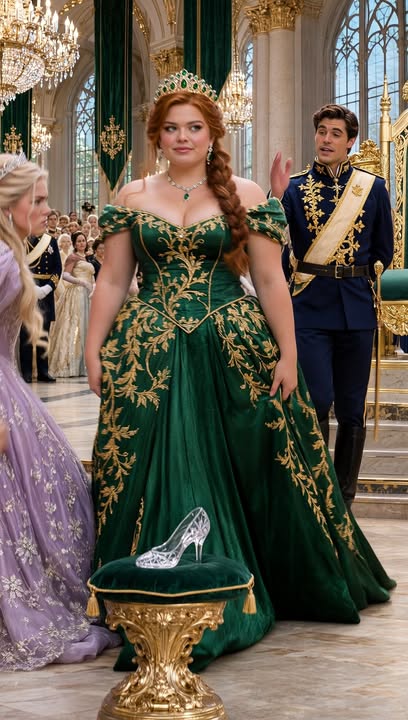
The queen’s eyes lowered to the green crest on my gown.
“I’m beginning to think,” she said, “that she may have been the only person who ever kept it safe.”
I looked again at the old record in my hands.
The words had been written in a confident hand, as if the person who penned them had never wondered whether they were true.
“Dismissed from royal service following the disappearance of the glass slipper.”
The sentence seemed too neat for a life as complicated as Eleanor’s.
“Was she accused of stealing it?” I asked.
The queen folded her hands before her.
“The record does not say that directly.”
“But it says she was dismissed because the slipper disappeared.”
“Yes.”
“That sounds like an accusation.”
“It does.”
Her answer held no excuse, and I appreciated that more than I wanted to.
I stepped aside to let her into the suite.
She entered slowly, glancing around at the pale curtains and the flowers on the table, then paused when she noticed I had not changed out of my emerald gown.
“You haven’t slept.”
“I tried.”
The queen’s face softened.
“I know what it is to have a question keep you awake.”
“Do you know what it’s like to learn that your grandmother had a whole life you never heard about?”
She was quiet for a moment.
“No,” she said. “I don’t.”
I looked down at the record.
“Did she work here?”
“For a time, according to the household accounts.”
“What kind of work?”
“I don’t know yet.”
The queen’s gaze moved to the crest on my gown, then away again.
I could feel her holding something back.
“You recognized this yesterday,” I said.
“I recognized the pattern.”
“What is it?”
“It is associated with the royal household, though I cannot yet tell you why it was embroidered into your grandmother’s dress.”
“Is it the same design as the one on the slipper?”
The queen’s expression altered.
Only slightly, but enough.
“I have not seen the slipper since it was secured.”
“That isn’t an answer.”
“No,” she said. “It isn’t.”
I placed the record on the table.
“I’m trying to understand why everyone is being so careful with me. If my grandmother was accused of taking the slipper, I deserve to know.”
“You do.”
“Then tell me.”
The queen looked toward the window.
For an instant, her composure seemed less like royal reserve than the effort of someone deciding which painful truth to speak first.
“I can tell you that the slipper is being examined by the royal conservator and two independent specialists,” she said. “I can also tell you that the old records are incomplete.”
“Convenient.”
“Yes,” she replied. “It is.”
That unexpected admission unsettled me more than a polished denial might have.
The queen turned back to me.
“Miss Brooks, I am not asking you to trust me. I know I have not earned that. But I am asking you to let us learn what happened before you decide what your grandmother’s choices meant.”
“I don’t know what they meant now.”
“You may not have to decide today.”
“I’m beginning to think the palace has been making decisions about her for decades.”
The queen’s shoulders lowered a fraction.
“That may be true.”
A knock sounded at the door.
The queen opened it to find Prince William in the corridor, already dressed, his expression alert with the look of someone who had been awake for hours.
“Mother,” he said. “The conservator has finished the first examination.”
“Is the slipper damaged?”
“No. But the light appeared again when they brought the gown near it.”
My breath caught.
The queen turned to me.
“Did you bring the gown close to the slipper?”
“No. It was in the sitting room when we left.”
“Then it happened while they were checking the pedestal,” William said. “The attendant carried your gown’s shawl from the room to the secure chamber, and when it passed near the glass, the blue light came back.”
“I wasn’t wearing the shawl,” I said.
“It had been draped over the chair,” he replied. “The conservator thought the reaction might be linked to the embroidery.”
The queen’s gaze sharpened at the word.
“Which part?”
“The crest near the hem.”
She looked at the stitching on my gown as if it had shifted beneath her eyes.
“Could I see it?” I asked.
William gave a small nod.
“If you’re willing.”
“I am.”
The queen hesitated, then said, “The examination chamber is private. No guests will be admitted.”
“Will Olivia be told?”
“She will be told the ceremony remains suspended.”
“That isn’t what I asked.”
The queen’s face softened.
“No,” she said. “She will not be brought into the examination.”
I understood the distinction.
Olivia had been a candidate, not an investigator.
Still, the memory of her face in the ballroom lingered with me: first laughter, then disbelief, then the quiet apology she had offered before everything changed.
“Could I speak with her before we go?” I asked.
William looked surprised, but the queen gave a thoughtful nod.
“If that is what you want.”
“I don’t want her to think I’m asking for an apology. I want to hear what she knows about the slipper.”
“Then I’ll have someone find her,” William said.
He offered me his arm, but I shook my head gently.
“I can walk.”
“Of course.”
He did not look offended.
That small courtesy mattered.
A few minutes later, an attendant led us to a sunlit room where Olivia waited beside a table set with tea.
Without her tiara and the glittering lavender gown, she seemed less like the untouchable figure I had watched from the crowd and more like a young woman who had not slept enough.
She stood when I entered.
“Amelia.”
“Olivia.”
The queen remained near the door, allowing us room but not leaving entirely.
“I’m glad you came,” Olivia said.
“I wanted to ask you something.”
“Anything.”
The answer came quickly, and then she seemed to reconsider it.
“I mean, I’ll answer what I can.”
I sat across from her.
“Yesterday you said the slipper was meant for a Montgomery bride.”
A flush rose in Olivia’s cheeks.
“Yes.”
“Why did you believe that?”
“It’s a story my family has told for generations.”
She sat down again, her hands resting around a porcelain cup she did not drink from.
“My great-great-grandmother was promised to a prince of this house,” she said. “The engagement ended before the wedding, but the family kept a painting of her wearing a glass shoe. My mother always said the slipper had been made for her.”
“Do you know if it was the same slipper?”
“No,” Olivia said. “I assumed it was. I never questioned the story.”
Her honesty made the answer harder to dismiss.
“Did your family ever say the slipper belonged to the Montgomerys?”
“Not exactly.” Olivia looked down. “They said it was meant for one of us.”
“And you believed that.”
“I did.”
She lifted her eyes to mine.
“I also believed that if the slipper fit me, it would prove something about my family. I thought the ceremony was a kind of inheritance.”
“Did your family tell you it was?”
“No. They told me I would be a perfect choice for the prince.”
She said it without pride.
Only weariness.
“I’m sorry about what I said to you,” Olivia continued. “About your size. I was embarrassed when the slipper wouldn’t fit, and I wanted to make it seem as if it had failed me rather than the other way around.”
“You didn’t have to say it.”
“I know.”
The apology sat between us, fragile and genuine.
I had imagined wanting to hear it.
Now that it had come, I found I did not want to turn it into a victory.
“Thank you for saying so,” I replied.
Olivia’s shoulders eased, but only a little.
“I don’t expect you to forgive me right away.”
“I don’t know you well enough to decide what I feel yet.”
For the first time, she almost smiled.
“That is fair.”
She looked at the emerald fabric pooled across my knees.
“My grandmother used to describe that shade of green,” she said. “She said it appeared in an old portrait of a household attendant who stood behind the royal family.”
I glanced at the queen.
Her expression remained composed, but her eyes were fixed on the small embroidered crest.
“Do you know the attendant’s name?” I asked.
“No. The portrait was never labeled in the family house. My grandmother said the woman had been important to the slipper’s history, though she didn’t explain how.”
A quiet unease moved through me.
“You’ve heard this story from more than one generation?”
“My mother used to mention it. She thought it was just family folklore.”
“Did she say anything else?”
Olivia hesitated.
“She said the Montgomery family had once been asked to keep a promise to the crown. I assumed she meant the old engagement.”
The queen’s gaze sharpened.
“What promise?”
Olivia looked toward her, then back at me.
“I don’t know. My mother never said.”
The room seemed to draw smaller around us.
The queen rose.
“Thank you, Lady Olivia.”
Olivia stood too.
“I’m sorry I could not be more helpful.”
“You have been,” I said.
She looked startled.
I meant it.
For all her assumptions, Olivia had given me something I had not expected: a family story that connected the Montgomerys to the slipper, and to a woman in a green gown.
When we left, William fell into step beside me.
“You didn’t need to make peace with her,” he said.
“I wasn’t making peace. I was asking a question.”
“And what do you think of her answer?”
“I think her family believes they were promised something. I don’t know what.”
“Neither do I.”
“You keep saying that.”
“It’s true.”
I studied his face.
“Doesn’t it bother you that your family’s history is full of people who know something and refuse to say it?”
“It does,” he said. “That’s why I’m trying to find out what they were protecting.”
I wondered whether he meant the slipper, the monarchy, or his own father’s silence.
The examination chamber was in a secure wing below the palace’s oldest library.
A conservator stood inside beside a glass case, accompanied by a woman with silver hair and a man carrying a leather folder.
The slipper rested on a cushion in the center of the case.
It looked unchanged, pale and delicate beneath the chamber lights.
The golden pedestal had been placed nearby, its small crack visible along one edge.
“Your Highness,” the conservator said. “The slipper itself has no fractures or structural defects. The glow was not caused by any chemical reaction we could identify.”
“And the gown?” the queen asked.
“The shawl was brought within several feet of the glass,” the conservator said. “The blue light appeared for just under three seconds.”
“Did it happen again?” I asked.
“Not when we moved the shawl away,” he said. “Not when we brought it back.”
“Only once?”
“Only once.”
William glanced at the queen.
“We need to test it again.”
“I agree,” she said, though her voice had grown faint.
The conservator turned toward me.
“If you’re comfortable with it, Miss Brooks, we would like to bring you closer to the case.”
I looked at the slipper.
The blue light had felt mysterious, but not dangerous.
Still, I did not like the idea of my body being treated as an instrument.
“I’ll come closer,” I said. “But I want to be told what you’re doing.”
“Of course,” the conservator replied.
I approached the case one measured step at a time.
At first, nothing happened.
The slipper remained still on its cushion.
The queen watched me, her hands clasped tightly in front of her.
William stood at my side, close enough to offer reassurance but not so close that I felt managed.
I moved another step.
A thread of blue appeared along the base of the case.
The light traveled upward through the slipper, illuminating its curved edge.
The conservator exhaled softly.
The slipper did not turn this time.
It only glowed.
I thought of the ballroom, where it had angled its toe toward me as though recognizing someone who had entered after a long absence.
“May I touch the case?” I asked.
“Not yet,” the conservator said. “We should record the response first.”
I let my hand fall back to my side.
The blue light faded.
The queen looked as if she had been holding her breath throughout.
“What does it mean?” I asked.
“We don’t know,” she replied.
The words were beginning to feel like a wall I kept walking into.
The silver-haired specialist opened her folder.
“I’ve reviewed the available conservation notes,” she said. “There are several inconsistencies in the palace inventory.”
“What kind of inconsistencies?” William asked.
“The slipper is listed in different years as being in the west vault, the old chapel, and the royal household archive. In one ledger, it is recorded as having been transferred to a keeper.”
“Who was the keeper?” I asked.
“That section is missing.”
“Missing because it was damaged?”
“It appears to have been removed.”
The queen’s expression tightened.
“By whom?”
“We can’t determine that from this copy.”
The specialist turned several pages.
“There are also references to an earlier version of the selection ceremony. It was not originally a test of whether a candidate could wear the slipper.”
I stared at her.
“What was it?”
“The entry is incomplete,” she said. “It refers to a witness, a keeper, and a choice that had to be made freely.”
William looked at me.
The same uneasy recognition moved between us.
The slipper had not reacted to me because of the size of my foot.
Perhaps the ceremony had never been about feet at all.
The queen asked the specialists to continue their review while she and William spoke privately with the archivist.
I stayed near the glass case.
The blue light had disappeared, but I could still see its faint afterimage, as if the slipper had left a mark on my eyes.
I began to wonder whether the gown was the key, whether the crest mattered more than the person wearing it.
Then I remembered the queen’s face when I had said Eleanor’s name.
I remembered the sentence in the old record.
My grandmother had been dismissed after the slipper disappeared.
She might have been its keeper.
She might have been accused of taking it.
Those were not the same thing, but the palace’s written history had made them sound identical.
The archivist returned carrying a narrow box of documents.
“I found something in the old household ledgers,” he said.
The queen joined us.
“Where?”
“In the collection from the east wing. Several pages were misfiled under staff expenses.”
He set the box on a table and removed a large book with worn leather covers.
The archivist opened it carefully.
Names and sums filled the first pages, written in tidy rows.
He turned several more, stopping at an entry marked with a small green crest.
“Eleanor Brooks,” I whispered.
The ink was faded, but the name was unmistakable.
The archivist read the lines beneath it.
“Assigned to the royal household in the spring of 1978. Duties included the care and cataloguing of ceremonial objects.”
My fingers went cold.
“She worked with the slipper,” I said.
“It appears so,” the archivist replied.
He turned to the next page.
A later entry had been written in darker ink.
“Dismissed after the disappearance of the royal glass slipper,” he read.
The queen looked down at the ledger.
“That is the same wording as the household record.”
“Is there anything else?” William asked.
The archivist leafed through several pages, then stopped.
“There’s a notation in the margin.”
His voice changed as he read it.
“‘Promise made: keeper’s name to remain among the household histories, whatever choice follows.’”
No one spoke.
I leaned closer to the page.
The promise had been made to Eleanor.
“Was it kept?” I asked.
The archivist looked uncomfortable.
“No. Her name appears in the service ledger, but not in the official history.”
“Why?”
“I can’t say.”
The queen’s eyes remained on the words.
“Someone made a promise and then erased the person it was made to.”
“Or forgot it,” William said.
“Would that be better?” I asked.
He had no answer.
I looked at the ledger again.
A small mark had been pressed into the page beside the promise, almost hidden by the fold.
It was the same crest embroidered into my gown.
“What is that?” I asked.
The archivist bent over it.
“It appears to be a seal.”
“Can you tell whose?”
He turned the page under the chamber light.
The impression was clear enough to show a leaf-shaped design, crossed by a narrow line.
The queen went very still.
“Your Majesty?” William asked.
“I have seen that mark before,” she said.
“Where?” I asked.
“On a document in the king’s private papers.”
William’s expression shifted.
“My father’s papers?”
The queen closed the ledger gently.
“Yes.”
“Could it be the same one he used when he wrote about the lost line?”
The queen did not answer immediately.
Her silence was no longer merely protective.
It had the weight of someone recognizing a door she had hoped would remain unopened.
The archivist cleared his throat.
“There is another section in the ledger, Your Majesty.”
He turned to the back of the book.
A thin sheet had been pasted over the final page, its edges almost invisible beneath the binding.
With careful work, he lifted one corner.
The paper came away without tearing.
Beneath it lay a short handwritten note.
The queen read it once, then again.
Her face lost color.
“Mother,” William said. “What does it say?”
She passed the page to him.
The handwriting was old-fashioned and cramped, but the words were plain.
William read aloud.
“‘If the slipper turns toward Eleanor’s child, do not announce what she is until the guardian has been given the choice.’”
He lowered the paper.
Everyone in the room looked at me.
I felt the words settle over my shoulders, heavier than the emerald gown.
“What does ‘Eleanor’s child’ mean?” I asked.
The queen reached for the note, but William held it a moment longer.
Then the queen looked at me, and I saw in her expression the same fear I had glimpsed the night before, now sharpened by recognition.
“Your grandmother was not merely part of the slipper’s history,” she said.
I held her gaze.
“Then who was she?”
The queen did not answer.
Instead, she turned to the archivist.
“Find the king’s private papers.”
And from the way William’s face changed, I understood that the answer waiting in those papers might alter everything we thought we knew about Eleanor Brooks.
**–END OF PART 3–CLICK “NEXT” AT THE BOTTOM OF THE PAGE TO CONTINUE READING**
* * *
[PREVIOUS: PART 2](https://echoesofstories.idolsgift.com/blog/part-2-the-slipper-turned-toward-me-046) | [NEXT: PART 4](https://echoesofstories.idolsgift.com/blog/part-4-the-slipper-turned-toward-me-046)
✓ Lynn R. Adams
Part 3 – The Name in the Ledger “What did my grandmother take?” The queen’s eyes lowered to the green crest on my gown. “I’m beginning to think,” she said, “that she may have been the only person w…