PART 3: The Silver Bird Beneath the Lion 069
Part 3 – The Record Beneath the Dust
“I don’t know,” Mr. Vale said. “But if this is Mara’s mark, the archive may hold the reason she left the palace—and the record of what happened before she did.”
For a moment, no one spoke.
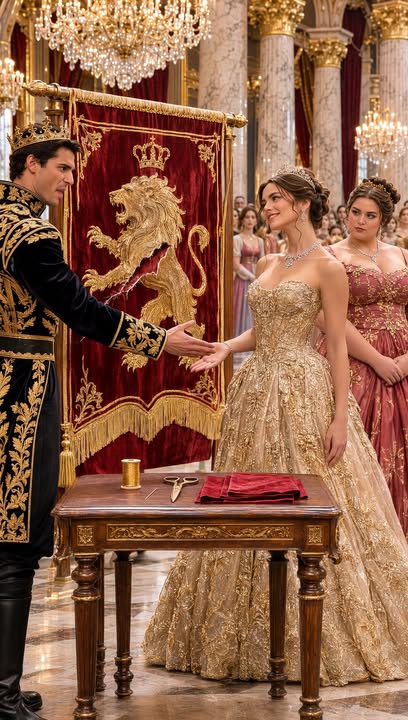
Above them, the banner stirred faintly in the breath of the room, its golden lion looking out over the throne as though it had heard the question too.
Elara held herself very still.
The little silver bird seemed too small to carry the weight of all the years her mother had kept silent, yet she could not look away from it.
“Can you find the record?” she asked.
“I can look,” Mr. Vale replied. “I should be careful not to promise more than the archive can give us.”
“That is fair,” Elara said, though her hands had curled into the folds of her gown.
The prince watched her with quiet concern.
“If you wish to leave this for another day, you may,” he said. “No one should ask you to follow a question you are not ready to answer.”
Elara looked at the banner, then at the tiny bird.
“I have spent years thinking there was nothing to ask,” she said. “I would rather know what is there.”
Mr. Vale inclined his head.
“Then I’ll begin with the work ledgers and the old mounting records.”
“May I come with you?” Elara asked.
The archivist hesitated, glancing toward the prince as if the request belonged to the court rather than to her.
Adrian answered before Mr. Vale could.
“If you want to, you should.”
The words were simple, but Elara heard the difference between permission and invitation.
She gave him a small nod.
“I do.”
The prince turned to the steward.
“Have the banner secured above the throne as planned, but make certain the patched section is not pulled taut.”
The steward bowed and began quietly directing the attendants.
Celeste remained near the doorway, her attention fixed on the silver bird.
“Is that truly your mother’s mark?” she asked.
“I believe so.”
“You never knew she worked here?”
“No.”
Celeste drew in a breath, then let it out slowly.
“I’m sorry. I know that is not much to say.”
“It is something.”
The other woman looked down at her clasped hands.
“I used to think the palace kept every truth somewhere,” she said. “In a book, or behind a locked door. It never occurred to me that some truths might simply be left out.”
Mr. Vale glanced at her.
“Records are written by people,” he said. “They can be mistaken, incomplete, or preserved only from one point of view.”
Celeste’s eyes flickered toward him.
“Then I hope the archive has room for another point of view.”
“So do I,” Elara said.
The prince’s expression had tightened, not with anger, but with thought.
“Mr. Vale, take us to the records you mentioned.”
The archivist led them through a narrow passage at the back of the throne room, where the palace’s polished grandeur gave way to older stone walls and a row of tall windows.
The light was already beginning to soften toward evening.
Servants moved through the distant corridors carrying candles and folded cloth, while the sounds of the ballroom faded behind them.
As they walked, Adrian kept pace beside Elara without crowding her.
“You need not feel that this discovery makes you responsible for what happened,” he said quietly.
“I don’t,” Elara replied. “Not yet.”
“Not yet?”
“I don’t know what I’ll feel when I learn more.”
“That seems honest.”
She glanced at him.
“Is honesty always welcome in a palace?”
The prince’s mouth curved faintly.
“I would like to think it could be.”
“Would you?”
The question landed between them more sharply than she had intended.
Adrian did not retreat from it.
“I’m trying to,” he said. “The competition has made it easy to speak in grand promises and difficult to hear what people are actually saying.”
Elara thought of the challenge, the clock, and the room full of eyes waiting to see which woman would prove worthy of a crown.
“Then perhaps the first thing to hear is that the contest makes people afraid of one another.”
“I have begun to understand that.”
“Understanding it is not the same as changing it.”
“No,” he said. “It isn’t.”
For a few steps they walked in silence.
Behind them, Celeste followed with the archivist’s assistant, a young clerk who carried a lantern and a narrow case of papers.
She seemed to be weighing every word she might say before she spoke.
At the end of the passage stood a heavy oak door, its brass handle polished by generations of hands.
Mr. Vale unlocked it and ushered them into the archive.
The room smelled of dry paper, cedar shelves, and the faint mineral coolness of old stone.
Tall cabinets lined the walls, each marked with a neat label in faded ink.
At the center of the room, a broad table had been cleared for examining records.
The archivist removed his blue coat and hung it over the back of a chair.
“Royal sewing records were kept separately from the household accounts,” he explained. “The work was considered practical rather than political, which means the ledgers are less complete than they should be.”
“Perhaps that is why people thought no one would look,” Celeste said.
“Perhaps,” Mr. Vale replied. “Or perhaps no one imagined the work would matter beyond the day it was finished.”
Elara ran her gaze over the shelves.
She wondered how many years her mother’s name had sat among these books, waiting quietly for someone to find it.
Mr. Vale asked the clerk to bring the ledgers from the year Mara would likely have worked in the sewing rooms.
While the young man went to the cabinets, the archivist opened a drawer and searched through a bundle of folded catalog cards.
“Do you know when she left the palace?” Elara asked.
“No,” she said. “I only know that she lived outside the city before I was old enough to remember.”
“Do you know if she spoke bitterly of the court?”
Elara considered.
“She never spoke bitterly about anyone. That may have been her way of keeping the past from following us.”
Adrian leaned one hand against the edge of the table.
“Did she ever mention a banner?”
“No.”
“Or a steward?”
“Not that I can recall.”
The answer seemed to settle over the room with more force than the questions.
Mr. Vale stopped sorting through the cards.
“What is it?” Elara asked.
“I found her name in an older index,” he said. “The year is uncertain, but the mark is recorded beside it.”
He set the card on the table.
The writing was small and careful.
Mara, royal sewing room, silver bird.
Elara looked at the ink until the letters seemed to blur.
A clerk returned carrying two thick volumes and placed them gently on the table.
Mr. Vale opened the first ledger and began tracing the entries with one finger.
He turned several pages, then paused over a section marked with a strip of faded ribbon.
“There,” he said.
The entry was brief.
Mara, needleworker, assigned to ceremonial textiles.
A date followed, then a notation in a hand different from the one used for the rest of the page.
“Her name is here,” Elara whispered.
The prince stood beside her, his face sober.
Mr. Vale checked a second ledger.
“The records indicate she worked on the royal lion banner,” he said. “There are several references to repairs and adjustments, though not all are dated clearly.”
“Was that this banner?” Adrian asked.
“Possibly. The fabric has been restored more than once.”
Elara’s eyes moved to the line beneath her mother’s name.
“What does that say?”
The archivist bent closer.
His expression changed.
“It says she was dismissed from the sewing rooms after a royal banner was damaged.”
The sentence seemed to take the warmth from Elara’s face.
“Dismissed?” she repeated.
Mr. Vale read the entry again, as if careful attention might soften it.
“Accused of damaging a banner,” he said. “The record does not state that she admitted responsibility.”
Elara’s fingers pressed against the table’s edge.
“My mother was accused of ruining a royal banner?”
“I’m afraid so.”
The silence that followed was not empty.
It held the image of Mara’s quiet hands, her worn sewing basket, and all the years she had never told her daughter that she once worked beneath these palace ceilings.
Adrian straightened.
“Who made the accusation?”
Mr. Vale searched the margin.
“There is no name here.”
“Was there a review?” Elara asked.
“I haven’t found one.”
“Did anyone speak to her?”
The archivist looked troubled.
“The ledger says only that her service ended following the damage.”
Elara lowered her gaze to the page.
Her mother had taught her that cloth remembered where it had been strained.
She had never said what had strained her.
“Perhaps there is another record,” Adrian said. “A report, a letter, something that explains what happened.”
“I’ll search,” Mr. Vale replied. “This entry refers to a separate inventory, but it is not listed here.”
He went to one of the cabinets and pulled open a narrow drawer.
Several bundles of papers rested inside, tied with linen ribbon.
The young clerk offered to help, and the two of them began sorting the folders by date.
Elara stayed beside the ledger.
A few moments later, Celeste came to stand across the table from her.
“I had no idea,” she said.
“Neither did I.”
“I know that doesn’t make it better.”
“No.”
Celeste seemed to brace herself against the answer.
“My family has a record of service at court going back generations,” she said. “I used to be proud of how carefully it was kept. Now I’m wondering whose names were never written down.”
Elara looked at her.
“Are you wondering because of my mother, or because of what happened in the ballroom?”
“Both.”
Celeste’s voice was low, but not defensive.
“I was so certain that winning would prove I deserved to be here. When you repaired the banner, I thought I had simply made a mistake.”
“You did make a mistake,” Elara said.
Celeste gave a small, rueful nod.
“But now I see how quickly everyone was ready to decide what the mistake meant,” she said. “You became the clever one, I became the careless one, and the banner became a test of our worth.”
“It was only cloth,” Elara said.
“It was never only cloth to the people watching.”
Elara could not disagree.
The challenge had begun as entertainment, but the contest had placed their names beside the possibility of a crown, and every small failure had been enlarged by the audience around it.
“Do you still want to win?” Elara asked.
Celeste looked toward the prince.
He was speaking quietly with Mr. Vale, his attention fixed on the records rather than on either woman.
“I don’t know,” Celeste said. “I know my family expects me to. I know I have spent months preparing to be judged.”
“That is not the same as wanting it.”
“No.” Her eyes returned to Elara. “And you?”
“I came because I was asked to compete. I don’t know what I want now.”
Celeste seemed almost relieved by the answer.
“I suppose none of us has been asked that very often.”
The clerk found a folder bearing the same year as the dismissal entry.
Mr. Vale carried it to the table and opened it with care.
Inside were inventories of ceremonial objects, notes on repairs, and several short descriptions of textile damage.
He turned a page.
“Here is the reference,” he said.
The record described an older royal banner, damaged while in palace storage.
Beneath it, another hand had added a later note.
Recorded as unrepairable.
Elara bent closer.
“Does it say why?”
Mr. Vale followed the lines.
“The original damage is described as a small cut near the embroidered lion.”
The prince’s gaze sharpened.
“A small cut, but the banner was declared unrepairable?”
“That is what the inventory says.”
“Could the fabric have been more damaged than the note records?” Adrian asked.
“It could have been,” Mr. Vale said. “Or the note may have been written after the damage worsened.”
“Do we know how it worsened?” Elara asked.
“No. Not from this document.”
She looked at the old work ledger again.
Her mother had been dismissed because a banner had been damaged.
The inventory said the first damage was a small cut, yet the final record called the entire banner unrepairable.
A familiar unease settled behind her ribs.
“The tear on the banner today began small too,” she said.
Adrian’s eyes went to the patched lion above the throne, which they could just glimpse through the open archive door.
“Yes,” he said. “And one attempt to repair it made it worse.”
Celeste folded her arms, though her face had lost its earlier composure.
“Is there anything that says Mara caused the cut?” she asked.
Mr. Vale searched the page.
“Not here.”
“Anything saying she was even present when it happened?”
“No.”
The prince’s voice was measured.
“Then the record does not prove she damaged it.”
“It does not,” Mr. Vale agreed.
Elara stared at her mother’s name, which seemed suddenly to have been written into the page by a stranger who had never met her.
“She never told me,” Elara said.
No one rushed to answer.
Perhaps they understood that she was not asking them to defend Mara or condemn her.
She was trying to understand the shape of a silence.
Adrian moved closer, but left enough space between them that she could choose whether to meet his eyes.
“Whatever the archive says, it does not change the mother you knew,” he said.
“No,” Elara replied. “But it changes what I understand about her.”
Mr. Vale gathered the ledger and the inventory together.
“There may be additional papers in the steward’s records,” he said. “The dismissal note refers to an official report, though I have not yet located it.”
“Can you find it?” Elara asked.
“I can search the boxes from that period. It may take time.”
“Then please do.”
“I will.”
The prince looked toward the shelves.
“Could the former steward’s household records still be in the archive?”
“Some are,” Mr. Vale said. “The personal accounts are incomplete, and certain documents were sealed when the office changed hands.”
“Why sealed?”
“To protect private household matters, in some cases. In others, simply because the record was considered disputed.”
“Could the report about Mara be among them?”
“It is possible.”
Elara drew a careful breath.
The thought that her mother’s name might be buried in a sealed record did not comfort her.
It only gave the silence a door.
Adrian looked at Mr. Vale.
“Search what can be searched, and tell us what you find. No conclusions should be drawn from a single ledger entry.”
“I agree, Your Highness.”
The prince’s gaze returned to Elara.
“And there should be no public discussion until we know more.”
Elara noticed the word should.
“Is that for my sake?” she asked.
“Partly,” he said. “I don’t want the court turning your mother’s life into a story before we understand it.”
“That is considerate.”
“It is also practical. The first version people hear is often the one they keep.”
For a moment she saw the young man beneath the crown, not a prince performing concern, but someone realizing that a record could do harm even when no one intended it.
Then Celeste spoke.
“And if the first version has been wrong for years?”
The question was quiet, but it made the prince turn.
“Then we should correct it,” he said.
“Even if correcting it embarrasses the court?”
Adrian held her gaze.
“Especially if the court has been wrong.”
Celeste seemed to search his face for hesitation.
She found some, perhaps, but not a retreat.
Mr. Vale closed the ledger gently.
“I will continue through the older papers tonight. I’ll send word if I locate the official report.”
“Thank you,” Elara said.
The archivist bowed his head.
As they left the archive, the palace bells marked the approach of sunset.
The light in the corridor had turned amber, casting long bars across the stone floor.
Elara walked slowly, still hearing the words accused and unrepairable.
The prince walked with her, while Celeste followed a little behind.
At the turn toward the throne room, Adrian stopped.
“Your repair is holding,” he said.
Elara looked back through the open doorway at the distant banner.
“So is the question,” she replied.
He did not ask her to explain.
Celeste came to stand beside them.
“I said I would watch the banner while it was moved,” she said. “I should go back and make certain the attendants haven’t pulled it too tightly.”
“That would be helpful,” Elara said.
Celeste nodded, then looked toward the throne room.
“I’m sorry about the contest,” she said. “Not only for what happened today. I’m sorry I treated you as if your presence were an insult to my own chances.”
Elara watched her for a moment.
“I was hurt,” she said.
“I know.”
“I don’t know yet what we are to each other.”
“That is fair.”
“But I would rather find out by speaking plainly.”
Celeste’s expression eased.
“So would I.”
They returned to the throne room together.
The banner had been secured above the throne, and the attendants were standing back to inspect their work.
Its patched chest looked steady in the fading light.
Adrian watched Elara study it.
“Does it need anything?” he asked.
“Not now,” she said. “Not unless the strain shifts.”
The prince gave a quiet nod.
“Then we’ll let it rest.”
The silver bird remained hidden beneath the lining, invisible from the floor.
Yet Elara could picture it clearly, a mark made by a hand that had once belonged to a young woman with a sewing needle and a place in the royal rooms.
She wondered whether Mara had looked at that same banner and known what had happened to it.
She wondered whether she had been allowed to explain.
And she wondered why she had carried the secret alone.
Behind them, a servant entered with a message for Mr. Vale, who had returned from the archive by another passage.
The archivist read it once, then again, his face tightening with concentration.
Adrian approached.
“What is it?”
“I have found the old mounting inventory,” Mr. Vale said. “It confirms that the banner was first recorded with a small cut near the lion’s chest.”
“That is what we saw,” the prince replied.
“Yes. But there is another notation in the same file.”
The archivist glanced at Elara before continuing.
“It says the banner was removed from service after the damage was reported, then officially declared unrepairable several months later.”
“Several months?” Celeste asked.
Mr. Vale nodded.
“Who made that later assessment?” Elara asked.
The archivist turned the page toward her.
The ink was faint, but the name was clear.
Mara.
**–END OF PART 3–CLICK “NEXT” AT THE BOTTOM OF THE PAGE TO CONTINUE READING**
* * *
[PREVIOUS: PART 2](https://storyly.idolsgift.com/blog/part-2-the-silver-bird-beneath-the-lion-069) | [NEXT: PART 4](https://storyly.idolsgift.com/blog/part-4-the-silver-bird-beneath-the-lion-069)
✓ Lynn R. Adams
Part 3 – The Record Beneath the Dust “I don’t know,” Mr. Vale said. “But if this is Mara’s mark, the archive may hold the reason she left the palace—and the record of what happened before she did.” …