PART 3: The Shortcut No One Was Meant to See 057
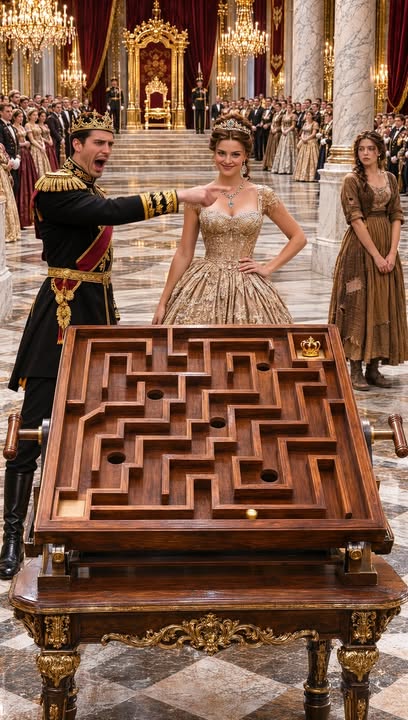
Part 3 – The Mark Beneath the Varnish
“If Thomas Vale helped build it,” Prince Adrian said, “why would the maze contain a route no one told the court about?”
No one answered at once.
Elara looked again at the tiny mark cut into the brace, the three-pronged notch beside a curved line.
The hall had begun to empty, but the last of the courtiers still lingered near the table, their voices softened by curiosity.
“I don’t know,” she said.
The honesty felt more difficult than a guess.
Celestine studied the carved mark without touching it.
“Could it be a maker’s mark?” she asked.
“My father used something like it on his drawings,” Elara replied. “He said it helped him remember which pieces belonged together.”
“Did he ever make this exact mark?”
“I think so.”
Elara disliked how uncertain she sounded, but memory was not a ledger she could open and read.
Her father’s sketches had been folded into a small bundle and stored for years in a wooden box beneath her bed.
Some had faded at the creases, and one had been stained by a cup of tea she had spilled when she was twelve.
She remembered the mark most clearly because he had once let her trace it with her finger.
Adrian bent nearer to the brace.
“Could we remove the varnish around it?” he asked the attendant.
“Only with the palace joiner’s permission, Your Highness.”
“Then let us ask the joiner before anyone scrapes at it.”
Celestine gave a brief nod, as though approving the caution.
It was the first agreement Elara had seen between them.
The attendant went to fetch the palace joiner, while Adrian turned back to Elara.
“Would you be willing to look at your father’s drawings?”
Elara glanced toward the high windows, where the last light of afternoon had thinned to a gray glow.
“They’re at my lodging.”
“Could you bring them tomorrow?”
“I can.”
The answer came too quickly.
She had not shown the drawings to anyone outside her family, and she was not sure why the prince’s request made her want to protect them.
Perhaps it was because a father’s handwriting could feel more intimate than his face.
“Only if you’re comfortable,” Adrian added.
The correction mattered.
Elara lowered her gaze to the mark.
“I’ll bring what I can find.”
Celestine’s expression had grown thoughtful.
“I’ll come as well,” she said.
Elara looked at her.
“Why?”
“To examine the maze.”
“That was not what I asked.”
A faint color rose beneath Celestine’s cheekbones.
“No,” she said. “It wasn’t.”
She seemed to consider a more polished answer, then let it go.
“I failed in front of the court, and I would rather understand why than spend the next week pretending I wasn’t bothered.”
The admission was not warm, exactly, but it was honest.
Elara knew what it cost to say something plain when a clever excuse was available.
“You may come,” she said.
Celestine inclined her head.
Adrian’s attention moved between them.
“Tomorrow morning, then.”
He asked the attendant to secure the maze in the palace workshop and have its frame examined without altering the joinery.
As they left the hall, Elara could hear Celestine asking the joiner to record the position of every piece before he moved anything.
The noblewoman’s attention to detail surprised her.
So did the fact that Celestine did not ask anyone to praise her for it.
The next morning, Elara arrived at the palace workshop carrying a cloth-wrapped bundle of drawings.
The workshop was a high-ceilinged room that smelled of pine, wax, and old dust.
Tools hung in precise rows along the walls, and pale curls of wood gathered beneath the workbenches.
A broad window admitted the cold morning light.
The maze stood on a table at the center of the room, its wooden frame supported by blocks so the joiner could inspect the underside.
Celestine was already there, wearing a dark green traveling gown instead of her glittering champagne dress.
Without the jewels and the court’s eyes upon her, she looked younger, though no less composed.
“Good morning, Miss Vale,” she said.
“Lady Celestine.”
“I asked for the maze to remain untouched,” Celestine continued. “The joiner has only examined it from below.”
“He has not removed the brace,” said the palace joiner, a square-shouldered man named Master Pell. “And I have not found a reason to.”
He wiped his hands on a cloth and nodded toward the mark.
“That symbol is old, but the brace is sound.”
Adrian stood beside a bench, looking over a sheet of paper on which the maze’s underside had been sketched.
He had set aside his royal uniform for a plain dark coat, though the gold signet on his hand made his rank impossible to forget.
“Thank you for coming,” he said to Elara.
She set the bundle on the bench.
“Thank you for asking.”
She untied the cloth carefully.
The drawings were not a complete set.
They were the ones her father had kept closest: a sketch of a stair rail, a plan for a pantry door, and several pages of notes about a wooden frame with adjustable supports.
At the corner of each page, the same small mark appeared.
Celestine leaned in, then stopped herself before her sleeve could brush the paper.
“That is the same symbol.”
“It is,” Elara said.
Adrian studied the drawings.
“Do you know what the frame was for?”
“I don’t.”
She touched one page lightly at its edge.
“My father drew more than he built. Some were plans for repairs. Others were ideas he never had the chance to finish.”
“Did he ever mention the maze?” Celestine asked.
“No.”
The words came out firm, though Elara could not be entirely sure.
Her father had spoken of palace work only in fragments, usually when something he built at home reminded him of a larger project.
He had told her about a gallery railing that had been made too high for a child’s hand, and about a service door that opened inward despite a narrow passage behind it.
He had never described a royal contest.
Master Pell examined the sketch of the adjustable frame.
“This could be the support system,” he said. “The maze is built to tilt in two directions. The frame beneath it would need to remain responsive without twisting.”
He pointed to a small drawing near the bottom of the page.
“This brace looks much like the one under the narrow passage.”
Elara felt the room grow still around her.
“Could my father have designed the frame?”
“He could have,” Pell said. “But I can’t prove it from this alone.”
Celestine looked from the drawing to the maze.
“If the brace was built so carefully, the passage was not an accident.”
“That is what I said yesterday,” Elara replied.
“I didn’t believe you yesterday.”
Celestine said it without looking away from the maze.
Elara could hear no apology in the words, but there was no mockery either.
“Why not?”
“Because it was easier to believe you had found a way to make my failure seem deserved.”
Elara took that in.
The explanation stung, but it was not unfair.
“You don’t have to make your failure deserved,” she said. “You can simply have failed.”
Celestine turned toward her.
For an instant, the old defensiveness returned to her face.
Then it eased.
“I was frightened when the ball sped toward the trap,” she said. “I thought everyone would see that I had been frightened, so I tried to force it through the turn.”
“That is usually when the board moves more than you mean it to.”
“Does that happen to you?”
“Every time I hurry.”
A small, reluctant smile appeared at Celestine’s mouth.
“Then perhaps I have more to learn from the maze than I expected.”
The words softened the room.
Adrian watched them, but he did not interrupt.
Master Pell turned over the brace drawing and noticed a line of faded writing beneath the sketch.
“Wait,” he said. “There’s a note here.”
Elara moved closer.
The words were written in her father’s narrow hand, partly obscured by a crease.
It took her several seconds to make them out.
“Leave the quiet route open,” she read.
No one spoke.
The sentence seemed too deliberate to be an ordinary carpenter’s instruction.
“What does ‘quiet route’ mean?” Celestine asked.
“I don’t know.”
Elara’s fingers curled at her sides.
Her father’s handwriting had always slanted slightly downward, as if the words were traveling somewhere out of sight.
She had seen it on shopping lists, on the little labels he tied to boxes, and on the drawings in her bundle.
But she had never read those words before.
“Was there anything else on the page?” Adrian asked.
Elara examined the notes.
“Only measurements.”
The joiner lifted the paper by its corners, taking care not to damage it.
“The maze’s maker may have kept a separate plan,” he said. “This drawing shows the frame, not the full layout.”
“Could the palace archives have it?” Adrian asked.
“They might,” Master Pell replied. “If it was filed under the contest rather than as a construction record.”
Adrian turned toward the door.
“Then we’ll search the records room.”
Celestine’s brows drew together.
“Why would a plan for a game be hidden in the repair records?”
“Because it may not have been catalogued as a game,” Elara said.
She had not intended to speak with such certainty.
The others looked at her.
“If the maze was first designed as a structure or an exercise, it might have been filed under the person who built it.”
The prince considered that.
“Then we should look for Thomas Vale.”
They went to the palace records room after the workshop visit.
It occupied a narrow wing behind the old council chambers, where wooden shelves reached nearly to the ceiling.
The archivist, Mistress Rowe, listened as Adrian explained what they sought.
Her first response was cautious rather than dismissive.
“Records from the earlier palace workshops are uneven,” she said. “Some were moved after the east wing was repaired, and others were entered under the names of the commissioning household.”
“Could you search for my father’s name?” Elara asked.
“I can.”
Mistress Rowe opened a large ledger and ran one finger down a column of names.
The room was so quiet that Elara could hear the fire shifting in the grate.
She had thought she wanted to find her father’s name.
Now that the search had begun, she found herself wishing the ledger would remain shut.
If it held nothing, her uncertainty would be settled.
If it held something, her life might change in ways she had not asked for.
The archivist paused at a line near the middle of the page.
“Thomas Vale,” she read. “Carpenter, temporary commission, west court works.”
Elara leaned closer.
The entry was dated eleven years earlier, long before she had been old enough to remember the palace.
Beside it was a reference number and a note in a different hand.
“Transferred to the Queen’s private household records,” Mistress Rowe read.
Adrian’s face changed.
“My mother’s household?”
“It appears so, Your Highness.”
Elara stared at the note.
Her father had left the palace when she was young, and she had always understood that his work ended because illness made it impossible for him to continue.
She had never heard that he had worked directly for the queen.
“Could there be a record of why?” she asked.
“Possibly,” said Mistress Rowe. “The household books from that year are in the lower cabinet.”
She unlocked a narrow drawer and removed a ledger bound in faded blue leather.
The pages smelled of dust and dry paper.
Most entries were ordinary: repairs to a gallery, the purchase of hinges, a request for new shelves in the queen’s solar.
Then Elara saw her father’s name again.
This entry was brief.
“Vale, Thomas: consultation regarding a timber exercise for Her Royal Highness, Princess Helena.”
Adrian read it over her shoulder.
“Princess Helena was my mother,” he said.
The room seemed to contract around the words.
Elara did not move.
The name was familiar from portraits, memorials, and the few stories the palace still told about the late queen.
It was not familiar beside her father’s.
“Timber exercise,” Celestine murmured. “Could that have been the maze?”
“Perhaps,” Elara said.
The next page held no further explanation.
There was only another reference to a private commission, followed by the name of a clerk who had retired many years ago.
Mistress Rowe searched the index and found no accompanying plan.
“What happened to the rest of the record?” Adrian asked.
“The books were reorganized after the queen’s death,” she said. “Some private correspondence was sealed. Some papers were returned to the offices that commissioned them.”
“Was there a reason?”
“I don’t know.”
The archivist’s tone remained careful.
She did not seem to be hiding an answer.
She seemed to be looking for one.
Celestine stood beside the open ledger, her eyes fixed on the words “private commission.”
“My family had a clerk in the queen’s household then,” she said.
Elara turned.
Celestine’s posture had become rigid.
“Do you know something?” Adrian asked.
“Not something I can claim to know.”
She looked down at the page.
“My grandfather’s brother was Lord Marlowe’s secretary. He kept copies of official letters and records for the family estate.”
“Do you have those records?” Elara asked.
“I don’t. My family house does.”
Celestine hesitated.
“Some of them were given to my aunt when my grandfather died. She has been sorting them for years.”
“Could one mention the maze?” Adrian asked.
“It could.”
Celestine closed the ledger gently, though Mistress Rowe had not asked her to.
“My relatives were proud of their closeness to the late queen. They kept letters and invitations. If there is a record that contradicts what they were taught, I can’t promise everyone will welcome it.”
Elara understood the strain in her voice.
Celestine’s family had given her a title, a place at court, and a history she had been taught to carry without question.
To search those papers was not merely to search for an answer.
It was to risk finding that the answer had been kept from her too.
“You don’t have to do it alone,” Elara said.
Celestine met her eyes.
“I thought you wanted me to prove I was wrong.”
“I want to know why the passage is there.”
“And if the answer makes my family look foolish?”
Elara considered the question.
“Then it will make them look human.”
A quiet expression passed over Celestine’s face.
She looked down at the ledger again.
“I’ll ask my aunt to look.”
Adrian placed one hand on the table.
“Only if you wish to.”
“I do,” Celestine replied. “That is what makes it difficult.”
The prince did not argue.
Neither did Elara.
They returned to the palace records room two days later, after Celestine had written to her aunt.
The reply had not yet come.
In the meantime, Elara continued her duties in the palace, carrying linens, polishing the stair rail, and dusting the same portraits that had watched her grow from a child into a young woman.
The court had begun to speak of her as one of the remaining trial candidates.
Some looked at her with new respect.
Others seemed to consider her a curiosity, an amusing break in the expected order of things.
Elara found the attention more tiring than the maze.
Prince Adrian did not seek her out every day, but when their paths crossed, he asked how she was settling into the trials.
He never spoke as if the contest had turned her into someone new.
That, she appreciated.
One afternoon, she found him in the small gallery overlooking the palace gardens.
He was reviewing a list of the remaining candidates, but his attention had drifted beyond the windows to the bare branches outside.
“You look as though the list has offended you,” Elara said.
He glanced up.
“It has not offended me. It has made me wonder who wrote it.”
“You didn’t?”
“I approved it.”
“That sounds close to writing it.”
A smile touched his face.
“Then I may have offended myself.”
Elara sat on the bench opposite him, though she remained careful not to disturb the papers.
“Does every trial have to be a contest?” she asked.
“No,” Adrian said. “But everyone expects the court to choose a queen through one.”
“Does the court know what it is looking for?”
He considered that before answering.
“Not as well as it thinks.”
Elara looked through the window.
“Then perhaps the trials should test whether the court can learn.”
The prince’s expression grew thoughtful.
“You speak as if you expect me to change them.”
“I don’t expect anything.”
“That is fair.”
He set the list aside.
“When I was a child, my mother used to say that a rule could appear fair simply because it was the same for everyone.”
Elara looked at him.
“What did she mean?”
“She said the same step can be easy for one person and difficult for another, depending on what they carry.”
He traced a line on the table with his fingertip.
“I understood the words as a child. I don’t think I understood the work they required.”
Elara remembered her father’s drawings, the unusual brace, and the private commission in the queen’s records.
“Do you remember her speaking to my father?”
“No,” Adrian said. “I remember very little of the years before she became ill.”
His voice remained steady, but he had looked away from her.
“She liked to walk through the workshops,” he said. “The palace staff found it strange that she asked to see unfinished things.”
“Why?”
“Because most people wanted to see what was finished.”
“That does not surprise me.”
“No,” he said softly. “I suppose it wouldn’t.”
For a moment, neither of them spoke.
Then he asked, “Do you miss your father most when something reminds you of him, or when nothing does?”
The question caught Elara by surprise.
She had been asked how he died, how old she was, and whether she had any family left.
No one had asked about the shape of missing him.
“When something reminds me of him,” she said. “At least then I know why I’m sad.”
Adrian lowered his eyes.
“That makes sense.”
“Do you miss your mother that way?”
“Sometimes. More often I miss the person I might have become if she had lived long enough to know me.”
Elara did not know what to say.
The prince looked up, and she saw that he had not asked for comfort.
He had offered a truth and left room for her to answer in her own way.
“I don’t think parents ever finish knowing us,” she said. “Even when they’re here.”
The prince’s smile was faint and grateful.
“I hope that’s true.”
Their conversation ended when a messenger brought word that Celestine had received a reply from her aunt.
She had asked them both to meet her at the records room.
Celestine stood there with a sealed envelope in her hand.
The wax carried her family crest, and its edges had been pressed firmly into the paper.
“My aunt has found a box of old correspondence,” she said. “She hasn’t opened it yet.”
“What did she write?” Adrian asked.
“She says there is a ledger among the papers, but she doesn’t remember what it contains.”
“Will she bring it?”
“She is coming tomorrow.”
Celestine looked at Elara.
“She also asked whether the prince is certain this search should continue.”
Adrian answered before Elara could.
“I am certain the records should be understood. I’m not certain what they will say.”
“That was not quite her question,” Celestine said.
“No,” he replied. “It wasn’t.”
Celestine tucked the letter back into its envelope.
“My aunt worries that the family will be judged for a decision made before I was born.”
“She has a reason to worry,” Elara said.
Celestine’s gaze sharpened.
“Do you think they should be blamed?”
“I think people should answer for what they choose, not for being related to someone who chose it.”
The answer seemed to unsettle Celestine more than condemnation would have.
She glanced toward Adrian.
“And if the choice helped your family?”
“Then I still need to understand it,” he said.
Celestine held the envelope with both hands.
“My aunt may not bring the ledger.”
“She may decide not to,” Elara said.
“Would you be disappointed?”
“Yes.”
Celestine looked down.
“But I would understand.”
For a moment, the noblewoman’s composure seemed to loosen.
“I used to think people only said they understood when they wanted to appear generous.”
“And now?” Elara asked.
“Now I think sometimes they mean it.”
The next morning, Celestine’s aunt arrived with a small leather-bound book wrapped in linen.
She was a dignified woman with silver hair and a steady manner, and she greeted Adrian with respect without making a show of it.
“This belonged to my husband’s family,” she said, placing the bundle on the table. “I found it among my father’s papers.”
Celestine remained beside her.
“Have you read it?” Adrian asked.
“Only the first few pages. It appears to be a record of household expenses and correspondence.”
“Do you know why it was kept?”
“No,” the aunt replied. “But I recognized the queen’s name.”
She unwrapped the ledger.
Its pages were brittle at the edges, but the writing remained clear.
Mistress Rowe joined them, turning the pages with a thin bone folder.
The entries began with purchases of ink, candle wax, and travel expenses.
Then, near the back, a line appeared in a cramped hand:
“Received from Her Royal Highness, Princess Helena, for the matter of the quiet passage.”
Elara’s breath caught.
Celestine looked at the entry.
“Quiet passage,” she said.
Below it was a date, a small payment, and the initials of the clerk who had logged the funds.
Adrian bent over the page.
“Does it say what the passage was for?”
Mistress Rowe turned to the next sheet.
The paper had been cut close to the binding, and the writing on the opposite side was faint.
She angled it toward the window.
“There is something beneath the ink.”
The words did not become clear.
Only a partial line could be made out.
“…one route must remain unseen until the…”
The rest had been lost where the page was torn.
Celestine’s aunt pressed her lips together.
“I have never seen this before.”
Celestine glanced at her.
“I believe you.”
The aunt seemed relieved, but not entirely comforted.
The ledger had raised more questions than it answered.
Adrian asked Mistress Rowe to make a careful copy of the entry and note the missing portion without attempting to restore it.
Elara stood very still, her eyes on the phrase “quiet passage.”
Her father had written the same words beside his drawing of the adjustable frame.
Leave the quiet route open.
The clues no longer pointed only toward a carpenter’s mark.
They pointed toward an intention.
When the others had finished discussing the record, Elara asked to see the maze’s brace again.
Master Pell brought it from the workshop and laid it on a padded table.
The mark on the wood was clearer now that the varnish around it had been gently cleaned.
A small notch had been cut into the brace beside the symbol.
Elara compared it with the drawing in her bundle.
It matched the mark on her father’s sketch.
Celestine stood beside her.
“There can’t be many carpenters who used it,” she said.
“I don’t know how many.”
“But you recognize it.”
“I do.”
Celestine folded her hands.
“I used to think your knowledge made my failure meaningless.”
Elara raised her eyes.
“And now?”
“Now I think I failed because I panicked, and you succeeded because you understood what you were doing.”
The admission was quieter than the hall’s applause had been.
Elara felt it settle between them with a weight she had not expected.
“You may still have a reason to question the challenge,” she said.
“I do.”
Celestine’s gaze moved to the maze.
“If this route was designed for a purpose the contestants were never told, then the challenge was not what it claimed to be.”
Adrian had been listening from the other side of the table.
“Do you think the rules were unfair?”
“I think we don’t yet know the rules,” Celestine replied.
She looked at the prince.
“And I think my family may be connected to the reason they were forgotten.”
No one contradicted her.
The afternoon light fell across the brace, catching the careful joinery beneath the polished surface.
Elara thought of her father’s hands, of the way he had taught her to wait before moving a board, and of the queen who had asked names instead of titles.
She had once believed those small lessons belonged only to her family.
Now they seemed to have been placed within the palace itself, hidden in the grain of the wood.
Mistress Rowe returned with a fresh note from the archives.
She had found a reference to another document, filed under the royal household rather than the contest.
The title was not a plan or a repair record.
It was listed as a “memorandum concerning the young heir’s judgment.”
Adrian read the words twice.
“My mother wrote this?”
“The record does not say,” Mistress Rowe replied. “Only that it was held among her private papers.”
“Where is it now?”
The archivist turned the note over.
A location had been written on the back in faded ink.
“Sealed cabinet, north gallery.”
The prince’s expression changed.
“That cabinet was never opened after my mother’s death.”
Mistress Rowe looked at him carefully.
“Then the memorandum may still be inside.”
Elara stared at the words.
The maze had not been built only to test a contestant’s skill.
Someone had wanted it to test judgment.
Someone had wanted a route to remain unseen.
And now they had found a record that suggested the challenge had once been meant for a future ruler.
Adrian turned toward the north gallery.
**–END OF PART 3–CLICK “NEXT” AT THE BOTTOM OF THE PAGE TO CONTINUE READING**
* * *
[PREVIOUS: PART 2](https://storyly.idolsgift.com/blog/part-2-the-shortcut-no-one-was-meant-to-see-057) | [NEXT: PART 4](https://storyly.idolsgift.com/blog/part-4-the-shortcut-no-one-was-meant-to-see-057)
✓ Lynn R. Adams
Part 3 – The Mark Beneath the Varnish “If Thomas Vale helped build it,” Prince Adrian said, “why would the maze contain a route no one told the court about?” No one answered at once. Elara looked a…