PART 3: The Secret Beneath the Music 046
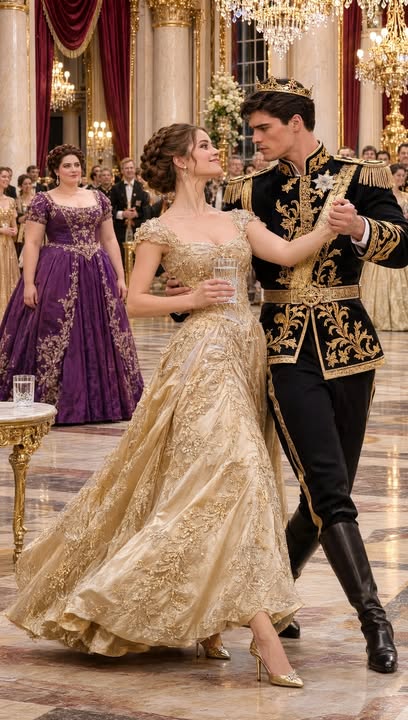
Part 3 – The Name in the Notebook
I paused beneath the ballroom doors, listening to the violin’s last note fade into the high, shadowed ceiling.
The prince had told me he practiced alone, but the thought stayed with me as I crossed the palace corridor and followed the attendants toward the guest wing.
The challenge had not been a kindness, exactly.
It had been a question he was too afraid to ask plainly.
I could understand that fear, but understanding did not make the way he had tested us feel fair.
By the time I reached my room, my feet ached and my mind had begun to turn the evening over from every angle.
I unfastened the small clasp at my throat, changed out of the orange gown, and carefully hung it in the wardrobe.
The glass had been returned to the attendants, but I could still feel its balance in my hand.
A few moments before the reversal, the prince’s palm had shifted against my back, and I had known his weight was about to move.
I had not anticipated him because I was clever.
I had anticipated him because years of practice had taught me to pay attention to the body beneath the steps.
My mother used to say that dancing was a conversation, and that the feet were only one way to speak.
I had not heard her voice in years.
Still, the words came back to me so clearly that I sat down on the edge of the bed and let the silence gather.
A knock sounded at my door.
I stood, expecting one of the attendants, and opened it to find the woman in champagne gold.
Her hair had come loose in a few places around her face, and without the ballroom’s lights on her jewels, she looked younger and more tired.
“I’m Celeste,” she said.
“I know.”
“Of course you do.”
She glanced at the corridor, then at me.
“May I come in for a moment?”
I hesitated.
Her earlier remark about my appearance had not been especially cruel, but it had been meant to make me feel small.
Yet there was something careful in her expression now, a reserve that looked less like confidence than the effort to hold herself together.
“All right,” I said.
Celeste stepped inside, leaving the door open behind her.
She did not sit until I gestured toward the chair by the window.
“I wanted to congratulate you,” she said.
“You already did.”
“I nodded.”
“I noticed.”
“That was not a proper congratulations.”
“Then thank you.”
She gave a small, rueful smile.
“I’m not very good at apologizing.”
“Is that what you came to do?”
“I’m trying to work out what I came to do.”
She folded her hands in her lap, and the stones at her neckline flashed faintly in the lamplight.
“I was unkind before the dance,” she said.
“You were.”
“I thought you would fail.”
“So did a lot of people.”
“That doesn’t make it better.”
“No.”
She nodded, accepting the answer without reaching for an excuse.
“I suppose I wanted someone else to look unprepared,” she said. “Then I wouldn’t feel so foolish for failing first.”
I studied her face.
She had spilled her water on the first sharp change, but I remembered the way she had held her shoulders afterward, chin high as the ballroom watched.
“You were the first,” I said.
“And the most confident.”
“You were confident.”
“I was certain I could do it.”
“Those aren’t always the same thing.”
“No,” she said softly. “They aren’t.”
For a moment, the only sound was the distant murmur of the palace settling around us.
Then Celeste’s eyes moved to the wardrobe, where my gown hung like a deep orange flame against the dark wood.
“You trained,” she said.
“I did.”
“At the old Vale Studio?”
The name startled me.
“Yes.”
Celeste’s face changed.
“I thought so.”
“How do you know that studio?”
She lowered her gaze to her hands.
“Because I trained there too.”
I waited.
“When I was younger,” she continued. “Not for long, but long enough to know the steps. My family stopped sending me after my second year.”
“Why?”
“They said dance was an indulgence.”
Her mouth tightened around the word.
“Then they hired tutors in etiquette and history, and began introducing me to people who could help me get invited to the right places.”
“People like the royal family?”
“People who could bring me closer to them.”
She said it without bitterness, but the absence of bitterness felt practiced.
“I was told the competition would be useful,” she added. “A chance to meet the prince, to show I could represent my family well.”
“And did you want that?”
Celeste looked toward the open door.
“I wanted to dance.”
The answer was so plain that I felt my guardedness shift.
Not disappear.
Just make room.
“I’m sorry,” I said.
“So am I.”
She rested one hand against the edge of the chair.
“Your mother taught you, you said?”
“At first.”
“Do you remember what she looked like when she danced?”
The question was unexpectedly intimate.
I pictured my mother in our little apartment, sweeping the kitchen chairs aside and turning a patch of floor into a studio.
Her hair had been dark, her movements unhurried, her hands light even when she was tired.
“I remember the way she made space,” I said.
Celeste’s eyes softened.
“That sounds like her.”
I stared at her.
“You knew her?”
“I knew of her,” Celeste said quickly. “At the studio, they spoke about one of the instructors who had left years before I arrived. I thought it might have been her.”
“What was her name?”
“Marian.”
My mother’s name sounded different in someone else’s voice.
It made the room feel smaller.
“Yes,” I said. “Marian was my mother.”
Celeste’s fingers pressed together.
“She was remarkable.”
The words unsettled me more than praise from the prince would have.
“Did you meet her?”
“Once, I think. I was very young. I remember a woman helping the instructor demonstrate a turn. She wore plain clothes and didn’t seem to care who was watching.”
“That sounds like her.”
“She moved like she was listening to something no one else could hear.”
I looked down at my hands.
That, too, sounded like her.
“What happened to her here?” I asked.
Celeste’s gaze rose to mine.
“Here?”
“You said the studio spoke about her. What did they say?”
“Only that she had been asked to leave.”
“Asked by whom?”
“I don’t know.”
The answer came too quickly to be complete, but she looked genuinely uneasy.
“I never asked,” she said. “At the time, it didn’t seem important.”
“And now?”
“Now you’re here, and the prince is practicing alone, and I’m wondering if the things I was told not to ask about were connected.”
I held her gaze.
“What do you know about his tremor?”
Her expression went still.
“Nothing official.”
“That isn’t what I asked.”
Celeste looked toward the doorway again.
“I’ve heard people talk,” she said quietly. “Not the contestants. The staff, sometimes. They say his hand has been unsteady for years, but the court has kept it private.”
“Did you know before tonight?”
“I suspected something.”
“But not enough to say anything.”
“No.”
“Why tell me now?”
“Because when you danced with him, he was not looking at the glass.”
I remembered his eyes on mine.
“He was watching my balance,” I said.
“Yes. And watching whether you noticed his.”
She gave a small breath, almost a laugh without humor.
“I used to think he made the challenge difficult because he enjoyed seeing people fail.”
“I thought that too.”
“Maybe he did not know how else to find someone who would understand.”
“That doesn’t make it fair.”
“No,” she said. “It doesn’t.”
For a while, we sat with the truth of that between us.
Celeste did not ask me to excuse him.
I did not ask her to forgive herself for the sharp remark.
Some apologies needed to be allowed to stand on their own.
At last, she rose.
“There’s something else,” she said.
“What?”
“If your mother kept anything from the studio, you should look through it.”
“I have some of her things.”
“Notes?”
“An old dance notebook.”
Celeste’s expression sharpened.
“Can I see it?”
“Not tonight.”
The refusal came out more firmly than I expected.
She accepted it with a small nod.
“Of course.”
“I don’t know what’s in it.”
“Then perhaps it’s worth finding out.”
She turned toward the door, then paused.
“May I ask you something?”
“You may.”
“Do you think he likes you?”
The question caught me off guard.
“I barely know him.”
“That wasn’t my question.”
I looked at the pale moonlight beyond the window.
“He respects what I did tonight,” I said.
“That wasn’t my question either.”
“I don’t know.”
Celeste watched me carefully.
“He looked at you as if he had been waiting for someone to see him.”
I thought of the tremor in his fingers, visible only after the music ended.
“Seeing someone isn’t the same as knowing them,” I said.
“No,” she replied. “But it can be the beginning.”
She left without making me answer the question.
I slept poorly.
Each time I closed my eyes, I saw the water trembling in the glass, and the prince’s hand changing pressure just before the turn.
In the morning, the palace felt quieter than it had the night before.
The other contestants had been invited to breakfast in the east salon, where sunlit windows overlooked the gardens.
Celeste was there, speaking with the silver-gowned woman from the ballroom.
When she saw me, she gave a brief nod that felt more sincere than her earlier one.
The prince did not appear.
A court attendant explained that he had a private meeting and would join us later, though he never did.
The absence gave the conversations a restless edge.
Some women discussed the next round.
Others wondered whether the prince would invite me to dance again.
I kept my attention on the tea.
By the time I returned to my room, the question Celeste had asked was still following me.
Do you think he likes you?
I set my cup down and opened the small trunk I had brought from home.
At the bottom, beneath a folded shawl and a stack of old recital programs, lay my mother’s notebook.
Its cover was cracked brown leather, the corners softened from years of use.
I had seen it many times.
I had never thought of it as a mystery.
My mother had filled it with music counts, diagrams of footwork, grocery lists, and reminders to call the landlord.
It was less a formal record of her work than a little window into the life she had lived.
I carried it to the window and began turning the pages.
Her handwriting moved between neat notes and quick, slanting lines.
There were sketches of dance positions, small arrows marking direction, and phrases I remembered from childhood: soften the knee, listen through the hand, never mistake stillness for certainty.
I smiled despite myself.
Then I reached a page tucked between two loose sheets of music.
A small drawing had been made in dark ink.
It showed a pair of dancers in profile, one guiding the other through a turn that ended with their weight shifted off-center.
The lead’s hand was drawn with particular care.
Beside it, my mother had written a sequence of counts and a short name.
The Vale Turn.
I leaned closer.
The notation was different from the rest of the page.
The lines were more precise, the lettering smaller, as if she had copied the movement from someone else.
At the bottom, she had added a date from years before I was born.
I traced the shape of the step with one finger.
It was the reversal from the ballroom.
Not merely similar.
The same.
The same quick shift of balance, the same pause before the leading hand changed direction, the same way the partners’ weight came together rather than pulling apart.
A knock sounded at my door.
I closed the notebook.
When I opened it, a palace archivist stood in the corridor, an older woman with silver hair and a slim folder tucked under one arm.
“Miss Marian’s daughter?” she asked.
“I am.”
“My name is Mrs. Vale. I work with the palace archives.”
The name made me glance at the notebook in my hand.
“Is that a common name here?”
A faint smile crossed her face.
“Common enough.”
She looked at the book.
“May I speak with you about it?”
I kept one hand on the cover.
“How did you know I had it?”
“The prince asked whether your mother’s name might appear in the old dance records.”
My pulse gave a small, startled beat.
“He asked you that?”
“He asked me to search the archive. I found a reference to a Marian, though I have not yet confirmed that she is your mother.”
Mrs. Vale did not step inside.
She seemed to understand that the decision was mine.
“Is there a reason he wanted to know?” I asked.
“His Highness did not explain.”
“Did you find anything?”
“I found a notation beside a ballroom diagram that may correspond to the step in your notebook.”
I opened the door wider.
“You recognize it?”
“I recognize the name.”
She glanced again at the worn cover.
“May I see the page?”
I hesitated, then turned to the drawing.
Mrs. Vale studied it with the focus of someone examining a document that might alter the meaning of other documents around it.
After a moment, she looked up.
“This is the Vale Turn,” she said.
“I thought the name came from the studio.”
“It may have been used there later, but the step was recorded in the palace collection long before the studio adopted it.”
“Who created it?”
Mrs. Vale’s answer was careful.
“That is what I am trying to establish.”
She closed the folder under her arm.
“May I examine the notebook in the archive?”
“I don’t want it taken from me.”
“I would not ask you to surrender it. I can compare the notation here, if you wish, or you may bring it in yourself.”
I looked down at the page.
My mother had drawn the turn with the same quiet precision she used when she taught me how to shift my weight.
“Can you tell me anything now?”
Mrs. Vale seemed to weigh her words.
“The step was associated with a period of private instruction at the palace, after an injury in the royal family.”
I remembered the prince’s hand.
“His father?”
“I cannot confirm that without checking the record.”
“But the turn was designed for someone injured?”
“Possibly.”
A knock sounded behind me, from farther down the corridor.
Mrs. Vale glanced toward it.
“I should return to the archive,” she said. “If you’re willing, I would be grateful if you came by this afternoon.”
“I’ll think about it.”
“That is all I ask.”
She started away, then paused.
“One more thing, Miss Marian.”
“Yes?”
“Your mother’s name appears in a restricted ledger beside the words ‘demonstration and adaptation.’ It was not listed among the official instructors.”
The words made the notebook seem suddenly heavier in my hands.
“Why would her name be restricted?”
“I don’t know.”
“Can you find out?”
“I can try.”
Mrs. Vale left me with the question.
I closed the door and returned to the window, where the page lay open to my mother’s drawing.
The Vale Turn.
My mother had taught it to me as if it were an ordinary piece of dance, one more way to listen through the hand.
But she had never said she learned it at the palace.
She had never mentioned the prince’s father, the archive, or a restricted ledger.
A few minutes later, another knock came.
This time, it was the prince.
He stood in the corridor without his formal jacket, dressed in a dark blue suit that made him look less like the man beneath the chandeliers and more like someone who had stepped away from a meeting before it was finished.
“I hope I’m not interrupting,” he said.
“You are.”
He accepted the answer with a faint nod.
“Then I’ll be brief.”
I held the notebook against my chest.
“Did you send the archivist?”
“I asked her to look into your mother’s name.”
“Why?”
His gaze flickered to the book.
“When you mentioned her last night, I thought there might be a connection.”
“To what?”
“To an old step my father used to practice.”
The room seemed to narrow around us.
“What happened to your father’s hand?”
The prince did not answer at once.
“It was injured before I was born,” he said. “I know very little about what happened afterward.”
“Your family never told you?”
“I was given the official account.”
“And you don’t trust it?”
“I’ve never had reason to question it.”
He looked at the notebook in my arms.
“Until now.”
I did not open the door any farther.
“Mrs. Vale said my mother’s name was in a restricted ledger.”
His face changed.
“What did she say it was beside?”
“Demonstration and adaptation.”
He lowered his eyes briefly, as if trying to recall a detail that had never been given to him.
“Did she tell you the step was called the Vale Turn?”
“Yes.”
He looked at me with a new, searching attention.
“My father used that name,” he said.
“Did he know my mother?”
“I don’t know.”
“Did he know who created the step?”
“I don’t know.”
The repetition made the silence between us feel more honest than any confident answer could have.
The prince’s right hand rested against the seam of his trousers.
His fingers trembled once.
He did not hide them.
“I don’t want to take anything from you,” he said. “Not the notebook, and not your mother’s story.”
“Then why did you ask the archivist to search without telling me?”
“I should have asked you first.”
“Yes.”
“I’m sorry.”
I looked at his face, trying to decide whether this apology was another way of smoothing over the palace’s secrets.
He did not look away.
“I’m not sure you understand what you may have uncovered,” he said.
“That makes two of us.”
He nodded.
“Would you let me see the drawing?”
I turned the notebook so he could read it without letting go.
The prince stared at the sketch.
For several seconds, he said nothing.
Then he lifted his gaze to mine.
“My father taught me this turn,” he said. “He told me it was safer than the old way.”
“Safer for whom?”
His expression had gone pale beneath its warmth.
“I don’t know.”
I looked back at my mother’s handwriting.
She had written the name beside the step, but she had never told me who the name belonged to.
The prince’s voice dropped.
“Did your mother ever say she worked at the palace?”
“No.”
“Did she know my father?”
“I don’t know.”
The question hung between us, larger than the room could contain.
The archive, the missing credit, the hidden injury, my mother’s sketch.
And the prince, standing at my door with his hand trembling in plain sight.
I tightened my grip on the notebook.
“Mrs. Vale wants to compare it with the palace records,” I said.
“I’ll go with you, if you want me to.”
“I haven’t decided whether I want you there.”
“I understand.”
I could tell he did not entirely understand.
Still, he did not press me.
Instead, he stepped back from the doorway, leaving the choice where it belonged.
I watched him turn toward the corridor, then looked down once more at the page.
The date beside my mother’s sketch was older than the official record Mrs. Vale had mentioned.
And beneath the drawing, in faint pencil I had never noticed before, was a second line of writing.
Not a dance count.
A name.
My mother had written: For King Adrian—after the fall.
**–END OF PART 3–CLICK “NEXT” AT THE BOTTOM OF THE PAGE TO CONTINUE READING**
* * *
[PREVIOUS: PART 2](https://echoesofstories.idolsgift.com/blog/part-2-the-secret-beneath-the-music-046) | [NEXT: PART 4](https://echoesofstories.idolsgift.com/blog/part-4-the-secret-beneath-the-music-046)
✓ Lynn R. Adams
Part 3 – The Name in the Notebook I paused beneath the ballroom doors, listening to the violin’s last note fade into the high, shadowed ceiling. The prince had told me he practiced alone, but the th…