PART 3: The Secret Beneath the Little Horse 052
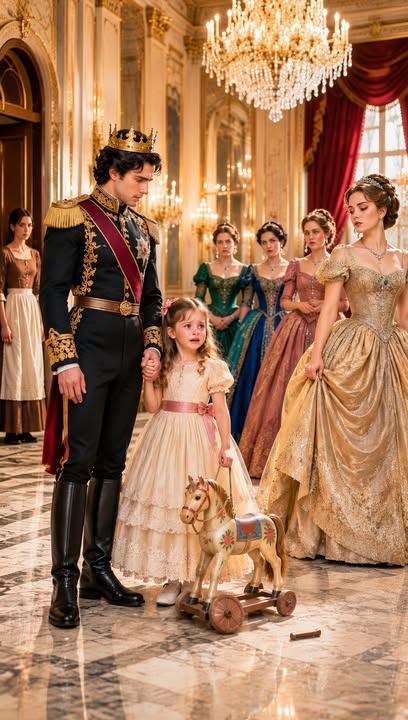
Part 3 – The Mark Beneath the Saddle
The maid spent the rest of the morning hearing her father’s old advice as clearly as if he were standing beside her.
Look first.
The emblem beneath the horse’s saddle had been no more than a few shallow cuts in the wood, yet it had unsettled her more than a broken wheel ever could.
She had seen the same star and crescent on her father’s awl, carved into the handle near the base.
As a child, she had asked him about it once.
He had smiled and told her it was a maker’s mark, a small sign that helped him recognize his own tools when they were mixed with another craftsman’s.
She had never asked whose mark it was.
She had never needed to.
The maid returned the horse to the princess and kept her thumb over the carving.
The child was busy turning the wheels, pleased that they moved smoothly, and did not notice the brief uncertainty in the maid’s face.
“Is he all right now?” the princess asked.
“He is,” the maid said. “The wheel is holding.”
“Then he can watch the garden with me.”
The maid helped her place the horse on the windowsill, where the morning sun rested across its painted back.
She might have asked the princess when the horse had been made, or whether her mother had told her where it came from.
But questions could turn a child’s treasured toy into an object of investigation.
The maid did not want that.
She wanted the little girl to have a morning in which the horse was simply safe.
So she stayed to read a picture book, and when the princess asked her to read the same story twice, she did.
The question of the emblem waited patiently.
It waited while the maid returned to her assigned work.
It waited while she carried linens through a sunlit corridor and polished the silver handles on a sideboard.
It waited while she tried to remember every toy she had seen in her father’s workshop and whether any had carried the same mark.
By noon, she had decided not to speak of it yet.
She would need to know more before she troubled the prince or the child.
But the court had other plans for the day.
When the maid entered the west gallery with a basket of folded cloths, she found several nobles gathered near the tall windows.
Their voices lowered when they noticed her.
That was how she knew they had been speaking about her.
She set the basket on a bench and began arranging the cloths with care, pretending she had heard nothing.
“Everyone is pleased by a touching story,” said one woman, “but a royal household cannot be guided by sentiment.”
“She has not asked to be considered for anything,” another replied.
“Not yet,” said the first. “The prince made a public challenge. The court will naturally wonder whether he intends to honor it.”
The maid kept her eyes on the folded linen.
She had not thought the prince’s words would travel so far beyond the hall.
She had also not thought that a repaired toy could make people question what place she belonged in.
A third voice spoke, quieter but no less certain.
“His daughter asked the maid to stay beside her. That is what has caused the talk.”
The maid’s hands paused.
Then she continued folding.
She had not wanted the princess to become a reason for anyone’s ambition, least of all her own.
The princess’s trust was a fragile thing, and it belonged to the child.
It was not a prize to be won.
The nobles moved on, their conversation fading into the gallery.
The maid stood alone beside the basket, feeling the palace seem larger and more watchful than it had the day before.
Not long afterward, the royal steward found her near the service stairs.
He was an elderly man with silver hair and a measured manner, and he had served the family for so many years that even the prince often listened when he spoke.
“The prince requests that you attend him in the small council room,” he said.
The maid felt a small tightening beneath her ribs.
“Has something happened to the princess?”
“No,” the steward assured her. “She is with her nurse and is quite well.”
He seemed to study her expression before adding, “The prince wishes to speak about yesterday’s challenge, and the noblewoman who withdrew from it has asked to make a statement.”
The maid understood.
The gold-dressed woman had not finished trying to explain away what had happened.
She followed the steward through a quiet passage and into the council room.
The prince stood beside a long table, reading a sheet of paper.
The noblewoman was there too, her gown now a softer shade of blue, her posture composed and her hands folded neatly before her.
She looked less like the proud figure who had recoiled from the dusty horse and more like someone preparing to offer a carefully polished apology.
“Thank you for coming,” the prince said.
The maid bowed her head.
The noblewoman met her eyes.
“I hope you will forgive the inconvenience,” she said. “I thought it best to clarify what I saw yesterday before the matter grew into something larger than it was.”
The prince set the paper down.
“Then please clarify.”
The noblewoman drew a quiet breath.
“The horse was already in poor condition,” she said. “I noticed that its wheel was loose before the challenge began. The maid found a peg that had fallen out and put it back. It was a simple repair, not a test of character or skill.”
The maid listened without interrupting.
The noblewoman continued, “It would be unfair to suggest that I failed to help the princess when the toy may have been broken for some time. The child was distressed before I had even touched it.”
“You did not touch it,” the prince said.
The woman’s cheeks colored, but she kept her voice even.
“No. I believed the repair should be handled by someone more accustomed to such work.”
“Yet you called for a servant to do it.”
“I did.”
The prince’s expression remained calm.
The maid recognized that calmness from the previous day.
He was not raising his voice, but he was paying close attention.
The noblewoman glanced toward the maid.
“I do not dispute that she was kind to the child. I simply don’t believe that a small repair should be treated as proof that she belongs in a marriage contest.”
“I have never said it was proof of that,” the prince replied.
“Your Highness, you declared that whoever helped your daughter would take one step closer to becoming your queen.”
“I did.”
“Then the court has a right to ask what you meant.”
The prince rested his hands on the edge of the table.
“The court may ask. It may not decide what my daughter’s comfort means on her behalf.”
The noblewoman’s expression softened a fraction.
“I understand that you wish to protect her.”
“Then you understand why I will not let her grief or her toys become instruments in an argument about rank.”
Silence settled in the room.
The maid looked at the prince, surprised by the firmness in his voice.
He did not appear angry with the noblewoman.
He appeared tired of having to explain that his daughter was a person, not a symbol.
The noblewoman looked down at her hands.
“I did not intend to make her grief an instrument.”
“I believe you,” the prince said. “But intentions are not the only things that matter.”
For a moment, the woman seemed to have no answer.
Then she turned to the maid.
“I was unkind yesterday when I mocked your offer to help. I should not have spoken to you that way.”
The apology was formal, but there was a shadow of embarrassment beneath it.
The maid bowed slightly.
“Thank you for saying so.”
The noblewoman seemed to expect something more.
When nothing came, she gave a short nod and turned back to the prince.
“Whatever you decide, Your Highness, I hope you will consider what is best for the princess.”
“I will.”
The noblewoman left the room, passing the maid with a faint rustle of silk.
The door closed behind her.
The prince looked down at the paper on the table.
“She is not wrong that the court will ask what I intended,” he said.
“I don’t know what Your Highness intended,” the maid replied.
“Neither do I, not entirely.”
He looked up.
“When I announced the challenge, I was thinking only of my daughter. I wanted to see who would notice that she needed comfort rather than another promise.”
The maid wondered whether he regretted making the challenge public.
“I did not mean to make you the center of a debate over who may stand beside me,” he said.
“I know.”
“Do you?”
She considered his face.
“You have not told me that I must accept anything.”
“No,” he said. “I won’t.”
The answer came so quickly that she believed him.
The prince lowered his voice.
“But the court will not be so careful. You may hear whispers. Some may assume you want a place you have never asked for.”
“I don’t want the princess to think I came to her rooms because of a title.”
“She won’t.”
The certainty in his voice reassured her, but not completely.
“She is four,” the maid said. “She may not understand why people are talking about me.”
“She understands more than the court gives her credit for.”
The prince stepped away from the table and glanced toward the window.
“When her mother died, people tried to make her feel better by offering her new things. New books, new toys, new lessons. They wanted to be kind, but they were also afraid of her silence.”
The maid thought of the princess pressing the horse against her chest.
“They were trying,” she said.
“Yes. But trying to fill a silence is not the same as listening to it.”
He turned back to her.
“You listened to her.”
“I only sat with her.”
“That is not a small thing.”
The maid did not know how to receive the praise.
Her father had taught her to mend what she could, and she had assumed that listening required no skill at all.
But perhaps she had learned that too.
The prince’s gaze flickered to the pocket of her dress.
“Is that the tool you mentioned?”
The maid touched the pocket lightly.
“Yes.”
“May I see it?”
She hesitated.
Not because she feared the prince, but because the awl felt like one of the last small things that belonged only to her and her father.
Then she remembered that he had asked, not commanded.
She took it out.
The cloth wrapped around its narrow point had been carefully tied in place.
The wooden handle rested across her palm, dark with age and smooth from years of use.
The prince looked at it without reaching for it.
“It is well cared for.”
“My father kept it that way.”
The prince leaned closer.
“Does this mark belong to the maker?”
The maid’s breath caught.
He had noticed the carving.
“Where did you see it?”
“On the handle.”
She turned the awl so that the worn emblem caught the light.
The star and crescent were faint, almost blurred by the years.
The prince studied it.
“I have seen this before,” he said.
The maid closed her fingers around the tool.
“Where?”
He did not answer at once.
His eyes had gone distant, as if he were searching through a memory he had not visited in a long time.
“I cannot say,” he said at last. “Perhaps on an old piece of furniture in the palace.”
The answer seemed to satisfy him, but it did not satisfy her.
She slipped the awl back into her pocket.
“I saw the same mark beneath the princess’s horse,” she said.
The prince looked sharply at her.
“You did?”
“Yes. Beneath the saddle. It is nearly hidden by the paint.”
“Why didn’t you tell me?”
“I did not know what it meant. I did not want to unsettle the princess by asking questions about a toy her mother gave her.”
His expression eased.
“That was thoughtful.”
“I thought it best to understand more before saying anything.”
“And now?”
“Now I would like to understand.”
The prince nodded slowly.
“So would I.”
For a heartbeat, the room felt less like a place where a servant had been summoned and more like a place where two people were sharing a question.
Then the steward appeared at the door.
“Your Highness, the princess is asking for the maid.”
The prince looked toward her.
“Would you like to go?”
The maid smiled faintly.
“Yes.”
The steward led her back to the princess’s rooms.
The girl was sitting beside the toy shelf with her rabbit in her lap and the horse placed in front of her.
When the maid entered, the princess’s face brightened.
“You came.”
“I did.”
The girl picked up the horse.
“Can we look at the funny wheel again?”
The maid knelt beside her.
“We can look, though I think it is working well.”
The princess turned the horse over, keeping one hand around its body.
The maid could see the faint emblem beneath the saddle now, partly covered by the child’s fingers.
“You have to be careful,” the princess said. “It’s old.”
“I will be.”
“My mother used to tell me that he had traveled a long way before he came to me.”
The maid felt her attention sharpen.
“Did she?”
The princess nodded.
“She said he had been to the village once. I thought she meant a village from one of her stories.”
The maid kept her face still.
She was afraid that any sign of surprise might make the child think she had done something wrong.
“Do you remember why she said that?” she asked.
“Not exactly.” The girl frowned in concentration. “She said he had been away before I was born, and then he came home to her.”
The maid’s fingers rested on her own knee.
“Perhaps he was made in a village workshop,” she said.
“Maybe.” The princess rubbed the horse’s painted neck. “Mother liked things made by hand.”
The girl looked up.
“Do you think your father made him?”
The question was quiet, but it changed the air between them.
The maid could have told her what she had seen.
She could have said that the emblem resembled the mark on her father’s tool.
But she still did not know whether it meant anything more than what her father had once claimed.
She would not put an uncertain story into a child’s heart.
“I don’t know,” she said gently. “But I can ask someone who might know.”
“Who?”
“The steward. He has been at the palace a long time.”
The princess looked toward the doorway.
“Will he know my mother’s horse?”
“He may know where it came from.”
The girl gave the toy a careful turn in her hands.
“Please don’t let anyone take it away.”
“I won’t.”
The maid realized at once that she had promised more than she could control.
She corrected herself gently.
“I will do everything I can to make sure it stays with you.”
The princess considered the distinction, then nodded.
The maid remained with her through the afternoon.
They read together, counted the horse’s painted spots, and made up a story about its journey to the palace.
In their story, it had crossed a forest, passed a river, and rested in a little workshop where a kind carpenter had repaired a wheel.
The maid did not say that the story was close to something she feared might be true.
She did not need to.
For a while, the princess was content to make the story belong to the two of them.
Later, when the child’s nurse came to take her to supper, the maid went in search of the steward.
She found him in the archive passage, overseeing the return of several bound account books to their shelves.
“May I ask you something?” she said.
“Certainly.”
She described the small emblem beneath the horse’s saddle.
The steward’s expression changed before she had finished.
Not with shock, but with recognition.
“Where did you see that mark?” he asked.
“On the princess’s toy.”
He looked past her, toward the distant corridor leading to the child’s rooms.
“Was it carved into the wood?”
“Yes. Beneath the saddle.”
The steward was quiet for a moment.
“Did you tell the prince?”
“I did.”
“And did you mention that the same mark is on a tool belonging to your father?”
The maid’s hands went still.
“I did not tell him that it is the same mark.”
“Why not?”
“I wanted to be certain I was not imagining it.”
The steward nodded.
“That is sensible.”
He rested one hand on the open ledger before him.
“May I ask your father’s name?”
The maid told him.
The steward repeated it under his breath.
Then he closed the ledger.
“I remember that name.”
The maid searched his face.
“From where?”
“An old account of household purchases. It was many years ago, before you came to the palace.”
He looked toward a narrow door at the end of the passage.
“I will need to consult the archive books before I can tell you more.”
“Do they say where the horse came from?”
“I cannot be certain. Some records are incomplete, and some were moved when the west wing was renovated.”
He seemed to be choosing his words carefully.
“Was my father known to the royal family?”
“Not personally, as far as I know.”
The maid felt an unexpected rush of disappointment.
Then the steward added, “But he may have done work for someone who was.”
The words stayed with her as he turned toward the archive door.
“Would you like me to ask the prince to look into it?” she said.
“I believe he already intends to.”
The steward gave her a thoughtful glance.
“Still, be careful with what you tell the princess until we know more.”
“I will.”
The archive door opened, revealing a cool room filled with shelves and the dry, familiar scent of old paper.
The steward disappeared inside.
The maid returned to her duties, but her thoughts remained with the emblem and the story of the horse’s long journey.
The next day, the palace felt different.
Nothing in the rooms had changed, and the sun crossed the same windows as before.
Yet people looked at the maid for a moment longer when she passed.
Some offered her a smile.
Others lowered their voices.
She tried not to let the whispers alter the way she entered the princess’s rooms.
The child greeted her with the same small smile as before and asked whether she had learned anything about the horse.
“Not yet,” the maid said. “The steward is searching the old records.”
“Will it take long?”
“I don’t know.”
The princess hugged the horse.
“I hope he finds something.”
“So do I.”
Before the maid could say more, a familiar voice sounded behind them.
“Your Highness, I was told the princess wished to see me.”
The noblewoman stood at the threshold.
She had come without her bright gown and jewels, dressed in a simple lavender day dress with her hair pinned back neatly.
The princess drew the horse against her chest.
The maid shifted closer to the child.
The noblewoman noticed and paused.
“I’m not here to frighten her,” she said.
“I know,” the maid replied, though she remained where she was.
The noblewoman looked toward the princess.
“May I speak with you for a moment?”
The child did not answer.
The prince entered the room behind the noblewoman.
He had apparently heard the request and followed her himself.
“You may speak here,” he said. “There is no need for anyone to leave.”
The noblewoman’s shoulders tightened.
“I only wished to apologize to the princess.”
The prince looked toward his daughter.
The girl’s fingers closed around the wooden horse.
“You don’t have to answer,” he told her.
The noblewoman lowered herself slightly, careful to keep a respectful distance.
“I am sorry I laughed at your horse yesterday,” she said. “It was precious to you, and I should have treated it with care.”
The princess glanced at the maid, then back at the noblewoman.
“You didn’t fix it,” she said.
“No,” the noblewoman admitted. “I didn’t.”
“Why not?”
The question was innocent, but the noblewoman’s answer mattered.
She took a moment to consider it.
“I was afraid of getting my dress dirty,” she said. “That was a poor reason to leave you upset.”
The princess studied her.
“Did you want to help me?”
The noblewoman’s composure faltered.
“I wanted to behave as I thought a future queen should behave,” she said. “I was more concerned with looking right than with noticing what you needed.”
The maid watched the woman’s face.
There was regret there, though it had come after the moment when it was most useful.
The princess lowered her gaze to the horse.
“My mother said people should be kind even when no one is watching.”
The noblewoman’s expression softened.
“Your mother sounds as though she understood something important.”
“She did.”
The prince looked away, and the room became quiet.
The noblewoman bowed her head.
“I am sorry,” she said again.
The princess did not smile, but she gave a small nod.
That was enough for now.
The woman straightened and looked toward the prince.
“I won’t trouble you further.”
The prince nodded.
She turned to leave.
At the doorway, she glanced once more at the maid.
“I hope the court does not make this harder for you than it needs to be.”
It was not quite an apology for what she had said in the hall.
It was not quite a warning either.
The maid could not tell which.
The noblewoman left without waiting for an answer.
The princess pressed her cheek against the horse.
“Was she still trying to be queen?” she asked.
The prince sat beside her.
“I don’t know what she hopes for.”
“Do you want her to be?”
The prince took a breath.
“What I want most is for you to feel safe.”
The girl’s eyes moved to the maid.
“Then she can stay?”
The prince’s gaze followed hers.
“She can stay as long as she wishes to visit you, and as long as it is right for her.”
The princess nodded, but her grip on the maid’s sleeve tightened.
The maid felt the child’s worry pass through the small fingers between them.
She understood then that even kindness could make a child afraid when every change seemed to carry the possibility of another loss.
“I am not going anywhere today,” she said.
The princess looked up.
“Today?”
“I can’t promise everything about tomorrow,” the maid said gently. “But I can be honest with you about where I am, and I can tell you when I have to leave.”
The girl seemed to think about that.
Then she leaned against the maid’s shoulder.
The prince watched them, his expression tender and troubled.
Later that evening, the steward sent for the maid and the prince together.
They met in the archive room, where a small stack of old ledgers lay open beneath a brass reading lamp.
The steward turned a page with careful fingers.
“I have found a record of a commission made by the late queen,” he said.
The prince leaned over the table.
The maid stood beside him, unable to keep her attention from the faded ink.
The steward traced a line written in a narrow, elegant hand.
“Several wooden toys were ordered from a village workshop,” he said. “The commission is dated shortly before the princess was born.”
The prince read the name of the village.
It was the maid’s home.
Her breath caught.
The steward turned to the next line.
“Here is the craftsman’s name.”
The maid recognized her father’s.
For a moment, the room seemed to tilt around her.
The prince glanced at her, but she could not return his look.
The steward continued reading.
“The record describes a painted horse, a small bird, and a set of carved blocks. It also notes that the queen chose the workshop because the craftsman used a mark showing a star and crescent.”
The maid touched the pocket where her father’s awl rested.
The prince read the date again.
“This was before my daughter was born.”
“Yes, Your Highness,” said the steward. “The queen had the toys sent to her family rooms.”
The maid stared at the page.
Her father had never spoken of a royal commission.
He had never said he had made toys for the queen.
He had never said that a wooden horse made in his workshop might one day become the most precious possession of a little princess.
The steward turned another page.
“There is a note attached to the order,” he said. “The original paper has been kept with the record.”
He drew out a narrow, folded sheet, yellowed at the edges.
The prince looked toward the maid.
“Would you like to read it?”
She could not tell whether she wanted to.
But the answer was already in her.
“Yes.”
The steward unfolded the paper carefully.
The hand belonged to the queen, though the maid had never seen it before.
A few faded lines described the toys and thanked the craftsman for his care.
The final sentence was written more lightly, as if it had been added after the rest.
“May my daughter remember that kindness matters more than the station of the hand that offers it.”
The prince’s face grew still.
The maid looked at the sentence until the letters blurred.
Her father had made the horse.
The queen had chosen it for her daughter.
But the record did not yet explain why the maid had seen the emblem beneath the saddle, or what it meant that the horse had come to the palace years before the princess received it.
The steward turned the page once more.
Beneath the queen’s note, in a different hand, was an entry written after the toys had already arrived.
It recorded that the horse had been returned to the village workshop for repairs.
And beside that entry, in the margin, someone had written the date of its return.
**–END OF PART 3–CLICK “NEXT” AT THE BOTTOM OF THE PAGE TO CONTINUE READING**
* * *
[PREVIOUS: PART 2](https://storyly.idolsgift.com/blog/part-2-the-secret-beneath-the-little-horse-052) | [NEXT: PART 4](https://storyly.idolsgift.com/blog/part-4-the-secret-beneath-the-little-horse-052)
✓ Lynn R. Adams
Part 3 – The Mark Beneath the Saddle The maid spent the rest of the morning hearing her father’s old advice as clearly as if he were standing beside her. Look first. The emblem beneath the horse’s …