PART 3: The Secret Beneath the Boat 057
Part 3 – The Mark Beneath the Floorboard
The brass token lay in Lina’s palm, cool against her skin, while the candle flame shivered above it.
Her father’s name was faint, but unmistakable.
She turned the token toward the light and traced the stamped letters with one careful finger.
The royal dock emblem had been pressed into the other side: a small anchor beneath a crown, surrounded by a circle of tiny rays.
Lina had seen the mark before, on the iron fittings of the palace docks and on the seals that guarded the royal stores.
She had never seen it on anything that belonged to her family.
The note slipped from her other hand and landed beside the open box.
Keep this safe until the truth is ready to be heard.
For years, she had thought the words meant her father believed her sketches might one day matter.
Now the token made the note feel different.
It seemed less like a farewell and more like a message he had entrusted to her.
Lina leaned closer to the faded name.
The final letters were worn almost smooth, but enough remained to read them.
“Elias.”
Her father’s name.
She had known it all her life, of course.
What she did not know was why it had been stamped on an official royal token.
Perhaps he had worked at the docks before she was old enough to remember.
Perhaps the token had been given to him by someone who wanted to honor his work.
Perhaps it meant nothing at all.
She tried to tell herself that last possibility was the most likely.
But the token felt too carefully hidden to be ordinary.
She wrapped it in the note and tucked both beneath the sketches, then closed the wooden box.
Sleep came late.
When it did, she dreamed of the boat on the shore, but the rollers beneath it were not round pieces of wood.
They were brass tokens, turning slowly beneath the weight.
The next morning, Lina carried the little box to the palace dock beneath her shawl.
She did not bring it because she had decided to show the prince.
She brought it because she could not bear to leave it alone in her room.
The palace was already stirring around her.
Servants crossed the courtyard with baskets and folded linens, while guards changed posts beneath the broad stone arches.
Beyond the terrace, the lake shone pale beneath a high veil of cloud.
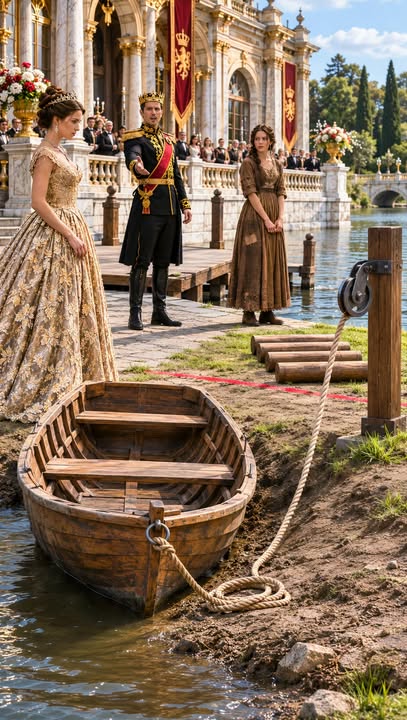
The contest boat still rested on the marked bank.
A pair of dockworkers had begun inspecting its hull before returning it to the water.
The sight of it brought back the applause, the mud on her hands, and the prince’s attentive questions.
It also brought back the sensation of the token against her palm.
“Lina.”
She turned.
Prince Adrian was crossing the terrace with a narrow ledger tucked under one arm.
He had removed his crown, though the gold clasp of his royal uniform still caught the light.
“I hoped you might be here,” he said.
“I was passing by, Your Highness.”
The lie was small, and they both knew it.
He glanced at the box beneath her shawl but did not ask about it.
“Would you have time to help inspect the boat before the workers put it back in the lake?”
Lina hesitated.
Her duties for the morning were nearly finished, but there was still laundry to deliver to the eastern rooms.
“I can stay for a little while.”
“That is all I ask.”
He turned toward the boat, and she followed at a respectful distance.
The dockworkers had propped the hull slightly on one side.
Their tools lay arranged on a cloth beside them: a wooden mallet, a small pry bar, a coil of rope, and a lantern for looking into dark spaces.
“Your Highness,” said the older worker, touching his cap.
The prince greeted him by name.
“This is Lina,” he said. “She helped move the boat yesterday, and I thought she might notice something we miss.”
The worker looked at Lina with an approving smile.
“We saw what she did, miss.”
A second worker, younger and broad-shouldered, nodded toward the rollers.
“Better than half the men on the dock could have managed.”
Lina felt color rise in her cheeks.
“I only kept pulling.”
“You kept thinking,” the older worker replied.
The prince looked pleased, but not triumphant, as if the praise belonged to her and he had no wish to claim any part of it.
They began with the outside of the hull.
The workers checked the bow ring, the rope marks, and the seams where the oak boards met.
The boat was old but sturdy, with a narrow strip of painted blue along its upper edge.
Lina ran a hand near the bow without touching the wet paint.
“Was this boat built at the palace?” she asked.
“Repaired here many times,” the older worker said. “The original timbers may be older than I am.”
“Do you know who made it?”
The worker shrugged.
“Not offhand.”
Prince Adrian opened the ledger.
“I asked the harbor office to bring the repair records.”
“You thought I might find something?” Lina asked.
“I thought it was worth looking,” he replied. “There are many questions about this boat that no one has bothered to ask.”
The answer made Lina glance at him.
It was not only the token he wanted to understand.
Perhaps he had sensed there was something in her silence she had not yet named.
The inspection proceeded slowly.
One of the dockworkers tested the boards along the floor with the mallet, listening to the difference between a solid knock and a hollow one.
Most of the hull answered with a deep, steady sound.
Near the center, however, the mallet gave a thin tap.
The worker tried again.
The hollow note returned.
“This board has lifted,” he said.
He knelt and pressed his fingers along the seam.
“Not by much.”
“Could water have worked beneath it?” the prince asked.
“Possibly,” the worker said. “Though the boat was used only for the contest.”
He eased the pry bar into the narrow gap and looked toward the prince for permission.
“Go ahead,” Adrian said.
The board lifted with a soft creak.
Beneath it was a dark space no wider than a hand.
The worker leaned toward the opening.
“What do you see?” Lina asked.
“Something caught along the frame.”
He reached inside and drew out a small object wrapped in a strip of faded cloth.
It was a brass token.
For one suspended second, Lina could not breathe.
The token was the same size as the one in her box, though this one was darker, its surface dulled by dust and age.
The royal dock emblem showed through on one side.
The prince reached for it, then stopped.
“Would you like to look?” he asked Lina.
She stared at the token.
“I should.”
The worker set it gently in her palm.
It was heavier than it looked.
The emblem was almost identical to the one on her father’s token, but the worn letters on the reverse were different.
A small name had been stamped beneath the crown.
Lina tilted it toward the light.
“Can you read it?” Adrian asked.
“Not yet.”
She brushed away a film of grit with her thumb.
The letters became clearer, one by one.
“Elias,” she whispered.
The older dockworker looked up sharply.
The prince’s face changed.
“Your father’s name?” he asked.
Lina nodded, still staring at the token.
The second worker leaned closer.
“How did it get inside the boat?”
No one answered.
The question seemed to settle over the dock, heavier than the hull itself.
Lina’s fingers closed around the brass.
“I found another one last night.”
The prince looked at her.
She had not intended to tell him so quickly, but the discovery had made secrecy feel pointless.
“Where?” he asked.
“In a box with my father’s old sketches.”
“May I see it?”
Lina took the box from beneath her shawl.
She opened it and brought out the folded note, then the token wrapped inside.
The older dockworker let out a quiet breath.
“Two tokens stamped with the same name,” he said. “That is no accident.”
“Not necessarily,” said a voice behind them.
The noblewoman had arrived with her father and two members of her household.
She wore a deep green day dress, its fine embroidery catching the light at the cuffs.
Her manner was composed, but her eyes went first to Lina, then to the two tokens.
“Lady Seraphina,” the prince said.
She inclined her head.
“I was told the boat was being inspected, and I thought I should come. My family has maintained the royal vessels for several generations.”
Her father, Lord Varrick, stood beside her.
He was a tall, silver-haired man with a precise way of holding himself, as if even his silences had been rehearsed.
“Your Highness,” he said. “This boat is probably older than the token’s current design. Dock markers were often reused.”
The prince held the token bearing Elias’s name.
“Could this one have been placed inside the hull by a worker?”
“It is possible,” Lord Varrick replied. “Dock crews marked tools and materials in all sorts of ways.”
Seraphina looked at Lina.
“Your father worked at the palace docks?”
“I don’t know,” Lina said.
She could hear the uncertainty in her own voice.
“Then we should not assume more than the evidence tells us,” Seraphina replied.
Her tone was not unkind.
That made the words harder to dismiss.
The prince studied the token.
“Do you recognize it, my lord?”
Lord Varrick stepped closer, keeping his hands clasped behind his back.
“I recognize the emblem,” he said. “Not the name.”
He examined the old brass, then returned his gaze to Adrian.
“The royal dock issued hundreds of tokens over the years. Some marked access, some marked tools, and some merely identified a worker’s berth or locker. Their meaning changed from one season to another.”
“Do you recall seeing one with this stamp?” the prince asked.
“Not specifically.”
“Could it have belonged to someone outside the dock crew?”
“It could have been found there, borrowed, or passed along. Without a record, there is no way to know.”
His explanation was reasonable.
It also left Lina with the uncomfortable sense that every door had been opened only to reveal another corridor.
The older dockworker looked at the underside of the raised floorboard.
“There’s no space for it to have fallen through,” he said. “Someone would have had to place it here.”
“Or it was caught in a seam during an old repair,” Lord Varrick replied.
The worker nodded slowly.
“That could happen.”
Seraphina’s gaze remained on Lina.
“You should be careful what stories you build around a name,” she said. “The palace is full of old objects that people want to make important.”
The sentence sounded like practical advice.
It also sounded like a warning.
Lina thought of the note in her box.
Keep this safe until the truth is ready to be heard.
She tucked it beneath her shawl.
“I’m not trying to build a story,” she said. “I only want to understand why it was there.”
Seraphina’s expression softened for a moment.
“I know.”
The brief kindness unsettled Lina more than the earlier caution.
The prince noticed the exchange.
“An honest question does not become an accusation merely because the answer is inconvenient,” he said.
Lord Varrick inclined his head.
“Of course, Your Highness. I am only saying the evidence is incomplete.”
“So am I.”
Adrian’s voice stayed calm, but his attention had grown more intent.
He turned to the older worker.
“Can you tell whether the board has been lifted before?”
The worker examined the seam.
“More than once, I’d say. See these marks along the edge? The wood was pried up and put back down. Not yesterday.”
“Could you identify when?”
“Not precisely.”
The younger worker ran a finger along the frame.
“There’s a second mark here.”
He pointed to a thin groove inside the cavity, nearly hidden beneath the board.
Lina leaned closer.
It looked like a line drawn with a narrow blade, followed by several short strokes.
Not a name, but a rough shape.
A wheel.
Or perhaps a pulley.
“Do you know what that is?” she asked.
The older worker bent beside her.
“It could be a carpenter’s guide mark.”
“Or a repair notation,” Lord Varrick said.
Adrian’s eyes moved from the groove to Lina.
“You have seen marks like this before?”
She shook her head.
“No, Your Highness.”
But the sight of it tugged at a memory.
The sketches in her box had many marks like that: small circles, arrows, and short lines that helped her remember where a beam should sit or which way a wheel should turn.
Her father had taught her to draw them before she was old enough to understand what they meant.
She had never seen him carve one into wood.
“Could we look at the other side of the board?” she asked.
The worker examined the narrow gap.
“If we remove it fully, we may damage the old fittings.”
“Then we shouldn’t,” she said at once.
The prince nodded.
“Not until we know more.”
The boat had become a puzzle with too many careful hands around it.
Lina could feel the difference between curiosity and danger, though no one had raised their voice or made a threat.
The danger was in what a discovery might cost.
For Seraphina’s family, the token could suggest old neglect, a forgotten worker, or an embarrassment buried in the royal boats.
For Lina, it could mean that her father had once belonged to a world she had never been allowed to enter.
And for the prince, it could mean that his family’s records had left something important in the dark.
“Your Highness,” Lord Varrick said, “the palace archive may hold the original dock inventories. I would be glad to help locate them.”
“I’ll ask the archivist to search,” Adrian replied.
“That may take some time.”
“Then we will give it time.”
Seraphina’s eyes moved to the crowd gathering at the far end of the dock.
A few attendants had noticed the inspection and were whispering to one another.
“Perhaps we should keep this quiet until there is something definite,” she said.
The prince looked at the onlookers.
“Quiet is not the same as private,” he replied. “People have already seen the token.”
“They have seen a piece of brass,” she said. “They have not heard a story.”
“Nor should they hear one from us before we understand it.”
Seraphina accepted the answer with a small nod, but her mouth remained tense.
The dockworkers carefully lowered the floorboard back into place without fastening it.
The older man wrapped the token in clean cloth and offered it to the prince.
Adrian turned to Lina.
“Would you be comfortable keeping this with you until the archivist has had a chance to look?”
Lina looked at the small bundle.
“It came from the boat.”
“Then it should remain with the palace until it can be documented,” Lord Varrick said.
The prince paused.
“He is right about the record,” he said. “The archivist can log it and keep it secure.”
Lina did not argue.
She had not expected the token to belong to her simply because it bore her father’s name.
Still, releasing it felt like surrendering the only tangible link between her father and the hidden past.
Adrian seemed to understand.
“Would you like to come with me when we take it to the archive?”
She glanced at the housekeeper, who was not present, then at Seraphina.
The noblewoman’s face revealed little.
“If my duties allow,” Lina said.
“I’ll speak to the steward.”
Lord Varrick’s eyes rested on her for a brief moment.
“An ordinary token can become a troublesome symbol if people are careless with it,” he said.
Lina met his gaze.
“Then we should be careful.”
His expression did not change.
“No one could disagree.”
Seraphina turned slightly toward her father.
“May I speak with Lina for a moment?”
The prince looked to Lina, leaving the choice with her.
She nodded.
They moved a few steps away from the workers, though the others remained within sight.
The morning air smelled of wet timber and lake water.
Seraphina’s voice lowered.
“My father is not trying to insult you.”
“I didn’t think he was.”
“He has spent most of his life keeping the royal household’s affairs in order. He knows how quickly an old question can spread beyond what anyone intended.”
Lina thought of the crowd’s applause the previous day, and how quickly admiration had turned into speculation.
“Are you worried about the truth?” she asked.
Seraphina looked toward the boat.
“I’m worried about what people do when they think they know the truth.”
It was not an answer, but it was more honest than Lina had expected.
Seraphina drew a slow breath.
“My family has served the crown for generations. We have been trusted with repairs, records, and the care of the docks.”
“I know.”
“People depend on that trust.”
“So does the palace.”
“Yes.” Seraphina looked at Lina again. “And the prince.”
For a moment, she seemed less like the contestant who had laughed at Lina beside the lake and more like someone carrying an inheritance she had never chosen.
“Yesterday, I thought you wanted attention,” Seraphina said.
“I didn’t.”
“I understand that now.”
Lina wondered whether she did.
Seraphina touched the edge of one embroidered sleeve.
“Still, the court will take an interest in you. The prince’s interest will make it greater.”
“He asked me about the boat.”
“He asked you about your dreams.”
Lina had no reply.
Seraphina’s expression tightened, though not with anger.
“I’m not telling you to hide what you know,” she said. “I’m asking you to remember that once people begin deciding what your story means, they may stop listening to what you actually say.”
Lina studied her face.
“Is that what happened to you?”
A flicker crossed Seraphina’s eyes.
“My family has been spoken for by others since I was a child.”
The answer made the space between them feel different.
Before Lina could respond, the prince called to them.
“The archivist is ready to receive the token.”
Seraphina gave a slight nod.
“Then I will leave you to it.”
She turned back toward the others.
Lina watched her go, unsure whether she had been offered a warning, an apology, or both.
The prince accompanied Lina through the palace’s long eastern corridor toward the archive.
Their footsteps echoed beneath the painted ceiling.
“I’m sorry that became uncomfortable,” he said.
“It was not only uncomfortable.”
“What was it?”
“Complicated.”
He considered that.
“Seraphina is trying to protect her family.”
“She said as much.”
“Her father has served the crown for many years. His work is important.”
“So is the truth.”
Adrian looked at her.
“Yes.”
The simplicity of his answer eased something in Lina, though it did not remove her unease.
They reached the archive, a high-ceilinged room lined with shelves and narrow cabinets.
The palace archivist, Master Pell, met them at a broad oak table.
He was a short, silver-haired man whose spectacles seemed permanently fogged from the dry, dusty air.
Prince Adrian handed him the wrapped token from the boat.
Master Pell opened his ledger.
“Found beneath a floorboard in the contest vessel?” he asked.
“Yes,” Adrian replied.
“And the inscription bears the name Elias?”
Lina stiffened.
“How did you know?”
Master Pell glanced at her.
“The prince mentioned the name in his message. I thought it wise to have the relevant dock lists ready.”
He turned several pages in the ledger.
“Elias is not a rare name,” he said. “The older records are incomplete, but I can search the inventories and workers’ rolls from the previous generation.”
“Would you look for both tokens?” Adrian asked.
“The second token as well, if Miss Lina is willing to let me record its details.”
Lina placed her father’s token on the table.
Master Pell examined it through a small lens, then made a careful sketch of the emblem and the letters.
He did not take it from her.
“These are very similar,” he said. “Different batches, perhaps, but the same form.”
“Can the records tell us what they were used for?” Lina asked.
“Possibly.”
The archivist opened a cabinet and drew out a box of narrow, cloth-bound volumes.
“Dock records were kept in several places. There are inventories for tools, ledgers for wages, and lists of royal commissions. The trouble is that not all of them survived the damp.”
He began with a list of dockworkers from twenty years earlier.
Lina watched as he moved down the page, his finger following the faded names.
The first names were familiar only in the way of old names heard at family gatherings.
Then he stopped.
“Here,” he said.
Lina leaned closer.
The entry was written in dark brown ink.
Elias Vale, contract carpenter and mechanical draftsman.
Her breath caught.
“My father’s family name was Vale,” she said.
The prince looked from the record to her.
Master Pell turned the ledger so she could see it clearly.
Beside the entry, in a different hand, someone had written a small note.
“Commissioned to assist with river transport improvements.”
The archive seemed to grow very quiet.
Lina read the line again.
Mechanical draftsman.
The words she had once only imagined herself becoming were written beside her father’s name.
“What does that mean?” she asked.
“It means he did more than work as a carpenter,” Adrian said.
Master Pell examined the record.
“The palace sometimes hired skilled workers to help solve practical problems. A draftsman would have made plans or sketches for a particular project.”
Lina thought of the drawings in her box.
Her father’s hand had been steady and precise.
She had known that from the letters he used to write to her mother.
She had never known he had been paid to draw designs.
“Can you tell what project he worked on?” the prince asked.
“Not from this page.”
Master Pell searched another volume, then a third.
He read entries in silence, occasionally stopping to compare dates.
Lina’s father had worked at the docks during the same years as the older records of the palace boat.
The dates overlapped, but they proved nothing by themselves.
Master Pell turned another page.
“There is a separate index for royal commissions,” he said.
He stood and crossed to a cabinet at the back of the room.
The prince followed him.
Lina remained at the table, looking again at the words beside her father’s name.
Mechanical draftsman.
The title felt like a piece of a life she had never been allowed to see.
From the far side of the archive, Master Pell called out.
“Your Highness, I may have found the commission.”
Adrian returned with a thin folder.
Its leather cover was cracked, and a strip of faded blue ribbon marked the page inside.
Master Pell laid it on the table.
“This record is from the year before Elias Vale’s name disappears from the wage rolls.”
Lina’s hands went cold.
“Disappears?” she asked.
“Sometimes a worker left the palace service,” Master Pell said quickly. “The records do not always say why.”
The prince opened the folder.
The first page described a project to improve the movement of heavy vessels between the dock and the repair yard.
Several lines were missing where the ink had been damaged by water.
The remaining words mentioned a system of pulleys and wooden rollers.
Lina stared at the page.
She could see the boat on the shore, its keel resting on the cylinders she had placed beneath it.
She could see the rough sketch in her box, the one she had made long before the contest.
“Is there a drawing?” she asked.
Master Pell turned the next page.
A sheet had once been attached there, but only its darkened outline remained.
“Perhaps the design was kept separately,” he said.
“Could there be another record?” the prince asked.
“I will check the engineering collection.”
Master Pell reached for the folder, then stopped at a line near the bottom of the final page.
He read it silently.
“What is it?” Adrian asked.
The archivist looked troubled.
“It says the completed method was formally presented to the crown by Lord Varrick.”
Lina’s gaze lifted.
“Seraphina’s father?”
The archivist nodded.
“According to this record, he received a royal award for the design.”
The prince’s face became still.
“Was Elias Vale credited?”
Master Pell searched the page.
“Not here.”
“But his name is on the work order,” Lina said.
“It is,” Master Pell replied. “That does not tell us who designed the final method.”
A quiet knock sounded at the archive door.
Seraphina stood in the entrance, her face pale with contained composure.
“My father told me what you found,” she said.
She looked at the open folder.
Then at the dock token beside Lina’s sketches.
“Is there any possibility,” she asked, “that my father received the award for work he did not create?”
**–END OF PART 3–CLICK “NEXT” AT THE BOTTOM OF THE PAGE TO CONTINUE READING**
* * *
[PREVIOUS: PART 2](https://storyly.idolsgift.com/blog/part-2-the-secret-beneath-the-boat-057) | [NEXT: PART 4](https://storyly.idolsgift.com/blog/part-4-the-secret-beneath-the-boat-057)
✓ Lynn R. Adams
Part 3 – The Mark Beneath the Floorboard The brass token lay in Lina’s palm, cool against her skin, while the candle flame shivered above it. Her father’s name was faint, but unmistakable. She turn…