PART 3: The Secret Behind the Silver Balance 057
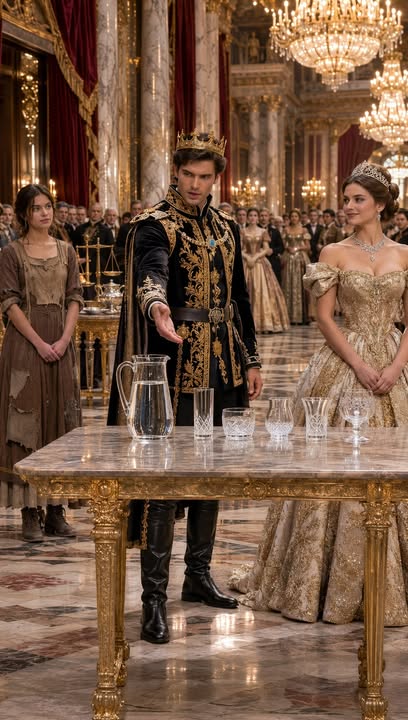
Part 3 – Two Halves of a Secret
The noblewoman did not sleep well that night.
Whenever she closed her eyes, she saw the silver token at the maid’s throat, its old royal crest catching the light as she passed through the servants’ doorway.
By morning, the memory had sharpened into something more troubling than curiosity.
Her grandmother’s token had been kept in a small velvet-lined box, alongside letters tied with faded ribbon.
The box had not been opened in years, but the noblewoman remembered the token clearly: the crown above a branch of three leaves, worn smooth at the edges.
She had once asked about it.
Her grandmother had only said, “It belonged to someone who should not be forgotten.”
The answer had seemed poetic then, and the noblewoman had not pressed her.
Now she wished she had.
She found the box in a writing cabinet in her rooms, beneath a stack of old household accounts.
The velvet had faded to the color of dried roses.
Inside lay a silver token, almost identical to the one she had seen.
She lifted it carefully, feeling its cool weight against her palm.
The crest matched, though a narrow seam ran down the center of the design.
At first, she thought it was a scratch.
Then the light shifted, and she noticed tiny letters engraved along the lower edge.
Only a few were visible.
The rest disappeared where the silver had been cut cleanly in half.
A quiet knock sounded at the door.
Her lady-in-waiting entered carrying a tray of tea, then paused at the sight of the open box.
“Is something wrong, my lady?”
“I am not certain.”
The noblewoman turned the token over between her fingers.
“Do you know whether my grandmother ever spoke of a sister?”
The lady-in-waiting searched her face.
“I heard that she had a younger sister, but I never knew her name.”
“Why have I never heard that from my family?”
“Perhaps it was a sorrowful subject.”
The noblewoman looked again at the token.
“Or perhaps it was a subject someone wished forgotten.”
She did not explain further.
The lady-in-waiting set down the tea and waited, but the noblewoman had no answer to give.
For the first time, her family’s silence felt less like privacy and more like a locked room.
Across the palace, the maid began the morning in the royal kitchens.
The head cook had spread the supply accounts across a worktable, and the prince stood beside him, listening as they discussed the poor harvest and the stores that would need to last through winter.
The maid kept to the edge of the table at first.
She was used to working where she was needed, not to being invited into a conversation about what the whole palace would eat.
The head cook, Master Orlan, was a broad-shouldered man with flour caught in the creases of his sleeves.
He had served in the kitchens for nearly thirty years and was not easily impressed by a clever answer in a ballroom.
He tapped the account book with one thick finger.
“Beans are down by a quarter, and the southern grain wagons are delayed.”
“Then we will need to plan around what we have,” the prince said.
“Of course, Your Highness,” Orlan replied. “But there is only so much planning can do.”
The maid studied the figures.
“What happens to the kitchen staff’s portions when the stores run low?” she asked.
Orlan looked at her.
“Everyone receives what the steward approves.”
“And the younger servants?”
“They receive the same ration as the others.”
The maid hesitated.
“Some of them are still growing.”
The prince glanced toward her.
“Have you noticed they are not eating enough?”
“I have noticed that they leave the table hungry.”
Orlan’s brow furrowed.
“They are given the portions listed here.”
“Perhaps the portions are fair on paper,” the maid said, “but some of the children work longer hours than others.”
The prince rested one hand on the table.
“Can we make a plan that accounts for the work each person does, without making anyone feel singled out?”
The maid considered the question.
“If we set aside a small amount for the late kitchen shift and for the youngest workers, then the cooks can serve it as part of the ordinary meal.”
Orlan rubbed his chin.
“That would mean changing the schedule.”
“And writing down what is used,” the prince added. “We should know whether the plan is working.”
The maid nodded.
“I can help track it, if Master Orlan agrees.”
The cook looked from her to the prince.
“I do not mind someone checking the accounts, Your Highness, but I will not have a stranger telling my cooks how to stir a pot.”
The maid met his gaze without taking offense.
“I would not presume to do that.”
For a moment, the cook’s expression remained guarded.
Then he gave a short nod.
“Good. You can start by helping me find where the flour has gone.”
A quiet laugh slipped from the prince.
The maid returned to the accounts, and the work began.
No one praised her for understanding the need, and she was grateful for that.
She counted sacks, checked dates, and asked the cooks which meals could be made with less grain without leaving anyone hungry.
The prince stayed longer than his other duties required.
He listened as Orlan described the difficulty of feeding the palace staff when deliveries were uncertain, and he listened just as closely when the maid suggested that some of the stores be moved closer to the kitchen entrance to reduce waste.
The work was practical and sometimes tedious.
It brought the three of them into disagreement over small matters: how much dried fruit could be used in porridge, which day the bread ovens should run, and whether a record of the younger servants’ meals would make them feel watched.
The maid argued that the food should be recorded but the children should not be.
The prince agreed.
Orlan, after some thought, agreed too.
By late morning, a simple plan had taken shape.
The palace would serve a modest extra portion during the late shift, and the kitchen would keep a daily account of the ingredients used.
The prince asked the maid to return the following day so they could see whether it worked.
She accepted, though she still seemed uncertain how to stand when he addressed her as a colleague rather than a servant.
When the meeting ended, the prince gathered the papers and thanked Orlan.
Then he turned to the maid.
“You did well.”
“I had good teachers.”
“I have begun to understand that.”
His voice was gentle, but the warmth in it lingered after he had left.
The noblewoman had seen enough of that warmth the night before to make her uneasy.
She arrived at the kitchen passage just after the prince departed.
The maid was carrying an empty tray toward the scullery when she saw her.
“My lady.”
The noblewoman stopped.
“I would like to speak with you, if you have a moment.”
The maid set down the tray.
“Of course.”
The noblewoman had prepared several ways to begin the conversation, but none sounded right now that they were standing face to face.
She looked at the maid’s worn dress, the careful way she held herself, and the thin chain that rested at her collar.
“Yesterday, I saw the token you wear.”
The maid’s hand moved instinctively to her throat.
“My mother gave it to me.”
“May I see it?”
The question came quietly, without the sharpness that had filled her voice in the ballroom.
The maid studied her for a moment.
Then she slipped the chain from beneath her collar and held the token in her palm.
The noblewoman took the silver piece with care.
There it was: the crown and three-leaf branch, worn nearly smooth by years of touch.
Her fingers trembled.
“Where did your mother get this?”
“She said it belonged to her family.”
“Did she ever tell you whose crest it was?”
“She said it had once been kept by people who served the palace. She did not know why the royal mark had been put on it.”
The noblewoman turned the token over.
The tiny letters along the edge were partly obscured by wear, but she could make out a narrow line ending at the cut seam.
The maid leaned closer.
“Is something wrong?”
“No,” the noblewoman replied, though her voice had changed. “I have seen this before.”
She returned the token.
The maid closed her fingers around it.
“My grandmother owned one like it,” the noblewoman said. “I found it this morning.”
For a moment, neither spoke.
The kitchen passage carried the sounds of pots and voices around them, but the space between them seemed unusually still.
“Perhaps they were made for people who worked in the palace,” the maid said.
“Perhaps.”
The noblewoman tried to keep her tone even.
“Would you come with me after your shift? I would like to compare them.”
The maid’s eyes narrowed slightly, not with suspicion but with caution.
“Why?”
“Because I do not want to make guesses about your family without asking you.”
The answer seemed to surprise the maid.
After a brief pause, she nodded.
“I finish at sunset.”
The noblewoman waited in a small sitting room near the courtyard until the maid arrived.
She had brought the velvet box and two cups of tea, though she had not touched her own.
The maid sat across from her, leaving a careful space between them.
The noblewoman took the token from the box and placed it on the table.
The maid set hers beside it.
The two pieces were the same size and shape.
Each bore the same crown and branch.
Along the edge of one token were the tiny engraved letters that had caught the noblewoman’s attention that morning.
The other carried their continuation.
The maid leaned forward.
“Those marks look like writing.”
“They are,” the noblewoman said. “But neither token has the complete line.”
Together, they turned the silver pieces until their cut edges nearly met.
The seam fit with a quiet precision.
The broken inscription became whole.
The maid traced the letters with one fingertip, careful not to press too hard.
“What does it say?”
The noblewoman bent closer.
“‘For those at the table, while any of us draws breath.’”
The maid read the words again.
“They sound like a promise.”
“Or a pledge.”
The noblewoman’s face had gone pale.
“My grandmother told me only that the token belonged to someone who should not be forgotten.”
The maid looked up.
“My mother said something similar.”
“What exactly?”
“She said it was a reminder that the palace had once made a promise to its servants, and that promises could be lost if no one kept asking about them.”
The noblewoman’s breath caught.
“Did she know my family?”
“I do not know.”
“Did she ever tell you that her mother had a sister?”
The maid’s expression changed.
“She said her mother had been close to a woman in the palace, but she never told me the woman’s name.”
The noblewoman lowered her eyes to the joined tokens.
“My grandmother may have been that woman.”
Neither of them spoke for several seconds.
Then the maid drew back slightly.
“Why would the tokens have been divided?”
“I don’t know.”
“Why would your grandmother keep one and my mother keep the other?”
“I don’t know that either.”
The noblewoman looked toward the window, where the last light rested against the courtyard stones.
“I am beginning to understand how little I know about my own family.”
The maid did not answer, but her face softened.
They separated the tokens and returned them to their owners.
The silver pieces felt heavier now, not because their weight had changed, but because each had acquired a question attached to it.
The prince found them together a short while later.
He had come to ask the noblewoman about a council meeting, but stopped when he saw the open box and the two women seated across from one another.
“Have I interrupted something?”
“No,” the noblewoman said. “We were comparing our tokens.”
The maid stood.
“Your Highness.”
He noticed the silver on the table.
“May I ask what you have found?”
The noblewoman glanced at the maid.
She did not want to answer for her.
The maid spoke first.
“They appear to be two halves of the same inscription.”
The prince moved closer.
He read the joined words, then looked at the matching crests.
“Do you know what they mean?”
“Not yet,” the noblewoman said.
The prince examined the engraved letters without touching them.
“These are old.”
“My grandmother kept hers with family papers,” she said. “I had not seen it in years.”
“Your mother gave me mine,” the maid added. “She said it came from her family.”
The prince’s expression grew thoughtful.
“Would you both be willing to let me search the palace records?”
The noblewoman looked at the maid.
The maid hesitated, then nodded.
“If the records are available to us both.”
“They will be,” the prince said.
The words were simple, but he seemed to understand the importance of them.
The noblewoman watched the way he looked at the maid—not with the admiration he had shown in the ballroom, but with a steady respect that troubled her more.
She knew how the court read closeness.
A prince who sought a servant’s judgment could be called generous.
A prince who relied on her could be called reckless.
A prince who appeared to favor her could turn a quiet kindness into a contest, whether either of them wanted it or not.
The noblewoman had once imagined that the prince’s choice of a queen would settle her future and her family’s standing.
Now she was not certain she wanted him to choose her.
Nor was she certain she could bear what the court might say if he chose the maid.
The prince gave the tokens back to their owners.
“I will ask the archivist to bring the relevant household registers and kitchen records.”
“Thank you, Your Highness,” said the maid.
“We should not assume the answer will be what we expect,” he cautioned.
“No,” said the noblewoman. “But we should find out what it is.”
The search began the following morning.
The palace archivist, a patient woman named Mistress Vale, brought several bound volumes and a small wooden box of loose papers to a reading room adjoining the old library.
The prince joined them, as did the noblewoman and the maid.
The records smelled of dust, leather, and the faint sweetness of old paper.
Mistress Vale explained that the palace had kept careful household accounts for generations, though not every volume had survived fire, damp, or careless handling.
“We can begin with the kitchen staff lists,” she said. “If your mother served here, we may find her name.”
The maid gave it to her.
Mistress Vale wrote it down and opened a heavy register.
The prince stood behind her chair while the noblewoman and the maid sat on either side of the table.
For several hours, they searched.
They found the maid’s mother’s name in a kitchen ledger from years earlier.
The entry listed her as a capable worker assigned to the pastry room, with no note of misconduct and no record of a formal hearing.
Then, several months later, her name appeared in a different hand beside a short line: “Service concluded by order of the household steward.”
“That is all?” the noblewoman asked.
“It appears so,” Mistress Vale replied. “The reason was not entered here.”
“Was that usual?” the maid asked.
“Not when someone had been dismissed for a serious offense,” the archivist said. “There would normally be a report or a witness statement.”
The prince leaned over the page.
“Could the rest be in another record?”
“Possibly. We will need to check the steward’s correspondence and the household petitions.”
The maid kept her eyes on the page.
She did not seem surprised to learn her mother had been dismissed without explanation.
That, more than any outburst could have, showed how long she had carried the unanswered question.
The noblewoman set one hand on the table.
“My grandmother might have known something.”
The maid glanced at her.
“Do you think she was involved?”
“I don’t know. I hope not.”
The noblewoman’s voice was honest, but the uncertainty hurt.
The prince asked Mistress Vale to search the petition register.
As the archivist left to fetch it, the noblewoman turned toward the maid.
“I should tell you something about the way I spoke to you yesterday.”
“You apologized.”
“I did, but an apology does not undo a habit.”
The maid listened without interruption.
“I have spent years believing that wealth and position made me responsible for decisions others could not make for themselves,” the noblewoman continued. “Sometimes I have mistaken that belief for wisdom.”
“That is a difficult thing to notice.”
“It is harder to admit.”
The maid considered her.
“I do not think you need to be perfect to be kind.”
The noblewoman looked down at the old ledger.
“I am not sure I know how to be kind without first making myself feel important.”
“Then you can practice without announcing it.”
The words were gentle, but they landed with the force of a truth the noblewoman could not set aside.
The prince watched the two women, saying nothing.
When Mistress Vale returned, she carried a narrower volume and a folded sheet of paper protected between two pieces of stiff board.
The register contained a brief note recording that the maid’s mother had petitioned for assistance after her dismissal.
The petition itself had not survived, but a later clerk had copied part of its summary into the margin.
The archivist read it aloud.
“‘Applicant disputes the steward’s account and requests review of the household fund withheld from the kitchen servants.’”
The maid went still.
The noblewoman turned toward her.
“Your mother asked for help about money?”
“Not that I know of,” the maid said. “She never told me about a household fund.”
The prince looked again at the entry.
“Was there a fund for the kitchen servants?”
Mistress Vale searched the next page.
“There was a small charitable account administered by the household steward. It was intended to support workers during illness or hardship.”
“Do the accounts show where it went?” the prince asked.
“Not in this volume.”
The archivist opened the loose sheet she had brought.
It was a damaged ledger fragment, its lower corner darkened and several lines erased by age or damp.
A sum had been written beside the words “servants’ charity,” then crossed out.
Below it, a different entry read, “Transferred to household reserves by instruction of the steward.”
The prince’s jaw tightened.
“Was that transfer authorized?”
“I cannot tell from this page.”
The noblewoman examined the damaged writing.
“Could my grandmother have approved it?”
“Possibly,” Mistress Vale said. “Or someone may have used her authority without her knowledge.”
The maid looked at the inscription on the joined tokens, which rested between them on the table.
“For those at the table, while any of us draws breath.”
The noblewoman’s face had gone pale again.
“My grandmother would have remembered a promise like that.”
“Then perhaps we should look for her letters,” the prince said.
Mistress Vale nodded.
“Some correspondence from that period is stored in the west archive. It may take time to locate.”
The prince turned toward the noblewoman.
“Would your family have kept private papers from her?”
“There are boxes in our country house,” she said. “My grandmother’s letters were kept together, but I don’t know whether they were ever sorted.”
“Could they be examined?”
“I can ask.”
The maid studied the damaged ledger.
“If my mother petitioned for help and never received it, then she may have been dismissed for asking questions.”
“That is possible,” the prince said. “But we should not decide before we have the rest of the record.”
The maid nodded, though the effort of restraint was visible in her face.
She had spent years living with the absence of an answer.
Now an answer seemed close enough to touch, and she was afraid of what it might cost.
The archivist continued the search through the afternoon.
They found another note, this one in a clerk’s hand, recording that a sealed letter had been attached to the petition.
The letter itself was not among the papers.
Beside the note, someone had written, “Forwarded to the steward’s private cabinet.”
“Was the steward’s cabinet preserved?” the prince asked.
Mistress Vale considered.
“The room was cleared when the old steward retired. Some papers were moved to the west archive, but not all were catalogued.”
The prince looked toward the tall windows.
The day had dimmed around them.
“Then we will search there tomorrow.”
The maid closed the ledger carefully.
The noblewoman touched her token through the fabric of her sleeve.
For the first time, the mystery seemed to reach beyond two matching pieces of silver.
It reached toward a promise, a fund, a dismissal, and a silence that had crossed from one generation into another.
As they prepared to leave, Mistress Vale paused over the copy of the old petition.
“There is one more note here,” she said. “I had not seen it before.”
The prince turned back.
The archivist lifted the page toward the light.
A faint line of writing, almost hidden beneath the damaged edge, became visible.
She read it twice before speaking.
“‘The matter concerns the two sisters and their joint gift to the servants’ fund.’”
The noblewoman stared at her.
“Two sisters?”
Mistress Vale nodded.
The maid’s fingers closed around the silver token at her throat.
The prince leaned toward the page, his expression suddenly intent.
Beneath the line, in a different hand, someone had added a name.
Mistress Vale read it aloud.
It was the name of the noblewoman’s grandmother.
**–END OF PART 3–CLICK “NEXT” AT THE BOTTOM OF THE PAGE TO CONTINUE READING**
* * *
[PREVIOUS: PART 2](https://storyly.idolsgift.com/blog/part-2-the-secret-behind-the-silver-balance-057) | [NEXT: PART 4](https://storyly.idolsgift.com/blog/part-4-the-secret-behind-the-silver-balance-057)
✓ Lynn R. Adams
Part 3 – Two Halves of a Secret The noblewoman did not sleep well that night. Whenever she closed her eyes, she saw the silver token at the maid’s throat, its old royal crest catching the light as s…