PART 3: The Secret Behind the Bell 057
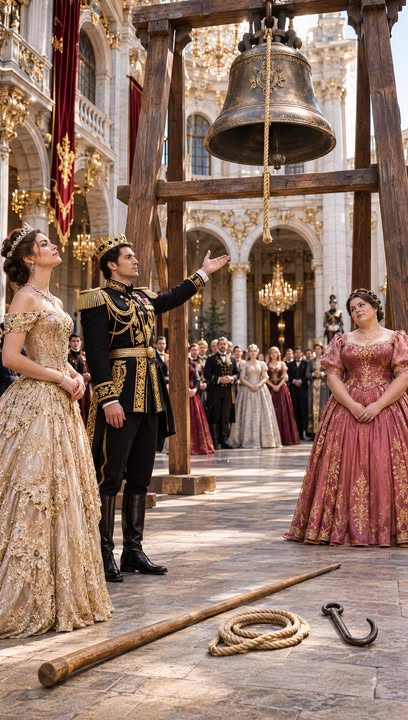
Part 3 – The Mark Beneath the Dust
Emma looked from the brass instrument to the bell, the old memories stirring but not yet falling into place.
“My father had one just like this,” she repeated, more quietly.
The attendant glanced down at the case, as though he had only just realized the object had become personal.
“The archivist asked that you come to the records room,” he said. “He believes the diagram may be easier to understand alongside the bell itself.”
Julian studied Emma’s face.
“Would you like to see it?”
She wanted to say yes at once.
She also wanted to turn away from the case, go home, and open the sewing box where her father’s tool lay wrapped in cloth.
If the two instruments were truly alike, then the old stories she had kept at a safe distance might become something more than stories.
“I’d like to see the diagram,” she said.
Victoria looked at the bell again.
“So would I.”
There was a note of concern in her voice that had not been there earlier.
“My family’s name is attached to the renovation,” she added. “If something was changed without approval, I want to understand how.”
Julian gave a small nod.
“Then we’ll go together.”
He did not offer Emma his arm or assume she needed him to lead the way.
Instead, he waited until she had taken the first step.
The records room lay beyond the inner courtyard, behind a pair of tall oak doors that opened onto a cool passageway.
The palace grew quieter as they walked, the noise of the gathering fading behind them until only the measured tap of their shoes remained.
Emma carried the wooden case herself.
It was lighter than she expected, but the weight of what it might mean seemed to rest in her hands.
The palace archivist met them at the entrance.
He was a slender, gray-haired man named Mr. Vale, with ink on the side of one finger and a magnifying lens hanging from a cord around his neck.
“Your Highness,” he said, bowing to Julian.
Then he turned to Emma.
“You must be Miss Emma.”
“I am.”
“I’m sorry to have summoned you without more explanation,” he said. “The object in that case was discovered among papers from the courtyard renovation. When I saw its maker’s mark, I thought it might be wise to ask whether anyone recognized it.”
Emma set the case on a broad table.
The room smelled of old paper, beeswax, and rain-damp stone.
Tall shelves lined the walls, crowded with ledgers and rolled plans, while narrow windows let in a pale afternoon light.
Mr. Vale placed a sheet of paper on the table.
“Here is the drawing found with the instrument.”
The parchment had browned at the edges.
Its faint lines showed the bell frame from the side, with a rope passing over a small wheel near the upper beam.
A second line, drawn in darker ink, traced a route down through the frame and toward a small, square mechanism beside the base.
Emma bent closer.
“That’s the pulley,” she said.
“So it appears,” Mr. Vale replied. “The wheel was fitted to the frame, but it is no longer there.”
Julian leaned over the drawing beside her.
“Could the missing wheel have fallen off?”
“Not without leaving more damage,” Emma said.
She pointed to the small circles marked around its center.
“These are fittings. The wheel was held in place with a pin and a bracket.”
Mr. Vale nodded with quiet satisfaction.
“That is what I thought, though I hoped someone with practical knowledge might confirm it.”
Victoria moved to the opposite side of the table.
“Does the drawing show who designed it?”
Mr. Vale turned the parchment slightly.
At its lower corner, nearly hidden beneath a crease, was a small mark: three curved lines around a central dot.
Emma’s breath caught.
She knew that mark.
It was the same one stamped on the brass instrument her father had kept.
“It’s a maker’s mark,” she said.
“Do you recognize it?” Julian asked.
“My father used it on his tools.”
Mr. Vale’s expression sharpened.
“Your father’s name?”
“Thomas,” Emma said. “Thomas Bell.”
The archivist’s eyebrows lifted.
“Bell-maker Thomas Bell?”
Emma looked at him.
“You knew his name?”
“I have encountered it in several old maintenance records,” he said. “But I had no idea you were his daughter.”
The discovery brought a strange mixture of pride and unease.
For years, her father’s name had belonged to the stories he told at home, to the worn tools in his workshop, to the quiet work he had done without asking for praise.
Here, in the palace, it appeared in the careful ink of official records.
“May I see the instrument?” Emma asked.
Mr. Vale opened the case and lifted the brass piece with gloved hands.
Its curved end matched the small socket drawn beside the pulley.
He placed it gently on a clean cloth.
Emma did not reach for it at once.
The marks on its handle were almost identical to those on her father’s tool, but the brass was less worn and its curve was slightly narrower.
“It isn’t his,” she said.
Julian glanced at her.
“But it is the same design?”
“Yes. Or close to it.”
Mr. Vale turned the instrument so its stamped mark faced them.
“Three lines, one central point,” he said. “The mark appears on the diagram as well.”
Emma traced the same pattern on the parchment with one finger, careful not to touch the ink.
Her father’s work had been here all along, fixed to the frame, recorded in a drawing, and then somehow separated from both.
“What does the instrument do?” Victoria asked.
“It fits over the pulley pin,” Emma said. “It could help release the wheel or adjust its position without damaging the frame.”
She looked more closely at the brass.
“There are small grooves along the curve. They’re made for grip, not decoration.”
“You learned to read tools as a child?” Julian asked.
“My father taught me to notice what hands had done to them,” Emma said. “A polished place shows where someone held on. A worn edge tells you what they used it for.”
Julian watched her as she spoke.
It was not the look of someone waiting to praise her for being unexpectedly capable.
He seemed to be trying to understand how she had learned to see the world this way.
The distinction mattered, though Emma could not yet explain why.
Mr. Vale reached for another sheet, this one a copy of a work order.
“This was included in the renovation papers,” he said. “It may explain why the rope’s current arrangement differs from the drawing.”
The sheet was newer than the diagram, though its ink had faded to brown.
A date appeared near the top, followed by a list of work completed on the courtyard.
The bell had been inspected, cleaned, and retensioned.
At the bottom, a short notation read: Original pulley to be removed; cord to be rerouted over upper support.
Victoria went still.
“Who authorized this?”
“The order bears your family’s renovation seal,” Mr. Vale said, “but the signature is not your father’s.”
Victoria’s chin lifted.
“Who is it?”
The name below the seal had been partly obscured by a water stain.
Mr. Vale tilted the paper toward the window.
“Only the first letters remain clear,” he said. “A. R.”
Victoria stepped closer.
“My father didn’t approve that order,” she said. “He oversaw the garden restoration, but the bell was assigned to the palace office.”
“Then someone may have used the seal without his knowledge,” Julian said.
Victoria’s face tightened.
“You think my family’s seal was copied?”
“I think we don’t yet know who authorized the work.”
The care in Julian’s answer did not seem to reassure her.
She looked toward Emma, perhaps expecting her to say the same thing.
Emma could only study the order.
The altered route explained why the rope had slipped over the wooden support.
It also explained why the challenge had been harder than the drawing suggested.
“Would the original pulley have made the bell easier to ring?” she asked.
“Safer, certainly,” said Mr. Vale. “The drawing shows the rope passing through a guided system, rather than being pulled directly over the beam.”
“Then whoever altered it did more than remove a part,” Julian said. “They changed the way the bell could be used.”
“Yes,” Emma replied.
Her voice was even, but something inside her had tightened.
She thought of her father’s words about making a difficult thing safer.
That was the exact phrase he had used when he spoke of the brass tool.
Mr. Vale opened a ledger and ran his finger down a narrow column.
“Thomas Bell’s name appears beside the original installation,” he said. “He was listed as the craftsman responsible for the pulley assembly.”
Emma felt the room shift slightly around her.
“My father built it?”
“According to this record, he designed and fitted it.”
The answer should have filled her with uncomplicated pride.
Instead, it brought the ache of wondering how long everyone had known, and why she had never been told.
Julian looked at the ledger.
“Was he credited elsewhere?”
Mr. Vale began turning pages.
“I will need to search the older entries. The records have been moved more than once, and some references are incomplete.”
Emma’s attention remained on the faded drawing.
A line near the bottom described the mechanism as a safety release for emergency use.
“What kind of emergency?” she asked.
Mr. Vale scanned the accompanying note.
“I’m afraid this portion is too damaged to read.”
Victoria folded her hands in front of her.
“Could the missing pulley have been removed recently?”
“The work order is dated to the courtyard renovation,” the archivist said. “That was only a few months ago.”
Victoria looked down at the seal.
“I did not see this order.”
“I believe you,” Emma said.
Victoria’s eyes lifted, surprised.
Emma understood how easily suspicion could attach itself to a person because of a name, a family, or a room full of people who had already decided what that person represented.
“I don’t know who signed it,” Emma continued. “But you came here to find out. That matters.”
Victoria’s shoulders loosened a little.
“Thank you.”
She did not ask Emma to defend her further.
That restraint felt like its own kind of apology.
Julian turned to Mr. Vale.
“Can you trace the order through the renovation records?”
“I can try. The original office files may have been transferred to the sealed archive during the last cataloguing.”
“Why are they sealed?” Victoria asked.
“Some contain private correspondence and unapproved plans,” the archivist replied. “The royal steward’s office restricted access until the materials are properly indexed.”
Julian frowned.
“I can request access.”
“Of course, Your Highness,” Mr. Vale said. “But it may take a day or two.”
Emma glanced at the instrument on the cloth.
“And the original pulley?”
“If it was removed during the renovation, it may have been stored with discarded fittings,” Mr. Vale said. “I will search the workshop inventory.”
Her father’s design, altered and removed, had become a trail of paper and brass.
Emma felt her old curiosity returning, but it was tangled with a fear she did not want to name.
She had once imagined herself inside the royal workshops, learning from the same skilled hands that had taught her father.
Now, standing in the records room, she wondered whether that door had closed on her because someone had judged her unworthy—or because the palace had spent years quietly losing the work of people like him.
Julian had been silent for several moments.
When he finally spoke, his voice was lower than before.
“I’m sorry.”
Emma turned toward him.
“For what?”
“For making the bell into a contest before I understood what it represented,” he said. “I thought the challenge was about cleverness. I didn’t know the mechanism had been changed, or that your father had designed it.”
“You couldn’t have known all of that.”
“I still chose to make a promise in front of a crowd, as if a person’s future could be attached to a performance.”
The honesty in his words unsettled her more than an excuse would have.
She looked down at the lines of the drawing.
“You meant it to be playful,” she said.
“I did. But intention does not erase what it sounded like.”
Victoria watched him, her expression thoughtful.
“People were laughing,” she said. “I was laughing.”
“Because I gave them a stage,” Julian replied.
There was no accusation in his answer.
He seemed to include himself in the very thing he had begun to recognize.
Emma felt the memory of the courtyard press close: the laughter, the challenge, the attention that had made her feel both exposed and strangely seen.
“I don’t want anyone to pretend it didn’t happen,” she said. “But I don’t want the bell’s history turned into another performance either.”
“Then it won’t be,” Julian said. “Not without you.”
She searched his face for the easy confidence he had worn when he first raised his voice in the courtyard.
It was still there, but it had been joined by something more careful.
She could not yet decide whether that care came from genuine interest or guilt.
They spent the next hour comparing the drawing with the old maintenance entries.
Mr. Vale found three references to Thomas Bell’s work, each shorter than the last.
One praised his skill in fitting the pulley.
Another recorded that he had submitted a revised design to the palace office.
The third had been crossed through in a later hand, leaving only the words “recognition deferred.”
Emma read the phrase twice.
“Why would someone cross that out?” she asked.
Mr. Vale leaned toward the page.
“The ink is much newer than the entry,” he said. “Someone amended this after it was written.”
“Can you tell who?”
“Not from this page.”
Julian’s expression darkened with concentration, though he kept his voice level.
“Could the person who altered the record also have approved the later work order?”
“It is possible,” Mr. Vale said. “But we would need more evidence.”
Victoria studied the crossed-out words.
“Recognition deferred,” she murmured. “It sounds as if someone promised him something.”
Emma felt a hollow ache open beneath her ribs.
Her father had never said he expected recognition.
He had told her that the work mattered whether or not anyone knew his name.
But perhaps he had learned to say that because no one had kept their promise.
Julian noticed her silence.
“Emma?”
“I’m all right,” she said, though the words were no longer convincing.
Mr. Vale closed the ledger gently.
“I will continue searching,” he promised. “There may be more in the older files.”
As they left the records room, Victoria paused at the doorway.
“I’ll ask my father about the renovation seal,” she said. “He may remember who handled the contracts.”
“Would he be offended if you asked?” Emma said.
“He may be surprised,” Victoria replied. “But he would rather know the truth than have people assume his family approved something it did not.”
She glanced toward Julian.
“And I’ll make it clear that I’m asking as myself, not as a representative sent to protect our name.”
“That seems fair,” Emma said.
Victoria gave her a small, tentative smile.
It was not yet warmth, but it was no longer rivalry.
Julian waited until Victoria had gone before turning to Emma.
“Would you let me see the tool your father kept?”
Emma’s hand moved instinctively toward the pocket of her skirt, though the tool was at home.
“I have it with me,” she said. “I carried it for years, and I still bring it when I know I’ll be working with a mechanism.”
She drew a small cloth bundle from the inner pocket of her gown.
The gesture surprised even her.
She had not intended to show it today.
Slowly, she unfolded the cloth.
The brass tool lay inside, darkened with age and polished smooth at one end from years of use.
Julian leaned closer, but did not touch it.
Mr. Vale had come to the doorway behind them, drawn by the sight of the object.
He stared at the maker’s mark.
“May I?” he asked.
Emma nodded.
The archivist examined the tool beneath his magnifying lens.
“This mark is identical to the one on the diagram,” he said. “And the curve matches the original pulley fitting.”
“It’s his,” Emma said.
She had known that already, but hearing the archivist confirm it made the connection feel real.
Mr. Vale turned the tool gently.
“Wait.”
He bent closer to its narrow base.
“Do you see these tiny numbers?”
Emma leaned in.
Two faint figures had been stamped beneath the maker’s mark.
Julian drew the faded work order from the case and set it beside the tool.
The same figures appeared in the margin, almost hidden by the fold.
Mr. Vale’s face changed.
“These are not measurements,” he said. “They’re a cross-reference.”
“To what?” Victoria asked from the passageway.
She had returned, having evidently heard his voice.
Mr. Vale looked from the number on the tool to the notation on the order.
“To a file number.”
He crossed back into the records room and searched a nearby index.
The room seemed to shrink around the sound of turning pages.
At last, he stopped.
“Here,” he said.
The entry was short, written in a clerk’s hand from many years earlier.
“Bell mechanism—design correspondence and service account—restricted.”
Julian looked up.
“Restricted by whom?”
Mr. Vale followed the line to the final column.
A name had been written there in darker ink than the rest.
Emma read it once, then again.
The former royal steward.
The same office that had sealed the archive.
Mr. Vale’s finger moved to the next line.
“There’s another notation,” he said. “The file was transferred to the sealed archive shortly after the bell’s original installation.”
“And the work order?” Julian asked.
Mr. Vale placed it beside the index.
“The alteration order cites the same file number.”
Victoria’s face had gone pale.
“My family’s seal may have been placed on the order,” she said, “but the instruction came from the office that controlled the archive.”
“That would explain why the original records disappeared,” Julian said.
“But not why they were hidden,” Emma replied.
Mr. Vale studied the file index, then turned the page.
A final note had been written in the margin.
“Service account to be kept from public record until the matter is settled.”
Emma’s fingers closed around the edge of her father’s cloth.
“What matter?” she asked.
The archivist read the next line aloud, slowly.
“Bell-maker Thomas Bell claims the royal family promised recognition for his emergency service during the palace fire.”
No one moved.
The room was quiet enough for Emma to hear the old clock ticking above the shelves.
Her father had never told her he claimed anything.
He had only said that the palace bell had once rung when it was most needed.
Julian’s face had lost its color.
“Emergency service?” he repeated.
Mr. Vale turned the page over.
On the reverse, a final sentence had been written in a different hand.
The archivist read it, then looked directly at Julian.
“Prince Julian’s mother was rescued after the bell summoned help.”
Emma stared at the words.
The bell had not merely been part of her father’s work.
It had once called the palace to save someone in Julian’s own family.
And somewhere behind the sealed doors of the archive, the record of how he had done it was still waiting.
**–END OF PART 3–CLICK “NEXT” AT THE BOTTOM OF THE PAGE TO CONTINUE READING**
* * *
[PREVIOUS: PART 2](https://storyly.idolsgift.com/blog/part-2-the-secret-behind-the-bell-057) | [NEXT: PART 4](https://storyly.idolsgift.com/blog/part-4-the-secret-behind-the-bell-057)
✓ Lynn R. Adams
Part 3 – The Mark Beneath the Dust Emma looked from the brass instrument to the bell, the old memories stirring but not yet falling into place. “My father had one just like this,” she repeated, more…