PART 3: The Scar That Remembered 057
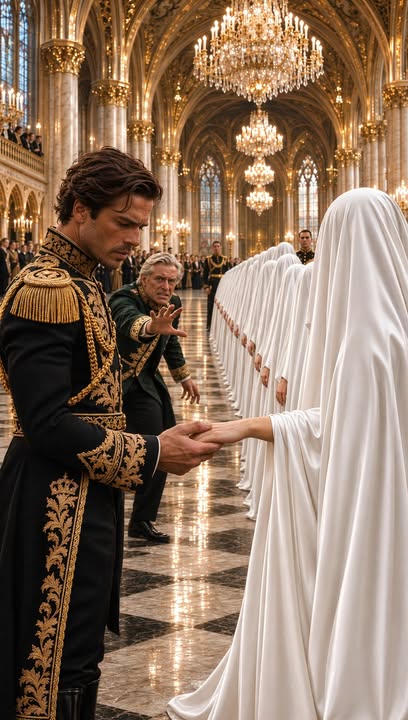
Part 3 – The Letter with a Missing Page
Elena reached for the letter, her fingers closing around the paper.
She had come to the estate hoping to learn why her father had been made to leave.
Now, for the first time, she wondered whether the truth he had kept was connected to someone still living beneath the royal roof.
The next morning, she asked Michael to meet her in the small sitting room of the guesthouse.
She carried the letter in both hands, as though the years it had spent hidden had made it fragile.
Michael arrived alone, but Alexander followed a moment later and paused at the doorway.
“I asked Michael to come,” Elena said.
“I know,” Alexander replied. “I won’t stay if you’d rather speak privately.”
She looked at him for a long moment.
“Stay,” she said at last. “But I want you to understand that I’m showing you this because I need answers, not because I’ve decided to trust your family.”
“That’s fair,” Alexander said.
Michael took the chair opposite her, careful not to reach for the envelope before she offered it.
Elena placed it on the table.
“My father kept this among his papers,” she said. “I found it a few weeks ago.”
“Have you read it?” Michael asked.
“The beginning.”
“And the rest?”
“I stopped when I saw the handwriting at the bottom.”
She looked to Alexander.
“It’s my mother’s.”
Alexander’s expression tightened.
“May I?”
Elena nodded.
He opened the letter gently and read the first lines in silence.
The paper had yellowed with age, but Mateo’s careful writing remained clear.
He had addressed it to no one, explaining that he had taken no royal property and had never betrayed the trust placed in him.
He wrote that the queen had asked him to keep a child safe, and that he would honor that promise even if the truth cost him his place at the estate.
The final lines on the page were written in a different hand.
Queen Margaret’s.
Alexander read them once, then again.
“If you have this letter,” he said quietly, “then Mateo did what I asked of him.”
Elena’s fingers tightened in her lap.
“What did she ask him to do?”
“There’s no name.”
“Is there another page?”
Michael leaned nearer, studying the fold.
“There may have been.”
At the bottom edge, the paper was uneven, as though a second sheet had once been attached and torn away.
Elena had noticed the ragged edge but not its meaning.
“Was it removed before my father kept the letter?” she asked.
“I can’t tell,” Michael said. “The paper may have separated with age.”
Alexander continued reading.
The queen’s note ended with a sentence that made the room feel suddenly smaller.
No one must learn the child’s name until the family is ready to bear the truth.
Elena lowered her eyes.
“Who was the child?”
“I don’t know,” Alexander said.
“You’re certain?”
“No.” He folded the letter along its old crease. “But I’m not going to pretend certainty because it would be easier.”
Michael looked at the handwriting again.
“I’ve seen Queen Margaret’s letters for most of my life,” he said. “I believe this is authentic.”
“What does that mean for my father?” Elena asked.
“It means he may have been protecting someone,” Alexander replied. “And it means the accusation of theft may have been used to cover something else.”
“Something important enough to make a good man leave his home.”
“I’m sorry,” Alexander said.
She studied his face.
“You keep saying that.”
“Because I am.”
“I don’t know whether your regret is for what happened to my father or for not knowing sooner.”
“Perhaps both,” he said. “But I won’t ask you to accept either as an apology.”
For a moment, no one spoke.
Then Michael said, “I should compare the letter with the estate’s old correspondence. If Queen Margaret wrote to Mateo, there may be another copy or a reference in the archives.”
“Could the missing page be there?” Elena asked.
“It’s possible.”
Alexander rose from his chair.
“I’ll help you search.”
Michael’s expression suggested he would have preferred the prince not become involved, but he did not object.
Elena slid the letter back into its envelope.
“Not yet,” she said. “I want to know what happened before we make this a family matter.”
Alexander sat again.
“Then we’ll begin with what we can verify.”
It was the first time since the ballroom that Elena had felt the prince was listening without trying to hurry her toward a conclusion.
She tucked the envelope into her bag and stood.
“Where would we start?”
“The household accounts,” Michael answered. “The accusation was never entered as a criminal charge. It was handled through the estate office.”
He led them to a long room adjacent to the library, where rows of ledgers and correspondence boxes rested behind glass doors.
A few hours later, the sun had climbed high over the gardens, warming the windows and revealing dust in the beams of light.
Michael worked through the indexes with steady patience.
Alexander turned pages more slowly, mindful of the old bindings.
Elena read each entry related to her father’s name.
The records were spare, written in the clipped language of administrators.
Mateo Reyes, grounds staff.
Employment ended by order of the private household office.
Inquiry closed at Her Majesty’s request.
No evidence attached.
Every line made her father seem less like a man and more like a problem someone had decided to file away.
“Here,” Michael said at last.
He had found a note in a ledger dated several days after Mateo’s dismissal.
The entry referred to a royal signet removed from Queen Margaret’s private collection.
A later notation said the item had been recovered, but did not say where or by whom.
Elena leaned over the table.
“Recovered?”
“That is what it says,” Michael replied.
“Then why was my father still accused?”
“I can’t answer that.”
Alexander read the entry again.
“If the signet was recovered, there should be a record of its return.”
“Unless it was never returned to the collection,” Michael said.
“Or unless the word ‘recovered’ meant something else.”
Elena’s voice was controlled, but her face had gone pale.
“My father never kept a signet.”
“No one has said he did,” Alexander replied.
“Not yet.”
“I’m not accusing him.”
“You’re asking questions about an object he was blamed for taking.”
“I have to ask what the records can tell us.”
“And I have to remember how these questions affected him.”
Alexander lowered his gaze.
“You’re right.”
The ease with which he conceded unsettled her more than an argument might have.
He seemed to understand that good intentions could not undo the harm of an old accusation.
Michael turned another page.
“There is a second notation,” he said.
The handwriting was cramped, likely added later.
It mentioned a sealed letter kept with the correspondence concerning the signet.
Elena took the envelope from her bag.
“This letter?”
“Possibly,” Michael said. “The archive inventory says the correspondence was transferred to the queen’s private rooms shortly before her death.”
“Then why was this in my father’s things?”
“That is what we need to discover.”
Elena set the letter on the table, but did not release it.
“Could my father have taken it?”
The words came out more softly than she intended.
Alexander looked at her.
“Could he have been given it?”
“I don’t know.”
“Neither do I.”
Michael closed the ledger.
“There’s someone who may be able to help,” he said. “Mrs. Bell was the queen’s secretary for many years. She retired before Her Majesty passed, but she still lives nearby.”
“Would she remember?” Elena asked.
“She might remember the circumstances, if not every detail.”
Alexander glanced at Elena.
“Would you want her questioned?”
“I would want to ask her myself.”
“Then I’ll arrange it.”
“No,” Elena said. “I’ll ask her. You may come if she agrees.”
Alexander nodded without protest.
They visited Mrs. Bell that afternoon in a modest cottage a short distance from the estate.
She was small and silver-haired, with a straight back and an observant gaze that seemed to miss very little.
When Michael introduced Elena, the older woman’s hands grew still in her lap.
“Mateo’s daughter,” she said.
“You remember my father?” Elena asked.
“I remember him as a quiet man who never raised his voice and never took more than his share of tea.”
A trace of warmth entered her face.
“He was kind to the garden staff, too.”
Elena felt a tightness in her throat.
“Do you remember why he left the estate?”
Mrs. Bell looked at Alexander before answering.
“I remember that the queen asked him to leave.”
“Was he accused of taking a signet?” Elena asked.
The old woman’s expression changed.
“Yes.”
“Did you believe he took it?”
“No.”
The answer came without hesitation.
Alexander leaned forward.
“Why not?”
“Because I knew Mateo,” Mrs. Bell said. “And because the queen herself told me the signet had been placed in safe hands.”
“Whose hands?” Elena asked.
Mrs. Bell pressed her lips together.
“I was never told.”
“Did she say Mateo had it?”
“She said the signet was not stolen.”
The room fell quiet.
“Then why was my father sent away?” Elena asked.
“To protect someone,” Mrs. Bell replied. “That was all I was permitted to know.”
“Did the queen tell you who?”
“No.”
“Did she leave any written instructions?”
Mrs. Bell’s gaze moved to Michael.
“There was a letter.”
Michael sat very still.
“What happened to it?” he asked.
“I don’t know,” Mrs. Bell said. “The queen sealed it herself. She told me it was to remain with the family papers, but not to be opened until the right time.”
Elena’s hand moved to the bag at her side.
“Could this be that letter?”
She brought out the envelope.
Mrs. Bell leaned closer, her expression sharpening with recognition.
“That is the seal Queen Margaret used on private correspondence.”
“Have you seen it before?” Alexander asked.
“Not this exact letter, but the paper and seal are hers.”
“Do you know why she wrote to my father?”
“I know only what she told me,” Mrs. Bell said. “She said Mateo had been entrusted with a difficult duty, and that he had accepted it without asking for anything in return.”
Elena’s eyes shone.
“My father never told me he was protecting anyone.”
“Perhaps he wanted you to have a childhood untouched by it.”
“Or perhaps he thought I was too young to understand.”
“Both may be true.”
Alexander looked down at his hands.
“My mother kept so much from me.”
“Her Majesty kept many things from many people,” Mrs. Bell said gently. “She believed silence could protect a family. Sometimes it only postponed the pain.”
Elena glanced at him.
For the first time, she saw not only the heir who had summoned her into a ballroom, but a son trying to understand the choices his mother had made.
“Do you know what the signet was used for?” Alexander asked.
“It was an old royal seal,” Mrs. Bell replied. “It could authenticate private instructions. But the queen had several seals. This one mattered because she used it only for matters she considered personal.”
“Could it prove that she authorized something?” Michael asked.
Mrs. Bell’s gaze flicked toward him.
“Perhaps.”
“Did you see it after Mateo left?”
“No.”
“Did anyone?”
“I can’t say.”
The answer did not accuse anyone, but it seemed to place a new weight in the room.
When the visit ended, Elena thanked Mrs. Bell.
The older woman took her hands.
“Your father was a decent man,” she said. “Whatever the records say, don’t let them erase what you know of him.”
Elena nodded, unable to answer at once.
Outside, the air carried the damp sweetness of the garden after a brief rain.
Alexander walked beside her, leaving enough space between them that she did not feel crowded.
“You don’t have to come back to the estate tonight,” he said. “You can stay with a friend or return home.”
“I’ll stay in the guesthouse.”
“Because you want to?”
“Because I want to know what my father left behind.”
He accepted that.
They returned to the library after dinner, where Michael had laid out copies of the relevant records.
Elena placed her father’s letter beside them.
As they studied the queen’s note, she noticed that one line had been written more firmly than the others, as if her mother-in-law—Queen Margaret—had paused before committing it to paper.
The child must never be named until the family is ready to bear the truth.
“The child,” Elena said. “Not a child.”
“Do you think that matters?” Alexander asked.
“I don’t know.”
“It may have been how she wrote,” Michael said. “We should be cautious about reading too much into a single word.”
Elena glanced at him.
“You sound like you’re trying to keep us from finding something.”
“I’m trying to keep us from deciding what we’ve found before we know.”
The response was measured, but there was tension beneath it.
“Do you remember this letter?” Alexander asked.
“No,” Michael said. “I was not part of the queen’s private correspondence then.”
“Your family served mine for generations.”
“Serving a family is not the same as knowing every secret kept within it.”
Alexander watched him.
“Did you ever hear of a child being sent away from the estate?”
Michael’s jaw tightened, almost imperceptibly.
“No.”
It was an answer, but not a comfortable one.
Elena picked up the letter and turned it toward the light.
There were faint marks near the torn edge, possibly from the pressure of writing on a page laid above it.
“Could we read what was written on the missing page?” she asked.
“Not from this,” Michael said. “The impressions are too faint.”
“Then where might the page be?”
Michael looked again at the inventory.
“If the letter was kept with the family correspondence, the missing page may have been separated when the papers were moved.”
“Where were they moved?”
“To the private rooms after the queen’s death.”
Alexander rose.
“Then we search those rooms.”
Michael did not immediately follow.
“Your Highness, those rooms have been closed for years.”
“Are they still locked?”
“Yes.”
“Then we ask the household steward to open them.”
“There may be family records in there that the council considers private.”
“Then we’ll tell the council what we’re doing.”
Elena watched the exchange.
Alexander did not sound angry.
He sounded tired of letting unease make decisions for him.
“I don’t want the search to turn into a spectacle,” she said.
“It won’t,” he replied.
“You can’t promise that.”
“No,” he said. “But I can promise not to let anyone make your father’s name a subject for gossip.”
“That isn’t the same as protecting him.”
“No,” Alexander said again. “It isn’t.”
He looked at the letter.
“But it’s something I can do while we search for the truth.”
The next day, the household steward unlocked Queen Margaret’s old study.
The room had remained nearly untouched since her death, preserved with the kind of care that made it feel less like a workspace than a memory.
A writing desk stood near the windows.
Books lined the walls, and a silver-framed portrait of Margaret sat beside a small vase filled with dried rose stems.
Alexander stopped at the threshold.
Elena noticed the change in him.
“Are you all right?” she asked.
“I haven’t been in here since the funeral.”
“You don’t have to come in.”
“I do,” he replied. “If I’m asking you to face what my family did, I can face what my mother left behind.”
Michael waited near the door as Alexander crossed the room.
The desk held no obvious clue.
Its drawers contained correspondence, fountain pens, and neatly sorted household papers.
Elena examined the shelves while Alexander searched the desk.
Michael moved toward a cabinet of ledgers.
After nearly an hour, Elena found a small bundle of letters tied with blue ribbon.
None mentioned Mateo.
Alexander opened a narrow drawer beneath the writing surface and found a list of personal effects, but no signet.
Michael discovered a stack of old inventories in the cabinet.
“Here,” he called.
The three gathered around him.
One page recorded that a family portrait had been removed from the study and sent to the west gallery for cleaning shortly after Mateo’s departure.
“Why does that matter?” Alexander asked.
“Because it says the portrait frame was found to contain an additional paper,” Michael replied. “The note says it was returned to the queen, but there is no description.”
Elena looked at the inventory of Queen Margaret’s effects.
“Could it have been the missing page?”
“It could,” Michael said. “But we don’t know whether the paper was kept.”
Alexander studied the entry.
“What portrait?”
“The large family portrait in the west gallery,” Michael said. “The one painted when you were a child.”
Alexander’s expression shifted.
“I remember it.”
Elena looked at him.
“Were you in it?”
“I was.”
“Then we should look.”
They crossed the long corridor together, and the gallery doors opened onto a room filled with generations of painted faces.
The portrait hung near the far end.
Queen Margaret stood in the center, one hand resting on the shoulder of a younger Alexander.
The prince looked no more than eight years old in the painting, solemn in a dark jacket, his hair neatly combed.
Elena found herself looking at the child’s expression.
He seemed watchful, as if even then he had understood that people were deciding things around him.
Alexander followed her gaze.
“I hated sitting still for the painter,” he said.
“I can imagine.”
“My mother said I had to learn patience.”
“Did it work?”
“Apparently not.”
The faint humor between them softened the room.
Michael examined the frame’s back, where the carved wood met the wall.
“There’s a panel here,” he said. “It may have been designed to protect the canvas.”
The household steward brought a small tool, and Michael carefully loosened the panel.
A thin layer of dust fell onto the floor.
Inside the frame, between the wooden backing and the canvas, something white was tucked into a narrow gap.
Elena held her breath as Michael eased it free.
The paper was folded twice and brittle at the creases.
Alexander did not touch it.
“Is that the missing page?” he asked.
Michael examined the handwriting on the outside.
“I believe so.”
Elena stepped closer.
“Can you read it?”
Michael unfolded the page with deliberate care.
The first lines were written in Queen Margaret’s hand.
Then, halfway down, the ink changed.
A name appeared, followed by a sentence that made Michael’s face lose its composure.
He read it again, as if the words might become something else.
“What does it say?” Alexander asked.
Michael looked up, his voice barely above a whisper.
“It names the child Queen Margaret was protecting.”
Elena’s hand found the edge of the table.
“Who?”
Michael’s gaze settled on Alexander.
“Your sister.”
**–END OF PART 3–CLICK “NEXT” AT THE BOTTOM OF THE PAGE TO CONTINUE READING**
* * *
[PREVIOUS: PART 2](https://storyly.idolsgift.com/blog/part-2-the-scar-that-remembered-057) | [NEXT: PART 4](https://storyly.idolsgift.com/blog/part-4-the-scar-that-remembered-057)
✓ Lynn R. Adams
Part 3 – The Letter with a Missing Page Elena reached for the letter, her fingers closing around the paper. She had come to the estate hoping to learn why her father had been made to leave. Now, fo…