PART 3: The Royal Wedding Dress Hid a Secret No Queen Had Ever Understood-060.17
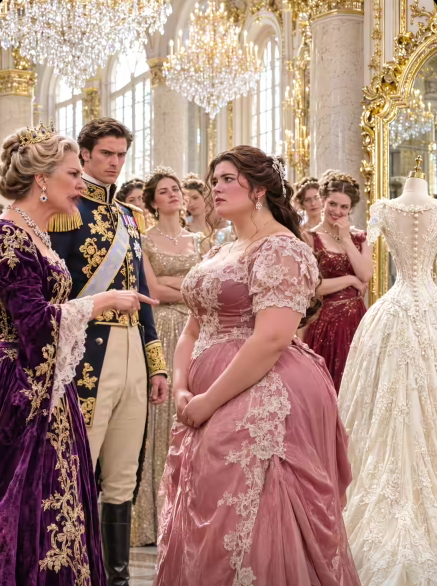
## PART 3 – The Year the Dress Changed
Queen Mariana remained motionless beside the old wooden mannequin.
No one in the dressing hall seemed willing to breathe too loudly.
Prince Adrian looked from the scratched inscription to his mother.
“What happened in 1994?”
Mariana’s lips parted.
Nothing came out.
Eleanor Whitcombe had known the queen for more than three decades, yet even she seemed startled by the expression on Mariana’s face.
Sofia stood near the doorway with her handbag clasped in both hands.
She had expected resistance.
She had expected disbelief.
She had not expected fear.
At last Mariana spoke.
“Everyone except my son, Mrs. Whitcombe, and Miss de Mendoza will leave the room.”
Several candidates exchanged looks.
“Your Majesty—” one began.
“Now.”
There was no cruelty in Mariana’s tone this time.
There was something more fragile.
Urgency.
The candidates filed out reluctantly.
Servants followed.
Within a minute, the immense dressing hall felt strangely empty.
Only four people remained beneath the chandeliers.
Mariana walked toward the windows.
The late-afternoon sun spread across the palace gardens, gilding the hedges and fountains.
For several seconds she stared outside.
Then she said, “I wore the dress in 1994.”
Adrian frowned.
“I know.”
Mariana had married his father, Crown Prince Julian, that autumn.
Their wedding portrait still hung in the west gallery.
In it, Mariana looked impossibly young, standing in the legendary gown beneath a cathedral archway.
“Was that when it was altered?” Adrian asked.
His mother did not answer directly.
“The week before my fitting, I was twenty-two years old.”
She folded her arms as though she had suddenly become cold.
“My waist measured seventy-four centimeters.”
Sofia’s brows lifted.
The official palace history claimed Mariana had fit the fifty-five-centimeter gown perfectly.
Mariana looked toward the dress.
“I was told that no future queen had ever failed the test.”
Eleanor quietly said, “That wasn’t true.”
“No.”
The queen’s mouth tightened.
“But I didn’t know that then.”
She turned.
“I was engaged to your father.”
Her voice softened when she mentioned Julian.
“He loved tradition.”
“Or believed he did.”
“The entire country was waiting for the wedding.”
“Every newspaper had photographs of the gown.”
“Every commentator discussed whether I would fit into it.”
Sofia understood before Mariana said the next words.
“You were afraid.”
The queen looked at her.
“Yes.”
It was the first vulnerable answer she had given Sofia.
“My mother told me not to eat bread for three weeks.”
Adrian stared at her.
“Grandmother told you that?”
“She thought she was helping.”
Mariana’s gaze drifted toward the floor.
“The palace physician gave me a diet.”
“The seamstress measured me every morning.”
“I lost seven centimeters.”
“But not nineteen.”
Eleanor closed her eyes briefly.
Mariana continued.
“Three days before the official fitting, the dress still wouldn’t close.”
“What happened?” Adrian asked.
“My mother spoke to the head seamstress.”
The queen looked toward Eleanor.
“Not you.”
“No.”
“Mrs. Halbrook.”
Eleanor remembered the name.
“She retired the following year.”
Mariana nodded.
“My mother told her the gown had to fit.”
Sofia’s stomach tightened.
“So she made it smaller?”
“No.”
Mariana looked genuinely confused.
“That makes no sense.”
Adrian frowned.
“If you couldn’t fit, why reduce the dress?”
“Because I did fit.”
The answer stunned them all.
Mariana walked toward the gown.
“When I tried it again two days later, it closed.”
Eleanor stared at her.
“Without alteration to your body?”
“Yes.”
“And no one told you the dress had been changed?”
“No.”
Mariana touched one pearl button.
“I believed Mrs. Halbrook had found a way to let out an old seam.”
Sofia stepped closer.
“That would mean the dress was larger when you married.”
“Yes.”
“Then someone reduced it afterward.”
Mariana’s eyes hardened with remembered confusion.
“That is what I now suspect.”
Adrian crossed his arms.
“Why?”
“I don’t know.”
“Did your grandmother know?” Sofia asked.
Mariana flinched slightly.
“My mother died six years ago.”
“That wasn’t what I asked.”
The queen looked at her.
“No.”
Then, after a pause, she corrected herself.
“I don’t think so.”
Sofia considered the scratched message.
Ask Mariana about 1994.
Someone had wanted the future to know that Mariana’s fitting mattered.
“Who made the mannequin?” Adrian asked.
Eleanor checked the engraved plaque beneath the base.
“A company in Boston.”
“Could the inscription have been added by one of their craftsmen?”
“Possibly.”
Sofia crouched beside the wooden base.
“May I?”
Mariana nodded.
Sofia examined the scratched letters.
The strokes were uneven.
The first word, Ask, tilted sharply upward.
She touched nothing.
“My grandmother wrote in capital letters when she labeled conservation boxes.”
Eleanor looked at her.
“You think she wrote this?”
“I don’t know.”
Sofia stared at the scratches.
“But the A looks like hers.”
A strange emotion passed through her.
For years, Lucía had been a memory attached to kitchens, fabric drawers, Sunday dinners, and the scent of lavender hand cream.
Now her presence seemed to inhabit the palace.
Not as a ghost.
As evidence.
Adrian knelt beside Sofia.
“Did she ever mention 1994?”
“No.”
“She never talked about the queen’s wedding?”
“Not specifically.”
Sofia looked at Mariana.
“She stopped talking about the palace when I was young.”
Mariana’s gaze lowered.
“I may know why.”
Sofia stood.
The queen looked uncomfortable.
“After the wedding, there was an internal dispute over the gown’s conservation.”
Eleanor nodded slowly.
“I remember rumors.”
“What dispute?”
Mariana hesitated.
“My mother wanted the dress permanently stabilized at its ceremonial dimensions.”
Sofia frowned.
“What does ceremonial dimensions mean?”
“The smallest accepted measurement.”
Eleanor’s face changed.
“Oh.”
Adrian looked at her.
“What?”
Eleanor answered.
“There was an old belief that the dress had gradually stretched.”
“Generations of seamstresses had altered and repaired it.”
“Some historians thought the original waist had been much smaller.”
Mariana nodded.
“My mother was among them.”
Sofia understood.
“So after you wore it at a larger size…”
“Someone decided that larger size was historically incorrect.”
Eleanor looked horrified.
“They folded the panels inward.”
Mariana’s voice was quiet.
“Apparently.”
Adrian walked away from them.
He rubbed the back of his neck.
For a long time, he said nothing.
Then he turned.
“And after that, the palace turned the reduced measurement into a requirement for every woman who wanted to marry the crown prince.”
No one answered.
He laughed once, but there was no amusement in it.
“That’s extraordinary.”
“Adrian.”
“No, Mother.”
His voice remained controlled, but hurt moved beneath it.
“For years, women have been measured against an alteration someone made because they misunderstood a dress.”
“We don’t know that yet.”
“We know the mannequin says ninety-eight centimeters.”
“We know there are folded panels.”
“We know you wore it after it was expanded.”
“And we know someone reduced it again after your wedding.”
Mariana looked toward the closed doors.
“The selection cannot continue today.”
“No.”
Adrian’s answer surprised her.
“It cannot continue at all.”
The queen turned sharply.
“What does that mean?”
“It means I’m not choosing a wife through a dress fitting.”
Mariana’s expression hardened reflexively.
“This ceremony is bigger than you.”
“It is my marriage.”
“It is also the succession.”
“I’m aware.”
“Then you know why tradition matters.”
Adrian looked at Sofia.
She wished he had not.
The queen noticed.
Her eyes moved between them.
Sofia immediately stepped back.
“I didn’t come here to destroy the tradition.”
Mariana’s voice sharpened.
“Intentions do not control consequences.”
Sofia absorbed the words.
For the first time, Adrian’s expression mirrored the queen’s earlier severity.
“That is enough.”
Sofia looked at him.
“Your Highness, she’s right about one thing.”
He frowned.
“Which thing?”
“We still don’t know the whole story.”
She looked at the gown.
“If the panels were folded in 1994, someone must have documented the work.”
Eleanor nodded.
“Conservation records.”
Mariana shook her head.
“The records from that period are incomplete.”
“Missing?” Adrian asked.
“Some.”
Sofia felt the same quiet pull she had felt when she first found her grandmother’s photograph.
Not certainty.
Direction.
“My grandmother kept notebooks.”
Mariana turned.
“What kind of notebooks?”
“Work journals.”
Sofia looked at Eleanor.
“She wrote down everything she restored.”
“Fabric type, thread, damage, alterations, provenance.”
Eleanor’s face brightened.
“Do you have them?”
“Most of them are in storage at my mother’s house.”
“Most?”
Sofia reached into her handbag.
“I brought one.”
The notebook was smaller than a paperback book.
Its brown leather cover had softened with age.
A pale ribbon marked one page.
Sofia opened it.
“I found this entry three weeks ago.”
She handed it to Eleanor.
The date at the top read September 18, 1994.
Eleanor read silently.
Her eyes moved faster.
Then stopped.
“What does it say?” Adrian asked.
Eleanor looked at Sofia.
“Would you read it?”
Sofia took the notebook.
Her grandmother’s handwriting made the past feel suddenly close.
She read.
“‘Examined ceremonial bridal gown after fitting preparation.’”
She continued.
“‘Contrary to palace inventory, the original side construction contains expansion folds integrated into initial pattern.’”
Mariana closed her eyes.
Sofia read on.
“‘The gown was not made to one fixed waist measurement.’”
Adrian stared at the dress.
Sofia’s voice grew quieter.
“‘It was made to accommodate change.’”
No one spoke.
She continued.
“‘Found evidence of at least three historical configurations.’”
Eleanor whispered, “Three.”
Sofia nodded.
“‘Smallest configuration appears ceremonial rather than original.’”
Mariana sat down slowly.
Her face had changed again.
This time, not from fear.
From recognition.
“My mother used that word.”
“What word?” Adrian asked.
“Ceremonial.”
The queen looked at the notebook.
“She always said the fifty-five-centimeter waist was the ceremonial standard.”
Sofia turned the page.
There was another entry dated two days later.
This one was shorter.
“‘Requested permission to document expansion system.’”
“‘Permission denied.’”
“‘Mrs. Halbrook privately confirmed gown was opened for royal fitting and ordered closed afterward.’”
Eleanor’s hand rose to her mouth.
Sofia continued.
“‘She believes the order came from above.’”
Mariana whispered, “My mother.”
Sofia did not agree or disagree.
The notebook did not name her.
The next line was underlined twice.
“‘If this construction is concealed again, future wearers may be judged by a false standard.’”
Adrian looked at his mother.
Mariana’s face was unreadable.
Sofia turned one more page.
The writing became less neat.
“‘I will preserve proof where they cannot discard it.’”
Adrian stepped closer.
“Proof where?”
Sofia shook her head.
“That’s the last entry about the dress.”
Eleanor looked toward the mannequin.
“The inscription.”
“Maybe.”
“But an inscription isn’t proof.”
“No.”
Sofia closed the notebook.
“My grandmother must have meant something else.”
Mariana rose.
“Where are the rest of her journals?”
“At my mother’s home in Maryland.”
“We need them.”
Sofia’s expression shifted.
Mariana caught it.
“What?”
“My mother won’t give them to the palace.”
“Why?”
“She blames the palace for what happened to my grandmother.”
Mariana’s eyes narrowed.
“What happened to her?”
Sofia looked at Eleanor.
The older seamstress lowered her gaze.
Sofia answered carefully.
“My grandmother left her profession.”
The queen frowned.
“You said she resigned from the palace.”
“She did.”
“And after that?”
“She stopped working in museums.”
Sofia’s fingers tightened around the notebook.
“She opened a small alterations shop.”
“There’s nothing wrong with that,” Adrian said.
“No.”
“There isn’t.”
Sofia’s voice softened.
“But conservation was her life.”
“She had studied for years.”
“She loved historical textiles.”
“She used to say that fabric remembered hands.”
Eleanor smiled sadly.
“She said that when I knew her too.”
Sofia looked down.
“She never told me exactly why she left.”
“Only that sometimes an institution cared more about protecting a story than discovering whether it was true.”
Mariana turned away.
The words seemed to land somewhere painful.
Adrian approached his mother.
“Did your mother have Lucía dismissed?”
“I don’t know.”
“Would she have?”
Mariana’s silence lasted too long.
Adrian understood.
“So yes.”
“I said I don’t know.”
“But you think she might have.”
Mariana looked at him.
“My mother believed the monarchy survived by preserving symbols.”
“She had lived through years when public confidence in the family was weak.”
“She treated every tradition as if removing one stone might collapse the entire building.”
Adrian’s voice softened.
“That isn’t an answer.”
“No.”
Mariana looked suddenly older.
“It isn’t.”
Eleanor returned to the gown.
“There is one way to know whether Lucía was right.”
Mariana glanced at her.
“The stitches.”
“Yes.”
“If we remove the later basting and open the hidden panels, we can examine the original construction.”
The queen’s hesitation was visible.
Adrian waited.
So did Sofia.
Finally Mariana asked, “Can it be reversed without damage?”
“Yes.”
“Then do it.”
Eleanor blinked.
“Your Majesty?”
“Open the dress.”
The words seemed to change the air itself.
Two conservation tables were brought into the room.
The gown was laid flat beneath bright lamps.
Eleanor and the other senior seamstresses returned, but the candidates remained outside.
Sofia watched from several feet away.
She had imagined this moment during long nights after finding Lucía’s notebook.
In her imagination, she had felt vindicated.
Instead she felt nervous.
What if Lucía had been wrong?
What if the first panel opened and revealed nothing?
Eleanor took a tiny pair of scissors.
She slid one blade beneath the first basting thread.
Snip.
The sound was nearly inaudible.
Yet everyone heard it.
One stitch became ten.
Ten became fifty.
Gradually, a folded section of silk loosened.
Eleanor unfolded it.
The waist expanded.
Another seam was opened.
More fabric appeared.
Then another.
Sofia stepped nearer.
The gown changed before their eyes.
Not dramatically.
Gracefully.
As though it had been holding its breath for thirty-two years.
When the final temporary stitch was removed, Eleanor lifted the measuring tape.
She measured once.
Then again.
Her face softened.
“Ninety-seven point eight centimeters.”
Sofia laughed under her breath.
The mannequin measurement had been correct within two millimeters.
Adrian looked at her.
“You’d fit.”
Sofia shook her head.
“We don’t know that.”
“We know your waist is ninety-five.”
“Bodies aren’t cylinders.”
He smiled.
“No.”
“They certainly aren’t.”
Mariana watched them exchange the small joke.
Something in her expression was difficult to read.
Not disapproval exactly.
Perhaps awareness.
Eleanor examined the newly exposed interior.
“There’s writing.”
Sofia moved closer.
On the inside of one expansion panel, nearly hidden beneath the silk lining, were tiny embroidered words.
Not modern handwriting.
Embroidery.
The thread had faded to cream.
Mariana bent over the table.
“What does it say?”
Eleanor adjusted the lamp.
The inscription was in Spanish.
Sofia recognized it immediately.
“Para la mujer que llegue.”
Adrian looked at her.
“What does that mean?”
Sofia translated softly.
“For the woman who arrives.”
Eleanor traced the phrase without touching it.
“There’s more.”
Another line appeared beneath the first.
This one was in English.
Sofia read it aloud.
“‘Let the gown meet her where she stands.’”
The room fell silent.
Adrian smiled slowly.
“That does not sound like a dress designed to eliminate women by waist size.”
“No,” Sofia said.
“It doesn’t.”
Mariana stared at the embroidery.
All her life, she had defended a tradition whose supposed meaning was written inside the very object that contradicted it.
But Eleanor was still examining the seam.
“Wait.”
She leaned closer.
“Something is inside the hem.”
A small rectangular shape had become visible now that the folded panel was open.
It was stitched between two layers of fabric.
Eleanor carefully removed three loose threads.
A narrow paper packet slipped onto the table.
The paper was brittle with age.
Across the front, in faded ink, someone had written a name.
Sofia read it.
“Isabella de Aragon.”
Prince Adrian’s expression changed.
“My great-great-grandmother.”
Isabella had been the first woman officially recorded as having passed the Royal Wedding Dress test.
According to family history, the tradition began with her marriage in 1912.
Mariana stared at the packet.
“That has been inside the gown for more than a century.”
Eleanor opened it carefully.
Inside was a folded letter.
Adrian looked toward his mother.
“Should we read it?”
Mariana took several seconds to answer.
“Yes.”
Eleanor unfolded the page.
The first lines were written in the same elegant Spanish hand as the embroidery.
Sofia began translating.
But after three sentences, she stopped.
Adrian noticed.
“What?”
Sofia looked up.
The queen’s face tightened.
“What does it say?”
Sofia held the century-old letter with trembling fingers.
“It says Isabella never passed the dress test.”
Adrian stared at her.
Sofia continued.
“She invented it.”
Mariana’s lips parted.
“That’s impossible.”
Sofia looked back at the letter.
“No.”
Her voice was almost a whisper.
“She invented it because the palace tried to prevent her marriage.”
Eleanor stepped closer.
Sofia read the next lines silently.
Her heart began pounding.
“What else?” Adrian asked.
Sofia raised her eyes.
“The dress wasn’t made for Isabella.”
“Then who was it made for?”
Sofia looked at the embroidered Spanish words again.
Then at the signature at the bottom of the letter.
A second name appeared beneath Isabella’s.
The name was Mendoza.
**–END OF PART 3–CLICK “”NEXT”” AT THE BOTTOM OF THE PAGE TO CONTINUE READING**
✓ Lynn R. Adams
## PART 3 – The Year the Dress Changed Queen Mariana remained motionless beside the old wooden mannequin. No one in the dressing hall seemed willing to breathe too loudly. Prince Adrian looked from…