PART 3: The Roots Beneath the Bark 058
Part 3 – The Name Beneath the Label
“Because I never expected to find that mark alive again.”
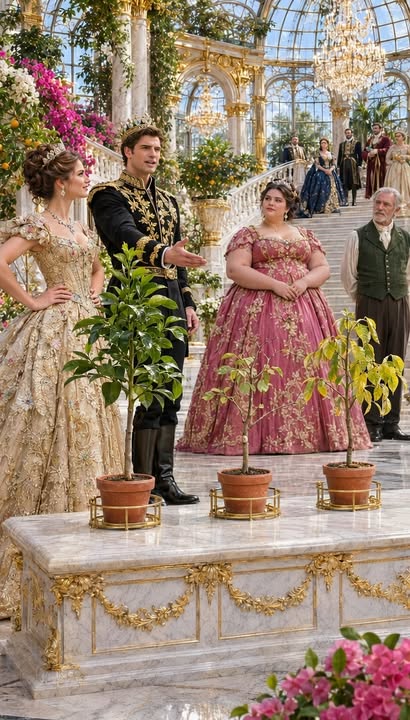
The gardener’s words lingered after he turned away, leaving the woman in pink alone beneath the glass dome with the sapling and a question she could not yet ask.
She looked once more at the narrow graft seam.
The little green bud below it seemed almost too small to carry the weight of the past.
“Will you tell the prince?” she asked.
“When I know what the record says, and what it does not say.”
The gardener’s answer was careful, but not evasive.
“I don’t want to offer him a memory as though it were proof.”
She understood that distinction.
Her mother had kept many things that looked ordinary until the right moment made them matter.
A folded note tucked into a recipe book.
A packet of seeds in a blue tin.
A gardening notebook whose pages were softened at the corners from years of use.
The woman felt a faint tightening in her chest.
“Did the record say who made the graft?”
The gardener glanced toward the doors.
“I don’t remember. The orchard ledger is kept in the old records room, and I haven’t seen it in years.”
“Then perhaps it’s best to look before anyone draws conclusions.”
He studied her face, as if weighing her words.
“That is what I intend to do.”
She nodded, accepting that she had no claim to the prince’s mother’s history merely because her own mother had loved a garden.
Still, the mark had stirred something in her memory.
She could almost picture her mother’s hands turning the pages of her notebook, pausing over a small drawing she had never thought to ask about.
The gardener covered the sapling with a light cloth before the attendants carried it toward the shade house.
The woman watched until it disappeared through the side passage.
Then she left the conservatory, carrying the image of the graft seam with her.
The next morning, she returned before the court had gathered.
The air in the conservatory was cool, and faint condensation silvered the lower panes of the glass.
The sapling stood in the shade house, protected from the strongest light.
A shallow tray beneath its pot caught the water that drained from the pale roots.
The gardener was already there, arranging tools on a bench.
“You came,” he said.
“I said I would.”
“That is more than many people manage when there is no audience.”
She smiled.
“Is the tree well?”
“It endured the night.”
He lifted the cloth from the pot and checked the soil’s surface.
“I’ll move it into the prepared bed this morning, if the roots remain firm.”
The prince entered a moment later, without his formal uniform.
He wore a dark riding coat and carried no insignia beyond the small crest at his collar.
“Good morning,” he said.
“Good morning,” she replied.
His eyes moved briefly to the sapling.
“I’m glad you came back.”
“So am I.”
The words came more easily than they had the previous day.
The gardener glanced between them, then returned his attention to the tree.
“I’m going to prepare the bed,” he said. “The prince asked me to let you help if you wished.”
The prince looked toward her.
“Only if you still want to.”
She appreciated that he had remembered the difference between an invitation and an expectation.
“I do.”
The gardener led them to a raised bed near the eastern wall of the shade house.
It had been filled with a loose, dark soil mix and lined with a protective woven cloth.
A narrow path ran around it, allowing the gardener to work without compacting the earth.
He explained how much of the old soil should remain around the roots, then showed them where to place their hands.
The prince took the sapling’s pot.
The woman in pink steadied its base.
Together, they eased the plant free, keeping the root ball intact.
She watched the pale roots emerge from the terracotta.
They were sparse, but the gardener’s assessment had been right: each one was firm, not brittle or darkened.
The sapling looked smaller outside its pot.
It also looked more vulnerable.
“Hold it upright,” the gardener said.
The prince supported the trunk below the graft while she guided the roots into the shallow bed.
They worked slowly, using the gardener’s directions to settle the root ball at the right depth.
When the soil was drawn in around it, the tree seemed to stand more steadily.
The gardener pressed the earth gently with his hands.
“Not too tight,” he reminded them. “The roots need room to breathe.”
The woman smoothed the soil near the trunk.
The raised graft line remained visible, and so did the tiny green bud beneath it.
“Will the bud grow?” she asked.
“If the tree settles in, it may.”
“And if it doesn’t?”
“Then we’ll know we gave it the best chance we could.”
The prince looked at the sapling.
“My mother would have liked that answer.”
The gardener’s hands paused for an instant, then resumed their gentle work.
“She liked honesty,” he said.
“And patience.”
“And patience,” the gardener agreed.
When the planting was finished, the prince poured a small amount of water around the base.
The woman watched it darken the soil.
There was no applause, no circle of courtiers, and no judgment to be made.
Only the quiet work of giving a fragile thing somewhere to grow.
The prince handed the watering can back to the gardener.
“Thank you for trusting me with it,” he said to the woman.
“You didn’t have to trust me.”
“I did not.”
He said it plainly, without flattery.
“Yesterday, I knew almost nothing about you.”
“And now?”
“Now I know you were willing to be uncertain in front of everyone.”
The warmth in his voice made her look away.
“I wasn’t trying to be brave.”
“Most people aren’t when they do something brave.”
The gardener cleared his throat, perhaps to remind them that he was still within earshot.
The prince gave him an apologetic glance.
“I should let you get on with your work.”
“You may stay if you like,” the gardener said. “But I have to fetch the ledger from the records room.”
At the word ledger, the woman’s attention returned to the old question.
The prince noticed.
“What ledger?”
The gardener’s expression remained measured.
“An orchard record from your mother’s years.”
“You found something in it?”
“I haven’t found anything yet. I want to compare it with the graft mark before I say more.”
The prince’s features grew still.
He did not ask the gardener to explain himself in front of her.
Instead, he said, “Let me know what you discover.”
“I will.”
The gardener left by the western door.
The prince watched him go.
“Did he tell you what he saw?”
“He said the graft resembled one in your mother’s orchard records.”
The prince’s attention returned to the tree.
“He told you that?”
“He did.”
“Did he tell you what he thinks it means?”
“No. He wants to be certain before he says anything.”
The prince nodded, though something in his expression had become guarded.
“My mother kept meticulous records,” he said. “If the mark is in one of them, there should be a reason.”
“Perhaps.”
He looked at her.
“You sound as though you know there may be another explanation.”
“I know only that one detail can belong to more than one story.”
A faint crease appeared between his brows.
“That is true.”
She wondered if she had unsettled him, or merely touched the part of his grief that had never been allowed to rest.
The prince crouched to inspect the soil around the tree.
“My mother’s final orchard was cleared after she died,” he said. “The court decided it was too expensive to maintain.”
“Was it?”
“It needed care. Whether that made it too expensive depended on who was asked.”
His voice remained calm, but she heard the old hurt beneath it.
“Did you want to save it?”
“I was younger then. I thought wanting something and being able to keep it were nearly the same thing.”
She rested her hands against the edge of the raised bed.
“What did you want to keep?”
“Everything she had planted.”
The answer seemed to surprise him as much as it did her.
He looked down at the sapling.
“Of course, that was impossible.”
“Not everything has to be kept in the same place to survive.”
The prince glanced up.
“No,” he said slowly. “I suppose it doesn’t.”
They stood in silence until the gardener returned, carrying a thin, clothbound ledger.
The cover had faded to the color of old leaves.
He placed it on the workbench and opened it with care.
“This is one of the records from the royal orchard,” he said. “It lists the trees planted, grafted, and moved during the final years of Her Majesty’s work there.”
The prince moved closer.
The woman in pink stayed back, feeling suddenly like an intruder in a private family matter.
The gardener turned several pages.
His finger traced the columns of ink, stopping at dates and brief notes written in a narrow hand.
“Here,” he said.
The prince leaned over the ledger.
The woman could not read the entry from where she stood, but she saw the date and a small symbol in the margin.
A circle crossed by a short diagonal line.
Her breath caught.
She knew that mark.
Not from the sapling.
From her mother’s garden notebook.
She had seen it beside sketches of fruit trees and notes about pruning.
Her mother had never explained it, and the woman had assumed it was a private shorthand.
The gardener glanced at her.
“What is it?” the prince asked.
“Nothing,” she replied too quickly.
The prince looked at her, but did not press.
The gardener turned the ledger around so that both could see.
The entry described a graft preserved at the queen’s request.
The writing was compact, but the words were clear.
Keep the narrow-marked graft apart from the main orchard stock.
It is to be protected through the next winter and not entered under the ordinary rootstock.
Beneath the note was the same small angled mark etched into the sapling’s graft seam.
The prince read the lines twice.
“Why would she have kept it apart?”
The gardener studied the page.
“I don’t know.”
“Was there another note?”
The gardener turned the next page, then the one after it.
A line near the bottom of the following entry had been crossed through in dark ink.
The words beneath the strike were impossible to make out.
The prince’s expression tightened, though he did not touch the ledger.
“Was this crossed out later?”
“I can’t tell.”
The gardener tilted the page toward the light.
“The ink looks older than the crossing, but that doesn’t prove anything.”
The woman in pink kept her eyes on the symbol.
Her mother had drawn it beside two entries in the notebook.
One had been dated in the spring of the year the queen died.
The other was on a page near the back, beside a careful sketch of a young orange tree.
A name was written there, but the paper had been smudged where water had blurred the ink.
She had never known whether it was a person’s name or the name of a variety.
The prince closed the ledger halfway, then stopped.
“Could the tree be from the cutting my mother kept apart?”
“The graft suggests that it may be related,” the gardener said. “But I want to compare the old records with the sapling’s tag and the nursery notes.”
The word tag seemed to bring the woman back to the present.
She looked at the small wooden label tied to the sapling’s branch.
Its string was pale and clean.
The tag itself was a darker shade than the weathered stakes used elsewhere in the shade house.
“How long has that been on the tree?” she asked.
The gardener followed her gaze.
“I don’t know.”
“It looks newer than the pot,” the prince said.
The gardener stepped toward it.
The label was marked with a number and the name of a common orange variety.
He read it aloud, then compared it with a note in the ledger.
The two names did not match.
“That could be an ordinary nursery substitution,” he said. “The label may have been replaced after the tree came here.”
“But when?” the prince asked.
“Perhaps during the last repotting.”
“Do you have a record of that?”
“I’ll check the nursery book.”
The prince’s face had become careful again.
“If the label is wrong, I want to know how it happened.”
“So do I,” the gardener said.
The woman in pink kept looking at the little symbol stamped into the lower corner of the tag.
A circle crossed by a short diagonal line.
The same mark her mother had drawn in the notebook.
A memory rose with such clarity that she could almost hear her mother’s voice.
“Don’t throw that away, darling. Some labels are only useful to the person who wrote them.”
The woman’s throat tightened.
She looked at the prince, then at the gardener, and chose not to speak.
Not yet.
She needed to see the notebook before she could trust what her memory was telling her.
A symbol could travel farther than a family secret.
It could have meant something as simple as a variety, a date, or a gardening instruction.
“Could I see the old nursery records?” she asked.
The gardener glanced toward the prince.
“If you wish,” the prince said. “You may see anything that helps us understand the tree.”
His use of us struck her with unexpected force.
The gardener closed the ledger and tucked a strip of clean paper between its pages.
“I’ll bring the nursery book this afternoon.”
The prince looked at the woman in pink.
“Would you be willing to help me compare the planting records with what we find?”
She hesitated.
“What if the records tell us something you don’t want to hear?”
“Then I would rather hear it honestly.”
His answer was steady, but there was strain at the edges of it.
She thought of the crossed-out line in the ledger.
“I’ll help.”
The prince’s shoulders eased a little.
The gardener lifted the ledger from the bench.
“I’ll leave you both to the tree.”
He carried the book toward the records room.
The prince waited until he was out of sight before speaking.
“You recognized the symbol on the tag.”
It was not a question.
She looked at the narrow wooden label.
“I thought I did.”
“From where?”
“My mother kept a gardening notebook. She used a mark that looked like that beside some of her notes.”
The prince’s expression changed.
“Was she connected to my mother’s orchard?”
“I don’t know.”
“Did she ever say she knew my mother?”
“No.”
The truth came easily, but it did not make the conversation simple.
The prince looked away, his attention settling on the young tree.
“Why didn’t you tell us when you saw it?”
“Because I haven’t checked the notebook, and I don’t want to turn a resemblance into a claim.”
He considered this.
“That seems sensible.”
“I also don’t want to give you another reason to think your mother’s records were changed.”
His eyes returned to her.
“Do you think they were?”
“I don’t know.”
The answer disappointed him, though he hid it quickly.
She was beginning to understand that his composure was not indifference.
It was the effort he made to keep hope from running ahead of evidence.
The prince touched neither the tag nor the graft.
“When the orchard was cleared, people made decisions quickly,” he said. “I was told the trees had been catalogued, and the records were complete.”
“Did you see the records yourself?”
“No.”
The quiet admission seemed to cost him.
“I was away at school. By the time I came back, the orchard was gone.”
She wanted to offer him a comforting certainty.
Instead, she said, “Then we should find out what the records actually say.”
He gave a slow nod.
“Yes.”
A soft footstep sounded at the entrance to the shade house.
The noblewoman stood there, no longer wearing her tiara.
Her champagne-gold gown had been replaced by a simple cream day dress, and she carried a narrow folder under one arm.
“I’m sorry to interrupt,” she said. “The gardener mentioned that you were looking into the orchard records.”
The prince glanced at the folder.
“What have you found?”
“I asked to see the planting ledger after the trial.”
The woman in pink had not expected that.
The noblewoman entered, her gaze briefly meeting hers before turning to the prince.
“I know I have no right to demand an explanation after the way I behaved yesterday,” she said. “But I wanted to understand the test, and the record of your mother’s orchard seemed relevant.”
The prince’s expression remained neutral.
“You were allowed to ask.”
“I read the ledger in the records room this morning.”
She set the folder on the workbench.
“I found an entry that appears to describe the same graft.”
The prince glanced toward the place where the gardener had left the book.
“What did it say?”
“That the cutting was to be preserved, but not planted with the rest of the orchard stock.”
The woman in pink felt the air grow still.
It was almost exactly what the gardener had read aloud.
The noblewoman opened her folder and removed a sheet of paper.
“I copied the entry before I left.”
The prince studied it.
“Why?”
“Because I thought it might answer the question I had yesterday.”
She looked toward the sapling.
“And because I didn’t want to assume the tree was merely a test specimen.”
The woman in pink was surprised by the quietness of the confession.
The noblewoman had not come to reclaim the court’s attention.
She had come carrying a record.
“Did you find anything about who received the cutting?” the prince asked.
“No.”
“Any other names?”
“Not on that page.”
The noblewoman’s eyes moved to the wooden tag.
“I also noticed the label does not match the ledger’s description.”
The prince looked at her.
“You noticed that?”
“I went back after the gardener left the records room.”
She folded her hands over the folder.
“I know what it is like to have people assume you only care about appearances.”
The words were addressed to the woman in pink, though they were spoken quietly.
“I’m sorry I treated you that way.”
The woman in pink held her gaze.
“Thank you.”
The apology did not make them friends, but it made the space between them feel less fixed.
The noblewoman looked back to the prince.
“I didn’t want to bring you an incomplete answer.”
“Neither do I,” he said.
“Then perhaps we should wait for the nursery book.”
The prince’s attention shifted to the tag.
“Before we do, I’d like to know who replaced this label.”
The woman in pink looked at the small symbol again.
The thought of her mother’s notebook pressed against her memory, insistent but unconfirmed.
She would retrieve it as soon as she could.
She would check the exact mark, the dates, the faded name.
Then she would tell the prince what she knew.
The gardener returned with a thick, battered book.
Its spine had been repaired with green thread.
“I found the nursery register,” he said. “It lists every tree moved into the conservatory over the past decade.”
He laid it beside the old orchard ledger and opened it to a marked page.
The prince stood beside him.
The noblewoman leaned in from the other side.
The woman in pink moved closer, careful not to crowd them.
The gardener found the sapling’s numbered entry.
He ran his finger down the column, reading each note under his breath.
“Received from the west nursery,” he said. “Repotted two years ago. Original label recorded as—”
He stopped.
The prince leaned toward the page.
“What is it?”
The gardener turned the book slightly.
At the bottom of the entry, in a different hand, someone had written:
Label replaced. Name retained by request of M. Vale.
The woman in pink went still.
Her mother’s name had been Mara Vale.
She knew the prince had noticed her reaction before she could hide it.
The gardener read the line again, more slowly.
The old nursery register contained her mother’s name beside the living tree.
**–END OF PART 3–CLICK “NEXT” AT THE BOTTOM OF THE PAGE TO CONTINUE READING**
* * *
[PREVIOUS: PART 2](https://storyly.idolsgift.com/blog/part-2-the-roots-beneath-the-bark-058) | [NEXT: PART 4](https://storyly.idolsgift.com/blog/part-4-the-roots-beneath-the-bark-058)
✓ Lynn R. Adams
Part 3 – The Name Beneath the Label “Because I never expected to find that mark alive again.” The gardener’s words lingered after he turned away, leaving the woman in pink alone beneath the glass do…