PART 3: The Room That Had Waited 056
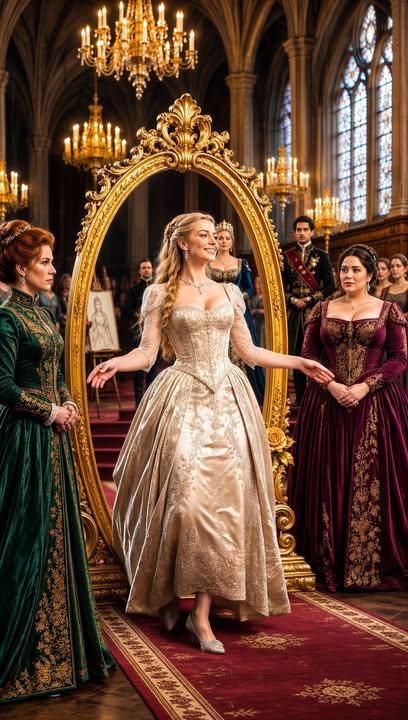
Part 3 – The Rose Remembers
Lucía turned toward the wall.
The line behind the empty portrait space remained as fine as a pencil mark, running from the upper edge down through the dust.
Adrian rose from the bed, the unfinished letter still in his hand.
“What is it?”
“I don’t know yet,” Lucía said. “But it wasn’t there before.”
The Queen stepped closer, then stopped at Lucía’s shoulder.
The faint seam seemed to divide the wall panel beneath the wallpaper, though the pattern of leaves and roses continued over it without interruption.
Lucía leaned near enough to see that the dust had been disturbed along one edge, as if something had shifted behind the wall.
“Could the portrait have covered a panel?” Adrian asked.
“Possibly.”
“Why would anyone hide a panel behind her portrait?”
Lucía studied the clean rectangle, then the pigment in the desk seam.
“Perhaps the portrait was not only covering it.”
She turned to the desk and lifted the iron key, testing its weight in her palm.
The ribbon stirred against her wrist.
“May I see the small opening again?”
Adrian stepped aside.
Lucía brought the key to the brass plate set into the back of the desk.
Its teeth aligned with the tiny keyhole, but the key would not enter far enough to turn.
She withdrew it at once.
“I don’t want to force it.”
“Could it be the wrong key?” Elara asked.
“It could be. Or the lock may have another catch.”
Adrian bent to look.
“Is there anything else on the plate?”
A narrow groove ran beneath the keyhole, barely visible in the polished brass.
Lucía pressed the lower edge with one fingernail.
The plate shifted inward by the smallest degree.
A dry click sounded within the desk.
The Queen drew in a breath.
Lucía pressed again, this time at the center of the groove.
A concealed drawer slid from the back of the desk, scarcely wider than her hand.
Inside lay a small brass key, wrapped in a square of yellowed paper.
Adrian stared at it.
“Another key.”
“Perhaps the key to the lock we just found,” Lucía said.
She unfolded the paper carefully.
A few words, written in a familiar, slanting hand, showed through the thin sheet.
The note was not addressed to anyone.
Only one sentence had been written there.
“The rose remembers what the court forgets.”
Adrian took a step closer.
“That is Isolde’s handwriting.”
The Queen’s eyes remained on the note.
Lucía glanced from the words to the faded blue ribbon on the iron key.
“Do you know what she meant?”
“No,” Elara said.
Her answer came too quickly to sound certain, but not quickly enough to be a denial.
Adrian noticed the hesitation.
“Mother?”
“I have seen that phrase before,” she said. “Years ago, perhaps. I cannot remember where.”
The note trembled slightly in Lucía’s fingers.
It was not fear that made her hands unsteady, but the sense that the room had begun to answer them in a language each person understood differently.
Adrian took the small brass key from the paper.
“Let’s see what it opens.”
Lucía checked its teeth against the keyhole in the desk plate.
They fitted.
Adrian turned it gently.
The brass plate released with a muted snap, and a narrow compartment opened beneath it.
There was no letter inside, only a rolled sheet of paper tied with a thread that had once been red.
Lucía set the iron key aside and untied the thread.
The paper had been folded so many times that the creases were soft and nearly split.
A sketch appeared when she opened it.
It showed the Queen’s Frame, seen from the side, with its inner rim drawn in careful detail.
Several lines marked the frame’s carved layers, and a small circle had been placed beside the golden rose.
At the bottom, in Isolde’s hand, were the words: “Behind the inner rim. Do not pull at the carving.”
Lucía looked at the Queen and Adrian.
“The frame has another hidden space.”
Adrian turned the sketch toward himself.
“That is the presentation frame from the gallery.”
“Yes,” Lucía said. “And the note tells us how to look for the compartment without damaging it.”
Elara held out her hand for the sketch, but stopped before touching it.
“May I?”
Lucía gave it to her.
The Queen examined the drawing in silence.
Her eyes moved over the fine lines, then settled on the golden rose.
“The frame was restored when I was a child,” she said. “It was old even then.”
“Do you remember who worked on it?” Lucía asked.
“An artisan from the palace workshop. I remember the smell of varnish in the gallery and the rose being polished afterward.”
“Do you remember seeing this mark?”
Elara lowered the paper.
“No.”
Adrian watched her closely.
“Mother, did you know the frame held a compartment?”
“No.”
“But you knew the phrase.”
“I said I had seen it, not that I understood it.”
The distinction was careful, and Adrian seemed to hear the care.
Lucía folded the sketch along its existing creases.
“If the drawing is accurate, there may be a panel beneath the inner rim. I’ll need to examine the frame in good light and with the right tools.”
“Can it be done today?” Adrian asked.
“If the panel is as old as the frame, I should not try to open it in a hurry.”
He looked down at Isolde’s note.
“She put it there for us to find.”
“She may have wanted someone to find it,” Lucía said. “That is not quite the same as knowing who, or when.”
For a moment, Adrian’s expression suggested he wanted to argue.
Then he folded the note again, carefully and along its original creases.
“We should go back to the gallery.”
The Queen returned the sketch to Lucía.
“Bring it with you.”
She did not sound like a monarch giving an order.
She sounded like a mother who had been afraid to ask.
The room remained quiet as they left.
At the door, Adrian glanced back at the letter on the desk.
Lucía had placed it beside the empty envelopes, where the light could reach its unfinished final line.
He did not take it with him.
The steward closed the chamber door behind them and set the old seal back in place, though no one pretended it would restore the room to what it had been.
On the stairs, Adrian walked ahead of his mother.
Lucía followed at a measured pace, the sketch protected between two sheets of clean paper.
When they reached the gallery, the court had dispersed, leaving only a few attendants and the muted echo of the morning’s presentation.
The Queen’s Frame stood beneath the high windows, its carved gold bright against the pale walls.
In the clearer daylight, Lucía could see details that had been lost amid the ceremony: fine scratches around the inner rim, tiny repairs at the lower curve, and a faint, darker line where the old gilding had been touched up.
She set the sketch on a padded table.
The frame’s golden rose rested just above the floor.
Lucía crouched to examine it.
She did not touch the petal that had opened the first compartment until she had studied the surrounding surface.
“There,” she murmured.
A thin line followed the inner curve of the frame, concealed beneath a ridge of carved leaves.
The sketch showed the line continuing behind the rose.
“It’s a panel,” Adrian said.
“I think so. The frame’s layers were joined here.”
“Can you open it?”
“Not without loosening the old fill.”
Lucía looked over the surface, tracing the marks with her eyes.
The panel did not appear to have been opened in years.
Its edges were sealed with a brittle material that had been gilded over, then retouched more recently.
“There are at least two periods of work,” she said. “The first may be original. The second is much later.”
The Queen came to stand opposite her.
“How much later?”
“I can’t tell from looking alone.”
Lucía adjusted the lamp so the light crossed the rim sideways.
A narrow crescent of gold leaf shone differently from the surrounding surface.
She recognized the shape of a restoration patch.
“That mark is familiar,” she said.
“From the frame?” Adrian asked.
“From the gallery record books. There was a restoration forty years ago, but I have not read the full entry.”
The Queen’s expression altered.
“Forty years ago, Isolde had not been born.”
“No,” Lucía said. “But the work may have revealed the compartment, or it may have been made to hide it.”
Adrian frowned at the frame.
“Could someone have opened it then?”
“Possibly. There may be a note in the workshop register.”
The palace’s restoration records were kept in a small archive off the western passage, along with inventories, receipts, and accounts of past repairs.
Lucía had been allowed to consult them during the selection, but never without an attendant.
She looked at the Queen.
“May I check the record?”
“Of course.”
Lord Veyne’s voice came from behind them.
“I was beginning to wonder whether the selection had ended.”
They turned.
He stood at the entrance to the gallery, holding a leather folder beneath one arm.
His clothes were immaculate, his expression mild enough to make his displeasure appear like concern.
“Lord Veyne,” the Queen said.
“Your Majesty.” He bowed. “I had hoped to speak with the committee about Lady Vale’s appointment.”
“The committee can wait,” Adrian said.
“I am sure it can,” Veyne replied. “But the royal contract cannot.”
His gaze moved to Lucía’s notes, then to the sketch on the padded table.
“What is that?”
“A drawing found in Princess Isolde’s chamber,” Lucía said.
“Found during a search of the sealed room?”
“During the chamber’s opening, with the Queen and Prince Adrian present.”
Veyne’s brows lifted.
“Then there is no question of unauthorized access. I am glad to hear it.”
The words were smooth, but the relief in them felt practiced.
Lucía placed a clean sheet over the sketch.
“We’re examining a panel inside the frame.”
“Another compartment?”
“Yes.”
“An intriguing frame,” Veyne said. “It seems to produce secrets whenever Lady Vale is nearby.”
“Perhaps it has been waiting for someone to look closely,” the Queen replied.
Veyne smiled.
“An elegant thought, Your Majesty. Though I hope we remember that discovery and custody are different matters.”
“The frame is palace property,” Lucía said.
“As is everything found within it.”
He turned to the Queen.
“The appointment committee has asked whether a formal review is necessary. We should take care not to let a candidate’s involvement in a sensitive matter become a qualification by itself.”
Lucía heard the quiet warning beneath his words.
If the committee decided she had mishandled palace property, her family’s contract could vanish before anyone learned what she had found.
Adrian’s shoulders stiffened.
“Lucía did nothing without our permission.”
“I have not accused her of anything,” Veyne said. “I am asking for proper procedure.”
It was the sort of statement that could be used to make suspicion sound like prudence.
The Queen looked at the padded table.
“Then proper procedure will be followed. Lady Vale will consult the restoration register, and I will authorize her examination of the frame.”
Veyne inclined his head.
“I would recommend that the committee appoint a senior conservator to supervise.”
“Your workshop?” Lucía asked.
The question escaped before she could soften it.
Veyne’s smile thinned.
“My workshop has served the palace reliably for decades.”
“So has mine,” Lucía said. “When we have been given the work.”
The gallery seemed to quiet around them.
Veyne’s gaze touched her face, then settled on the frame.
“I hope you understand that the crown cannot appoint someone on the strength of one fortunate discovery.”
“I don’t expect it to.”
“Good.”
He turned to leave, then paused.
“Do not attempt to open the panel until the committee has reviewed the matter.”
Lucía did not answer.
The Queen did.
“She will not.”
Veyne bowed again and walked out.
For a few moments, no one spoke.
Adrian looked toward the doorway.
“He came because he heard we had found something.”
“He came because he is concerned about the appointment,” Elara said.
“Those are not the same thing.”
“No,” she replied. “They are not.”
Lucía gathered the sketch and records she had been carrying.
“I should find the register before anyone else can decide what it says.”
The archive was cool and narrow, its shelves rising almost to the ceiling.
The attendant assigned to the room helped her find the volume covering the year of the Queen’s Frame restoration.
Lucía opened it on a reading stand and searched the carefully ruled pages.
Most entries listed routine work: cleaning, replacement of worn backing boards, repairs to torn canvas.
The Queen’s Frame appeared halfway through the register.
The entry was brief.
“Inner rim repaired and regilded; old join secured. No contents found.”
Lucía read it twice.
“Who wrote this?” Adrian asked.
“Master Oren, the conservator at the time.”
“Was he reliable?”
“His notes are precise. But this entry is unusually short.”
The Queen stood beside the shelves, one hand resting on the edge of the reading stand.
“Could he have found something and concealed it?”
“I can’t say.”
Lucía turned the page.
A receipt had been folded into the binding beside the entry, its ink faded but still legible.
The work had been paid for by the palace household.
No mention was made of the rose, the panel, or anything hidden within the frame.
Yet a small sketch in the margin showed the inner rim before it was repaired.
Lucía compared it with Isolde’s drawing.
The old join had been closed, but the line beneath it was clearly marked.
Someone had known the panel was there.
“They didn’t find an empty compartment,” Adrian said.
“Not necessarily,” Lucía replied. “The record only says no contents were found. It does not tell us whether anything had been removed already.”
The Queen’s face had grown very still.
Lucía returned the receipt to its place and kept reading.
A note at the bottom of the page referred to a separate instruction from the Queen’s household, but the page containing it had been cut from the register.
The neat edge of the missing leaf was visible at the binding.
“Was a page removed?” Adrian asked.
“It appears so.”
“Could that be ordinary?”
“It could. A damaged sheet might have been taken out during rebinding. But this one was cut cleanly.”
The Queen’s hand tightened on the reading stand.
“Who would have ordered that?”
“The note might have said,” Lucía answered. “Or something else entirely.”
Adrian looked at his mother.
“Did you order the repair?”
“I was young,” she said. “I remember the work being done, but I did not choose the conservator.”
“Did anyone tell you they found a hidden compartment?”
“No.”
“Did anyone tell you they found nothing?”
The Queen did not answer immediately.
The silence stretched.
At last she said, “I don’t remember.”
Adrian turned away.
Lucía understood that the answer was not proof of a lie, but it was not enough to close the question, either.
The Queen seemed to understand it too.
“I will search the household records,” she said. “If there was an instruction, it may be recorded elsewhere.”
Adrian’s voice was low.
“You keep finding things you don’t remember.”
The Queen accepted the rebuke.
“Yes.”
Lucía closed the register and set it aside.
The day had shifted from discovery to uncertainty, and the distinction mattered.
A hidden panel did not tell them who had placed anything inside it.
A missing page did not reveal who had removed it.
And a phrase repeated in a mother’s memory did not prove she had known what her daughter planned.
“I want to see the frame’s inner rim with magnification,” Lucía said. “The record confirms that the panel was closed during that restoration. We should examine the join before opening it.”
The Queen nodded.
“Do what you need to do.”
Adrian remained by the shelf, studying the old entry.
“Could we open it today?”
“Only if the panel releases cleanly,” Lucía said. “If it resists, I stop.”
He seemed to consider the answer.
“All right.”
They returned to the gallery together.
Lucía set out a small lens, a soft brush, and a wooden tool shaped to lift old fill without scratching the gilding.
She examined the inner rim under the magnifying lens.
The seam was hidden beneath the carved leaves, exactly where Isolde’s sketch had shown it.
At the lower curve, near the rose, the old fill had been replaced with a softer material.
Someone had worked there more recently than the record described.
The new material had been colored to match the surrounding gold, but a thin trace of blue pigment remained at the edge.
Lucía leaned closer.
“Here.”
Adrian bent beside her.
“Blue like the pigment in the chamber?”
“It could be the same pigment. I would need to compare the particles under a microscope.”
“Was the portrait blue?”
“It may have been. Many pigments were used in blue backgrounds, and the frame could have picked up color from the canvas or backing.”
The Queen looked from the seam to the rose.
“If the portrait was removed, could it have been taken with the hidden contents?”
“It could,” Lucía said. “But we have not established that the portrait and the frame compartment were connected.”
The answer seemed to leave the room emptier than before.
Lucía began clearing the softened fill with the wooden tool.
She worked slowly, loosening only what lifted without force.
The Queen remained beside the table, silent.
Adrian watched Lucía’s hands with the focus of someone waiting for a word he could not ask the frame to say.
After several minutes, a narrow section of the inner rim gave slightly beneath the tool.
Lucía stopped.
“Something has released.”
She set the tool down and eased the edge up by a fraction.
The panel opened enough to reveal a dark hollow beneath the carved rim.
Inside lay a folded piece of paper, its edges browned and its center marked by an old water stain.
Lucía did not reach for it.
She adjusted the lamp and leaned close.
The paper bore two lines of handwriting.
One was in Isolde’s familiar hand.
The other was written in a firmer, more formal script that the Queen recognized before Lucía had even unfolded the sheet.
Elara’s face lost its color.
“That is mine,” she said.
Adrian looked at her.
“You wrote to Isolde?”
“I don’t know what this is.”
But her gaze had fixed on the first visible words, and her hand had risen to her throat.
Lucía turned the fragment carefully so they could all read it.
The ink was faded, yet the sentence remained clear enough.
“Your wish to leave is understood. I will keep your confidence until—”
The paper broke off there, its lower half torn away.
Adrian did not look at the fragment.
He looked at his mother.
“You knew she was planning to leave.”
Elara’s mouth opened, then closed.
“I knew she wanted to escape the engagement,” she said at last. “I did not know where she intended to go.”
The words seemed to surprise even her.
Adrian held the fragment’s edge with his gaze.
“You said you didn’t know what this was.”
“I didn’t know it was hidden here.”
“But you knew the rest.”
“I knew she was unhappy,” Elara said. “I knew she had asked me to help her. I did not know what she wrote to you, and I did not know where she went.”
“You let the court believe she vanished in the storm.”
The Queen’s eyes shone, though her voice did not break.
“I believed it was the safest story.”
“For whom?”
Elara looked at him, then at the fragment between them.
“For Isolde.”
Adrian stepped back from the table.
Lucía did not move.
The fragment lay within the open rim, caught in the shadow of the frame, its sentence unfinished as Isolde’s letter had been.
The Queen reached toward it, then stopped before touching the paper.
“I never knew she put this here,” she whispered.
Lucía looked again at the words, at the tear along the bottom, and at the blue pigment clinging to the seam.
“Then someone removed the rest.”
The Queen’s eyes lifted.
From somewhere beyond the gallery doors came the faint sound of an attendant announcing Lord Veyne’s return.
And in the open frame, beneath the golden rose, Isolde’s note ended with a promise that none of them yet knew how to complete.
**–END OF PART 3–CLICK “NEXT” AT THE BOTTOM OF THE PAGE TO CONTINUE READING**
* * *
[PREVIOUS: PART 2](https://storyly.idolsgift.com/blog/part-2-the-room-that-had-waited-056) | [NEXT: PART 4](https://storyly.idolsgift.com/blog/part-4-the-room-that-had-waited-056)
✓ Lynn R. Adams
Part 3 – The Rose Remembers Lucía turned toward the wall. The line behind the empty portrait space remained as fine as a pencil mark, running from the upper edge down through the dust. Adrian rose …