PART 3: The Room Behind the Portrait 069
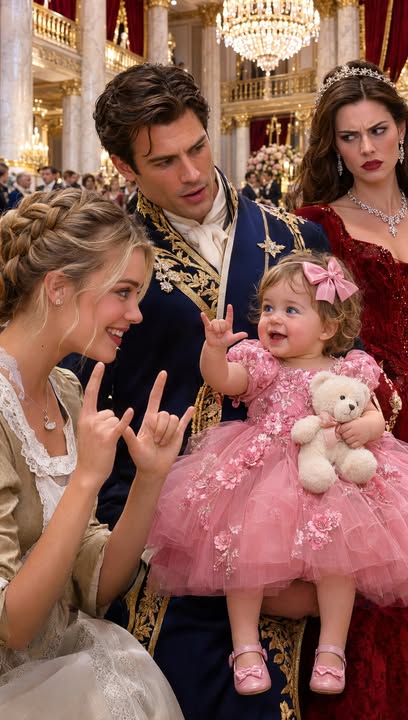
Part 3 – The Name Beneath the Ink
Alexander turned the nursery card toward the light, and all three of them stared at the same chilling question:
Why had someone erased Sophia from the palace nursery records?
The question remained between them as the room settled into silence.
Sophia could hear the faint ticking of the clock on Eleanor’s mantel, each measured sound pressing her further from the life she had believed was hers.
She had grown up knowing her name, her mother, and the small house where they had lived.
She had never imagined that somewhere inside a palace, a clerk had once written her name beside a royal nursery.
“That could be a different Sophia,” Alexander said at last, though his voice held little conviction.
“Perhaps,” Sophia replied.
The hope in her answer was so fragile that she could not bear to look at the card again.
Lily reached toward the paper, and Alexander folded it carefully before the child could touch its brittle edge.
“We should not decide what it means without seeing the records around it,” he said.
Sophia looked at him.
“You mean the palace archives.”
“I do.”
“And your mother?”
His eyes shifted toward the open doorway.
The Queen Dowager’s order still stood between them, even though she was nowhere in the room.
“I’ll speak to her first,” Alexander said. “Not to ask permission, but to give her the chance to tell us what she knows.”
Sophia’s fingers closed around Eleanor’s letter.
“And if she says nothing?”
“Then I’ll look for answers elsewhere.”
Lily tugged gently at Sophia’s sleeve.
Sophia turned, and the child lifted both hands, making the family gesture with solemn care.
I will find you.
Sophia touched Lily’s little fingers.
“I know,” she whispered.
Alexander placed the nursery card back in the box, beneath the cloth, and closed the lid.
He did not conceal it again behind the portrait.
Instead, he carried it with the letter and photograph as they left Eleanor’s chambers.
At the door, Sophia paused and looked back once more.
The room appeared unchanged, but it no longer felt like a place preserved only for grief.
It had given them a sister’s face, a sister’s words, and now the first clear indication that the past had been arranged by someone’s hand.
The corridor seemed colder when they stepped into it.
Mr. Hale had remained nearby, waiting without asking questions.
Alexander instructed him to return the box to his private study, where it could be kept safely until they had examined its contents more carefully.
Then he asked the chamberlain to bring Lily to her nursery.
Lily clung to Sophia’s hand when the nurse arrived.
Sophia leaned close and signed, “I’ll see you soon.”
The child looked to Alexander, who repeated the promise aloud.
“I’ll come too.”
Only then did Lily allow the nurse to lift her.
She kept her eyes on Sophia until the two of them disappeared down the corridor.
Alexander watched them go.
“You’ve given her a way to reach us,” he said.
“She already knew how to reach you,” Sophia replied. “She was simply waiting for you to understand.”
He looked down at the silver swan at her throat.
“I hope I can keep learning.”
They walked together toward the Queen Dowager’s private sitting room.
The palace seemed to have grown quieter after the ballroom, its servants moving with practiced care through the dim passages.
When they arrived, they found the Queen Dowager waiting beside the fire.
Her cane rested across her lap.
The sharp authority she had carried into the ballroom was still present, but it seemed to have drawn inward, leaving her tired and old.
She looked first at Alexander, then at Sophia.
“So you opened the door.”
“Yes,” Alexander said.
“And you found something.”
He did not answer immediately.
Sophia could feel the photograph inside the box they had left in his study, as if the two girls in the garden were standing with them.
“We found a photograph of Eleanor and me,” she said. “We found a letter she wrote because she knew who I was.”
The Queen Dowager’s gaze dropped to Sophia’s pendant.
For a moment, her face lost all color.
Then she lowered her eyes to her folded hands.
“Eleanor did not know who you were,” she said. “She thought she recognized a necklace.”
“She wrote that she saw me during a palace visit,” Sophia replied. “She knew the swan.”
“Memory is not proof.”
“No,” Sophia said. “But the photograph is.”
Alexander spoke with a patience that seemed harder to maintain than anger.
“Mother, there is a nursery record with Sophia’s name on it.”
The Queen Dowager’s fingers tightened around the cane.
The stillness in the room changed.
It was no longer the silence of people avoiding a painful subject.
It was the silence of someone who had heard a truth arrive at the door.
“You have been looking through old papers,” she said.
“We found the card in Eleanor’s private room.”
“Eleanor kept many things.”
“She kept a record with Sophia’s name crossed out and another name written in its place.”
The Queen Dowager sat very still.
Sophia watched her closely, trying to understand whether the old woman’s silence meant guilt, sorrow, or simply exhaustion.
At last, the Queen Dowager said, “Your mother left willingly.”
The words came too quickly.
Sophia felt them land like a stone.
“My mother never told me she had been here.”
“She may have had her reasons.”
“Did you know her?”
The Queen Dowager looked past Sophia, toward the fire.
“I knew of her.”
“Then you knew I existed.”
“I knew that a child had been placed in the palace nursery.”
Alexander took a step forward.
“Mother.”
The Queen Dowager raised one hand, not to silence him, but to ask for a moment.
“I am not saying that the record is accurate,” she continued. “Old registers were amended for many reasons. A name could be entered incorrectly, or copied from another page.”
“Then why did you say my mother left willingly?” Sophia asked.
The Queen Dowager’s face tightened.
“Because that is what I was told.”
“By whom?”
“By people who had already made their choices.”
It was not an answer, but it sounded like the nearest thing to one the Queen Dowager could offer.
Alexander’s voice softened.
“You ordered Eleanor’s rooms sealed.”
“I did.”
“Why?”
The old woman looked at him.
“Because my son had just lost his wife, and those rooms were full of memories that would have made the loss harder.”
“Only that?”
Her gaze moved to Sophia.
“And because I wanted this matter to remain buried.”
There it was.
Sophia’s heart gave a painful, bewildered beat.
“Why?”
The Queen Dowager drew a careful breath.
“Because an old scandal had already unsettled the family. I believed that bringing it back into the light would harm people who had no part in it.”
“What scandal?” Alexander asked.
The Queen Dowager’s mouth pressed into a thin line.
“Your father’s reign was not as peaceful as the history books suggest.”
“That does not explain a baby being removed from a nursery.”
“It may explain why the decision was made.”
Sophia stared at her.
“Was I that baby?”
“I cannot tell you what I cannot prove.”
“But you knew a child had been placed there.”
“I said I had heard of it.”
“Was my mother asked to leave?”
The Queen Dowager glanced down at her hands again.
“I was told that she left.”
“By whom?”
She did not answer.
Sophia’s grief shifted, finding a sharper edge.
“My mother raised me alone,” she said. “She gave me a name and a home. If she was hiding something, I deserve to understand why.”
The Queen Dowager’s shoulders lowered a fraction.
“I do not doubt that you deserve answers.”
“Then help us find them.”
“I cannot give you certainty when I have none.”
Alexander moved closer to Sophia, though he did not touch her.
“Mother, if you have documents, witnesses, or anything that might tell us what happened, we need to see them.”
The Queen Dowager looked at him with an expression that held both affection and warning.
“You think the truth will make this simpler.”
“No,” he said. “I think the absence of truth has already made it harder.”
She turned her gaze toward the fire.
“When Eleanor was young, she became convinced that her sister had been taken from her. She searched through old letters and questioned people who had been gone for years. She believed she had seen you at court.”
“I had no idea,” Sophia said.
“She was told that the girl had been sent away with her mother.”
“Was that true?”
“It was what I believed then.”
Sophia’s voice grew quieter.
“And what do you believe now?”
The Queen Dowager closed her eyes briefly.
“I believe that Eleanor loved you, and that she was denied the chance to know you.”
It was the first thing she had said that sounded free of defense.
Alexander heard it too.
He looked toward the old woman, but she would not meet his gaze.
“Why did you stop her from searching?” he asked.
The Queen Dowager’s hands tightened around the cane once more.
“I did not stop her.”
“Then why did she write that every path led to silence?”
“Because the people she asked did not know enough to help her.”
“Or because someone made sure they wouldn’t.”
The Queen Dowager’s expression changed, but she said nothing.
Sophia felt the room narrowing around them.
She had come to the palace as a maid, believing that the most difficult thing before her was the possibility of being mistaken for someone else.
Now the evidence suggested that her own life had been shaped by a secret she had never been allowed to see.
She touched the pendant at her throat.
“Did my mother give me this swan?”
“I don’t know,” the Queen Dowager said.
It was the first answer that did not sound rehearsed.
Sophia searched her face.
“Did Eleanor have one like it?”
“Yes.”
“Was it a family keepsake?”
The Queen Dowager did not respond.
Alexander stepped between them, not as a barrier, but as a quiet presence.
“We will look through the archives,” he said. “If the records conflict, we’ll find out why.”
“You will find scraps of paper and unanswered questions,” the Queen Dowager replied. “You will disturb old hurts without restoring a single lost year.”
“Those years are already lost,” Sophia said. “Not knowing why won’t bring them back.”
For the first time, the Queen Dowager met her eyes.
There was something like regret in her expression.
“I am sorry for what you have endured.”
Sophia wanted to accept the apology.
She also wanted to ask why it had taken so long to hear it.
Both feelings remained with her, neither yielding.
The Queen Dowager rose slowly from her chair.
“I will not stop you from looking,” she said. “But I will ask you to remember that a record can mislead as easily as it can reveal.”
Alexander bowed his head slightly.
“We’ll remember.”
The Queen Dowager turned toward the door.
Before she left, she looked once more at Sophia’s pendant.
“Your mother left willingly,” she repeated, though less firmly than before. “Whatever else the papers suggest, I do not believe she was forced.”
Then she was gone.
The silence she left behind felt different from the silence in Eleanor’s room.
This one was heavy with questions that had almost been answered.
Alexander walked Sophia to the door.
“You don’t have to continue tonight.”
“I know.”
“We can wait until morning.”
Sophia turned to him.
“If I go back to my room without looking for the truth, I’ll spend the entire night imagining what I might find.”
“Then we’ll look together.”
The archive occupied a long, windowless room in the oldest part of the palace.
Its shelves were crowded with ledgers, letters, household accounts, and boxes labeled in fading ink.
The palace archivist, a careful man named Mr. Ashcombe, was summoned from his quarters and arrived carrying a ring of keys.
He seemed unsettled to see the prince and a maid standing before him so late in the evening.
Alexander explained that they were looking for nursery records from the year of Sophia’s birth.
“Of course, Your Highness,” Mr. Ashcombe said. “Though I should warn you that the older registers were moved during the west-wing repairs.”
He unlocked a cabinet and brought out three ledgers.
They settled at a long table beneath a green-shaded lamp.
For the first hour, they found little beyond ordinary details: the names of wet nurses, lists of linens, and careful notations about the children’s meals.
Sophia read each line more slowly than she needed to.
Every name seemed to belong to someone else’s life.
Alexander worked beside her without impatience.
When he found a reference to Eleanor’s childhood, he marked the page gently and passed it to Sophia.
A record from the year she was born showed that two royal infants had been expected.
One had been entered under the name Eleanor.
The other line was blank.
The entry had been made in a different ink.
Mr. Ashcombe leaned over the page.
“That is unusual,” he said.
“Could it have been damaged?” Alexander asked.
“Not in this manner. The paper is intact.”
Sophia looked down at the blank space.
The silence in the room gathered once more.
They continued.
Near midnight, Mr. Ashcombe found a second register, smaller and more informal, with a faded ribbon marking several pages.
“This is the temporary nursery book,” he said. “It was used before the official records were copied.”
He turned the pages until he reached the date on the card from Eleanor’s box.
There, in neat, slanted writing, was Sophia’s name.
Beneath it, another name had been added in a darker ink.
The same replacement name appeared on the card.
Alexander read it aloud.
“Mary.”
Sophia stared at the letters.
The name meant nothing to her.
Mr. Ashcombe adjusted his spectacles.
“Mary may have been a wet nurse’s child, or an infant brought to the palace temporarily. The book does not say.”
“Can you tell who wrote the correction?” Alexander asked.
“Not from this register alone.”
He turned the page and checked the entry before it.
Then the one after it.
His expression grew thoughtful.
“This is stranger than I first thought.”
“What is?” Sophia asked.
“The correction was made later.”
“How can you tell?”
“The ink has settled differently, and the handwriting does not match the original clerk’s entries. Whoever added the second name came back to the record after it had been written.”
Alexander’s gaze hardened with concentration.
“Can you identify the hand?”
“I would need to compare it with other documents.”
Mr. Ashcombe searched through a nearby box and brought out a bundle of household papers.
Some were folded in half.
Others had been tied together with thin string.
As Sophia waited, her mind returned to the Queen Dowager’s words.
Your mother left willingly.
She tried to picture her mother at the palace, carrying a baby through these corridors.
The image would not settle.
Her mother had never spoken of royal life.
She had spoken of the market, the rain, the little garden behind their house, and the neighbor who brought warm bread when Sophia was sick.
She had never spoken of a sister.
Or if she had, Sophia had been too young to remember.
Mr. Ashcombe examined a page, then another.
At last, he found a household order bearing the Queen Dowager’s seal.
The writing was formal and difficult to read, but the signature at the bottom was clear.
He set it beside the nursery record.
Alexander leaned over both pages.
The altered name had been written in a hand that looked strikingly similar to the signature.
Sophia’s stomach tightened.
“Are you certain?” she asked.
“Not without a proper comparison,” Mr. Ashcombe said. “But I can say the correction was made by someone accustomed to writing formal documents.”
Alexander turned the paper so the signature faced them.
His mother’s name sat beneath the seal.
Sophia felt as though she had stepped into a room where every door led back to the same question.
“Why would the Queen Dowager change the name?” she asked.
“Perhaps the record was wrong to begin with,” Alexander said.
But the answer sounded like a possibility he was offering for her sake, not because he believed it.
Mr. Ashcombe read the order more closely.
“It appears to concern the transfer of household staff,” he said. “It does not mention children.”
“Could the handwriting still be hers?” Sophia asked.
“It could.”
Alexander straightened.
“Then we need the surrounding records and the original ledgers from the west wing.”
“The west wing archive is still being catalogued,” Mr. Ashcombe replied. “Some boxes were sealed after the repairs.”
“By whose authority?”
The archivist glanced toward the order.
“I cannot say without checking the catalogue.”
Sophia had to look away from the page.
Her hands had begun to tremble.
Alexander noticed and pushed a glass of water toward her.
She drank, though her throat remained tight.
“This doesn’t prove I was raised here,” she said.
“No,” he replied. “It proves your name was written here.”
“And then changed.”
“Yes.”
The truth was not a destination.
It was a corridor, and each door seemed to open onto another.
As Mr. Ashcombe returned the papers to their folders, the door to the archive opened.
Victoria stood in the threshold.
Her crimson gown was gone, replaced by a simple evening dress, and the bright confidence she had displayed in the ballroom was absent.
She looked first at Alexander, then at Sophia.
“I was told you were here,” she said. “I hope I’m not intruding.”
Alexander turned from the table.
“Is there something you need?”
Victoria’s gaze moved to the nursery register.
“No,” she said. “I came because I wanted to speak with Sophia.”
Sophia stood, uncertain what to expect.
Victoria’s hands were clasped in front of her.
“I was cruel to you in the ballroom,” she said. “I made a joke because I was embarrassed that Lily wouldn’t respond to me.”
Sophia said nothing.
“I’m not asking you to say it was all right,” Victoria continued. “It wasn’t.”
Alexander watched without interrupting.
Victoria took a breath.
“I thought this whole gathering was a contest. The marriage announcement made it feel like every woman had to prove she deserved a place beside you.”
“You never had to prove that,” Alexander said.
“I know that now.”
“What changed?” Sophia asked.
Victoria glanced down at her hands.
“I wanted security. A title, a position no one could take away, the kind of life where I wouldn’t have to worry about what came next.”
She looked up again.
“That is not the same as loving someone, and I was pretending it was.”
Alexander’s expression softened, but did not become indulgent.
“Marriage cannot be a prize,” he said. “And Lily is not a test to pass.”
“I understand.”
“Do you?”
Victoria met his eyes.
“I think I do now. Lily did not owe me a word, and Sophia did not deserve to be laughed at because she could reach her.”
The apology seemed difficult for her, but she did not look away from it.
Sophia recognized the effort.
“I hear your apology,” she said.
Victoria’s shoulders eased, though she did not mistake the words for instant forgiveness.
“Thank you.”
She looked once more at the record on the table.
“Are you all right?”
“I don’t know yet.”
“That seems fair,” Victoria said.
She left without asking for anything in return.
When the door closed, Alexander looked at Sophia.
“You did not have to accept her apology.”
“I didn’t say I had forgiven her.”
“No,” he said. “You didn’t.”
Sophia returned to the table.
The corrected name waited beneath the green-shaded lamp.
Mr. Ashcombe had finished tying the papers together, but one narrow slip remained beside the register.
It had slipped from the bundle when he moved the household order.
He bent to pick it up, then stopped.
“Your Highness,” he said quietly.
Alexander came closer.
The slip was an old nursery receipt, creased at the center and marked with the same date as the altered record.
Mr. Ashcombe read the faded line twice.
Then he looked at Sophia.
“This may be nothing,” he said. “But the record does not say that Sophia left the palace.”
He turned the slip so they could read it.
It said that on the morning after the correction, an infant named Mary had been delivered to a household beyond the palace walls.
And beside the child’s name, in a different hand, someone had written:
“Returned in place of the princess.”
**–END OF PART 3–CLICK “NEXT” AT THE BOTTOM OF THE PAGE TO CONTINUE READING**
* * *
[PREVIOUS: PART 2](https://storyly.idolsgift.com/blog/part-2-the-room-behind-the-portrait-069) | [NEXT: PART 4](https://storyly.idolsgift.com/blog/part-4-the-room-behind-the-portrait-069)
✓ Lynn R. Adams
Part 3 – The Name Beneath the Ink Alexander turned the nursery card toward the light, and all three of them stared at the same chilling question: Why had someone erased Sophia from the palace nurser…