PART 3: The Question Behind the Royal Chair 069
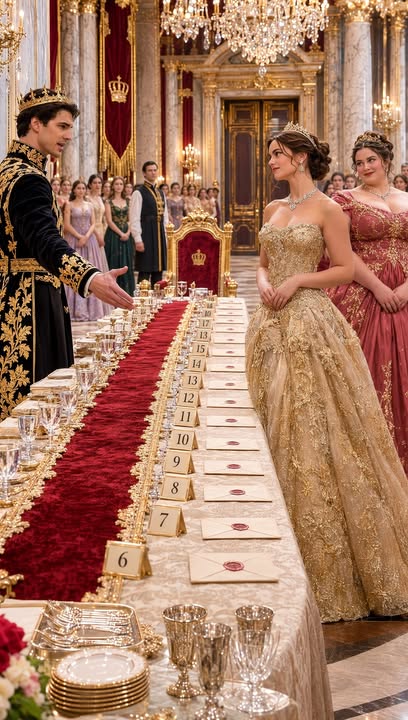
Part 3 – The Seal Beneath the Flap
“That seal should not be on these instructions.”
The steward’s words seemed to draw all the warmth from the ballroom.
Mara kept the envelope balanced in her palm, careful not to crease it.
“What does the seal mean?” the prince asked.
The steward glanced at the contestants, then toward the doorway, where two attendants stood in the shadow of the carved arch.
“It belonged to the household office that prepared the banquet records,” he said. “But that office stopped using it years ago.”
“How many years?” Mara asked.
“Nearly fifteen.”
Her fingers tightened around the paper.
The charity banquet her father had organized had taken place fourteen years earlier.
Across the table, Lady Celestine had gone very still.
“Could the seal have been copied?” she asked.
“It could,” the steward replied. “But I don’t believe it was.”
The prince studied him.
“You recognize it.”
“I do, Your Highness.”
“Then tell us what you know.”
The steward’s gaze lowered to the dark red mark.
“I saw it when the envelopes were delivered this morning.”
A murmur rippled through the onlookers.
“You saw it and said nothing?” Lady Celestine asked.
Her voice was not sharp, but disbelief had crept into it.
“I noticed that the seals were old,” the steward said. “I also noticed some of the numbers didn’t match the chairs.”
“Yet you let us begin,” the prince said.
The steward’s shoulders drew inward.
“I was told the envelopes had been checked.”
“By whom?”
The steward hesitated.
“By my superior.”
The prince’s expression remained calm, though the crown in his hand caught a brief, hard gleam from the chandeliers.
“And you trusted that assurance?”
“I wanted to.”
The answer was quiet and unadorned.
The steward looked around the ballroom, where every contestant seemed to be listening now.
“I thought it would be improper to contradict him in front of the court. I told myself the mistakes were small, and that someone would notice before they caused trouble.”
Mara felt the paper grow warm against her fingers.
“Someone did notice,” she said.
The steward looked at her, and the shame in his face was more painful than any defense might have been.
“Yes,” he said. “You did.”
The prince took a measured breath.
“What is your name?”
“Edwin, Your Highness.”
“Edwin, you will remain here while we determine how these instructions were prepared.”
“Yes, Your Highness.”
The command was firm, but not harsh.
Edwin bowed his head.
The prince turned to the contestants.
“The challenge is complete. No one will be judged further until the envelopes are examined.”
Lady Celestine’s gaze moved from the prince to Mara, then to the careful rows of place settings.
“Does that mean she passed?” she asked.
The prince looked at the plain glass beside the royal chair.
“It means her choice was correct.”
A few contestants exchanged surprised looks.
Mara’s breath caught, though she had known the prince might say something like that.
“The challenge was never about whether a person could reproduce a seating chart without question,” he continued. “It was about whether she could attend to the guests’ actual needs, especially when appearances suggested something else.”
He turned the plain glass a fraction so that its rim faced the light.
“Elias asked for this. Mara heard him. The envelope assigned to the royal seat was marked with the number for seat twenty, and no name connected it to the person sitting here. Giving Elias crystal would have been a choice based on a label, not on the guest.”
Elias looked up from the gilded chair.
The servant’s face had not entirely lost its pallor, but the fear in his eyes had eased.
Mara gave him a small, reassuring smile.
He returned it, then looked toward the prince.
“Your Highness,” he said, “I didn’t mean to disrupt the test.”
“You did not disrupt it,” the prince replied. “You gave it meaning.”
For a moment, the room felt less like a competition and more like a gathering of people who had all been waiting for permission to speak.
Lady Celestine looked down at her own hands.
“I failed because I assumed the correct arrangement was the one that looked most impressive,” she said.
Her voice carried only to those nearest her.
Mara heard it, and so did the prince.
Celestine lifted her chin again, but there was no longer a bright, practiced smile on her face.
“I thought the test rewarded flawless presentation,” she continued. “I believed if every glass and card was beautiful, the people seated around the table would be satisfied.”
“Presentation has its place,” the prince said. “But it cannot replace attention.”
“I understand that now.”
It was not an apology, exactly, but it was honest.
Mara looked at the arrangements she had made.
“We can still return the tableware,” she said. “Some of it belongs on the service trays, and I’d rather not leave the staff to sort it all alone.”
The words seemed to surprise the contestants more than the prince’s declaration had.
Lady Celestine stepped toward the nearest row of settings.
“I can help.”
Mara glanced at her.
“You don’t have to.”
“I know.”
Celestine reached for a crystal tumbler, then paused before lifting it.
“Would you show me which pieces are borrowed?”
Mara nodded.
Together, they began to gather the unused tableware.
The other contestants remained uncertain for a few seconds, as though waiting to learn whether helping was another part of the competition.
Then the young woman in lavender joined them.
So did two others.
Soon, several contestants were carrying serving plates toward the sideboard, while the attendants collected the linens.
The prince did not order anyone to help.
That made their movement feel less like obedience and more like a choice.
Mara showed Celestine how to separate the glasses by shape, placing the plain ones in one tray and the crystal in another.
“You’re very organized,” Celestine observed.
“I used to help my father prepare for community suppers.”
“Was that where you learned to notice what people needed?”
“I think I learned it at home,” Mara said. “The suppers gave me a place to practice.”
Celestine set a row of water glasses into the tray.
“My family hosted formal dinners every season,” she said. “I was taught to remember which silver went with which course.”
“That sounds useful.”
“It is. I’m beginning to wonder what else I should have been taught.”
Mara took a stack of folded napkins from the sideboard.
“What would you have wanted someone to teach you?”
Celestine’s hands paused over the crystal tray.
“How to know when the rules are serving people and when people are serving the rules.”
Mara looked at her, surprised by the seriousness in her tone.
Celestine gave a small, rueful smile.
“I’m not used to asking questions like that.”
“Neither am I, sometimes.”
“You seemed perfectly certain when you spoke to the prince.”
“I was certain about Elias’s glass,” Mara said. “I wasn’t certain about anything else.”
The answer made Celestine’s expression soften.
“Perhaps that is a better kind of certainty.”
Across the room, Edwin remained beside the table while the prince examined the envelopes.
The prince had removed his black-and-gold coat, leaving it draped over the back of a chair.
Without the formal line of it, he looked less like the distant figure the contestants had watched from the entrance and more like a young man who had been asked an uncomfortable question in front of a room full of people.
He was reading each envelope carefully, comparing the seals and handwritten numbers.
“Are they all from the same hand?” he asked Edwin.
“I can’t say, Your Highness. I saw only the outer papers.”
“Who delivered them?”
“A page from the records office.”
“Can he be found?”
“I expect so.”
The prince glanced toward the steward.
“I will not have anyone punished for speaking honestly about what they saw.”
Edwin looked up, his surprise apparent.
“I should have spoken earlier.”
“You should have,” the prince agreed. “But the choice to speak now still matters.”
Mara heard the words as she returned a serving spoon to its tray.
She wondered if the prince meant them only for Edwin.
The sealed envelopes lay in a neat line beside him.
Mara approached with a tray of empty glass holders.
“May I see the seal again?” she asked.
The prince passed her the envelope.
The wax was pressed with a branching emblem, its edges worn thin.
Mara turned it slowly beneath the chandelier.
“It matches the seal on my father’s banquet papers,” she said. “He kept a bundle of instructions and receipts in a wooden box.”
“Do you still have them?” the prince asked.
“My mother does.”
“Would you be willing to bring them to the palace?”
Mara’s first response was to nod.
Then she stopped.
“I would, if I knew why you needed them.”
The prince accepted the question without offense.
“To determine whether these envelopes were copied from the same records, and whether the old numbering mistake is connected to what happened today.”
“You know about the old banquet?”
“Only what the royal records say.”
“And what do they say?”
The prince’s face shifted, the change small but unmistakable.
“They say your father was responsible for a series of errors in the seating arrangements.”
Mara felt the floor beneath her seem to move.
It was a familiar sentence, one she had heard in fragments all her life, but its presence here made it feel newly sharpened.
“He was blamed for that,” she said.
The prince’s gaze remained steady.
“I know.”
“My father always told us he had followed the instructions he was given.”
The prince glanced down at the envelope.
“I understand.”
“Do you?”
Her voice was not raised, but it had lost the softness that had carried her through the challenge.
The prince was quiet for a moment.
“I know that the records say he was dismissed after the banquet.”
“That isn’t the same as understanding.”
“No,” he said. “It isn’t.”
Mara looked toward Edwin, who had turned his attention to the floor.
“Was this seal used on the envelopes from that banquet?”
“I believe so,” he said.
“Why would it be used again now?”
“I don’t know.”
“Who has access to the old records?”
The prince answered before Edwin could.
“The palace archive is accessible to senior clerks, the steward’s office, and members of the royal household who request particular documents.”
The words were practical, but they did not ease her unease.
Mara had spent years believing her father’s career ended because he had made mistakes he would never discuss in detail.
He had never complained about the royal family.
He had never asked anyone to clear his name.
When she was younger, she thought his silence meant he had accepted his fault.
As she grew older, she began to wonder whether he had simply wanted to spare his family the embarrassment of arguing with a story everyone else had already accepted.
The old seal in her hand seemed to hold the weight of that silence.
Lady Celestine came to stand beside her.
“Do you want me to keep helping?” she asked.
Mara looked at her.
“Why wouldn’t I?”
Celestine’s cheeks colored faintly.
“I wasn’t sure if you’d prefer me to leave you alone.”
“You can help return the tableware.”
“I meant with the envelopes.”
“Oh.”
Celestine’s gaze moved to the wax.
“I heard what he said about your father.”
“It’s not a secret.”
“Still, I’m sorry.”
Mara studied her face.
The apology seemed sincere, though neither of them knew what it could repair.
“Thank you,” Mara said.
Celestine looked down at the tray she had been carrying.
“My family attended that banquet.”
Mara’s hands stopped.
“Your family?”
“My grandmother was there. My mother was young, but she told the story often enough that I heard it growing up.”
“What story?”
“That the banquet had been badly organized. That the seats were mixed up, and a few important guests were left waiting while the household tried to sort everything out.”
Celestine’s voice grew quieter.
“She said your father had been careless and that the royal staff had no choice but to dismiss him.”
Mara felt the old ache move through her chest, familiar and unwelcome.
“That’s what your family believed?”
“That’s what I believed.”
Celestine did not look away.
“I repeated it once at a dinner, years ago, as though it were a harmless anecdote. I never thought about what it meant to the person being talked about.”
The tray in her hands gave a faint rattle.
“I’m sorry, Mara.”
Mara wanted to tell her that an apology could not undo the story.
She also wanted to say that Celestine could not be responsible for every account passed down from her family.
Neither answer felt complete.
So she said, “Thank you for telling me.”
Celestine nodded, accepting the limits of what had been offered.
The room had almost returned to its ordinary sounds.
Glasses touched gently against felt-lined trays.
The contestants spoke in low voices as they helped the staff.
The clock, having finished its role in the challenge, kept ticking above them as if nothing unusual had happened.
The prince moved along the table, collecting the envelopes in the order Mara had sorted them.
“Please leave the request groups as they are,” he told the steward. “We need to know which envelope came from which stack.”
Edwin began to gather the papers.
Mara reached to help, then stopped when she saw the faintest crease beneath the seal.
“Wait.”
Everyone nearby turned.
She leaned closer to the envelope marked twenty.
The corner had been folded over once, then pressed flat.
“Was that there before?” the prince asked.
“I don’t know,” Mara said. “It may have been folded before I opened it.”
“Can you tell?”
She examined the paper without touching the crease.
“The ink is slightly darker where the fold runs through the number. It could have been made before the number was written.”
The prince leaned beside her.
“Or the number could have been altered afterward.”
“Could the original number be visible?”
“Perhaps if we hold it to the window.”
The nearest tall window looked out onto the palace gardens, where the late afternoon light had begun to fade.
The prince carried the envelope toward it.
Mara followed, with Celestine and Edwin close behind.
Together they held the paper before the window.
The written number darkened against the light.
Beneath the twenty, another mark showed through.
Not a whole number.
Just a curved stroke and the faint start of a second line.
Mara leaned nearer.
“Could that be the original number?”
The prince rotated the envelope slightly.
“It may be.”
“Seat one?” Celestine asked.
The mark did not look like a one.
The prince studied the paper, then held it closer to the glass.
“Someone may have changed the number,” he said.
“Can we tell when?” Mara asked.
“Not from this alone.”
The prince lowered the envelope.
The change was subtle, yet it altered the room’s mood.
Until then, they had been dealing with a mismatch that could have been a careless error.
The crossed-out mark suggested someone had touched the paper after it was prepared.
Edwin drew in a shallow breath.
“I should have examined them.”
“You noticed the numbers,” the prince said.
“I noticed enough to worry, but not enough to understand.”
“Then we need to understand before we decide what it means.”
Mara looked back toward the table.
The other envelopes were still arranged in groups, their wax seals catching the light.
“Do any of the others have changed numbers?” she asked.
The prince returned to the table.
“Let us check.”
They examined the envelopes one by one.
Most were clean, marked with clear numbers and unbroken seals.
At the fifth envelope, Celestine noticed a small smudge along its edge.
At the ninth, Mara found a digit written over a pale indentation.
The number had once been different.
At the twelfth, the paper was too heavily folded to tell.
With each discovery, the old charity banquet seemed to grow closer, though no one had yet named what connected it to the challenge.
The prince set the altered envelopes in a separate row.
“Three have been changed,” he said.
“Perhaps more,” Mara replied. “We can’t know without comparing them to the original requests.”
“Then we will compare them.”
He looked at Edwin.
“Find the page who delivered the envelopes. Ask him where they came from, and who gave them to him.”
“Yes, Your Highness.”
Edwin bowed, then turned toward the doorway.
Before he reached it, a young attendant stepped inside carrying a small ledger.
“Your Highness, the delivery record from the records office.”
The prince accepted it.
“Thank you.”
The attendant nodded to the group and withdrew.
The prince opened the ledger, turning through its pages until he reached the day’s entries.
The ink was fresh.
“Twenty envelopes,” he said. “Prepared by the steward’s office and delivered at noon.”
He looked toward Edwin.
“Who signed for them?”
“I did, Your Highness.”
“Did you inspect the seals?”
“I glanced at them. I didn’t compare the numbers with the seating chart.”
“Was anyone else present?”
“Only the page who brought them.”
The prince read the line again.
At the bottom of the entry was a small notation in a different hand.
Mara leaned closer.
“What does that say?”
The prince turned the ledger slightly.
“‘Use previous arrangement.’”
Celestine’s brows drew together.
“Previous arrangement for which event?”
“There’s no event listed.”
Mara looked at the envelope again.
“What does the hand look like?”
The prince compared the notation with the rest of the ledger.
“It is not the same as the entry above.”
Edwin stepped closer.
“I recognize it.”
The prince looked up.
“Whose hand?”
“I’m not certain.”
“Take your time.”
Edwin traced the letters with his eyes.
“It looks like the writing of my former superior.”
“Who was that?”
“Mr. Hales. He retired three years ago.”
“Could he have prepared these envelopes?”
“I don’t know, Your Highness. He still consults on the archive from time to time.”
Mara felt the room narrow around the small ledger.
“Was Mr. Hales involved in my father’s banquet?”
Edwin’s gaze flicked toward her.
“He was a junior clerk then,” he said. “I had heard his name in connection with the records, but I don’t know what he did.”
The prince closed the ledger.
“We will speak with him.”
Mara’s attention stayed on the notation.
“‘Use previous arrangement.’ That sounds as if the envelopes weren’t prepared for today.”
“It could refer to the table plan,” the prince said.
“Or the requests,” Celestine added.
“Or the old instructions,” Edwin said.
No one spoke for a moment.
The prince looked toward the clock.
“We have enough to investigate. The challenge is over, and the contestants should be allowed to leave if they wish.”
A few women near the sideboard began collecting their wraps.
Others lingered, their curiosity stronger than their desire to depart.
Mara remained beside the table.
She felt exhausted, yet the envelopes had drawn a thread through time that she could not simply set down.
The prince noticed her expression.
“You don’t have to remain.”
“I know.”
“Your mother’s records may help us, but I won’t ask you to bring them tonight.”
Mara met his gaze.
“If this is connected to what happened to my father, I want to know.”
“I understand.”
She searched his face for the polished reassurance of a courtly promise.
Instead, she found uncertainty, and perhaps the beginning of discomfort.
“I hope you do,” she said.
Celestine placed the last crystal glasses on the service tray.
“Would you like me to come with you when you speak with your mother?”
Mara looked at her, surprised.
“You don’t have to involve yourself.”
“I know,” Celestine said. “But I would like to.”
“Why?”
“Because I helped repeat the wrong story about your father. I can’t change that, but I can at least listen while the truth is being examined.”
It was an imperfect offer, made without asking for forgiveness.
Mara felt the tension in her shoulders ease a little.
“Perhaps,” she said.
Celestine nodded.
The prince returned the altered envelopes to the table.
“We will preserve these until the records office can examine them properly.”
He spoke as if the matter were now settled, though the unease in his eyes suggested otherwise.
Mara reached for the envelope bearing her father’s seal.
The prince did not stop her.
She turned it once more beneath the light.
The branching emblem was pressed into the wax, but the paper beneath it held another faint impression.
This one was not a number.
It was a word, written on a sheet that had once rested against the envelope.
Mara could make out only the final letters.
“—WARD.”
The prince saw her expression change.
“What is it?”
She angled the paper so he could see.
He read the faint impression and went very still.
Edwin looked over the prince’s shoulder.
“Is that a name?” Celestine asked.
Mara could not answer.
The word beneath the seal appeared to have been written in the same ink as the old notation in the delivery ledger.
The prince’s voice lowered.
“Bring me the original banquet records as soon as you can.”
Mara looked from the envelope to the sealed doors at the far end of the ballroom.
“Why?” she asked.
He held her gaze.
“Because this may not be a mistaken seat number.”
He turned the envelope in his hand, exposing the half-erased word to the room.
“It may be the name of the person the instructions were meant for.”
**–END OF PART 3–CLICK “NEXT” AT THE BOTTOM OF THE PAGE TO CONTINUE READING**
* * *
[PREVIOUS: PART 2](https://storyly.idolsgift.com/blog/part-2-the-question-behind-the-royal-chair-069) | [NEXT: PART 4](https://storyly.idolsgift.com/blog/part-4-the-question-behind-the-royal-chair-069)
✓ Lynn R. Adams
Part 3 – The Seal Beneath the Flap “That seal should not be on these instructions.” The steward’s words seemed to draw all the warmth from the ballroom. Mara kept the envelope balanced in her palm,…