PART 3: The Portrait in the Forgotten Wing 053
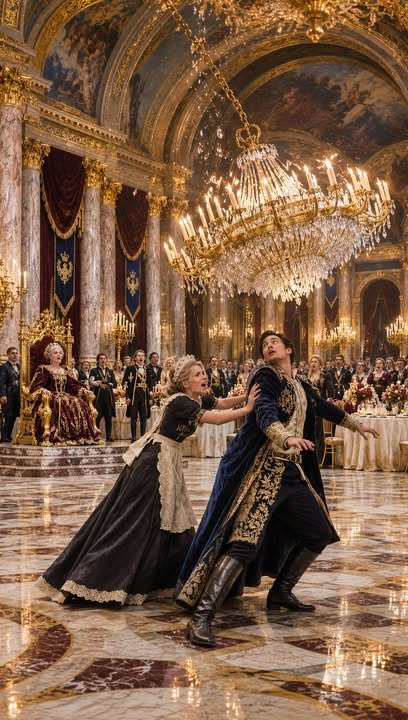
Part 3 – The Page That Wasn’t There
The nursery door handle turned again.
Mrs. Bell pressed one finger to her lips, then pointed toward the hidden stair.
Alexander descended first with the candle, and I followed, careful not to let the cradle’s wooden panel fall shut behind us.
Mrs. Bell came last, easing the panel into place just as the nursery door opened above.
We waited in the narrow stairwell, listening to footsteps cross the room.
The old boards creaked beneath someone’s weight.
Then a voice called from the nursery.
“Your Highness?”
Alexander’s face tightened in the candlelight.
The guard sounded uncertain, not angry.
He was not hunting a criminal in that moment, only trying to find the prince who had vanished from a crowded celebration.
“Keep moving,” Mrs. Bell whispered.
The steps led into a low passage that smelled of dust and cold stone.
At the end, a small wooden door opened onto the chapel’s side aisle.
The chapel was dark except for the faint glow of the sanctuary lamp, and the hush inside it felt different from the silence of the nursery.
Here, the years seemed to have gathered not in fear, but in prayer.
Mrs. Bell closed the door behind us and rested her hand against it.
“We cannot remain in the eastern wing,” she said. “The guards will search every passage they remember.”
“Then where can we go?” I asked.
“There is a servants’ lodging house beyond the old gardens,” Alexander replied. “We can reach it by the chapel crypt.”
Mrs. Bell studied him.
“And what will you tell the people waiting in the ballroom?”
“The truth.”
“Which truth?” she asked. “That you have found Eleanor’s daughter, or that you have only found a woman with a birthmark and a portrait?”
Alexander had no quick answer.
I was grateful for that.
The palace had already given me enough certainty for one night.
“I don’t want anyone announcing who I am until I know more,” I said.
Alexander nodded.
“Then I won’t.”
“You might not get to choose.”
“No,” he said. “But I can choose what I say.”
Mrs. Bell led us down the chapel’s narrow side aisle, where old memorial plaques gleamed faintly beneath the windows.
As we passed the royal pew, I caught sight of the Queen Mother’s family crest carved into its polished wood.
I wondered how many times she had sat there, listening to words about duty and mercy, while knowing that the daughter of Princess Eleanor might be alive.
The thought made my chest ache.
We emerged through a low door into the enclosed garden behind the chapel.
Night mist softened the hedges and silvered the stone path.
A bell rang from the main palace, followed by the distant murmur of people gathering in the ballroom again.
“They will be told something soon,” Mrs. Bell said.
“Probably that I was a thief,” I replied.
“Or a conspirator,” Alexander said.
“Would either surprise you?”
He looked at me.
“No.”
The simple answer made me glance away.
He had not tried to make his family seem innocent.
For now, that mattered.
Mrs. Bell led us through a side gate and along the garden wall to a small house where the palace’s retired staff were sometimes lodged.
An elderly caretaker named Mr. Finch opened the door without asking why a prince, a housekeeper, and a young maid had arrived after midnight.
He gave us dry clothes, tea, and a room with a window overlooking the dark gardens.
Only once the door was locked did my hands begin to shake.
I set the wool cloak on the table and stared at the torn sleeve of my uniform.
The birthmark was hidden again, but I could still feel the cool night air against the exposed skin.
Mrs. Bell placed a cup of tea in front of me.
“You should drink,” she said.
“I don’t think I can.”
“Then hold it until your hands remember they are yours.”
I wrapped my fingers around the cup.
The warmth seeped slowly into my palms.
Alexander stood near the window, watching the palace lights.
“I should return before the Queen Mother makes the search worse,” he said.
“You’re going back?” I asked.
“I need to know what she has told the court.”
“And then?”
“Then I’ll come back here.”
“How do I know you will?”
“You don’t,” he said. “But I’ll give you my word.”
I searched his face for the confidence of a prince accustomed to being believed.
Instead, I saw a man who knew his word might not be enough.
“Go,” I said. “But don’t decide anything about me while you’re away.”
“I won’t.”
He paused at the door.
“Emily, my father’s signature on an order doesn’t prove he knew you were alive.”
“No,” I said. “But it means you have more to find out.”
His expression darkened with the burden of a question he could not answer.
“Yes.”
After he left, Mrs. Bell sat across from me.
For a while, she spoke only of small things: the weather, the gardens, the way the palace cooks always over-salted their evening broth.
I knew what she was doing.
She was giving me a little space before the next truth arrived.
At last, I asked, “Did Margaret ever speak of Eleanor?”
“Not often.”
“What did she say?”
“That Eleanor was brave in the quiet ways that matter. She could read a room full of ministers and still notice when a servant was tired.”
Mrs. Bell’s voice softened.
“She also said Eleanor sang to you when the palace was asleep.”
The memory could not belong to me, yet I felt its absence as if something had been taken.
“Did she know I might have a claim to the throne?”
“She knew you were Eleanor’s daughter.”
“That isn’t what I asked.”
Mrs. Bell lowered her gaze to her tea.
“I believe she knew enough to understand that the court would never leave you alone if your identity became public.”
“So she let me grow up without knowing where I came from.”
“She wanted you to have ordinary choices.”
I looked down at my hands.
“My life has been ordinary in the ways that make people invisible.”
Mrs. Bell said nothing.
Her silence held no defense, only sorrow.
The first pale hint of dawn appeared before Alexander returned.
He entered the lodging house with his coat damp from the mist and his face drawn with fatigue.
“The Queen Mother has given a public account,” he said.
“What did she say?”
“That Princess Eleanor died in the fire, and the infant died with her.”
Mrs. Bell shut her eyes briefly.
“And me?” I asked.
“She said a servant interfered with the celebration, then escaped before the guards could question her.”
“Did she say my name?”
“No.”
The omission felt deliberate.
The Queen Mother was not denying that I existed.
She was denying that I mattered.
“Lady Victoria was there when she made the announcement,” Alexander added.
“Did she believe it?”
“I don’t know.”
“Does she know who I am?”
“She knows what everyone in the ballroom saw.”
I thought of Victoria’s mocking laugh when my sleeve tore.
“She probably thinks I planned the whole thing.”
“She may,” he said.
Mrs. Bell’s voice was careful.
“Has the Queen Mother ordered a search?”
“She has asked the household to cooperate with the guard captain. She also dismissed several staff members who were near the ballroom.”
“That is a polite way of saying she wants to know who helped us,” I said.
Alexander looked at me with regret.
“I’m sorry.”
“You didn’t order it.”
“No, but my family did.”
The word family settled between us.
For a moment, I wondered whether he had ever been able to separate the people he loved from the institution they served.
Then he reached into his coat and pulled out a folded sheet.
“I found this in my father’s private papers.”
Mrs. Bell stood.
“Where did you find it?”
“In his study. The Queen Mother has kept the room sealed since he died, but the outer cabinet was left unlocked.”
He laid the page on the table.
It was an order written in an old royal hand, with the ink faded but legible.
At the top was the late king’s seal.
Near the bottom, beneath several formal lines about security, was a sentence that made my stomach tighten.
The infant is to be transferred to royal protection until the threat has passed.
My eyes moved to the signature.
King Edward Whitmore.
“That’s his writing?” I asked.
Alexander nodded.
“I saw enough of his correspondence as a boy to recognize it.”
“What does ‘royal protection’ mean?”
“I don’t know.”
“You said that before.”
“I know.”
He looked as though he wished he could offer me something firmer than uncertainty.
Mrs. Bell leaned over the page without touching it.
“The order is dated three days after the fire,” she said.
“Then someone must have told him I survived,” I said.
“Possibly,” Alexander replied.
“Or he was arranging to find me.”
“Possibly.”
“Or he knew exactly where I was.”
His silence was answer enough.
I stepped away from the table.
The old king had been a child in the portrait gallery, a distant figure in ceremonial photographs, and a father Alexander remembered with affection.
Now his signature lay before me, attached to the secret that had divided my life in two.
“Did he ever speak about Princess Eleanor?” I asked.
“Not to me,” Alexander said. “When I asked, Grandmother told me the subject upset him.”
“Did you believe her?”
“I wanted to.”
He rubbed his thumb over the edge of the paper.
“He loved me,” he said quietly. “I don’t know whether that means he would have hidden this from me for my sake, or because he expected me to inherit everything.”
I could hear the strain beneath his words.
He was not only questioning his father’s choices.
He was questioning the memories that had shaped him.
“I’m sorry,” I said, before I could stop myself.
He looked up.
“You don’t have to comfort me.”
“I’m not. I’m sorry that you have to find out who your father was from a page he left behind.”
For a moment, neither of us moved.
Then Mrs. Bell reached for the royal order.
“The nursery records may tell us more,” she said. “There was a ledger for every child born to the royal household.”
“Where is it?” I asked.
“In the old records room beneath the eastern wing.”
Alexander frowned.
“That room has been locked for years.”
“Then we will need to find a key.”
Mrs. Bell shook her head.
“I kept one.”
She removed a brass key from the ring at her belt.
Her hands were steady, but her face had turned pale.
“Why didn’t you tell us earlier?” I asked.
“Because I wanted to know whether the order was real before I opened another door.”
The key felt heavier than it looked.
I studied Mrs. Bell.
“You have been carrying that all this time?”
“I never knew when someone would need it.”
We waited until the palace had stirred fully awake before returning through the servants’ entrance.
Alexander changed out of his formal clothes and borrowed a plain dark coat from Mr. Finch.
I covered my torn sleeve with the cloak, and Mrs. Bell tied a scarf over my hair.
The three of us moved through the lower passages as if we belonged there.
In some ways, I did.
I knew which stairs creaked and which corridors were used for deliveries.
But with every step toward the eastern wing, I felt less like the maid I had been and less like the royal person others suspected me to be.
The records room lay behind a narrow door at the end of a stone corridor.
Mrs. Bell’s key turned with a dry click.
Inside, shelves rose from floor to ceiling, packed with registers, household accounts, and bundles of documents tied with ribbon.
A thin film of dust covered everything.
Alexander lit a lamp.
Mrs. Bell searched the shelves until she found a row of ledgers marked with the year of the palace fire.
She slid one free and placed it on the table.
The cover had warped with age.
I stood beside her as she opened it.
The first pages listed births, christenings, and the names of nurses assigned to each child.
Near the middle, I found the entry.
Princess Eleanor Whitmore gave birth to a daughter at dawn on the seventeenth day of October.
The child was named Emily.
The ink had run slightly at the edge, as if someone had tried to blot it with a damp cloth.
Beside the entry, in a different hand, someone had written: Removed to royal protection.
“That’s the same phrase,” I said.
Alexander bent closer.
“The writing is not my father’s.”
“Can you tell whose it is?”
“No.”
Mrs. Bell turned the page.
The next entries recorded deliveries to the household kitchens, the arrival of a visiting doctor, and the changing of the nursery guard.
Then the ledger stopped.
A small rough edge remained where the next page had been torn away.
Mrs. Bell’s face tightened.
“Someone removed it.”
“How long ago?” I asked.
“Not recently,” she said. “The binding is old.”
Alexander took out the royal order and placed it beside the ledger.
“They may have been written by different people, but the phrase is the same.”
I traced the words with my eyes.
Removed to royal protection.
It could have meant safety.
It could have meant custody.
It could have meant a life hidden so completely that even a prince had never known it existed.
“Do you remember who took the page?” Alexander asked.
“No,” Mrs. Bell replied. “I was not responsible for the records then.”
She turned to the remaining pages, searching for another note.
A loose scrap of paper slipped from the back cover and fell to the floor.
I picked it up.
It was a small inventory card, the writing faded almost beyond recognition.
One line remained clear.
Silver locket, Eleanor initials, recovered from nursery after fire.
“Was there a locket?” I asked.
Mrs. Bell’s face changed.
“Yes.”
“What happened to it?”
“I thought it had been lost.”
Alexander turned the card over.
There was a second line on the back, written in a different hand.
Stored with chapel relics.
The chapel archives were seldom used, but they were not as forgotten as the eastern wing.
Mrs. Bell knew the way, and she led us through a service corridor to a narrow room beside the chapel vestry.
The archives smelled of old paper and beeswax.
Small wooden drawers lined the walls, each marked with a number or a family name.
We searched among them until Alexander found a box labeled with Princess Eleanor’s initials.
Inside lay a scorched silver locket, its hinge bent but still intact.
I held it carefully.
The outer face bore a small engraved letter E.
When I opened it, the metal gave a faint creak.
The inside was empty, but blackened around the edges.
A tiny blue ribbon remained caught in the clasp.
I could not say why the sight of it moved me so deeply.
Perhaps it had once rested against my baby’s skin.
Perhaps Eleanor had held it in her hands before the fire.
Or perhaps it was only another object the palace had left behind when it decided my life should be hidden.
Alexander watched me.
“We’ll find the missing page,” he said. “And we’ll learn what my father meant by that order.”
“You’re sure you want to?”
He did not answer at once.
“I’ve spent my life believing that my father protected the kingdom,” he said. “If he protected me by keeping the truth buried, I need to know what it cost.”
“And if the truth means your family took something from me?”
“Then I need to know that too.”
I closed the locket.
For a moment, I believed him.
Then footsteps sounded in the corridor outside the archive.
Mrs. Bell extinguished the lamp, and we stood still among the shelves.
A quiet voice called from beyond the door.
“Your Highness?”
Alexander moved toward the entrance.
The door opened before he could answer.
Lady Victoria stepped inside.
She had changed out of her evening gown, but her posture remained perfectly composed.
Her eyes passed over Alexander, Mrs. Bell, the open box, and finally the locket in my hand.
“You should not be here,” she said.
“Neither should you,” Alexander replied.
Victoria looked at the locket.
“I know what that is.”
“How?” I asked.
She hesitated.
“Because the Queen Mother showed it to me last week.”
Alexander’s expression sharpened.
“She told you about the locket?”
“She said it proved Eleanor’s child had died in the fire.”
“It proves no such thing,” Mrs. Bell said.
Victoria’s gaze shifted to her.
“I know that now.”
The words came out more quietly than I expected.
“You helped her search for me,” I said.
Victoria’s face flushed.
“I did.”
“Why?”
“Because I was afraid.”
“Of losing your engagement?”
“Yes,” she said, after a moment. “And of losing the life I was told I would have.”
Her honesty made my anger harder to hold in its simplest form.
Victoria looked at Alexander.
“I thought if I helped the Queen Mother find you, she would settle everything before the court heard rumors.”
“Did she promise you that?” he asked.
“She promised that the succession would remain stable.”
“That isn’t the same thing.”
“No,” Victoria said. “It isn’t.”
She turned back to me.
“When the Queen Mother announced that Eleanor and her baby died, she also said you were a servant who had tried to create a scandal. I did not believe that part.”
“You laughed when my mark was exposed.”
“I did,” she said. “And I’m ashamed of it.”
Her apology sounded painfully inadequate.
It was also the first thing she had said that did not ask me to accept a lie.
Before I could answer, a bell rang twice from the chapel tower.
Alexander looked toward the door.
“That is the council summons.”
“For you?” I asked.
“For the whole court.”
Victoria stepped aside, but did not leave.
“The Queen Mother is going to tell them a story before you can tell yours.”
“Then we should go,” I said.
Alexander looked at me.
“You don’t have to appear before the council.”
“I know.”
I slipped the locket into the pocket of my cloak.
“But I am tired of other people speaking about my life as if I’m not in the room.”
We reached the council chamber by a private passage shortly before the doors opened.
I remained in a side alcove, out of sight of the assembled ministers, while Alexander and Victoria entered the room.
Through the partly open doors, I heard the Queen Mother’s measured voice.
“Princess Eleanor perished in the palace fire,” she told the council. “Her child did not survive the night.”
No one interrupted.
Then she spoke of a “disturbance” at the engagement celebration and described me as a frightened servant who had mistaken a family symbol for a royal claim.
I looked down at the locket hidden beneath my cloak.
The Queen Mother’s account was calm, polished, and nearly convincing.
That frightened me more than a shout would have.
A minister asked whether the late king had ever recognized Eleanor’s child as a member of the royal family.
The room fell silent.
Alexander answered from within.
“I have found a royal order signed by my father. It states that the infant was transferred to royal protection.”
The council murmured.
The Queen Mother replied, “That order concerned a different matter.”
“What matter?” Alexander asked.
She did not answer immediately.
“Your father’s signature has been taken out of context,” she said at last. “He was dealing with the aftermath of the fire.”
A second minister asked whether the order had been accompanied by a record of the child’s whereabouts.
“No surviving record exists,” the Queen Mother replied.
I could feel Mrs. Bell beside me, listening without moving.
A clerk began reading from an old household register.
His voice faltered.
“Princess Eleanor gave birth to a daughter at dawn on the seventeenth day of October. The child was named Emily.”
Every word seemed to travel through the chamber and return to me changed.
The Queen Mother spoke over him.
“That entry is incomplete.”
“Why?” Alexander asked.
“Because it was later amended.”
“Where is the amendment?”
The answer did not come.
I heard the scrape of a chair and imagined the council members exchanging glances.
Then the Queen Mother said, “The original ledger is missing its final page.”
The door shifted slightly in its frame.
A draft from the corridor lifted the loose edge of the ledger page I had brought from the records room.
On the reverse, hidden beneath the stuck fold, a line of faded writing appeared.
I had not noticed it before.
I bent toward the light spilling from the council chamber and read the words.
Infant released to the custody of—
The rest had been torn away.
Then I saw the initials beneath the line.
E. W.
My breath caught.
Edward Whitmore.
The late king had not merely signed an order about royal protection.
He had personally released me into someone’s custody.
**–END OF PART 3–CLICK “NEXT” AT THE BOTTOM OF THE PAGE TO CONTINUE READING**
* * *
[PREVIOUS: PART 2](https://storyly.idolsgift.com/blog/part-2-the-portrait-in-the-forgotten-wing-053) | [NEXT: PART 4](https://storyly.idolsgift.com/blog/part-4-the-portrait-in-the-forgotten-wing-053)
✓ Lynn R. Adams
Part 3 – The Page That Wasn’t There The nursery door handle turned again. Mrs. Bell pressed one finger to her lips, then pointed toward the hidden stair. Alexander descended first with the candle, …