PART 3: The Place They Could Choose 052
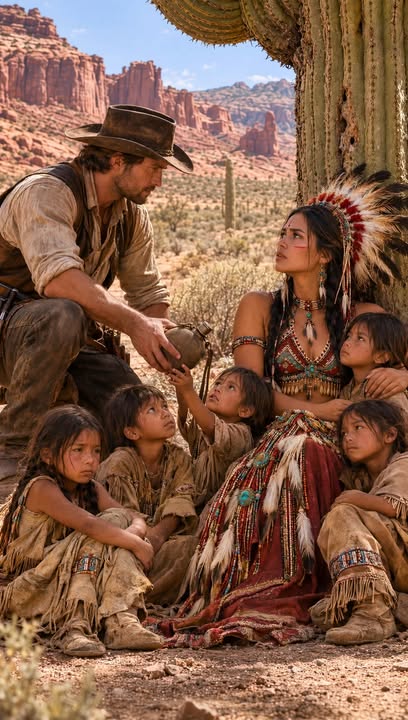
Part 3 – The Name on the Notice
Ryland read the name twice before the letters settled into meaning.
“Lydia Vale,” he said.
Elias Bell nodded. “That’s what she gave the storekeeper.”
From the house came the creak of a floorboard.
Yara stood in the open doorway, one hand braced against the frame, her face pale with sleep and something sharper beneath it.
“Let me see,” she said.
Ryland held out the notice.
She did not take it at once.
Her gaze moved over the page, stopping at the list of children’s names and ages.
Kea, Reco, Sani, Daro, and Merie.
The ages were close enough to be accurate, and the descriptions—dark hair, brown eyes, a small scar near Daro’s left eyebrow—were precise.
Yara’s fingers tightened around the edge of the paper.
“Who is Lydia Vale?” Ryland asked.
“I don’t know.”
It was an answer, but not quite a denial.
Elias shifted on the buckboard. “The woman said she was their aunt. She asked folks to send word if anyone had seen them.”
“What did she look like?” Yara asked.
“Older than you. Gray hair, dark coat. She spoke politely enough.” Elias paused. “There was a man with her, though he didn’t say much.”
Yara’s eyes lifted from the notice.
“Did he have a narrow face and a scar beneath his chin?”
Elias considered. “I couldn’t say about a scar. He kept his collar high.”
Ryland looked at her. “Do you know him?”
“No.”
The answer came too quickly.
Yara turned away, but Ryland saw the way her shoulders had drawn tight.
Elias folded his hands over the reins. “I don’t mean to bring trouble to your door. I thought it best you knew.”
“You did right,” Ryland said.
He gave the trader a coin for the notice, though Elias tried to refuse it.
“Keep it,” Ryland said. “And thank you for stopping.”
Elias tucked the paper into Ryland’s palm.
“If you want, I can tell the storekeeper you saw nothing.”
“No,” Yara said.
Both men turned toward her.
She held the notice flat, smoothing its creases with one careful finger.
“If someone is asking after them, it is better to know.”
Her voice was steady, but she looked as if she had not slept at all.
Elias tipped his hat. “Then I’ll be on my way. I’ll be back through in a week or so.”
Ryland watched the buckboard rattle down the lane until the dust swallowed it.
When he turned back, Yara was still studying the paper.
The children began stirring in the front room.
“Don’t let them see it yet,” she said.
“Why?”
“Because they will ask whether someone is coming to take them.”
“Is that what you think?”
“I think the woman who wrote this knows their names and ages, and has put them on a public notice.” Yara’s voice lowered. “That is enough for them to fear.”
Ryland looked at the names again.
“Maybe she is trying to help.”
“Maybe.”
“You don’t believe that.”
“I don’t know what to believe.”
She folded the paper and placed it on the table.
“Will you tell me who she is?” he asked.
“I told you, I don’t know.”
Ryland let the silence sit between them.
He had promised not to demand her story, and he meant to keep that promise.
But the notice had brought the story to his doorstep whether he asked for it or not.
Yara looked past him toward the front room.
“I’ll make breakfast,” she said.
“You don’t have to.”
“I know.”
She moved around him without touching his arm.
That morning, the children woke to the smell of warm oats and coffee.
They crowded around the kitchen table, still sleepy, their hair tousled from the blankets.
Merie sat beside Yara and reached for her hand before Ryland could set down the bowls.
“Are we staying here today?” she asked.
“If that’s what you want,” Ryland replied.
Merie glanced at Yara.
Yara gave a small nod.
“Then we’re staying.”
Kea looked toward the window, where the lane ran between the ranch and town.
“Will the lady in the paper come here?”
Ryland paused with the bowl in his hands.
“You heard us?”
“Not all of it,” Kea said. “I heard my name.”
Yara placed a spoon beside her.
“There is a woman asking questions in town.”
“Does she know our mother?” Daro asked.
Yara’s face softened, though sorrow remained in her eyes.
“I don’t know.”
“Is she family?” Reco asked.
“I don’t know that either.”
Daro watched her closely.
“You know more than you’re saying.”
“Daro,” Yara murmured.
The boy lowered his eyes, but his jaw remained set.
Ryland put the bowl down in front of him.
“You don’t have to figure everything out before breakfast.”
“I’m not hungry.”
“You can sit with us anyway.”
Daro stared at the food, then pulled the bowl closer.
No one pressed him to eat.
After breakfast, Ryland offered to take the children into town to buy shoes and a few things they needed.
Yara refused at first.
“We have enough.”
“They have one pair between them that isn’t split at the soles.”
“They can wear what they have.”
“They can,” Ryland agreed. “But they don’t have to.”
Yara’s gaze flicked toward the children.
They had been listening, though each pretended not to.
“If you buy things for them, I will find a way to repay you,” she said.
“I thought we had settled that.”
“We settled what you want. Not what I can live with.”
Ryland considered her words.
“Then you can choose what we buy,” he said. “That way it won’t be my decision alone.”
The suggestion seemed to catch her off guard.
She glanced at the children again.
“Shoes,” she said at last. “Only what they need.”
“And thread,” Kea added.
“Why thread?” Yara asked.
“Because my sleeve is coming apart.”
Yara touched the frayed edge of Kea’s shirt.
“We can mend it.”
“Then we need thread,” Kea said.
Ryland’s mouth twitched.
“Sounds settled.”
They walked into Dusty Creek late in the morning, with Ryland carrying Merie on his shoulders and the other children keeping close to Yara.
The town was small enough that most people knew when a stranger had arrived, and several heads turned as they passed the general store.
Ryland felt those glances, though no one stopped them.
Yara felt them too.
She kept her chin lifted and one hand resting on Merie’s blue-cloth wrist.
Inside the store, Ryland spoke with the owner, Mr. Givens, while Yara chose shoes for the children.
The children tried on each pair carefully, as if the right fit might be something they could earn by not asking for too much.
Kea chose sturdy brown shoes.
Reco picked a pair with a little brass eyelet missing from one side.
Sani liked hers because they were soft.
Daro insisted on the plainest pair in the shop.
“You don’t have to choose the cheapest,” Yara told him.
“I like these.”
“Do you?”
He looked down at his feet.
“They’re fine.”
Ryland did not interfere.
He asked Mr. Givens to add thread and a small tin of needles to the purchase.
Yara saw the sewing supplies.
“I said only what they need.”
“They need thread.”
“I can mend the clothes with what I have.”
“You’ve been doing that already.”
Her expression tightened, but she did not object.
While Mr. Givens wrapped the purchases, a woman near the counter lowered the newspaper she had been reading.
She was in her late sixties, with silver hair pinned neatly at the nape of her neck and a small pair of spectacles resting low on her nose.
Her gaze lingered on the children.
Then it settled on Merie’s wrist.
“My,” she said softly. “I haven’t seen that stitch in years.”
Yara’s hand closed around Merie’s.
The woman looked up at her.
“Did you make it?”
“No,” Yara replied.
“May I see the cloth?”
Yara hesitated.
Ryland moved half a step closer, not between them, but near enough that Yara could feel he was there.
The woman noticed and lowered her hands.
“I’m not asking to take it,” she said. “My name is Mrs. Bellweather. I used to help with the sewing circle at the mission.”
Yara’s eyes sharpened.
“What do you know about this stitching?”
Mrs. Bellweather leaned closer, careful not to touch.
“It’s a looped edge, worked in blue cotton. The women at the mission used it on blankets and children’s clothes. But this pattern is older than the others.”
She studied the strip.
“See how the thread crosses back beneath itself? That was the way Alma Voss taught us.”
Ryland went still.
“Alma Voss was my mother,” he said.
The woman turned toward him.
“Then she was your mother.”
Ryland looked down at the blue cloth, its pale, careful loops, and remembered the sewing chest beneath the stairs.
His mother’s hands bent over a lamp.
The soft pull of thread through fabric.
The faint smell of cedar in the old chest.
Yara drew Merie closer.
“Could anyone have copied the pattern?”
“Of course,” Mrs. Bellweather said. “A good needleworker can copy almost anything. But Alma’s work was distinctive. She favored this little knot at the corner, where the thread doubles back twice.”
She pointed without touching.
There it was: a tiny knot, nearly hidden among the faded stitches.
Ryland’s mind returned to the cloth he had seen at the ranch the night before.
His mother had died years ago, and he had never heard her speak of an Apache family or a child named Aven.
He had not even known she had been involved with the mission sewing circle.
“Are you certain?” he asked.
Mrs. Bellweather’s face softened.
“I’m certain she made work like this. I would not claim she made this particular piece without asking her.”
Yara’s voice was quiet.
“Could you have known Aven?”
The name seemed to stir a memory in the older woman.
“Perhaps. Many people came through the mission over the years. I remember a young woman with five little ones, though I can’t be sure of her name.”
Yara’s fingers tightened around Merie’s shoulder.
“Was she here recently?”
“No, dear. It must have been some years ago.” Mrs. Bellweather looked from Yara to Ryland. “I’m sorry. I wish I could tell you more.”
Yara gave a small nod.
“Thank you.”
Mrs. Bellweather reached for her newspaper again, but paused.
“Alma kept a record of the women who came to the circle,” she said. “If you want, I can look through the old books at the mission.”
Yara’s eyes met Ryland’s.
For the first time since the notice arrived, she looked not only guarded, but curious.
“Would you?” Ryland asked.
“I will.”
Mrs. Bellweather folded the newspaper and tucked it beneath her arm.
“Come by tomorrow afternoon. I’ll see what I can find.”
Outside, Yara did not speak until they had crossed the street.
“Your mother knew my sister?”
“I don’t know.”
“You said she had been gone a long time.”
“She was.”
“Did she ever tell you about the mission?”
“Not that I remember.”
Yara looked down at the blue strip on Merie’s wrist.
“Perhaps Aven did.”
“Perhaps.”
Ryland could hear the uncertainty in his own voice.
He had spent years thinking he knew the shape of his mother’s life.
Now a faded piece of cloth had opened a door into a room he had never seen.
At the edge of town, they passed the sheriff’s office.
Sheriff Calhoun stood on the porch, reading a sheet of paper.
When he saw Ryland, he folded it and came down the steps.
“Voss,” he said. “I was looking for you.”
Yara slowed.
“What is it?” Ryland asked.
“I’ve heard about the notice. I wanted to ask a few questions before stories grow legs.”
“Ask me.”
The sheriff looked at Yara.
“I’d rather ask both of you, if that’s agreeable.”
Yara’s posture stiffened.
“You can ask.”
“Did you take the children from their father?”
“No.”
“Are you their mother?”
“No. I’m their aunt.”
The sheriff nodded, taking care not to look as though he doubted her.
“Do you have any papers proving that?”
“No.”
“Do you know who Lydia Vale is?”
“No.”
“Did you ever hear your sister mention that name?”
Yara hesitated.
“No.”
The sheriff watched her face, not unkindly.
“Someone may come through town claiming the children are being held against their family’s wishes. I need to know what I’m looking at.”
“They aren’t being held,” Ryland said.
“I can see that. They’re walking around in new shoes.”
The sheriff glanced at the children.
“Are you safe here?” he asked them.
Kea nodded.
Daro said nothing.
Merie leaned closer to Yara.
The sheriff did not demand an answer.
“I’ll be at the office if you need me,” he said. “If that woman comes to town, I’ll speak with her before she reaches the ranch.”
“Thank you,” Yara said.
She sounded wary, but not dismissive.
As they continued home, Ryland asked, “Why did you hesitate when the sheriff asked whether your sister knew Lydia Vale?”
Yara’s steps slowed.
“I didn’t.”
“You did.”
She looked ahead, toward the ranch road.
“I have never heard the name Lydia Vale.”
“That isn’t what I asked.”
Yara’s mouth pressed into a line.
“I knew Toan used people to carry messages. He said once that a woman in the north had been asking questions about the children.”
“Who was she?”
“He didn’t say.”
“Could it have been Lydia Vale?”
“I don’t know.”
“Did Toan tell you the woman was their aunt?”
“No.”
Ryland waited.
Yara glanced back at the children.
“I kept the children’s surname from him,” she said. “I thought it might keep them safer.”
“What is it?”
She stopped walking.
The children went a few steps ahead before they noticed.
“Yara,” Ryland said gently.
“If you know their name, it can be repeated. Someone can write it down. Someone can send it ahead.”
“Someone already has.”
Her expression hardened.
“I know.”
“Was the notice using their true surname?”
“No.”
“Then how did the woman know their names and ages?”
“I don’t know.”
“Yara, if we’re going to protect them—”
“I have protected them.”
“I didn’t say you hadn’t.”
“Everyone asks for names, explanations, proof. They want me to tell them the whole road that brought us here, then they decide what I should have done differently.”
Ryland felt the force of the words, and the hurt beneath them.
“I’m not asking you to defend yourself.”
“Then what are you asking?”
“To help me understand what we’re facing.”
She looked at the children.
“They have already had enough people decide where they belong.”
Ryland’s voice softened.
“I won’t decide for them.”
“You said that before.”
“And I mean it now.”
For a moment, neither of them moved.
Then Daro came back to them, his new shoes scuffing the dirt.
“Are we going home?”
The question made Yara look away.
“Yes,” she told him. “We’re going home.”
He glanced at Ryland, then reached for Yara’s hand.
They walked the rest of the way together.
That afternoon, Ryland found Yara sitting on the porch with the thread and needles beside her.
She had pulled one of Kea’s sleeves into her lap and was working a neat stitch through the torn seam.
The children played near the windmill, their voices rising and fading with the breeze.
“You don’t have to mend everything today,” Ryland said.
“I know.”
“Do you want help?”
“No.”
He sat on the porch step, several feet away.
She pulled the thread through the cloth.
“My sister used to sit like this,” she said. “She would sew while the children played, and she would make up stories about wherever the road was taking us.”
“What kind of stories?”
“Stories where nobody was left behind.”
Ryland listened.
“She thought the children could tell when adults were afraid, so she made the ending certain.”
“That sounds like her.”
“You didn’t know her.”
“No,” he said. “But I can imagine.”
Yara’s needle paused.
“Did your mother tell stories?”
“She read aloud. Mostly books that were too serious for the age I was.”
“Did you like them?”
“I liked the sound of her voice.”
Yara lowered her eyes to the seam.
“I remember my mother’s hands,” she said. “I thought I had forgotten them until Merie held out the blue cloth.”
Ryland watched the needle move through the fabric.
“I found my mother’s sewing chest,” he said. “I never learned what she kept in it.”
“Have you opened it?”
“No.”
“Why not?”
He thought about it.
“Because I knew what was inside.”
Yara glanced up.
“Thread and needles?”
“And things she made. A few pieces of cloth, a thimble, some old patterns. I suppose I didn’t want to find out how much I missed her.”
Yara returned to the seam.
“Sometimes keeping something untouched is another way of losing it.”
The words settled between them.
Ryland looked toward the children.
Merie was showing Sani how the blue strip fluttered when she ran.
“Would you like to open it?” Yara asked.
“Maybe.”
“You don’t have to.”
He smiled faintly.
“I know.”
That evening, the children chose to sleep in the front room again.
Ryland left the door open as they had requested, and Yara arranged the blankets around them.
Merie placed the blue cloth beneath her pillow before lying down.
Yara watched her do it.
Then she looked at Ryland.
“Do you think the woman in town is coming for them?”
“I don’t know.”
“Do you think she is truly their aunt?”
“I don’t know that either.”
Yara studied him for a long moment.
“You are honest about what you don’t know.”
“I’ve learned that pretending otherwise makes a mess.”
“Most people pretend.”
“Most people are afraid of being wrong.”
“Are you?”
“Of course.”
She seemed surprised by his answer.
“Then why do you keep stepping forward?”
“Because being afraid doesn’t tell me what the right thing is.”
Yara said nothing.
Before dawn the next morning, Ryland saddled Flint and rode to the mission.
Mrs. Bellweather met him in a small room behind the chapel, where shelves held old ledgers, folded linens, and jars of buttons arranged by color.
She had brought out three books with cracked leather covers.
“I found Alma’s name,” she said.
Ryland leaned over the open page.
The entries were dated in his mother’s familiar, slanted hand.
There were notes about blankets, shirts, and children’s clothes.
Near the bottom of one page was a name written in blue-black ink.
Aven.
Beside it, in smaller letters, was another name.
“Yara,” Ryland read.
Mrs. Bellweather touched the margin.
“I remember them now. Aven came here with her sister and the children.”
“What did my mother do for them?”
“I don’t know. The book only records sewing supplies and measurements.”
She turned several pages.
“There are notes about a coat for the oldest boy, and a small blanket with blue edging.”
Ryland looked at the faded ink.
“Was there a letter?”
Mrs. Bellweather searched the remaining pages.
“Not here.”
She closed one ledger and opened another.
“Your mother sometimes kept personal correspondence in her sewing chest. She did not trust the mission’s office with every paper.”
Ryland felt his attention sharpen.
“Why not?”
“Not because she distrusted the people. She simply believed private promises belonged with the person who had made them.”
The room seemed to grow quieter.
“Do you remember Aven saying anything about my mother?”
Mrs. Bellweather considered the question.
“She told Alma she hoped the children would have a place to go one day. I remember that. But I can’t tell you more than that.”
Ryland thanked her and rode home with the name still turning in his thoughts.
When he reached the ranch, Yara was at the kitchen table, sorting the children’s clothes.
The five of them were in the yard, trying to teach Flint to accept a handful of grass.
Ryland laid the ledger copy Mrs. Bellweather had made beside Yara.
She read the entry.
Her fingers came to rest on Aven’s name.
“She was here,” Yara whispered.
“At the mission.”
“With my mother.”
“Yes.”
Yara looked up at him.
“You never knew?”
“Not until yesterday.”
“Your mother helped my sister.”
“It seems she did.”
Yara lowered her gaze again.
“She never told me.”
“Maybe she wanted to keep your sister’s confidence.”
“Or perhaps she did not think it mattered.”
Ryland pulled out the chair across from her.
“Do you think Aven knew my mother was the person named in that letter?”
Yara’s expression changed.
“What letter?”
Ryland held still.
“You didn’t tell me about one.”
“I didn’t say there was a letter.”
“Mrs. Bellweather said Aven hoped the children would have a place to go one day.”
“That does not mean there was a letter.”
“No.”
He saw the fear return to her face, quiet and immediate.
“Yara,” he said, “I’m not trying to trap you.”
She folded the ledger copy and pushed it back toward him.
“I know.”
“Then why does every question sound like a threat?”
“Because sometimes a question is the first step toward someone taking what you’ve guarded.”
Ryland’s hands remained on the table.
“I won’t take anything from you.”
“You might not mean to.”
He had no answer that could make the promise more certain.
A knock sounded at the front door.
They both turned.
The sheriff stood on the porch with his hat in his hands.
“I’m sorry to come without warning,” he said. “The woman from the notice has arrived in town.”
Yara stood so quickly her chair scraped the floor.
“Is she alone?”
“No.”
“Who is with her?”
The sheriff’s gaze shifted toward the children in the yard.
“A man named Toan.”
The name struck the room like a dropped stone.
Yara’s face lost its color.
Ryland rose beside her.
“Did they ask for the children?”
“Toan says he came to bring them to safety,” the sheriff replied. “The woman says she is their aunt.”
Yara looked toward the window.
In the yard, the children had stopped playing.
Daro held Flint’s lead rope in both hands.
Merie’s blue cloth fluttered at her wrist.
The sheriff lowered his voice.
“I wanted you to hear it from me before either of them came to the ranch.”
Yara’s fingers closed around the table’s edge.
“Did the woman give her real name?”
“She did.”
“What is it?”
The sheriff glanced at Ryland, then back at Yara.
“She says her name is Lydia Vale.”
Yara’s eyes stayed fixed on the road beyond the window.
“And what did she say about how she knows the children?” she asked.
The sheriff drew a breath.
“She says she has proof they belong with her.”
Then he reached into his coat and placed a folded paper on the table.
The name written at the bottom was not Lydia Vale’s.
**–END OF PART 3–CLICK “NEXT” AT THE BOTTOM OF THE PAGE TO CONTINUE READING**
* * *
[PREVIOUS: PART 2](https://storyly.idolsgift.com/blog/part-2-the-place-they-could-choose-052) | [NEXT: PART 4](https://storyly.idolsgift.com/blog/part-4-the-place-they-could-choose-052)
✓ Lynn R. Adams
Part 3 – The Name on the Notice Ryland read the name twice before the letters settled into meaning. “Lydia Vale,” he said. Elias Bell nodded. “That’s what she gave the storekeeper.” From the house…