PART 3: The Photograph in His Wallet 046
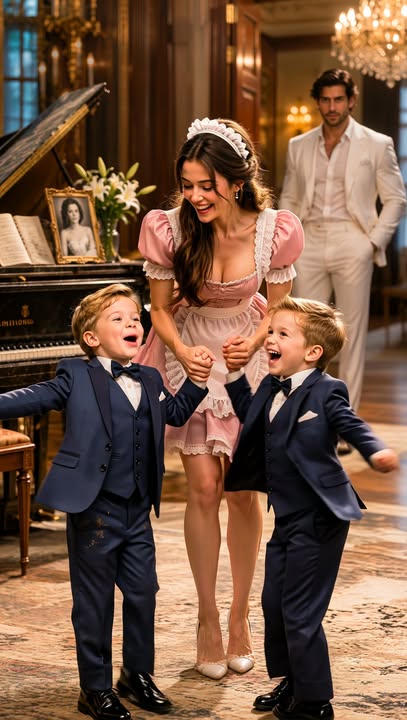
Part 3 – The Verse Clara Left Behind
The next morning, I returned to the mansion with the moon song still circling in my mind.
The twins were waiting in the playroom, their wooden train arranged in a crooked loop around the piano.
Leo ran to meet me, while Tomas hung back for half a second before deciding he had waited long enough.
“You came,” he said, as if he had been trying not to hope.
“I said I would.”
They each took one of my hands and led me toward the train.
Adrian stood beside the window, holding a cup of coffee he had not touched.
He looked tired, though he had clearly slept no more than I had.
“Good morning,” he said.
“Good morning.”
He glanced at the boys, then at the old piano.
“I found something last night.”
The way he said it made the twins look up.
“Something about Mommy?” Leo asked.
“Possibly,” Adrian replied carefully. “But it’s something grown-ups need to look at first.”
Tomas’s fingers tightened around mine.
“Is it bad?”
“I don’t know yet,” Adrian said, crouching so he was eye level with them. “And I promise I won’t keep secrets from you about anything that affects you. But this may be about the past, and I want to understand it before I confuse you.”
The boys exchanged a look.
It was not a complete answer, but it was honest enough for them to accept.
“Can Elena stay?” Leo asked.
“If she wants to.”
“I want to,” I said.
Adrian’s expression eased by a fraction.
“Then she’ll stay.”
He asked the housekeeper to take the boys to the garden for a little while.
Leo protested that the train was not finished, so I promised to help him complete the loop when we returned.
Tomas gave my hand one last squeeze before following his brother through the doorway.
When they were gone, Adrian led me to Clara’s old sitting room.
It was at the far end of the west hall, beyond a pair of tall windows that looked toward the gardens.
The room had been kept as she left it, though the dust had been carefully wiped away and fresh flowers stood on a table beside the hearth.
A pale shawl lay folded over the back of a chair.
There were books stacked near the piano, and a small silver music box rested beside a vase of dried lavender.
Adrian noticed me looking at it.
“She used to wind it before bed,” he said. “The tune was too bright for a lullaby, but she liked it.”
He gave a quiet, almost embarrassed smile.
“I thought if I kept things where they were, the room would still feel like hers.”
“It does,” I said.
He turned toward a writing desk near the window.
“I went through the top drawers last night. There were bills, old programs, and a few letters.”
“Did you find the song?”
“I found Clara’s music notebook.”
He opened the desk drawer and removed a cloth-bound book, its corners softened by time.
The cover had once been blue.
Now it was the muted gray of a rain-washed sky.
Adrian held it for a moment before setting it on the desk.
“I haven’t opened this in years.”
I stayed beside him, aware that he was sharing something private, perhaps more than he had intended to share.
The first pages were filled with Clara’s neat handwriting.
There were scales, fragments of melodies, and small notes in the margins.
Some pages carried dates.
Others had simple titles: “For Rain,” “For the Garden,” “For the Babies.”
Adrian touched the last title with his thumb.
“She wrote this before the twins were born.”
I leaned over the page.
A series of notes crossed the staff, followed by words written beneath them.
The first verse was familiar.
Sleep beneath the silver light,
While the quiet stars keep watch tonight.
When the river turns to glass,
I will sing until the shadows pass.
My throat tightened.
It was the moon song.
But the words were not the version my mother had taught me.
I read the verse again, slowly.
The river line was there, just as Tomas had remembered.
“Rosa sang a version of this,” I said. “Not exactly like this, but close.”
“Can you remember it?”
I searched through the old rooms of my childhood.
I remembered my mother humming over the kitchen sink.
I remembered her voice in the dark when fever kept me awake.
I remembered a line about moonlight being carried downstream.
But the rest remained just out of reach.
“There was something about a river carrying light,” I said. “And a promise to bring it home.”
Adrian looked down at the notebook.
“Here,” he said.
Beneath the first verse, in a different ink, another stanza had been added.
The river carries moonlight home,
Past sleeping reeds and fields of foam.
Though distant shores may hide from view,
The song will always lead to you.
I read the lines under my breath.
The phrasing struck me with the force of a half-remembered dream.
My mother had sung those words.
Not precisely the same, perhaps, but close enough that my hands began to tremble.
“That’s the verse,” I whispered.
Adrian stared at the page.
“I don’t remember Clara singing that part.”
“Maybe she wrote it later.”
“Maybe.”
He lifted the notebook, looking at the writing beneath the verse.
The ink was darker than Clara’s, the letters narrower.
“Who wrote this?” I asked.
“I can’t tell.”
He turned the page.
There was no name beside the added stanza.
There was only a faint indentation, as if something had once been pressed hard enough to leave its shape on the paper.
Adrian angled the book toward the window.
A few letters showed in the impression, but not enough to make out a word.
“Could be from another page,” he said.
“Or a note someone wrote while the book was closed.”
He gave me a thoughtful look.
“You have a good eye.”
“My mother used to write grocery lists on whatever paper was closest.”
I traced the edge of the page without touching the writing.
The second verse was not merely a variation of the melody.
It carried a different feeling.
A promise that distance could not erase a bond.
“Did Clara keep many notebooks?” I asked.
“Three, as far as I know.”
“Would there be anything else in them about Rosa?”
“I don’t know. I haven’t looked through all of them.”
He closed the book gently.
“I thought I knew her music.”
“You knew the songs she shared with you.”
The words came out before I had considered them.
Adrian’s gaze remained on the cover.
“Perhaps I knew what she wanted me to know.”
I thought of the photograph in his wallet, Rosa’s hand on Clara’s shoulder, the two women laughing together.
“Do you think she hid something from you?”
“I think there are parts of her life I never asked about.” He looked up. “That isn’t the same as saying she hid them.”
The distinction mattered to him.
It mattered to me, too.
My mother’s silence had never felt like deception.
It had felt like a room she had locked from the inside because opening it might hurt.
Adrian set the notebook on the desk and opened the lower drawer.
Inside lay a small stack of letters tied with a faded green ribbon.
He paused before touching them.
“These were mixed in with Clara’s music.”
“Have you read them?”
“Not yet.”
He turned the bundle over in his hands.
The ribbon was old but not brittle, and the knots gave way without a fight.
The first letter was addressed to Clara.
The handwriting was familiar from the music notebook, though more hurried.
At the top, someone had written a date from nearly thirty years earlier.
Adrian read the first few lines silently.
Then he stopped.
“What is it?” I asked.
He handed me the page.
I read the words slowly.
Clara, I wish you would let me take one of the night watches.
You are exhausted, and the little ones need you well more than they need you awake every hour.
I can finish the song while you rest.
You keep saying you only know half of it, but I heard the other half in your dreams.
I smiled despite myself.
“She was talking about the lullaby.”
“I think so.”
I continued.
You gave the first lines to me, and I’ll give them back when you’re ready to hear them.
Until then, I’ll keep them safe.
The letter ended with only a single initial.
R.
I looked at Adrian.
“Rosa.”
He nodded, but there was little satisfaction in his expression.
If anything, he looked more troubled.
“How many letters are there?”
“Six.”
The next was written a week later.
Then another, dated almost two months after the first.
Their words were ordinary in places, warm in others.
Rosa reminded Clara to eat.
Clara teased Rosa for leaving a book in the nursery.
They spoke of flowers in the garden, of the weather, of a tune that would not settle into the right key.
They wrote as women who had learned how to speak plainly with one another.
Not employer and employee.
Not an acquaintance who had passed through the house.
Friends.
One letter, folded into quarters, had been addressed simply: My dearest Clara.
Adrian read it standing beside me.
His jaw tightened as he reached the middle.
“What does it say?” I asked.
He took a breath and started again from the top.
You have always known how to make a frightened room feel smaller.
When you sang to the babies last night, they both quieted, even the one who was fussy.
You laughed when I called them your little moonlit listeners.
You said it was a name only you were allowed to use.
So I will keep it for you.
The letter continued with a few lines about the garden and the doctor’s instructions.
It ended with, All my love, R.
Adrian lowered the page.
“They were close,” I said.
“Yes.”
He sounded as if the fact had only just become real.
“Why didn’t you know?”
He looked at the letter again.
“Because I never saw these.”
“Were you away?”
“I was working in New York for part of that year. Clara told me Rosa helped her while she was ill, but she never described their friendship.”
He did not sound angry.
He sounded shaken by the gap between what he had assumed and what the letters revealed.
“Clara was a private person,” I said.
“So was I, apparently.”
He gave a brief smile, but it faded quickly.
He took the letter from me and read the final lines once more.
Then he placed it carefully on the desk.
“Could Rosa have been more than a friend to her?” I asked.
The question surprised us both.
Adrian looked up.
“I don’t mean—”
“I know what you mean,” he said. “I don’t think so.”
His answer was firm without being defensive.
“Clara loved me,” he continued. “But love doesn’t make the rest of a person’s life smaller. She could have loved me and still had a deep friendship I knew almost nothing about.”
I nodded.
That was true.
It was also the kind of truth that made grief more complicated, not less.
He opened the remaining letters.
Two were little more than notes.
One included a pressed flower that crumbled at the edges when the paper was moved.
The last was dated several months after the first.
It was addressed to Clara, but the envelope had never been sealed.
Adrian opened it with care.
The page inside was blank except for one line.
I can’t promise I will always be able to answer, but I will never forget what you trusted me with.
There was no signature.
The words seemed to darken the room around us.
Adrian placed the paper beside the music notebook.
“What did she trust Rosa with?” I asked.
“I don’t know.”
“Could it have been the song?”
“Perhaps.”
He searched the desk again, but there were no more letters beneath the ribbon.
The quiet between us grew heavier.
For the first time since I had arrived, I wondered if I should have kept my distance.
The boys had found comfort in me.
Adrian had begun to open a door he might have preferred to keep closed.
And now my mother’s name sat between us like an unanswered question.
A knock sounded from the hallway.
Adrian’s sister, Vivienne, stepped into the room without waiting for an invitation.
She wore a charcoal coat and carried a leather folder beneath one arm.
Her face was composed, but her eyes moved at once to the papers scattered across the desk.
“I wondered where you’d gone,” she said to Adrian.
Then she looked at me.
“And I see you brought your guest into Clara’s room.”
“Vivienne,” Adrian said, “this is Elena Marquez.”
“We’ve met.”
The correction was polite, but its chill was unmistakable.
Vivienne’s gaze moved from me to the open notebook.
“What are you looking through?”
“Clara’s music,” Adrian said.
“I thought you had decided not to disturb her things.”
“I changed my mind.”
“Because of a song?”
“Because there are questions I should have asked years ago.”
Vivienne glanced at me again.
“Questions about Rosa?”
The name sounded different coming from her mouth.
Not familiar.
Wary.
“You knew my mother?” I asked.
“Only briefly.”
“What do you remember?”
Vivienne placed the folder on a chair.
“I remember she was kind to Clara. I remember she was good with the children. And I remember that she left unexpectedly.”
“Why?”
“I don’t know.”
“You sound as though you think I should.”
Vivienne’s expression tightened.
“I think you should be careful about treating a few old letters as a complete account of what happened.”
“I haven’t done that.”
“No, but you’re standing in a room that has become a kind of shrine, and my brother is searching through his wife’s belongings with a stranger who shares a name with someone from her past.”
Adrian straightened.
“Elena is not a stranger to the boys.”
“She has known them one afternoon.”
“Yesterday mattered to them.”
“I’m glad of that,” Vivienne said, and for a moment the sharpness left her voice. “I am. But a single joyful afternoon doesn’t mean we understand what we’re bringing into their lives.”
“I’m not trying to bring anything into their lives,” I said.
“Then what are you trying to do?”
The question was fair.
I looked at the letters, the music book, the old photograph I could not see from where I stood.
“I’m trying to understand how my mother came to know Clara’s song.”
“And if the answer hurts the boys?”
“Then I would want to know how to protect them from that.”
Vivienne studied me for a long moment.
Her expression did not soften, but something in it became less certain.
“Rosa left this household under troubling circumstances,” she said. “That is all I’m willing to say without knowing more.”
Adrian frowned.
“You said she left unexpectedly.”
“That is what I remember.”
“Those aren’t the same thing.”
“No. They aren’t.”
“What were the circumstances?”
Vivienne looked toward the window.
“I was a teenager. I don’t remember every detail. I remember raised voices one evening, though not who was speaking. I remember Rosa leaving the following morning. Clara was upset for weeks.”
“What did Father tell you?”
“That Rosa had decided she couldn’t stay.”
“And Clara?”
“She said Rosa needed time.”
The room went still.
I heard my own pulse in my ears.
“Did Clara say where she had gone?” I asked.
“No.”
“Did she ever see her again?”
Vivienne looked at the letters.
“I don’t know.”
Adrian picked up the note with the single line.
“Clara wrote that she would never forget what Rosa trusted her with.”
Vivienne’s attention snapped to the page.
“You found that?”
“Yes.”
She came closer, but did not touch it.
For the first time, her composure faltered.
“I haven’t seen that before.”
“Does it mean anything to you?”
“No.”
Her answer was too quick, though not necessarily dishonest.
Adrian noticed.
“Vivienne.”
“I don’t know what it means,” she said. “I only know that this family has spent a long time learning how to live with what happened to Clara. I don’t want the boys pulled into a past none of us can explain.”
“Neither do I,” I said.
“Then don’t ask them questions.”
“I haven’t.”
“Don’t search their memories for answers they can’t give you.”
“I won’t.”
Vivienne held my gaze.
There was fear behind her caution, I realized.
Not fear of me, exactly.
Fear of what the past might ask of the family if someone opened the wrong drawer.
Adrian saw it too.
“Are you worried about something specific?” he asked.
“No,” she said.
Then, more quietly, “I’m worried about all of you.”
She picked up the folder again.
“I came to discuss the children’s winter schedule. I’ll leave it on your desk.”
She turned to go.
At the doorway, she stopped.
“Adrian, the boys are doing well today. Don’t mistake a new connection for a cure.”
“I wouldn’t.”
“I hope not.”
She looked once more at me, then left the room.
The door remained open behind her.
Adrian let out a breath.
“She’s protective of them,” I said.
“She is.”
“She’s also afraid.”
He looked down at the old letters.
“She remembers more than she’s saying.”
“Maybe she remembers less than she thinks.”
“Maybe.”
We returned the letters to the desk, though neither of us seemed ready to put them away.
For the rest of the morning, I stayed with the twins.
They finished the train loop, then built a fort in the garden using cushions from the sunroom.
Adrian joined us for a little while.
He sat on the rug and listened as Leo explained the engineering principles of the bridge, then allowed Tomas to place a paper crown on his head.
The boys laughed when their father pretended the crown made him king of the cushion fort.
It was not a large laugh, but it was easy.
I saw Adrian’s face change as he heard it.
He did not look at me this time.
He simply let himself be there.
At lunch, Tomas asked if the moon song had a river verse.
I told him I thought it did.
“Will you sing it when you remember?” he asked.
“I will.”
“Daddy said Mommy had more words.”
Adrian rested his hand on the table.
“She did.”
“Do you know them?”
“Not all of them.”
Tomas considered that.
“Maybe Elena remembers.”
“Maybe,” I said.
Leo leaned close to me.
“Maybe Mommy made the song for both of you.”
The words were innocent.
Still, they settled over the table with an unexpected weight.
Adrian’s eyes met mine.
Neither of us answered.
After lunch, the boys grew tired and went upstairs to rest.
I remained in the playroom while Adrian accompanied them.
The unfinished train track circled the piano.
One of the boys had left a toy engine on the keys.
I lifted it away and noticed a narrow drawer beneath the keyboard, one I had not seen the day before.
It was not locked.
Inside lay several folded sheets of music, a pencil, and a small envelope with a name written across it.
Rosa.
My breath caught.
I did not touch the envelope.
When Adrian returned, I was still standing beside the piano.
He followed my gaze.
For several seconds, neither of us moved.
“Was that there yesterday?” I asked.
“I don’t know.”
He approached slowly, as though the drawer belonged to someone sleeping nearby.
The envelope was yellowed at the edges, sealed with no wax, and addressed in Clara’s handwriting.
Rosa’s name was followed by an address.
The date in the corner was from the year I was born.
My hands went cold.
Adrian lifted the envelope but did not open it.
He turned it over.
The paper had been folded, unfolded, and folded again.
It had never been mailed.
“Do you recognize the address?” he asked.
“No.”
The handwriting blurred as I looked at it.
I was trying to make sense of the date, trying not to imagine my mother receiving a letter from Clara while carrying a child, when the folded paper slipped from beneath the envelope and landed at my feet.
Adrian picked it up.
It was not another letter.
It was a small card from a hospital, its name printed in faded blue across the top.
Beneath it was a date.
The date was three days before I was born.
**–END OF PART 3–CLICK “NEXT” AT THE BOTTOM OF THE PAGE TO CONTINUE READING**
* * *
[PREVIOUS: PART 2](https://echoesofstories.idolsgift.com/blog/part-2-the-photograph-in-his-wallet-046) | [NEXT: PART 4](https://echoesofstories.idolsgift.com/blog/part-4-the-photograph-in-his-wallet-046)
✓ Lynn R. Adams
Part 3 – The Verse Clara Left Behind The next morning, I returned to the mansion with the moon song still circling in my mind. The twins were waiting in the playroom, their wooden train arranged in …