PART 3: The Photograph Between Them 041
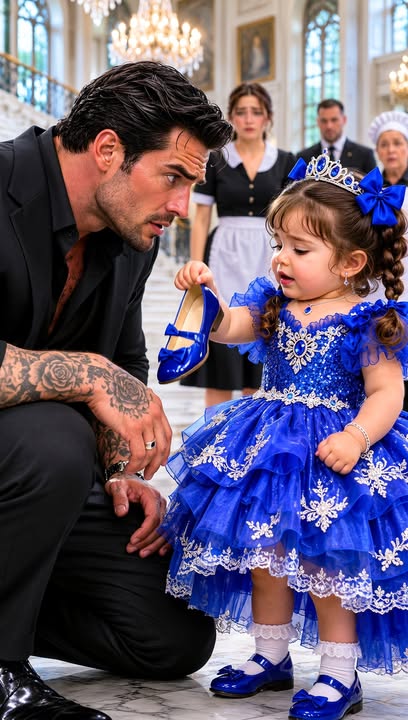
Part 3 – The Note Behind the Photograph
“For the care of the child, as promised.”
The words seemed to shift beneath the kitchen lamp, though I knew they were only ink on old paper.
I read them again, slower this time, hoping a name or date might emerge from the faded strokes.
Nothing did.
My mother had left behind a promise, a clinic receipt, and a photograph of a man I now knew was Luca Marchetti’s dead brother.
I returned everything to the tin box, but sleep did not come easily.
Across the narrow hall, Sofia breathed softly in her bed, one hand curled around the stuffed bunny’s ear.
I listened until the familiar rhythm steadied me, then closed my eyes with the unanswered question tucked beneath every thought.
In the morning, I signed the pharmacy form.
I told myself it was a practical choice, not a declaration of trust.
Sofia needed her prescription, and the terms were clear enough to make the decision mine.
At the estate, Marco met me near the side entrance with a folder tucked beneath his arm.
“Dr. Bellini has the pharmacy authorization,” he said. “Nothing will be processed until you confirm the amount.”
“Thank you.”
“And I’ve started reviewing the payroll records.”
He glanced toward the folder.
“Mr. Marchetti asked me to tell you that you can have a copy of anything connected to your wages.”
“Did he ask you to say that?”
“Several times.”
That almost made me smile.
“Then tell him I heard you.”
Marco walked with me toward the kitchen, maintaining the same respectful distance he had kept the day before.
He was a broad, quiet man, but there was something gentle in the way he lowered his voice whenever Sofia was nearby.
“She’s with Mrs. Lombardi?” he asked.
“She is. She insisted Bunny needed to see the kitchen.”
“Bunny has had a busy week.”
“He has.”
The small warmth between us faded when I noticed the folder.
“What have you found?”
“Not enough to draw a conclusion yet,” Marco said. “The deductions were entered under a code used for the medical reserve, but the account ledger doesn’t show the money arriving there.”
My stomach tightened.
“Then where did it go?”
“That’s what we’re tracing.”
“Could it have been a bookkeeping error?”
“It could.”
His answer was careful, and I appreciated that he did not rush to make my fear sound foolish.
“I’m speaking with the former payroll clerk today,” he continued. “She left the estate before you were hired, but she may know how the account was set up.”
“And the financial director?”
“Mr. Bellini is looking into the director’s old records. He handled the company finances until he retired two years ago.”
“Was he the one who approved the deductions?”
“We’re checking.”
The answer left me with little comfort, but it was more honest than a promise that everything would be fine.
Mrs. Lombardi appeared through the kitchen doors, carrying a plate of toast and looking over my shoulder toward the foyer.
“Elena, your little princess is negotiating for a second breakfast.”
“That sounds like her.”
“She says the first one was for her, and the second one is for Bunny.”
“Bunny has never had to worry about portions.”
“Then Bunny should be grateful.”
I went inside and found Sofia perched on a kitchen stool, her repaired shoe beside her on the counter.
The sole had been neatly mended with dark blue thread, and the edges had been reinforced so carefully that the repair looked almost like decoration.
She pointed to it.
“See, Mommy? Shoe got strong.”
“It does look strong.”
“Mr. Luca’s shoe friend did it.”
“The cobbler,” Mrs. Lombardi corrected gently.
Sofia considered that.
“Mr. Luca’s cobbler friend.”
“That’s right.”
She slipped the shoe on, then stamped one foot against the stool rung.
“It’s not ouchie now.”
I kissed her curls.
“Then we’ll thank him later.”
“Can I show him?”
“If he’s available.”
The thought of seeing Luca again brought a quiet tension to my shoulders.
I had spent part of the night wondering what the note meant, and whether I should tell him about it.
The letter had been addressed to my mother and carried his family’s crest.
Keeping it from him felt like concealing something important.
But sharing it might pull me and Sofia further into a history that had already crossed the boundary of our home.
Luca arrived in the kitchen shortly before noon.
He had traded his dark suit jacket for a charcoal sweater, though the change did little to soften the impression of authority he carried with him.
His gaze found Sofia first.
“How’s the shoe?”
Sofia jumped down from the stool and lifted her foot proudly.
“Strong now.”
He crouched to inspect it.
The small blue stitches followed the edge of the sole in an even line.
“It looks better than new.”
“Can I run?”
“You can test it slowly.”
She took several careful steps across the kitchen, then turned and ran two paces before remembering his instruction.
“Slowly,” he repeated, though a smile touched his eyes.
“I did slow.”
“I believe you.”
She ran to Mrs. Lombardi, who caught her around the waist and spun her once, drawing a burst of laughter from the girl.
Luca watched them for a moment, then looked at me.
“Did you have time to review the forms?”
“Yes. I signed the pharmacy authorization.”
“Thank you for letting us help.”
“I’m letting the account pay the pharmacy while you investigate the deductions,” I said. “That’s all.”
“That’s fair.”
The agreement was quiet, but I sensed he understood how carefully I had drawn the line.
He gestured toward the back hallway.
“Would you speak with me in the library? Marco is there with the records.”
“I need to stay with Sofia.”
“She can come too,” he said. “Or you can ask Mrs. Lombardi to stay with her.”
I looked toward the kitchen.
Sofia had resumed feeding Bunny toast crumbs.
“I’ll ask her.”
Mrs. Lombardi nodded at once.
“Go. I’ll keep the princess and her rabbit from taking over the pantry.”
Sofia looked up.
“Bunny not take over.”
“Then we have nothing to fear,” Mrs. Lombardi said.
The library smelled of old paper, lemon polish, and the faint trace of coffee.
Marco stood beside a wide table where the payroll folder had been opened beside several photocopied ledgers.
Luca did not sit until I had chosen a chair.
It was a small courtesy, but I noticed it.
Marco laid out a page with columns of dates and amounts.
“These are the deductions from your wages,” he said. “They began eleven months ago.”
I followed the entries with my finger.
The weekly amounts were small, but together they had taken more from my paycheck than I could afford to lose.
“Where did the money go?”
“We haven’t confirmed the final destination,” Marco said. “But the transfers were not deposited into the employee medical reserve.”
“Were other people charged the same amount?”
“Yes. Several household staff members.”
“How many?”
“We’re still checking.”
I looked at Luca.
“Did they know?”
“Not yet,” he said. “We won’t approach anyone until we understand the records and can explain what happened.”
His restraint surprised me.
I had expected him to send people through the house demanding answers.
Instead, he seemed aware that each employee would need the truth without being frightened by the way it was delivered.
Marco pointed to a second page.
“This is the reimbursement form from the folder you saw. The listed payment was issued to a clinic for care provided to Rosa Rossi.”
My mother’s name seemed to darken on the page.
“When?”
“Twenty years ago,” Marco said. “The clinic has since changed ownership, but we found an old index for the account.”
“What kind of care did she receive?”
“The record shows an emergency consultation and follow-up treatment. It doesn’t specify more than that.”
“Do you know why the Marchettis paid for it?”
“No,” Luca said.
The answer was immediate and plain.
“I don’t remember any program like this. Our family foundation did make private payments for medical care, but my father handled much of that work. Matteo also helped people without keeping records in the usual way.”
“You think my mother came through him?”
“I think the form may tell us that, but it doesn’t prove it.”
His measured answer kept the mystery from turning into certainty.
I was grateful, though some part of me wanted him to recognize the shape of the clues as quickly as I had.
“I found a letter,” I said.
Luca’s attention sharpened.
“It was in my mother’s tin box. The foundation thanked her for helping with medical care, and there was a handwritten note at the bottom.”
“What did it say?”
“For the care of the child, as promised.”
The words settled over the table.
Marco looked down at the reimbursement form, as if the two documents might complete each other if placed close enough.
“Did it name the child?” he asked.
“No.”
“Did it give a date?”
“The letter was dated almost twenty years ago.”
Luca leaned back slightly.
“The time fits with the year of the photograph.”
“You know when it was taken?”
“Not exactly. Matteo would have been in his twenties. He was still living in Chicago then.”
I reached into my bag and took out the photograph.
The woman beside Matteo looked quietly joyful, her face turned toward him.
The pencil mark on the back was faint, but it seemed darker than it had the day before.
Luca examined it without touching the image.
“May I read the writing?”
I turned the photograph over and handed it to him.
He studied the faded mark beneath the light.
“It may be a date,” he said. “Or initials.”
“Can your records department examine it?”
“Marco can arrange for a specialist to photograph it under different light, if you agree.”
“I’ll keep the original.”
“Of course.”
He returned it carefully.
“You said your mother told you some memories were better left quiet,” he said. “When did she say that?”
“I was a teenager. I had found an old photo of her at a clinic and asked who the man beside her was. It wasn’t this photograph, though.”
“Do you still have it?”
“No. It may have been one of her work photos. I wasn’t looking for secrets then.”
Neither of us said that I had been looking now.
I slid the photograph back into its sleeve.
“I don’t know why she trusted you people with her medical care, or why she kept the letter. I don’t know why she stood with Matteo. I only know she never told me.”
Luca’s gaze stayed on the photograph’s empty space on the table.
“I’m sorry she left you with questions.”
The sympathy in his voice was neither polished nor pitying.
For a moment, I saw the brother he might once have been, someone who had spent years asking questions about Matteo and received only silence in return.
“I’m sorry you lost him,” I said.
His eyes lifted.
“Thank you.”
We held each other’s gaze for a brief moment, two people carrying different parts of the same mystery.
Then Marco cleared his throat.
“There’s another issue with the payroll records,” he said.
Luca turned to him.
“Go ahead.”
“The authorization code for the employee reserve was changed shortly before your former financial director left. The change was made through an administrative account, not by an employee with the authority to approve benefits.”
“Can you tell who used it?”
“Not yet. The system was replaced, and the old access logs are incomplete.”
“Who was the financial director?”
“Peter Vale,” Marco said. “He left the estate seven years ago, just before the deductions began.”
Luca’s expression shifted.
“His departure was recorded as a retirement.”
“That’s what the file says.”
“Can you contact him?”
“We can. I’d prefer to speak with the former clerk first and establish what she remembers.”
Luca nodded.
“Do that.”
I looked at the records again.
“You said the reimbursement form was in the folder with my payroll records. Why was my mother’s name connected to my wages?”
“We don’t know,” Marco said.
Luca’s eyes moved to the narrow strip of paper clipped behind the form.
“That wasn’t in the copy we found,” he said.
Marco picked it up.
The strip was a narrow piece of carbon paper, almost transparent with age.
A line of faded type appeared near its center.
“Rossi,” I read.
Below it was a series of numbers and a note marked “dependent care.”
My mouth went dry.
“That could be anyone named Rossi,” Luca said, though his voice had gone quiet.
“I know.”
Marco tilted the paper toward the window.
“There’s a handwritten reference here. It may be the name of a clinic or a caseworker.”
I could make out only the first letters.
“St. Agnes,” I said.
My mother had worked at St. Agnes Medical Center for years.
“Could that be where the reimbursement was issued?” I asked.
“It could,” Marco said. “We’ll see whether their archive has records.”
Luca glanced at me.
“If the clinic can confirm anything about your mother, I’ll ask them to speak with you first.”
“I want to speak with them myself.”
“All right.”
The agreement came without hesitation.
Then he looked at the payroll figures.
“I also want to explain what I’ve found about the deductions, but I don’t have enough to give you a clear answer yet.”
“Then wait until you do.”
“I will.”
His calm acceptance eased something in me, though I was not certain I wanted it to.
The former financial director’s name remained in my mind as Marco gathered the papers.
“Was he close to your family?” I asked.
“He managed accounts for my father,” Luca said. “I knew him, but not well. He was precise and dependable. That was the reputation he had.”
“People can have reputations that aren’t the same as their choices.”
“I know.”
There was no defense in his voice, but I could see the burden settling on him.
It was one thing to learn that someone had stolen from workers.
It was another to wonder whether someone trusted by your family had once helped hide a part of your brother’s life.
“I’ll find out what happened,” Luca said. “But I won’t ask you to wait quietly while I do it.”
“I’m not waiting quietly,” I replied.
His mouth curved faintly.
“No, I don’t suppose you are.”
That afternoon, I took the reimbursement form and my mother’s letter to St. Agnes.
The hospital archive occupied a low, quiet office near the old outpatient wing, where a clerk named Mrs. Alvarez searched through catalogues and scanned indexes while Sofia colored beside me.
She was drawing a crown on Bunny’s head.
“Bunny is a king now,” she told Mrs. Alvarez.
“Then we should speak respectfully,” the clerk replied.
After nearly an hour, Mrs. Alvarez found a reference to Rosa’s clinic visit.
The older record had been transferred to a storage archive, but a digital note remained.
It confirmed that my mother had received emergency care and follow-up visits.
The record also noted that she had been accompanied by a patient, a young adult male whose name had been withheld at the family’s request.
“Can you tell me who paid the bill?” I asked.
Mrs. Alvarez looked at the screen.
“The entry lists a private reimbursement account connected to the Marchetti family foundation.”
The same name appeared in the letter.
“What was the emergency?”
“I’m afraid the note doesn’t say. The detailed record isn’t available without a formal request, and even then it may be restricted.”
“Could my mother have asked for it to be restricted?”
“Possibly. The note says the patient requested discretion.”
I thanked her and asked how to submit a records request.
On the way home, Sofia fell asleep against my shoulder in the car, her repaired shoe resting in my lap.
I looked at the tiny stitches and wondered how many times my mother had carried a child she had promised to protect.
By the time I returned to the estate, the late afternoon sun was slipping behind the trees.
Mrs. Lombardi took Sofia from me so I could meet Marco in the study.
He had made copies of the old letter and reimbursement form.
“Mr. Marchetti wanted to be here,” he said, “but he had to take a call from his attorney. He said you could leave whenever you wished.”
“I’m not leaving yet.”
Marco gave me a small, understanding nod.
He placed the papers on the desk.
“The clinic reference is clearer now,” he said. “The medical payment was authorized through an account that belonged to the old family foundation.”
“Does that account still exist?”
“It was closed years ago.”
“Who closed it?”
“Peter Vale signed the final papers.”
The name made the room feel smaller.
“He was the financial director?”
“Yes. He was responsible for closing the account after your mother’s last reimbursement.”
“When was that?”
“About a year after the letter was written.”
The hidden records had not simply been left in a box by mistake.
Someone had closed the account, retained the reimbursement form, and later connected a false medical reserve to employee wages.
I tried to make the events fit together without turning suspicion into certainty.
“Could Vale have been trying to hide the clinic payment?”
“We don’t know. The account may have closed for ordinary administrative reasons.”
“And the deductions?”
“Those began years later. But we found another detail.”
Marco turned one of the ledger pages toward me.
The line was marked “dependent care,” followed by a number that matched the reference written on the carbon strip.
The dates were faint, but the sequence was clear enough to see that the same number had appeared beside several payments over the years.
The final entry was dated less than a year before my mother died.
“What does that mean?” I asked.
“I can’t say yet. The notation may be an internal code. But someone continued to access the account after it was supposedly closed.”
“Who?”
“The user name is no longer visible.”
A door opened behind us.
Luca stepped into the study, his call finished, and looked immediately at the papers.
“What did you find?”
Marco summarized the clinic’s record and the account’s closure.
Luca listened without interrupting.
When Marco finished, Luca rubbed one hand over his jaw.
“Vale closed the account,” he said. “Then someone kept using its code.”
“Could he have used it?” I asked.
“He could have,” Marco replied. “But we don’t know that he did.”
Luca’s gaze met mine.
“I won’t call him guilty because his name is on one form.”
“Good.”
“I also won’t pretend the timing means nothing.”
“No.”
The honesty between us felt more fragile than the argument we might have had.
He reached for the ledger, then stopped before touching it.
“Would you like to take copies home?”
“Yes.”
Marco gathered them into a folder and handed it to me.
I was about to put it in my bag when I noticed a number beside the final reimbursement entry.
It matched the number on the carbon strip exactly.
I held the pages side by side.
The same sequence.
The same handwritten mark.
“Someone used this code after the account closed,” I said.
Marco leaned closer.
“Yes.”
“How often?”
“We’re still checking.”
Luca’s eyes moved from the paper to the photograph in my bag.
“You said there were two letters in your mother’s box,” he said.
“There were.”
“You haven’t opened the second?”
“I thought it was a blank envelope.”
His attention sharpened.
“Do you have it with you?”
“No. It’s at home.”
“I’m not asking you to bring it here,” he said. “I only wondered whether it might help identify the account.”
His restraint made it easier to trust the question, but I still felt a protective instinct rise.
“I’ll look at it tonight.”
“Whatever you find is yours to decide whether to share.”
That evening, after Sofia fell asleep, I returned to the tin box.
The envelope was exactly where I had left it, beneath the photograph album.
I turned it over in my hands.
My mother’s name was written across the front, and on the back, in the same neat blue ink, was a small number.
The number matched the code in the Marchetti records.
My fingers went cold.
I opened the flap carefully.
Inside was a folded note, yellowed at the creases.
It was not a letter from the foundation.
It was written in my mother’s hand, as though she had drafted a message to herself and never meant anyone else to read it.
The first line read, “Matteo says the child must stay safe.”
I sat very still.
Below it, the ink had faded almost to brown.
I tilted the page beneath the lamp and read the next line.
“If anything happens to him, I promised I would…”
The sentence stopped there, torn away along the edge of the paper.
Beneath the fragment was another line, faint but legible.
“Peter has seen the reimbursement file.”
My heart began to pound.
The note did not explain who the child was.
It did not explain what had happened to Matteo, or what Peter Vale had seen.
But it changed every question I had asked.
My mother had not merely known Matteo.
She had made a promise involving a child.
And someone in the Marchetti family’s accounts had known about it.
**–END OF PART 3–CLICK “NEXT” AT THE BOTTOM OF THE PAGE TO CONTINUE READING**
* * *
[PREVIOUS: PART 2](https://echoesofstories.idolsgift.com/blog/part-2-the-photograph-between-them-041) | [NEXT: PART 4](https://echoesofstories.idolsgift.com/blog/part-4-the-photograph-between-them-041)
✓ Lynn R. Adams
Part 3 – The Note Behind the Photograph “For the care of the child, as promised.” The words seemed to shift beneath the kitchen lamp, though I knew they were only ink on old paper. I read them agai…