PART 3: The Orange Flash Beneath the Dock 029
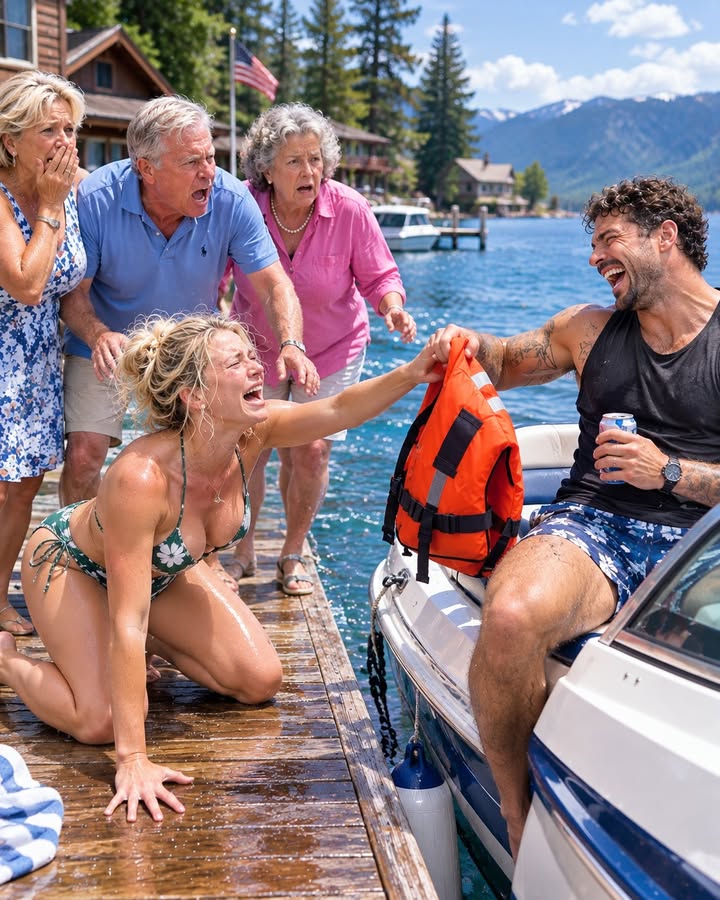
Part 3 – The Clip Nobody Meant to Keep
My nephew’s words stayed with me long after he finished speaking.
He looked back toward the water before he came in.
I wanted to ask what he meant, but Winnie had finally fallen asleep, her fingers still curled around mine.
So I kept my voice low.
“Did you tell the officer that?”
“Not yet,” he said. “I wasn’t sure if it mattered.”
“It matters if you saw it.”
He nodded, though he still seemed unsure of himself.
From the hallway came the soft murmur of my sister talking to someone on the phone.
My nephew glanced toward the door.
“Mom says Grandpa’s furious.”
“Your grandfather is upset,” I said. “That doesn’t mean you did anything wrong.”
“He said I should have come to him first.”
“You tried to get help when Winnie needed it.”
He looked down at his hands.
“I thought I was supposed to listen to the adults.”
“You were,” I said. “But you’re allowed to notice when something isn’t safe.”
The words sounded simple.
I knew they weren’t.
He had spent most of his life watching our parents make excuses for Rhett, smoothing over the aftermath of his choices before anyone else could name what had happened.
He had learned that keeping the peace mattered more than asking whether the peace was honest.
At sixteen, he had still managed to call for help.
I wished I could tell him that one brave decision could undo all the years of being told to stay quiet.
It couldn’t.
But perhaps it could be the first time he stopped carrying the silence as if it belonged to him.
The next morning, the doctor sent Winnie home with instructions and a follow-up appointment.
She was tired, and her throat was scratchy from coughing, but she was alert and breathing normally.
I drove us to my house rather than back to the lake.
Winnie sat in the passenger seat with the orange life jacket buckled across her lap.
“Can we keep it in the car?” she asked.
“Absolutely.”
“So if we go anywhere near a boat, it’s there.”
“It’ll be there.”
She touched the scuffed plastic buckle with her thumb.
“Uncle Rhett said I was too hot in it.”
I kept my eyes on the road.
“Being uncomfortable doesn’t mean you should be without something that keeps you safe.”
“He said I could hold on to him.”
“He was wrong to take you out without your life jacket.”
Winnie looked out the window.
“Is he in trouble?”
“I don’t know what will happen.”
“Will Grandpa be mad at me?”
“No,” I said, more firmly than I had intended. “You did nothing wrong.”
She looked at me then, searching my face.
I reached across the console and covered her hand with mine.
“None of this is your fault.”
She leaned back, quiet again, and watched the trees pass.
I did not try to fill the silence.
By the time we reached home, my phone had collected a string of messages.
My mother had written that everyone was shaken and needed time to calm down.
My father had said I had made a difficult situation worse by involving the police.
Rhett had sent one message that read, Winnie’s okay, so let’s leave it there.
I stared at the words until the screen dimmed.
Then I set the phone down and went inside with my daughter.
For the next two days, I kept Winnie close.
She slept badly the first night and woke once asking whether there was water near the bed.
I held her hand until she settled again.
The second night, she slept through.
She insisted on putting the life jacket on the chair beside her bed, where she could see it.
I let her.
My nephew called that afternoon.
He asked whether Winnie was feeling better.
“She’s tired, but she’s doing well,” I told him.
“Can I talk to her?”
I passed the phone to her, and she told him she was eating crackers and watching a movie.
He laughed softly when she described the movie’s talking dog.
After she handed the phone back, he said, “I keep thinking about the dock.”
“I know.”
“I should’ve said something sooner.”
“You’ve said that already.”
“I know. I just keep thinking it.”
“Then let’s remember the other part too,” I said. “You called 911. You told the police what you saw. You helped save her.”
He was quiet for a moment.
“Mom says the family’s mad at me.”
“Your mother may be upset about how things have unfolded. That’s not the same as you being responsible for it.”
“Grandpa says I’m making Rhett look like a bad person.”
“Rhett’s choices are his own.”
“I don’t want everyone to hate me.”
“No one who loves you should ask you to hide the truth to protect someone else.”
He breathed out slowly.
“I’m going to tell the officer everything. The part about the jacket, and looking back.”
“That’s your decision,” I said. “And I’ll support you.”
He thanked me, then asked if I could tell Winnie he was glad she was home.
When I did, she smiled and said she was glad he called.
The first few days were mostly quiet, but the family silence had a shape of its own.
It appeared in the messages I didn’t answer and the calls I let go to voicemail.
It sat between me and my mother when she stopped by with a casserole and left it on the porch because I didn’t invite her in.
It showed up in the way my father’s name appeared on my screen and my stomach tightened before I even read the message.
I did not want to punish my parents.
I wanted them to understand that what had happened was not a misunderstanding they could put away once the fear faded.
On the fourth day, my mother called while Winnie was drawing at the kitchen table.
“Can I come over?” she asked.
“Not today.”
There was a small pause.
“I’m her grandmother, Gwen.”
“I know.”
“I want to see her.”
“Then we can arrange a visit when she’s ready and when we can talk about what happened.”
My mother lowered her voice.
“Your father and I have been through a lot this week.”
“So has Winnie.”
“We’re all worried about Rhett.”
The words landed in me with a familiar heaviness.
“What about Winnie?” I asked.
“We are worried about her too.”
“Are you worried enough to tell her she was right to wear the life jacket?”
My mother did not answer immediately.
I looked toward the table.
Winnie was coloring a large orange circle on a sheet of paper.
“Your father thinks you’re determined to make this a police matter,” my mother said.
“It is a police matter. A child was thrown into open water without a life jacket, and the person responsible was drinking.”
“He didn’t throw her.”
“He took her out. She fell. He came back without her.”
“He said he didn’t know exactly where she was.”
“That doesn’t make it better.”
“I know,” she said, almost too softly to hear.
I closed my eyes.
For one brief second, I thought I had heard a door open.
Then she added, “But the important thing is that she’s safe now.”
“That matters,” I said. “It doesn’t erase the rest.”
My mother sighed.
“Gwen, I know you’re angry.”
“I’m not asking you to agree with every choice I make. I’m asking you not to turn this into something Winnie has to carry.”
“I would never do that.”
“Then don’t tell her she was overreacting. Don’t say she should forgive Rhett because he’s family. And don’t ask her to keep quiet.”
My mother was quiet.
At last she said, “I’ll call you later.”
After we hung up, Winnie looked up from her drawing.
“Was that Grandma?”
“Yes.”
“Is she mad at me?”
“No.”
“Is she mad at you?”
“Maybe.”
Winnie returned to her picture.
She had drawn the dock with uneven brown lines and a small boat nearby.
The person in the boat wore a blue cap.
“Is that Cal?” I asked.
“Yes. He helped me.”
“He did.”
She colored another small figure in the water.
“That’s you,” she said.
My heart tightened at the sight of it.
“Can you draw yourself, too?” I asked.
She added a tiny orange shape near the dock ladder.
“That’s my jacket.”
I sat beside her and watched while she shaded it in.
No one had asked her to make a picture of what happened.
She had chosen to.
I took a photograph of it for myself, then put the phone away.
For nearly a week, the most significant update from the police was that they were gathering statements and reviewing what had happened.
The officer had spoken with me, Cal, Rhett, and my nephew.
He told me the investigation would take time.
I understood that.
I also understood how easily a family could use time to soften a story until it no longer resembled the truth.
My father called twice.
The first time, I did not answer.
The second time, I did.
“Your mother is worried,” he said.
“About Winnie?”
“About the family.”
I leaned against the counter and kept my voice even.
“I’m worried about Winnie.”
“She’s recovering.”
“She is.”
“So perhaps we can stop talking as if this was some deliberate attempt to hurt her.”
“I have never said Rhett meant to hurt her.”
“You’re acting as if he did.”
“No. I’m asking people to take seriously what he did.”
He exhaled through his nose.
“Rhett says she wanted to go without the vest.”
“Winnie says she didn’t.”
“She’s seven, Gwen. She gets frightened and confused.”
“She was frightened because she fell in the lake.”
“That is not what I mean.”
“What do you mean, then?”
He made a sound like he was choosing his next words carefully.
“I mean the child may remember it differently than it happened.”
I looked through the kitchen window at Winnie, who was sitting on the living-room rug with a puzzle spread around her.
“She remembers falling off the jet ski. She remembers trying to hold on. She remembers that Rhett told her the vest was for babies. I’m not going to tell her those memories are wrong because they are inconvenient.”
My father was silent for a long moment.
Finally, he said, “You have always had a way of making everything a matter of principle.”
I looked at my daughter through the glass.
“No,” I said. “I’ve learned what happens when people keep calling a choice a family matter.”
I ended the call before the conversation could turn into something neither of us could take back.
That evening, my sister sent me a message asking if she could stop by.
She arrived with her son in the passenger seat and a paper bag of pastries in her hand.
She did not mention my parents until we were sitting on the back porch.
“I know Dad is putting pressure on him,” she said.
“On your son?”
“He says the boy shouldn’t have gone around him. He says he made everything worse by calling you and the police.”
My stomach tightened.
“What does your son think?”
“He thinks he should have said something sooner.”
“He’s not wrong to wish he had, but that isn’t the same as being at fault.”
“I told him that.”
She stared down at the paper bag in her lap.
“He heard Dad tell everyone not to cause trouble. He thought that meant the adults had things under control.”
I thought of my nephew’s face at the hospital, his eyes fixed on the floor as he tried to make sense of what he had seen.
“He did the right thing when it mattered.”
My sister nodded.
“I’m proud of him.”
“Tell him that.”
“I have.”
She glanced toward the living-room window.
“Winnie seems okay.”
“She’s doing better.”
“Is she asking about Rhett?”
“She asked if he was in trouble.”
“What did you tell her?”
“That I didn’t know.”
My sister rubbed the folded edge of the paper bag.
“Mom keeps saying the rescue proves he’s not a bad person.”
“That isn’t what it proves.”
“I know.”
She sounded exhausted.
“I don’t think she knows how to talk about him without either defending him or condemning him.”
“She doesn’t have to decide what kind of person he is right now,” I said. “She has to be honest about what he did.”
My sister looked at me.
“Do you think we’ve all been making excuses for him?”
I could have told her yes.
The answer was in years of hushed conversations, in the careful way my parents kept his latest arrest from the neighbors, in the holidays we planned around his moods and his drinking.
But a plain answer would not have made it easier for her to hear.
“I think we have been trying to protect him from consequences,” I said. “And I think some of us learned to call that love.”
She closed her eyes for a moment.
“Maybe.”
Her son came out to the porch a little later.
He had been in the car, waiting.
He told Winnie he was glad she was okay, then gave her the small paper sack of pastries to choose from.
She chose a cinnamon twist and thanked him.
He smiled at her, but his eyes still held a certain guilt.
“Are you still going to talk to the officer again?” I asked.
“He called Mom. He wants to make sure I’m okay before he writes everything down.”
“Are you?”
“I think so.”
“You can tell him if you’re not.”
He took a breath.
“I want to say the whole thing. Not just that Rhett took the vest off.”
“What else?”
“That Rhett was holding it when he got back, and he looked at the water before he turned in.”
My sister’s face changed.
“What does that mean?”
“I don’t know,” her son said. “It might not mean anything. I just saw him do it.”
“It matters that you tell the officer what you saw,” I said. “Let him decide what it means.”
He nodded.
The next morning, a neighbor from the lake called me.
Her name was Mara, and she lived two docks away from my parents.
She had been at her family’s picnic that afternoon and remembered the commotion.
“I’m sorry to call out of the blue,” she said. “I didn’t know whether I should say anything.”
“You can tell me.”
“I was looking through my phone videos from the party. I took a short clip while my kids were running around. It was before Winnie went out.”
My fingers tightened around the phone.
“Did you see her?”
“Yes. I didn’t realize who she was at first. I sent it to your mother, then she told me it might help you understand the timeline.”
“Could you send it to me, please?”
“Of course.”
The video arrived while we were still speaking.
I thanked Mara and ended the call.
Then I watched the clip alone in my car, parked outside Winnie’s school.
The video was only twenty seconds long.
At first, it seemed ordinary.
A row of folding chairs.
A red cooler near the end of the dock.
Children in bright swimsuits darting past the camera.
Then Rhett appeared, walking toward the jet ski with Winnie beside him.
She wore her orange life jacket.
The straps were fastened.
Rhett crouched to say something to her, and she looked up at him.
The image was small and grainy, but there was no mistaking the jacket.
Rhett stood, settled his hand on Winnie’s shoulder, and guided her onto the jet ski.
The clip ended as he pushed off.
I replayed it.
Then I noticed a second video in Mara’s message.
She had recorded more later, after the jet ski returned.
The camera was pointed across the water.
The jet ski cut toward the dock.
Rhett was alone.
He carried something bright in one hand.
The orange jacket.
Before he turned toward shore, he looked back over his shoulder, scanning the water behind him.
It was brief.
A second, maybe less.
Then he brought the jet ski in.
I watched the clip again, my pulse thudding in my ears.
The water behind him was broken by the boat’s wake, but there was no visible sign of Winnie.
I called Mara back.
“Can you tell me when you recorded this?”
“Not exactly. I was filming the lake because the kids were jumping off the swim platform. I think it was only a minute or two before everyone started shouting.”
“Did you realize he was alone?”
“No,” she said. “I didn’t know what had happened until later.”
“Do you still have the original videos?”
“I do.”
“Would you be willing to share them with the officer?”
“Of course.”
I thanked her again, then forwarded the clips to the investigator who had given me his contact information.
He called within the hour.
“Ms. Delgado, I’ve received the videos,” he said. “I’m going to preserve the originals and review them with the other statements.”
“Could the second one show that Rhett knew Winnie was still in the water?”
“I can’t draw that conclusion from a brief clip. I can say it shows him looking back toward the water before he returned to the dock.”
“My nephew saw the same thing.”
“Then I’ll make sure that’s included in the record.”
I took a slow breath.
“Thank you.”
After we hung up, I stayed in the car for another minute, watching the school doors.
Winnie had been at home with my sister that morning, resting.
I had left her a note beside her breakfast and promised to be back before lunch.
I did not want to bring her into another conversation about what the adults had seen or failed to see.
But when I returned home, she asked what I had been doing.
“Someone sent me a video from the lake,” I said.
“Was I in it?”
“Yes.”
“Was I wearing my jacket?”
“Yes.”
She seemed relieved.
“I thought I was.”
“You were.”
She went back to her puzzle.
I sat down beside her, careful not to crowd her.
“Do you want to talk about the lake?”
“Not right now.”
“Okay.”
She turned a piece between her fingers until it fit.
I was learning that my job was not to make her say everything.
It was to let her decide what she could bear to say, and to make sure the adults around her did not tell her which parts she was allowed to remember.
That evening, my father called again.
I nearly let it go to voicemail.
Then I thought of my nephew and the way he had looked at me in the hospital.
I answered.
“Did the police contact you?” my father asked.
“They did.”
“They’ve asked people to send in videos.”
“I sent one.”
“What video?”
“A neighbor recorded Winnie leaving the dock with her life jacket on, and Rhett coming back with it.”
The line went quiet.
“How did she get that?”
“She was filming at the lake.”
“People record everything now,” he said.
“They do.”
“Did you send the part where he looks back?”
“It was in the video.”
“You know that could be misinterpreted.”
“I didn’t tell them what it meant. I sent them what happened.”
My father sighed.
“Rhett says he thought she had come up on the other side of the dock.”
“Did he tell you that before or after the police asked him?”
“I’m not going to answer questions like I’m on trial.”
“I’m not putting you on trial.”
“You’re sending videos to the police and asking your nephew to repeat things he barely understands.”
“He’s telling them what he saw.”
“He’s a boy, Gwen. You should be protecting him from this.”
“I am protecting him from being made responsible for Rhett’s choices.”
“I never said he was responsible.”
“You told him not to cause trouble.”
“I told everyone to stay calm.”
“Those aren’t the same thing.”
My father’s voice softened, which somehow made the words harder to hear.
“This family is all we have.”
I looked toward the kitchen, where Winnie was taking the life jacket from the chair and placing it neatly beside her shoes.
“A family isn’t protected by keeping quiet,” I said.
He did not answer.
I could hear him breathing at the other end of the line.
After a moment, he said, “We’ll talk when things settle down.”
“I don’t think they’ll settle down by themselves.”
He ended the call without saying goodbye.
The next day, the investigator asked my nephew to come in and review his statement.
My sister drove him.
I went with them, but waited in the lobby with Winnie while he spoke privately with the officer.
He came out twenty minutes later.
“How did it go?” I asked.
“Okay.”
“Did you say what you wanted to say?”
He nodded.
“I told him Rhett took the life jacket off before they left. I told him Grandpa said not to cause trouble. And I told him Rhett looked back at the water when he came in.”
“That was honest.”
He looked at Winnie, who was sitting beside me with a book in her lap.
“I’m sorry,” he told her again.
She looked up.
“You said that already.”
“I know.”
“Then you don’t have to keep saying it.”
He gave a small, unsteady laugh.
“You’re right.”
She returned to her book, and he sat beside her.
On the way back to the car, he walked close to my sister.
She put her hand on his shoulder.
I saw him lean into it, just a little.
For a while, I thought that might be enough for one day.
Then my sister got a call from my mother.
She listened without speaking.
Her expression changed, and she glanced at her son.
“Mom,” she said, “I’m not sure that’s what happened.”
She listened again.
“No, I understand you want to help.”
Another pause.
Then she held the phone out to me.
“Gwen, she wants to talk to you.”
I took it.
“Mom?”
“I found something in your father’s garage,” she said.
“What kind of something?”
“A receipt. Or a work order. I’m not sure.”
“What does it say?”
“I don’t know. Your father told me to throw it out.”
A chill moved through me.
“Why?”
“He said it was old paperwork and didn’t matter.”
“What does it have to do with the lake?”
“I think it’s from the mechanic who looked at the jet ski.”
My sister stopped walking.
My nephew looked from her to me.
“What did the mechanic say?” I asked.
My mother’s voice faltered.
“I don’t know. The note is about the safety system.”
“The lanyard?”
A pause.
Then she said, “There’s something crossed out at the bottom.”
“What?”
“I can’t read it over the phone.”
I looked toward the car, where the late afternoon sun glinted off the windows.
“Can you take a picture and send it to me?”
“I can.”
“Please do.”
My mother did not send the photograph until after dinner.
When it arrived, I opened it at the kitchen table.
The paper was folded and stained with oil at one corner.
A handwritten line near the top read, “Engine safety shutoff not engaging—do not operate until repaired.”
Below it, in darker ink, someone had written a name.
Rhett.
And beneath that, a short note:
“Asked us to bypass it for the weekend. Advised against.”
My fingers went cold around the phone.
Winnie was in the next room, talking to my nephew about the talking dog in her movie.
I read the words again, slower this time.
The investigator’s number was already in my recent calls.
Before I could press it, a new message arrived from my mother.
Dad knew the mechanic had warned Rhett.
My father’s voice came back to me from the dock.
Don’t make a scene.
And then I noticed the date printed at the top of the work order.
It was not from the week of the accident.
It was from the summer before.
**–END OF PART 3–CLICK “NEXT” AT THE BOTTOM OF THE PAGE TO CONTINUE READING**
* * *
[PREVIOUS: PART 2](https://puretales.idolsgift.com/blog/part-2-the-orange-flash-beneath-the-dock-029) | [NEXT: PART 4](https://puretales.idolsgift.com/blog/part-4-the-orange-flash-beneath-the-dock-029)
✓ Lynn R. Adams
Part 3 – The Clip Nobody Meant to Keep My nephew’s words stayed with me long after he finished speaking. He looked back toward the water before he came in. I wanted to ask what he meant, but Winnie…