PART 3: The Note Behind the Photograph 047
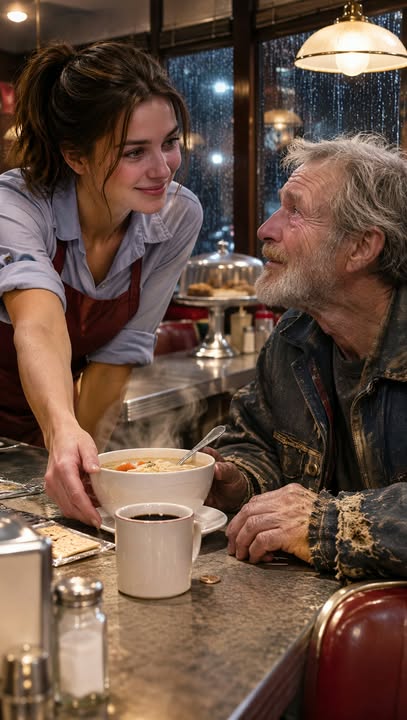
Part 3 – The Promise in the Ledger
“The promise about the child.”
The words remained in the hospital room after Arthur’s eyes had closed, as if they had not yet found a place to settle.
Harper watched the slow rise and fall of his chest.
She wanted to ask what he meant, but the effort of reaching for the memory had left him exhausted.
Alexander touched his father’s shoulder gently.
“He needs to rest.”
“I know.”
Harper eased her hand from Arthur’s, though his fingers had held hers with surprising strength.
Outside the room, the corridor seemed too bright.
She and Alexander stood beneath a window streaked with rain, each carrying a question neither could yet answer.
“Do you think he meant me?” Harper asked.
“I don’t know.”
Alexander’s honesty was plain, but his face had tightened.
“Could he have meant another child?”
“He might have.”
Harper looked down at the tarnished penny in her palm.
Her mother’s note had called Arthur’s kindness the beginning of something.
Arthur remembered a promise.
And Eleanor had written that she hoped one day to tell her daughter the whole story.
“I don’t want to make him remember something he can’t,” Harper said.
“Neither do I.”
Alexander leaned against the wall, his shoulders finally showing the weight of the day.
“My father spent years asking me to be patient with people,” he said. “He’d tell me that not every silence was a refusal. Sometimes people were just trying to find their way back to the right words.”
Harper glanced at him.
“Did he say that before he disappeared?”
“Before the head injury. He used to visit the nursing home where my mother volunteered. He was good at sitting with people who couldn’t explain themselves.”
The mention of Alexander’s mother seemed to surprise him.
He rubbed a thumb along the seam of his coat.
“She died when I was young,” he added. “It was just the two of us for a long time.”
Harper understood the careful distance in his voice.
Grief had taught both of them how to keep certain rooms closed.
“Maybe Eleanor was trying to find the right words,” she said.
“Maybe.”
The following morning, the hospital called to say Arthur was resting comfortably and had no new symptoms.
Harper had barely hung up when her phone rang again.
This time, it was Stan.
“Can you come in before your shift?” he asked.
His voice was measured, almost cordial, which made Harper more wary than his usual impatience.
“Why?”
“We need to talk about the meal charges.”
“What meal charges?”
“Come in and we’ll go over it.”
Harper looked around her small kitchen.
The photograph and the letters were spread across the table, and her mother’s penny rested beside the sugar bowl.
“I have plans.”
“Then make time before them.”
The line went quiet.
Harper set down the phone and stared at it.
Alexander had offered to come with her, but she refused.
“If I’m going to handle this, I need to do it myself.”
He studied her for a moment, then nodded.
“I’ll be at the hospital with Dad.”
“I’ll call if I need anything.”
“I know.”
The reply was gentle, without expectation.
Harper took the bus to Belle’s Diner.
The morning crowd had thinned, leaving the windows cloudy with steam and the smell of coffee soaked into the walls.
Stan waited at a booth near the office.
A stack of printed pages lay on the table in front of him.
“I thought we were done discussing this,” Harper said.
“We’re not.”
He gestured to the booth.
She stayed standing.
Stan shifted in his seat.
“I’m not accusing you of anything, Harper. I’m trying to clear up an accounting issue.”
“What accounting issue?”
He slid one of the pages toward her.
It showed dates, meal totals, and a series of deductions from Harper’s pay.
Her name appeared beside each entry.
“I never signed this.”
“You didn’t have to sign it. These were adjustments.”
“You took money from my wages?”
“Not all at once.”
“That doesn’t make it better.”
Stan looked toward the office door, then lowered his voice.
“Food was going out of the kitchen without a ticket. I had to account for it.”
“I paid for Arthur’s meals.”
“Sometimes.”
“Every time.”
“Then you should have kept your receipts.”
Harper stared at the page.
She remembered putting crumpled receipts into her apron pocket, then moving them into the drawer beside her bed.
She remembered telling herself she would organize them when she had time.
At some point, the drawer had filled with grocery lists, bills, and notes from her mother.
“I have them,” she said.
“Do you?”
“I paid for the soup, the coffee, the fries, everything.”
Stan rubbed his forehead.
“Maybe. But the numbers don’t say that.”
“Then the numbers are wrong.”
His face tightened.
“Don’t turn this into something it isn’t.”
“I’m not the one who deducted money from my paycheck.”
A silence opened between them.
The bell over the front door rang as a delivery driver came in carrying a crate of milk.
Stan glanced at him, then back at Harper.
“You’ve had a lot going on,” he said. “I thought it might be easier to settle the balance and move forward.”
“Settle what balance?”
“The food costs.”
“You think I owe the diner for feeding a man who was cold and hungry?”
“I think the restaurant can’t give away food without tracking it.”
“I didn’t ask the restaurant to give it away. I paid.”
Stan’s eyes flickered.
“Your hours have been reduced lately, and the kitchen inventory has been off. I’m trying to protect the business.”
“Are you protecting it by charging me for meals I bought?”
He did not answer.
Harper left the pages on the table and went to the office.
Her apron hung on a hook beside the time clock.
She reached into its pocket, then remembered she had taken it home the night Alexander arrived.
The small drawer in the office had always been used for loose pens and till slips.
Now it held a thin ledger with a blue cover.
Harper opened it.
The entries were neat and dated.
Beside several of Arthur’s meals, someone had written CASH—HARPER.
The handwriting was not hers.
“Who wrote this?”
Stan appeared in the doorway.
“Probably the cashier.”
“Which one?”
“I don’t know.”
“Someone recorded that I paid.”
“Those notes could mean anything.”
Harper flipped through the pages.
There were more entries, each with a date, a meal, and an amount.
Some were marked as paid directly by Harper.
Others showed a credit for money she had left in the register.
The pages contradicted the deductions on the printout.
“You knew these entries were here.”
“I knew there was a ledger.”
“And you still told me I’d stolen food.”
“I said there were questions about the food.”
“You told the staff I was taking it.”
“I said I was investigating.”
Harper closed the ledger.
“Then investigate the person who changed my pay.”
Stan’s mouth went thin.
“You don’t understand what happens when owners see irregularities.”
“Maybe I do.”
She remembered the seven dollars she had spent on Arthur’s soup.
She remembered how long she had stretched that choice into the rest of the week.
The cost had mattered.
The kindness had mattered more.
“I’m not going to apologize for it,” she said. “And I’m not going to let you call me dishonest because I didn’t keep every receipt in a neat envelope.”
“I didn’t call you dishonest.”
“You didn’t have to use the word.”
Harper left the office before he could answer.
At home, she emptied the drawer beside her bed onto the kitchen table.
Old receipts, folded and softened by time, scattered among envelopes and hair ties.
She sorted them by date, her fingers moving slowly as the faint ink blurred beneath her thumb.
There were receipts for coffee, fries, soup, sandwiches, and one large container of chicken noodle soup from the night of the storm.
The total came to more than the amount Stan had deducted.
She called the diner and asked for a copy of her pay records.
Then she took photographs of every receipt and sent them to Alexander.
He replied within minutes.
“I’m sorry this is happening.”
“I can prove I paid.”
“That isn’t the only thing that matters.”
“What do you mean?”
“Your work should not depend on whether you can prove you spent your own money to feed someone.”
Harper read the message twice.
She liked that he understood the distinction.
She also disliked the relief that rose in her at having someone else acknowledge it.
Her phone rang.
Alexander was calling.
“Are you all right?” he asked.
“I’m angry.”
“That sounds reasonable.”
“I don’t want you to talk to Stan for me.”
“I won’t.”
“And I don’t want you to buy the diner, threaten anyone, or make this disappear.”
A pause followed.
“I wasn’t planning to.”
“Good.”
“I was planning to ask the company’s accounting department to review the records.”
“That’s different.”
“Yes.”
She looked again at the receipts spread across the table.
“I need to handle this as an employee, not as someone you’re trying to rescue.”
“I understand.”
He did not add that she could lean on him whenever she wanted.
He did not tell her that money was no object.
He simply let her boundary stand.
It mattered more than she wanted to admit.
That afternoon, Harper returned to the hospital with the receipts tucked into her bag.
Arthur was awake, sitting beside the window with a blanket over his knees.
Alexander had brought him a cup of tea.
“Have you eaten?” Arthur asked when Harper entered.
“I had lunch.”
“What was it?”
“Soup.”
His eyes narrowed with gentle suspicion.
“Did you pay for it?”
“Yes.”
“Good.”
Alexander smiled from the chair beside the bed.
“You two have turned this into an examination.”
“It’s an important question,” Arthur said.
Harper sat on the other side of him.
“I found my mother’s letters.”
“Did you?”
“And the note about the penny.”
Arthur looked at the coin she placed on the table.
For a while, he seemed to recognize it only as an object.
Then his expression changed.
“She gave me one like that.”
“When?”
“I don’t know.”
He turned the coin with the tip of one finger.
“I remember a train station. Or a bus stop. There was rain.”
“Was my mother there?”
“I think so.”
Alexander leaned forward.
“What did you promise her?”
Arthur stared out at the pale sky beyond the glass.
“I can’t find the words.”
“Don’t force yourself,” Harper said.
“I’m not trying to.”
His voice carried a trace of frustration, though he kept it tucked beneath his mildness.
“Some memories come back like a room with the lights off,” he said. “You know where the furniture ought to be, but you can’t tell whether it’s still there.”
Harper placed her hand over his.
“That’s all right.”
Arthur looked at her.
“Your mother believed in people more than I did.”
“You knew her well?”
“I knew her for a little while. Then I knew her through letters.”
“What did you write about?”
“Ordinary things, mostly. Weather. Work. The price of flour.”
He gave a small, tired smile.
“She told me about you. Your school plays, your first broken arm, the time you tried to plant tomatoes in a coffee tin.”
Harper let out a quiet laugh.
“I hated tomatoes.”
“You hated waiting for them to grow.”
The detail sent an unexpected ache through her.
Her mother had told Arthur about her childhood.
Arthur had known small things Harper had forgotten she once cared about.
“Why did you stop writing?” Alexander asked.
“I don’t know.”
Arthur’s gaze dropped to the blanket.
“I thought I had more time.”
The words landed softly, yet Harper felt their weight.
She did not want to ask another question while his eyes had begun to tire.
Instead, she told him about the ledger and the receipts.
Arthur listened with a seriousness that made her feel he was not merely being polite.
“You should be paid what you’re owed,” he said.
“I’m working on it.”
“You shouldn’t have to prove you’re kind.”
“I know.”
“Do you?”
Harper looked at him.
Arthur’s eyes were gentle, but he had always been able to see past her easy answers.
“Sometimes,” she admitted.
Alexander looked from one to the other, then lowered his gaze.
The next day, the diner’s accountant called Harper.
He asked her to bring in the original receipts and said he would review the payroll deductions and kitchen records.
He did not promise the outcome, but he confirmed that the blue ledger was part of the restaurant’s official books.
Stan was present when Harper handed over her copies.
He looked tired rather than angry.
“I didn’t mean to make this personal,” he said.
“It was personal when you cut my wages.”
“I was following what I thought the system required.”
“Did you check the ledger?”
“I should have.”
It was not a full apology, but it was the first honest thing he had said.
Harper left the diner without knowing whether her hours would be restored or whether her job was secure.
She had expected to feel victorious after presenting the receipts.
Instead, she felt the familiar uncertainty of waiting for someone else to decide whether her truth counted.
Alexander met her outside the hospital later that evening.
“I can have the company review everything,” he said.
“The accountant is already doing that.”
“I know.”
“Then let them do it.”
He nodded.
“I’ll let them.”
They walked toward the entrance together.
Harper was beginning to understand that restraint could be a kind of care.
Inside Arthur’s room, a nurse had placed his old belongings in a small paper bag.
His mechanic’s jacket was folded at the bottom, still damp around the cuffs.
Harper recognized the pocket where he used to keep pennies.
“Would you like me to see if anything is in there?” she asked.
Arthur nodded.
She checked the jacket carefully.
There were no coins, only a worn button, a folded bus transfer, and a small card with an address written in faded ink.
Alexander took the card and read it aloud.
“Linden Street.”
He looked at his father.
“Does that mean anything?”
Arthur squinted at the writing.
“Maybe.”
“Is it where you lived?”
“I lived in many places.”
The admission seemed to cost him.
He closed his eyes, then opened them again.
“Not houses,” he said. “Rooms. Short stays.”
Harper sat beside him.
“After you left assisted living?”
“I don’t remember leaving.”
He rubbed his forehead, careful of the healing injury.
“I remember being angry. Or afraid. Perhaps both.”
“Were you looking for someone?”
Arthur did not answer at once.
His gaze settled on the card.
“I think I was looking for a letter.”
Alexander’s face changed.
“From Eleanor?”
“I don’t know.”
Harper felt the mystery tighten around the few facts they had gathered.
“What letter?”
Arthur shook his head.
“Something I was supposed to keep. Something I should have answered.”
The nurse returned to check his medication, and the conversation ended there.
Harper tucked the address card back into the paper bag.
That night, she went through the letters again, searching for any mention of Linden Street.
Most of the envelopes had no address.
One had a return address written in Eleanor’s handwriting, so faint that Harper had to hold it near the lamp.
It was an apartment building on Linden Street.
The date on the postmark was more than thirty years old.
The letter inside was short and careful.
Eleanor wrote that she had received Arthur’s last message and was grateful for the help he had given her.
She thanked him for remembering her plans and for believing she could finish school.
Near the end, she mentioned a promise she hoped he would still honor.
Harper’s hand went cold around the paper.
The sentence was not complete.
The bottom corner had been torn away.
She read what remained.
You told me the child would always have—
Then the words disappeared with the missing piece.
Harper heard the soft tap of a knock at her door.
Alexander stood in the hallway, holding the old address card.
“I found something in my father’s coat,” he said.
“You came all the way here for an address card?”
“There was a second paper folded behind it.”
He held out a small, brittle slip.
The handwriting was Eleanor’s.
Harper took it carefully.
The paper showed only one line, but every word was clear.
If anything happens to me, please let my daughter know who her grandfather is.
Harper stared at the sentence.
“Her grandfather,” she whispered.
Alexander read it over her shoulder.
Neither of them spoke.
Then, from the hallway behind him, came the faint chime of his phone.
He looked at the screen, and the color drained from his face.
“What is it?” Harper asked.
“The hospital.”
He answered at once.
“Hello?”
Harper watched him listen.
His expression shifted from alarm to disbelief.
“What did you find?” he asked.
There was a pause.
Then he looked directly at her.
“They’ve found another letter in Arthur’s medical records,” he said. “One he carried with him when he first arrived.”
He lowered the phone slowly.
“It’s addressed to you.”
**–END OF PART 3–CLICK “NEXT” AT THE BOTTOM OF THE PAGE TO CONTINUE READING**
* * *
[PREVIOUS: PART 2](https://echoesofstories.idolsgift.com/blog/part-2-the-note-behind-the-photograph-047) | [NEXT: PART 4](https://echoesofstories.idolsgift.com/blog/part-4-the-note-behind-the-photograph-047)
✓ Lynn R. Adams
Part 3 – The Promise in the Ledger “The promise about the child.” The words remained in the hospital room after Arthur’s eyes had closed, as if they had not yet found a place to settle. Harper watc…