PART 3: The Name That Silenced the Ballroom 052
Part 3 – The Record Beneath the Rose
“Yes,” Dr. Shaw said, “this one appears to have been removed deliberately.”
Ella kept her gaze on the narrow card in the archivist’s hand.
The date written across its top was more than twenty years old, and the ink had faded to the soft brown of fallen leaves.
Beneath it, in a different hand, someone had added: **Grounds office correspondence—see restricted household ledger.**
“Who was the groundskeeper?” Ella asked.
“Arthur Brooks,” Dr. Shaw replied.
The surname struck Ella with a quiet force.
“My father.”
Dr. Shaw’s expression gentled.
“I thought it might be.”
Ella reached for the card, then stopped before touching it.
She had grown up with fragments of her father: the remembered warmth of a hand on her shoulder, a tune he used to whistle when he was troubled, the stories her mother told when she thought Ella was old enough to hear them.
She knew he had cared for the gardens.
She had never imagined that his name might still be waiting inside the palace files.
“Does the index say what the correspondence was about?” she asked.
“No. Only that the file was transferred from the grounds office to the private household archive.”
“Why would a gardener’s papers be moved there?”
“I can’t say yet.”
Dr. Shaw set the card on the table between them.
“I have asked for access to the restricted ledger, but it will take the prince’s authorization. Some materials were sealed under a household rule that predates the current records system.”
Ella looked toward the windows of the archive, where the morning light lay in pale stripes across the shelves.
“Is that why the file is missing?”
“It may be. Or someone may have removed it. I don’t want to assume either explanation until we know more.”
Ella appreciated the caution, but patience was harder when the evidence bore her father’s name.
“Can I see the grounds office records?”
“I’ll request them.”
“And the old household ledger?”
“I’ll request that too.”
Dr. Shaw closed her folder carefully.
“I know this is personal,” she said. “But I want you to understand that the records may be incomplete, and a note can point toward a story without proving it.”
“I know,” Ella replied.
She looked again at the card.
“But I’m done letting other people decide that uncertainty means I should stop asking.”
Dr. Shaw nodded, as if she understood the difference.
That afternoon, the prince met Ella in a small music room on the east side of the palace.
He had chosen the room because it was rarely used, and because it had a door to the gardens that could be left open if she preferred not to feel enclosed.
No one had arranged a formal meeting.
There were no guards inside, no waiting guests, and no velvet cushion between them.
The prince stood beside the open window, his hands resting lightly on the back of a chair.
“I heard Dr. Shaw found your father’s name,” he said.
“She found an index card with his name on it.”
“I’m sorry I wasn’t there when you saw it.”
Ella studied him.
“You don’t have to be present every time something from my life appears in the palace archives.”
“I know.”
His answer came without defense.
“But I would like to understand what this is doing to you,” he added. “If you’re willing to tell me.”
Ella considered the question.
Part of her wanted to say that it was doing nothing, that a faded card had no power to unsettle her.
But the prince had asked about her rather than the mystery, and she found she did not want to lie.
“It feels strange,” she said. “My father worked here, and somehow his name ended up in a file no one can find.”
“Did he ever tell you much about the palace?”
“Not much.”
She moved to the window and looked into the garden below.
“He died when I was too young to ask him the right questions. My mother used to say he loved the grounds more than any room in the palace.”
The prince came to stand a few steps away, leaving her space at the window.
“Do you remember him?”
“Some things.”
Ella watched the wind move through the clipped hedges.
“I remember that he whistled when he was worried. I remember his coat smelled like rain and crushed leaves. I remember him lifting me onto the stone wall by the rose garden so I could see over it.”
The prince listened quietly.
“I think,” Ella said, “that I’ve spent most of my life believing the palace was just where my mother worked and where my father earned his living.”
“And now it feels as if they left more of themselves here than you knew.”
“Yes.”
She turned from the garden.
“That doesn’t mean I belong here. It doesn’t mean I want a title or a place at the royal table.”
“I wouldn’t assume that.”
“You might, without meaning to.”
He lowered his gaze, considering her words.
“You’re right. I might.”
The honesty unsettled her less than certainty would have.
“Do you ever think of the people who work here when you walk through these halls?” she asked.
“I try to.”
“That isn’t quite what I asked.”
“No,” he said. “It isn’t.”
His mouth tightened, not in displeasure but in thought.
“I’ve been taught to look at the palace as a family home, a public institution, and a symbol,” he said. “It’s easy to forget that for many people it is also a workplace, with long hours and lives that continue after the royal family has gone to bed.”
Ella had not expected him to say that.
“Then don’t forget it.”
“I’ll try not to.”
She looked at him for a moment, searching for the practiced shine of a royal answer.
She found no promise that he could never disappoint her.
Only a young man trying to listen.
The prince glanced toward the door.
“Dr. Shaw asked me to authorize access to the restricted household ledger.”
“Will you?”
“Yes.”
“Even if it complicates things?”
“Especially if it complicates things.”
The answer made Ella’s eyes narrow.
“Why?”
“Because a simple answer that leaves the important parts hidden would not be an answer.”
It sounded like something he believed, but Ella had learned that people often believed in honesty until honesty cost them something.
“Then we’ll see what you do when it does,” she said.
The prince accepted the challenge without flinching.
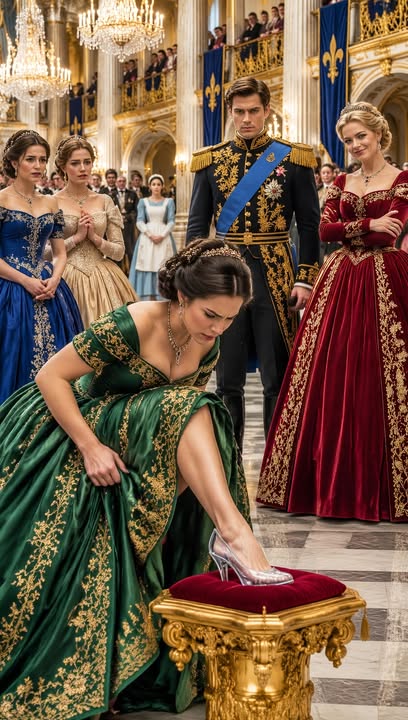
The glass slipper had been returned to the royal collection, but by the end of the day, the palace steward sent word that Ella could examine it if she wished.
The offer was made without ceremony.
Ella almost declined.
Then she realized that refusing because others had attached a meaning to the slipper would still let them choose what it meant.
She met the prince in a quiet fitting room near the royal chapel.
A seamstress named Mrs. Bell had been asked to assist, though Ella requested that the door remain open and that no one else attend.
The slipper rested on a low table.
Up close, it looked less like a legend and more like an exquisitely made object, thin and fragile, its curved edge catching the light.
Mrs. Bell knelt on a cushion and examined the fit.
Ella removed her work shoe.
The glass slipper slid onto her foot with such ease that the room seemed to draw in a breath.
It fit perfectly.
Mrs. Bell looked up, startled.
The prince’s face remained composed, though something in his eyes shifted.
Ella’s first thought was not wonder.
It was disappointment that the object had been right.
The slipper had fit the other women poorly, then settled around her foot as though the story had been waiting for her.
For a moment, the old hope stirred, bright and dangerous.
Then she remembered the ballroom, the laughter, and the way people had looked at her as if a perfect fit could tell them who she was.
She lifted her foot from the slipper.
“It fits,” Mrs. Bell said softly.
“Yes,” Ella replied.
The prince did not move toward her.
“What do you want to do now?” he asked.
“Nothing.”
She placed her foot back into her work shoe.
“I asked to try it. I’ve tried it. That’s all.”
The seamstress looked relieved, perhaps because she had expected more ceremony.
The prince nodded.
“Then that’s all.”
Ella turned toward him.
“You aren’t disappointed?”
“No.”
“You looked surprised.”
“I was.”
“But not disappointed.”
He considered the question.
“I’m relieved you still get to decide what the result means.”
Ella had expected him to say that the fit confirmed something about destiny.
Instead, he had left the meaning in her hands.
It did not make the slipper harmless.
But it made her feel less alone in the room.
When she stepped into the corridor, Lady Margaret was waiting.
The older woman’s eyes went first to Ella’s face, then to the slipper on the table behind her.
“So it fits,” she said.
“It does,” Ella answered.
Lady Margaret’s expression remained difficult to read.
“Does that change anything?” Ella asked.
“It changes a fact.”
“And the rest?”
“That depends on what we learn.”
Ella felt the edges of her patience fray.
“Everyone keeps saying that. What are you afraid we’ll learn?”
Lady Margaret looked toward the prince.
He remained silent, allowing Ella to have the question.
“I am afraid,” the older woman said slowly, “that we will learn your mother was caught in a choice that was never hers to make.”
“What choice?”
“I don’t know yet.”
“Do you know, or are you refusing to tell me?”
Lady Margaret’s composure tightened.
“I know that Clara left with more sorrow than she brought to the palace.”
“That isn’t an answer.”
“No.”
The older woman’s voice dropped.
“But I won’t pretend certainty where I don’t have it.”
Ella glanced at the prince.
He did not intervene.
She was grateful for that, though she was not sure she could have explained why.
Lady Margaret continued, “When you first entered the ballroom, I saw your face and the pendant together. I thought I recognized something from the past.”
“My face?”
“An expression. The way you held yourself.”
Ella stiffened.
“You think I look like my mother?”
“I think you reminded me of her.”
“That could mean anything.”
“It could.”
For the first time, Lady Margaret sounded tired rather than guarded.
“I should have met you without making you feel that your mother’s name was dangerous,” she said.
“You did make it feel dangerous.”
“I know.”
“Why did you try to stop me from speaking?”
Lady Margaret’s eyes lowered.
“Because I thought the moment your mother’s name was spoken, a question I had kept buried would become impossible to avoid.”
“What question?”
The older woman looked at Ella, and for an instant the lines around her mouth seemed deeper.
“Whether the choices I made were truly for Clara’s sake, or only for the sake of the palace.”
Ella could not answer.
The prince looked toward his grandmother.
“Margaret—”
“Not now,” she said, not sharply, but with a weariness that silenced him.
Ella caught the name.
It was the first time she had heard him address Lady Margaret by anything other than grandmother.
She wondered what had made him do so.
The archivist’s next discovery arrived two days later.
Dr. Shaw summoned Ella, the prince, and Lady Margaret to the archive in the early evening.
On the long table, she had laid out a large ledger, its leather cover faded nearly gray, along with two thin folders and several copied pages.
“The restricted ledger contains a number of entries omitted from the ordinary household register,” she said.
“Why were they restricted?” the prince asked.
“Some concerned matters of privacy. Others were marked confidential by the former household secretary, though the reason is not always noted.”
Lady Margaret stood at the far end of the table.
Her gaze rested on the ledger’s clasp.
Dr. Shaw opened the cover.
“I found Clara’s final entry. It shows that her service ended shortly after the prince’s birth.”
The prince looked down at the page.
“How shortly?”
“Three weeks.”
Ella felt the fact settle into her chest.
Her mother had still been in the palace when the prince was a newborn.
“She was dismissed?” she asked.
“The ledger uses the word ‘released from service,’” Dr. Shaw said. “That could mean a dismissal, but it can also refer to a voluntary departure recorded in formal language.”
“Was there a reason?”
“No reason is listed in the ordinary column.”
Dr. Shaw turned a page.
“In the restricted section, there is a reference to a private meeting with Lady Margaret. No notes are attached.”
Ella looked at the older woman.
“Did you meet my mother before she left?”
“Yes,” Lady Margaret replied.
“What did you say to her?”
“I don’t remember every word.”
“Do you remember the important ones?”
Lady Margaret’s hands folded together.
“I asked her to leave the palace.”
The prince’s expression changed.
“Why?”
“Because I believed her presence could draw attention to a private matter involving the royal household.”
“What matter?” Ella asked.
Lady Margaret did not answer.
The archivist kept her eyes on the open ledger, but her attention had clearly shifted to them.
“Did Clara have a choice?” the prince asked.
“She had a choice about where she would go,” Lady Margaret said. “I did not force her to leave.”
“That isn’t the same as saying she could stay freely,” Ella replied.
“No,” Lady Margaret said. “It isn’t.”
Her quiet agreement hurt more than a denial might have.
Ella reached for the back of the chair beside her.
“Did my mother know why you wanted her gone?”
“I told her the palace needed her absence.”
“Did you tell her the truth?”
“I told her what I thought was necessary at the time.”
The prince looked at his grandmother with a wounded disbelief.
“Necessary for whom?”
Lady Margaret’s face turned toward him.
“For the crown.”
The words seemed to lower the temperature in the archive.
“And for Clara?” Ella asked.
Lady Margaret lowered her eyes.
“I thought I was protecting her.”
“Did she ask you to?”
“No.”
The answer came quickly.
Ella’s fingers tightened on the chair.
“Then why did you decide you knew what was best for her?”
Lady Margaret took a breath that seemed to cost her something.
“Because I was young enough to mistake fear for wisdom.”
The prince’s eyes remained on her.
“What were you afraid of?”
Before Lady Margaret could answer, Dr. Shaw leaned over the ledger.
“There is another entry here,” she said.
The change in her voice drew their attention back to the page.
“On the date the prince was christened, the ledger records a private christening earlier that morning.”
The prince stared at her.
“Another christening?”
“Yes. It is listed as ‘unannounced infant christening,’ with a note that the service was attended by two members of the household and held in the old chapel.”
“Who was the infant?” Ella asked.
Dr. Shaw ran a finger beneath the line without touching the ink.
“The name has been scratched out in the original ledger.”
A long silence followed.
Lady Margaret moved to the table.
“Let me see.”
Dr. Shaw turned the book toward her.
Lady Margaret’s gaze fixed on the entry.
For a moment, her face seemed to lose every expression.
Then she sat down.
The prince stepped closer to Ella, not touching her but standing near enough that she could feel his presence.
“Could it have been one of the staff’s children?” he asked.
“It could,” Dr. Shaw replied. “The entry does not say.”
“Why was it marked confidential?” Ella asked.
“I don’t know.”
Dr. Shaw reached into the folder and removed a copy of the index.
“There should be a corresponding birth record in the household registry, but I have not found it.”
“Not found,” the prince repeated, “or removed?”
“The book has a gap where a page appears to have been cut out.”
Lady Margaret’s hands clasped together on the table.
The prince looked at her.
“Did you know about the christening?”
“I remember it,” she said.
“Whose was it?”
Lady Margaret’s lips parted.
She looked toward Ella, and Ella saw fear in her eyes again.
Not the sharp, startled fear from the ballroom.
This was older, more tired, and threaded with shame.
“I don’t know whose name was written in the original entry,” she said.
“Do you know who the infant was?” the prince asked.
Lady Margaret did not answer.
The archivist closed the folder.
“There may be another copy in the church records,” she said. “The old chapel kept its own register, though some of those books were transferred when the chapel was renovated.”
“Can you look for it?” Ella asked.
“Yes.”
The prince glanced at Lady Margaret.
“Was Clara at the christening?”
“I don’t remember.”
“You remember the ceremony.”
“I remember there was a private service. I don’t remember who carried the child.”
“Was it before or after Clara left?”
“Before.”
Ella tried to connect the dates.
Her mother had been working at the palace, the prince had just been born, and somewhere in the same household there had been an unannounced infant christening.
A child whose name had vanished from the registry.
She felt the pendant beneath her blouse, cold against her skin.
The rose engraved on it was not proof of anything.
Lady Margaret had made that clear.
But it was a reminder that the palace had once given her mother something she had never explained.
“I want to see the chapel records,” Ella said.
Dr. Shaw nodded.
“I’ll arrange it.”
The prince turned to her.
“You don’t have to keep doing this today.”
“I know.”
“Are you sure you want to continue?”
Ella watched him, then glanced at the ledger.
“If I stop now, I’ll spend the rest of my life wondering whether I stopped because I was tired or because someone else wanted me to.”
He accepted that.
“I’ll be there when you look,” he said.
“You don’t have to be.”
“I know.”
His willingness to leave the choice with her had begun to matter.
That frightened her almost as much as the secrets did.
They left the archive together, but Lady Margaret remained behind.
At the threshold, Ella turned.
The older woman was still seated at the table, one hand resting on the ledger, her eyes fixed on the scratched-out line.
“Lady Margaret,” Ella said.
The older woman looked up.
“Did my mother ever tell you who my father was?”
Lady Margaret’s expression shifted.
The prince turned back from the corridor.
For a heartbeat, no one moved.
Then Lady Margaret said, “She told me she loved him.”
“That wasn’t what I asked.”
“I know.”
“Did she tell you his name?”
“I believe she did.”
“Do you remember it?”
Lady Margaret looked down at the ledger.
“Not clearly.”
Ella could see the effort in the answer, the careful space left around a truth she did not yet know how to speak.
She walked away before she could ask again.
That night, she found a letter from Mr. Vale on the narrow desk in her room.
The steward had not written it himself.
He had enclosed a copied page from the palace household ledger, with a brief note saying that Dr. Shaw had discovered it among the loose papers attached to the restricted volume.
The page bore the date of the prince’s birth.
Near the bottom, in faded ink, someone had recorded that Clara Brooks was to receive her wages in full and that her personal effects should be returned to her before she left.
Below that was a second note, written in a different hand.
**The child’s baptismal record is to remain separate from the royal register.**
Ella read the words twice.
Then she turned the page over.
At the bottom, almost hidden beneath a crease, was a single line of writing that the archivist had not mentioned.
**The child is acknowledged by the King.**
**–END OF PART 3–CLICK “NEXT” AT THE BOTTOM OF THE PAGE TO CONTINUE READING**
* * *
[PREVIOUS: PART 2](https://storyly.idolsgift.com/blog/part-2-the-name-that-silenced-the-ballroom-052) | [NEXT: PART 4](https://storyly.idolsgift.com/blog/part-4-the-name-that-silenced-the-ballroom-052)
✓ Lynn R. Adams
Part 3 – The Record Beneath the Rose “Yes,” Dr. Shaw said, “this one appears to have been removed deliberately.” Ella kept her gaze on the narrow card in the archivist’s hand. The date written acro…