PART 3: The Name She Had Hidden 029
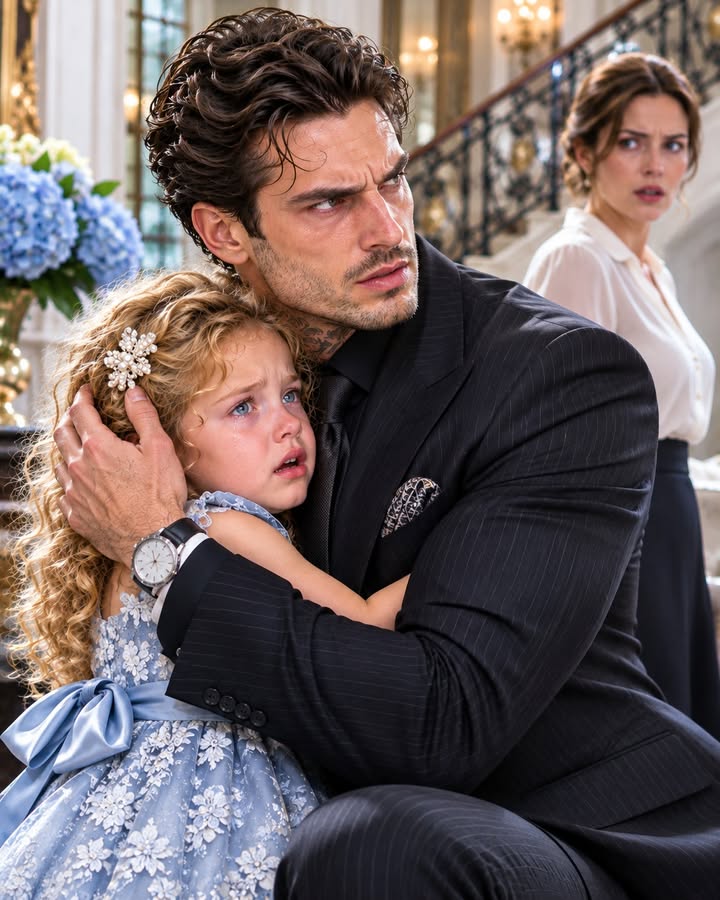
Part 3 – The Schedule in the Wrong Hands
“If Mara had been watching Sophie before I ever drove her to school, who had told her where to find her?”
The question stayed with me through the night.
I sat in my study long after the house had gone quiet, rereading the two messages from my head of security and watching the garden lights blur in the window.
Mara’s name had been absent from my life for years.
Now it was back, tied to a child I had only just begun to know.
In the morning, Elena found me at the kitchen table with untouched coffee and a folder open beside my hand.
“You didn’t sleep,” she said.
“I did for a little while.”
“That isn’t the same thing.”
“No.”
She set a plate of toast down, then glanced at the folder.
“Is that about Mara?”
“It’s about the school.”
Elena did not sit.
“What did you find?”
“Not enough yet.”
“That’s not an answer.”
I closed the folder.
“I asked my security team to review how she could have known Sophie’s routine.”
“Did you ask them to look into the school?”
“I asked them to check what information was publicly available.”
“And?”
“They found nothing that would tell someone which entrance Sophie uses or when she arrives.”
Elena’s hand tightened around the back of a chair.
“Then someone told her.”
“That’s one possibility.”
“Dante.”
“It’s the most likely one.”
Her gaze moved to the staircase, where Sophie was still getting dressed.
“Who has access to her schedule?”
“People in my household, the driver, and the school.”
“And your staff?”
“Some of them.”
“You said you would make sure no one approached her.”
“I did.”
“Have they?”
“No.”
“Have they spoken to the school?”
“Not yet.”
She studied me, searching my expression for the part I was withholding.
I understood the instinct.
“I’m not going to have anyone frighten the receptionist or accuse the teachers,” I said. “I’ll ask the school to preserve the camera footage and check who has requested information.”
“You can ask them yourself?”
“I can. But I won’t do it without you.”
For a moment, she seemed unsure what to do with that promise.
Then she nodded.
“Let me speak to the school first.”
“All right.”
“I don’t want them thinking Sophie is in trouble.”
“They won’t.”
“And I want to be there if anyone asks questions.”
“You should be.”
She looked at the folder again.
“What are you planning to do about the people in your house?”
“Nothing until we know there’s something to do.”
“People like you don’t usually wait for proof.”
“People like me have learned that guessing can hurt the wrong person.”
The answer seemed to soften her, though only slightly.
Sophie came down the stairs in her uniform, carrying a small stuffed rabbit by one ear.
“Good morning,” she said.
“Good morning,” I replied.
She looked at my untouched coffee.
“Did you forget to drink it?”
“I did.”
“Coffee gets cold if you forget.”
“I’ll try to remember.”
She placed her rabbit beside my cup.
“Maybe Hazel can remind you.”
“Does Hazel drink coffee?”
“No, but she has very good manners.”
Elena smiled as she helped Sophie into her coat.
“I’ll meet you at the school,” she told me. “You can follow separately.”
“I can drive you both.”
“I’d rather take my own car.”
I wanted to ask whether she was worried about traveling with me, but the answer would have been obvious.
“Of course,” I said.
Sophie held up the stuffed rabbit.
“Can Hazel come?”
“If your teacher says it’s all right,” Elena replied.
Sophie tucked the rabbit into her bag, leaving one soft ear peeking out.
At the front door, she turned back to me.
“Are you taking me to school today?”
“Your mother is.”
“Oh.”
The disappointment was small, but I felt it.
“I’ll see you later,” I said.
“Do you promise?”
“I promise.”
She seemed satisfied and hurried outside with Elena.
I stayed by the doorway until their car disappeared beyond the gate.
Then I called the school and arranged to meet Elena there.
The receptionist, Mrs. Alvarez, welcomed us into her office with the same warm manner she had shown Sophie the day before.
Elena sat beside her, leaving a chair between them for Sophie, who was occupied with a picture book in the waiting area.
I stayed by the doorway.
Mrs. Alvarez folded her hands on the desk.
“Elena said you wanted to ask about a visitor.”
“Yes,” I said. “A woman in a gray coat may have been near the school.”
“Was she here to see Sophie?”
“We don’t know.”
Elena leaned forward.
“We don’t want to alarm anyone. We only want to understand whether she spoke with a staff member or asked questions.”
Mrs. Alvarez’s expression grew more serious.
“I remember someone like that.”
“When?” Elena asked.
“Earlier this week, I think. She didn’t come inside. She spoke to me through the office window while I was helping with morning drop-off.”
“What did she ask?”
“She said she was a relative and wanted to know which entrance Sophie used.”
Elena went still.
“Did she give a name?”
“No. I asked her to speak with you if she was family, and she said she didn’t want to disturb you.”
“Did she mention Sophie by name?” I asked.
“She did.”
“Did she know anything else about her?”
Mrs. Alvarez paused, searching her memory.
“She knew that Sophie sometimes arrived with your household driver.”
Elena looked at me.
“That could be public information,” I said.
“Not which days he comes,” Mrs. Alvarez replied. “We don’t publish that.”
A cold knot formed beneath my ribs.
“What else did she ask?”
“Whether Sophie had any after-school activities.”
“Did she mention which ones?”
“She mentioned that Sophie sometimes stayed late on Thursdays for story circle.”
Elena sat very still.
“How would she know that?”
Mrs. Alvarez looked uncomfortable.
“I assumed a family member had told her.”
“I didn’t,” Elena said.
“Neither did I,” I said.
A small voice rose from the waiting area.
“Mama, can I show you my book?”
Elena glanced toward Sophie.
“Of course, sweetheart.”
Sophie came into the office and climbed onto Elena’s lap, opening the picture book to a page filled with painted birds.
“That one looks like Percy,” she said, pointing to a blue bird.
Mrs. Alvarez smiled.
“It does.”
Sophie leaned against her mother while Elena read the caption aloud.
I watched them and felt the strange weight of what we had just learned settle over the room.
The woman had not merely guessed where Sophie might be.
She knew a routine that was never meant to leave my household.
When Elena finished the page, Sophie looked at me.
“Do you know the bird?”
“I’m afraid not.”
“It’s a kingfisher,” Mrs. Alvarez told her.
“Does it wear a crown?”
“Not exactly.”
Sophie considered that, then turned back to her book.
Elena let her remain on her lap while she spoke quietly to Mrs. Alvarez.
“If she comes back, please call me immediately.”
“I will.”
“And don’t let her speak to Sophie.”
“Of course.”
When we left the school, Elena walked several steps ahead with Sophie, her hand resting protectively on the child’s shoulder.
I followed without trying to catch up.
At the car, Elena opened the back door for Sophie.
“Can I go to story circle on Thursday?” Sophie asked.
“We’ll talk about it,” Elena said.
Sophie’s face fell.
“Did I do something wrong?”
“No, sweetheart.”
“Then why?”
“Because we need to make sure everything is arranged properly.”
Sophie looked from Elena to me.
“Is this about the woman?”
Elena glanced at me, startled.
I crouched beside the open door so I could speak at her level.
“We’re checking that everyone who needs to know your schedule is someone we trust.”
“Is Mrs. Alvarez someone we trust?”
“Yes,” Elena said.
“Is Mr. Dante?”
The question caught me off guard.
Elena’s face tightened, but she did not answer for me.
“I hope so,” I said. “But you don’t have to decide today.”
Sophie seemed to think about that.
“Can I decide after you remember to drink your coffee?”
“I suppose you can.”
She nodded, accepting this as reasonable.
Elena fastened her seat belt and closed the door.
When she came around to the driver’s side, I waited beside her.
“Someone in your household had to know about Thursdays,” she said.
“Most likely.”
“Will you find out who?”
“I will.”
“And if it’s someone you trust?”
“I’ll listen to what they say before I decide what it means.”
Her expression said she was not sure she believed me.
“Don’t let your instincts make the decision for you,” she said.
“I’ll try.”
“You said that yesterday.”
“And I meant it yesterday too.”
She held my gaze for a moment, then got into the car.
At home, I asked my head of security to meet me in the study.
I did not raise my voice.
I did not need to.
“Who has seen the household schedule?” I asked.
He set a tablet on the desk.
“Four people have access to the current version, aside from you and Elena.”
“Names.”
“Mr. Bell, who coordinates household staff. Ms. Reyes, who manages the calendar. Thomas Vale, who oversees transport. And me.”
“Who had access to the version from last month?”
“The same people, plus two temporary staff members.”
“Did you send the schedule outside the house?”
“Only to the driver and the school contact.”
“Who was the school contact?”
“Ms. Alvarez.”
“She didn’t give it to anyone.”
He nodded, accepting the answer.
“Do you know which details were visible to each person?”
“I can find out.”
“Do that. Quietly. No one is to be questioned before you have a clear timeline.”
“Understood.”
I watched him gather the tablet.
“Was there anything else?”
He hesitated.
“There was a printout removed from the staff office last week.”
“By whom?”
“We don’t know yet. The printer log only shows that it was printed.”
“Was it the full schedule?”
“No. A partial page.”
“Which page?”
“The household assignments for Thursday.”
My attention sharpened.
“What did it include?”
“The driver’s afternoon route, the kitchen staff rotation, and the time Elena was scheduled to leave for her appointment.”
“Was Sophie’s story circle listed?”
“No.”
“Then the person who asked about it knew more than the printout showed.”
My head of security’s expression did not change, but I could see him recalculating.
“Unless they had access to another version.”
“Find out.”
He took the tablet and left.
I stayed in the study, looking at the closed door long after it shut.
For years, I had surrounded myself with people whose loyalty seemed beyond question.
I had treated loyalty as a fact that could be measured by time, by silence, by obedience.
I was beginning to understand that none of those things proved what I had wanted them to prove.
That afternoon, Elena came to my office after Sophie’s nap.
She carried the same folder I had seen at breakfast.
“I found this in the staff room,” she said.
“What is it?”
“A copy of the school calendar.”
She placed it on my desk.
Several dates were circled in blue ink, including the Thursday story circles and a day Sophie’s class would visit the library.
The paper had been folded into quarters and smoothed flat again.
“Where did you find it?”
“Under a stack of household invoices.”
“Did you tell anyone?”
“No.”
“Good.”
She pulled out the chair opposite me and sat.
“I don’t want to jump to conclusions.”
“Neither do I.”
“But someone had this in the house.”
“Yes.”
“Someone knew Sophie’s routines.”
“Yes.”
“And you’re going to ask everyone about it.”
“Not yet.”
“Why not?”
“I want the access records first.”
She looked at me for a long moment.
“Are you worried the answer will be someone you trust?”
“I’m worried the answer will involve someone who has been close to Sophie.”
Elena’s gaze lowered to the calendar.
“She has a way of trusting people quickly.”
“She trusts her teacher.”
“She trusted the first man who told her she was a queen.”
“You think she trusted me too quickly?”
“I think she wants to believe the best of people.”
The words brought back the laundry room: her wet cheeks, the brush in her hands, the fear that she was not beautiful enough to be loved.
“I want to deserve that,” I said.
Elena’s fingers moved over the folded paper.
“Can I ask you something?”
“Anything.”
“Why did you recognize Mara?”
“I worked with her years ago.”
“What did she do?”
“She coordinated security. She was good at her job.”
“What happened?”
“She disappeared after a breach.”
“What kind of breach?”
“One that cost me information and trust.”
Elena looked up.
“Did you think she caused it?”
“I did.”
“And now?”
“I don’t know.”
“Did you ever try to find her?”
“Yes.”
“Why?”
“Because people do not simply vanish from my world without leaving questions behind.”
“Was it about the breach or about her?”
I considered the question.
“At the time, I would have said the breach.”
“And now?”
“Now I’m not sure.”
Elena nodded slowly, as if she understood what it was like to carry a question until its edges changed.
“Sophie’s father once told me Mara helped him when he was trying to get away from something,” she said.
“You said that last night.”
“I know.”
“What did he mean?”
“I don’t know.”
“You must have asked.”
“I did.”
“And?”
“He said some people are brave enough to help you leave, but not brave enough to come with you.”
The sentence lingered between us.
“Did Luca tell you she was watching over you?”
“No.”
“Did he say she might come back?”
“No.”
“Then why connect the two?”
“Because when you said her name, I remembered Luca saying it. That’s all.”
I studied her face.
She was not hiding nothing.
But she was afraid of the shape of what she did not know.
“Did Luca tell you where he was going?”
“He said he wanted to make a life where Sophie could grow up without being afraid of every phone call.”
“And you agreed to keep his name off her records.”
“Yes.”
“What did he ask you to do if someone from his past came looking?”
Elena’s face changed.
“I don’t remember him asking that.”
The answer came too quickly.
I waited.
She pressed her lips together, then looked down at the calendar.
“He wrote things down,” she said. “He told me some of them might matter one day.”
“What things?”
“I don’t know where they are.”
“Did you keep the letter?”
“I don’t know.”
She stood, then seemed to reconsider and sat down again.
“I can’t keep doing this halfway,” she said.
“I’m not asking you to.”
“You are, though. Every time you ask another question, I have to decide whether answering it puts Sophie at risk.”
“I understand.”
“No, you don’t.”
She said it without anger, and that made it harder to hear.
“I’m sorry,” I said.
“I don’t want apologies. I want you to understand that I am not withholding things to make your life difficult.”
“I know.”
“Do you?”
“I know you’ve been carrying this alone for years because you thought it was the safest thing for Sophie.”
Her eyes shone, though she did not let the tears fall.
“I thought if I gave her a simple name and a simple life, she could just be a child.”
“You gave her that.”
“Did I?”
“You gave her a mother who kept showing up.”
Elena turned away, taking a slow breath.
Before either of us could say more, the door opened.
Sophie stepped into the study with Hazel tucked under one arm.
“I couldn’t find my purple pencil,” she announced.
Elena quickly wiped the corner of one eye.
“It might be in your drawing box.”
“I looked.”
“Then we’ll look together.”
Sophie turned to me.
“Are you busy?”
“I can help you look.”
“Good. Hazel thinks it’s under your chair.”
“Hazel has excellent instincts,” I said.
Sophie crawled under the desk, looking beneath the chair while Elena stood beside her.
As I reached down to help, my eyes caught on the folded school calendar.
The circled Thursday dates sat beside the edge of my open folder.
For a moment, I saw them as someone else might: not as ordinary entries, but as a map to a child’s week.
I closed the folder and set it aside.
That evening, I ate dinner with Elena and Sophie at the kitchen table.
Sophie told us about a picture she had drawn of a bird with a crown, and Elena told her that kingfishers did not need crowns to be important.
“Can they have one if they want?” Sophie asked.
“I suppose they can draw one,” Elena said.
Sophie looked at me.
“What would your bird look like?”
“Probably like a black crow with a very serious expression.”
“That’s not a kingfisher.”
“No, but it might be a good friend to one.”
Sophie accepted this and returned to her food.
The ordinary conversation helped, but it could not erase the question sitting beneath it.
After Sophie went upstairs, I found Elena in the kitchen rinsing the plates.
“You don’t have to do that,” I said.
“I know.”
She kept washing.
“Do you think Mara is the one who gave the school that information?”
“I don’t know.”
“Do you think she came because of Luca?”
“I don’t know that either.”
“You seem to say that a lot.”
“Because I don’t want to turn a guess into a fact.”
She set a plate in the drying rack.
“That’s new for you.”
“It’s becoming a necessary skill.”
She turned toward me.
“I recognized her name because Luca said it once,” she said. “But I didn’t tell you because I was afraid of what you’d do with it.”
“What did you think I’d do?”
“Assume she was dangerous and start looking for her.”
“I did start looking for her.”
“You did it quietly.”
“I promised not to scare Sophie.”
“Would you have looked for her if Sophie weren’t involved?”
“Yes.”
The honesty brought a faint, rueful smile to Elena’s face.
“At least you’re not pretending to be someone else.”
“I’m trying not to.”
She dried her hands on a towel.
“Luca told me once that the people around him could make a family feel like a set of locked doors.”
“Was he talking about my family?”
“I don’t know.”
“Did he ever mention the Morettis?”
“No.”
“Did he tell you his last name?”
Elena looked down.
“He told me not to put it on anything.”
“That isn’t the same answer.”
“No,” she said softly. “It isn’t.”
The kitchen seemed to hold its breath.
I wanted to ask her again.
Instead, I remembered what she had said: kindness could take up too much space, and even a question could feel like an order if it came from the wrong person.
So I waited.
Elena looked toward the staircase.
“He loved her,” she said. “That’s what I remember most clearly.”
“I believe you.”
“He used to hold her when she cried and tell her she’d never have to earn a place in the world.”
The words struck so close to the laundry room that I felt my throat tighten.
“I’m glad she had him, even for a little while.”
“So am I.”
The tenderness in Elena’s voice made the years between Luca’s death and this kitchen feel suddenly present.
When she reached to put the towel away, her sleeve caught on the corner of a drawer.
Something small slipped from its pocket and landed on the floor.
Elena bent to pick it up.
It was a photograph, old and worn at the edges.
She stopped.
I could see only the back at first, where a faded date had been written in blue ink.
Then she turned it over.
A young man stood beside a motorcycle, one arm draped around a woman whose face was partly hidden by sunlight.
He had Elena’s familiar softness in his eyes and a smile that made him look younger than his clothes.
Behind them, half in shadow, stood another man.
I recognized the shape of his face before I could place it.
Elena’s breath caught.
The young man in the photograph was the same man whose name she had spoken the night before.
Luca.
The figure behind him wore the Moretti family ring.
My ring.
“That’s my father,” I said.
Elena stared at the photograph.
“I think it is.”
The young man’s face could have been my own, softened by years and a different kind of life.
“What did Luca’s last name mean?”
Elena did not answer.
She turned the photograph over again, and the old date on the back became clear.
It was dated the year my younger brother vanished.
**–END OF PART 3–CLICK “NEXT” AT THE BOTTOM OF THE PAGE TO CONTINUE READING**
* * *
[PREVIOUS: PART 2](https://puretales.idolsgift.com/blog/part-2-the-name-she-had-hidden-029) | [NEXT: PART 4](https://puretales.idolsgift.com/blog/part-4-the-name-she-had-hidden-029)
✓ Lynn R. Adams
Part 3 – The Schedule in the Wrong Hands “If Mara had been watching Sophie before I ever drove her to school, who had told her where to find her?” The question stayed with me through the night. I s…