PART 3: The Name on the Screen 008
Part 3 – What Claire Wanted
For a moment, I forgot the roses in my hands.
“Did Graham tell you Claire wanted him to build something for this neighborhood?” Evelyn asked again.
“He told me she wanted the company to matter to the neighborhood,” I said. “He didn’t say there was a specific project.”
“No,” Evelyn replied. “I didn’t think he would.”
There was no bitterness in her voice, only a quiet weariness that made me wonder how many times she had waited for Graham to mention something he had spent years avoiding.
I set down the pruning shears and moved away from the open cooler.
“Why are you asking me?”
“Because you seem to have reached him in a way I haven’t managed lately.”
I glanced at the shop window, where the morning light lay pale across the display.
“I don’t know that I’ve reached him,” I said. “He told me something he hadn’t said out loud in a long time.”
“That may be more than he’s told himself.”
The words landed gently, but I felt the caution beneath them.
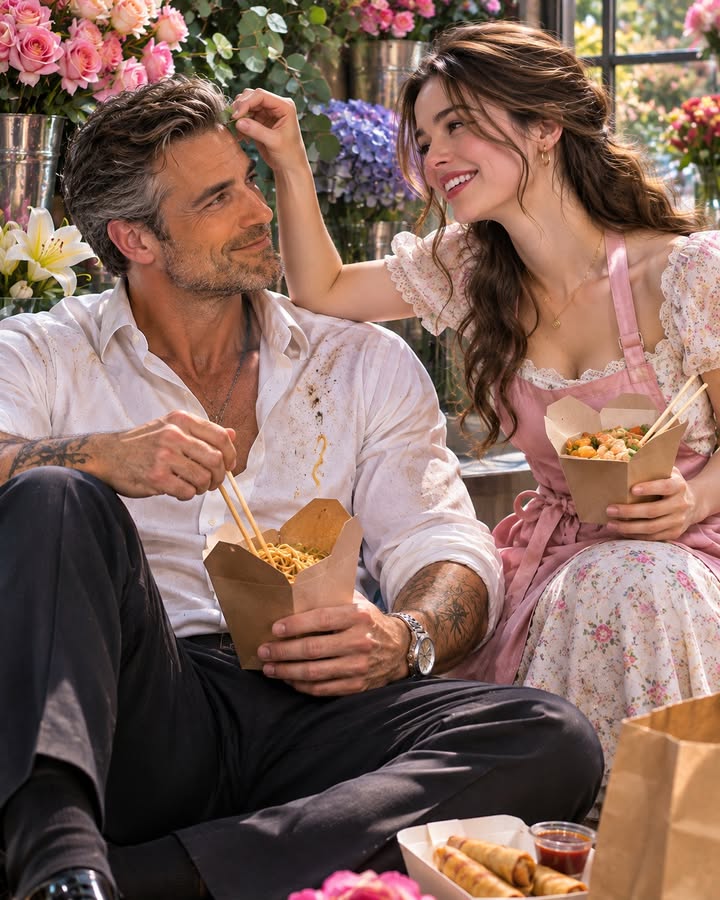
Evelyn and I had never met, yet there was a strange intimacy in discussing a man who had sat on my floor the night before, laughing over cold noodles and trying to make grief sound like a business problem.
“I don’t want to intrude,” I said.
“Neither do I,” Evelyn answered. “But Claire’s wishes are part of the decision Graham has to make now, whether he wants them to be or not.”
I heard paper shuffle on her end.
“Would you be willing to meet me for coffee?” she asked. “I can explain what I know, and you can decide whether any of it is yours to carry.”
The offer sounded careful enough that I couldn’t mistake it for a request to take sides.
“Where?”
“There’s a café on Beacon Hill, near the office. Is noon too soon?”
I looked toward the delivery buckets lined along the counter, their stems waiting to be trimmed and sorted.
“Noon is fine.”
“Thank you, Lucy.”
She ended the call without adding anything else.
For the next hour, I worked through the roses with the peculiar concentration of someone trying not to think.
I trimmed each stem cleanly, removed the lower leaves, and put the blooms in fresh water.
Still, the questions followed me from bucket to bucket.
What had Claire wanted Graham to build?
Why had Evelyn waited until now to tell me?
And why had she decided that I, of all people, might be able to help?
At noon, I left the shop in the care of Mara, who worked three mornings a week and knew better than to ask why I looked distracted.
The café Evelyn had chosen was warm and narrow, with brass lamps over the tables and a front window that looked onto a brick sidewalk.
She was already there, seated near the back with two cups of coffee between her hands.
I recognized her immediately from the photographs I had seen in business magazines.
She had silver threaded through her dark hair and wore a navy coat over a plain cream blouse.
There was nothing flashy about her, though I could imagine her walking into a meeting and making a room listen without raising her voice.
She stood when I approached.
“Lucy.”
“Evelyn.”
Her handshake was firm and warm.
“I’m glad you came.”
“So am I,” I said, though I wasn’t certain yet that it was true.
We sat.
Evelyn pushed one of the cups toward me.
“I hope you take milk.”
“I do.”
“I guessed correctly, then.”
She smiled, but her attention remained thoughtful.
For a few seconds, neither of us spoke.
I could hear the soft clink of cups and the low murmur of conversations around us.
“Graham said you and he built a company together,” I began.
“We did, though Claire was the reason it existed in the first place.”
Evelyn folded her hands around her cup.
“Graham was the one who could see how to grow an idea. Claire was the one who knew what the idea should do for people.”
“Did they start it together?”
“They started a small consulting firm in a rented room above a hardware store. Graham was twenty-three. Claire was twenty-six, and she had the more sensible head.”
“That must have been a surprise for him.”
“It still is.”
Her smile was affectionate, not possessive, and something in my chest loosened.
I had not realized I had been waiting to learn what kind of connection existed between them.
“Graham told me you’d been friends a long time,” I said.
“Long enough to have seen him in every version of that suit.”
“Was there ever a less polished version?”
“There was a period when he wore the same gray sweater every day because Claire told him people took him more seriously in it.”
“And did they?”
“Unfortunately, yes.”
I laughed.
Evelyn did too, and for a moment the room felt easy.
Then she looked down at her coffee.
“Graham has always believed that if he’s useful enough, no one will notice how much he’s hurting.”
I thought of him on the floor of my shop, his phone face down beside him.
“He said he was afraid to stop working because he wouldn’t know how to start again.”
“That sounds like him.”
“He also said he thought Claire would have wanted him to keep everything running.”
Evelyn’s expression turned still.
“She did want the work to continue,” she said. “But not the way he kept doing it.”
“What do you mean?”
“After she died, he made the company bigger, safer, more impressive. He thought that was how he honored her.”
“Wasn’t it?”
“Some of it was. But Claire never wanted a monument to the company. She wanted the company to make room for other people.”
Evelyn opened her bag and took out a slim folder.
She didn’t hand it to me right away.
Instead, she rested it on the table between us.
“This is a copy of a letter Claire left with me.”
I looked at the folder but didn’t touch it.
“Is Graham expecting you to show me this?”
“No.”
“Then shouldn’t you ask him first?”
“I would, if I thought he would say yes.”
The answer was honest, but it didn’t make the choice easier.
“Why not give it to him yourself?”
“I have tried. He keeps turning the conversation back to the sale, or to the numbers, or to what Claire would have wanted in theory.”
Evelyn lowered her eyes to the folder.
“I don’t want to use a letter from his sister to steer him toward a decision. That would be unfair.”
“Then why show it to me?”
“Because he listens to you.”
“He barely knows me.”
“Sometimes that makes it easier.”
I drew a slow breath.
“Evelyn, I care about him, but I’m not going to become a messenger between you.”
“I’m not asking you to.”
“And I won’t tell him what he should do.”
“I wouldn’t want you to.”
Her manner was calm, but I could see the strain beneath it.
“Claire wrote this after she and Graham had begun talking about a neighborhood business project,” she said. “Before she became ill.”
“What kind of project?”
“A fund and a shared workspace for small local businesses. Advice, modest loans, help with rent, that sort of thing. The people who were already part of the neighborhood, rather than the people who could afford to buy their way into it.”
I pictured the shop around me: the chipped wooden counter, the flower cooler that rattled at night, the invoices tucked into a drawer upstairs.
It was not difficult to understand why the idea touched something in me.
“Did they start it?”
“Not really. Claire and Graham had sketches, budgets, a few conversations with local organizations. Then an opportunity came along that would have made the company grow quickly.”
“And Graham chose that instead?”
“Claire chose it too, at first. They believed they could do both.”
Evelyn turned her coffee cup slightly.
“But Claire became sick, and Graham responded by doing more of everything. The project went quiet. After she died, he never brought it back.”
“Did you remind him?”
“More than once.”
“And?”
“He would say the timing wasn’t right. Then a year would pass, and he would say the numbers weren’t right. Eventually I stopped asking.”
She pushed the folder a little closer to me.
“Claire left this with me because she thought I might need to remind him what they had planned.”
“Why didn’t she give it to him?”
“She may have meant to. She was ill, and there were a lot of things she intended to do when she felt stronger.”
The phrase settled heavily between us.
Evelyn looked out through the window.
“I’ve kept it for years. I don’t know whether I was protecting him, protecting myself, or simply afraid of what it would mean if I handed it over.”
“You’re allowed to have your own grief too,” I said.
She looked back at me.
“That sounds like something Graham would need to hear.”
“Maybe he’s not the only one.”
For a moment her expression softened, and I saw how carefully she had carried her own history with Claire.
She slid the folder the rest of the way across the table.
“You don’t have to take it.”
I stared at the plain paper cover.
“If I do, I’m not promising to show it to him.”
“I understand.”
“And if he gets angry with you, I’m not going to defend the choice for you.”
“I wouldn’t expect you to.”
I opened the folder.
Inside was a single cream-colored sheet, folded once along the middle.
The handwriting was elegant and slightly slanted.
Claire had written Evelyn’s name at the top.
I read the first few lines, then stopped.
The letter was not a message to Graham.
It was a note about him.
Claire wrote that he could make anything sound urgent if he believed it might keep someone else from having to worry.
She wrote that his gift was not making a business grow, but seeing what people could build when someone took them seriously.
Near the bottom, she mentioned the neighborhood project.
The last sentence of the paragraph read, He has to be the one who decides to begin again, but I hope he remembers that success was never meant to be the whole point.
I read it twice.
The words didn’t tell Graham what to do.
They didn’t accuse him of failing Claire.
They simply described a version of him he seemed to have forgotten.
“Did you know she wrote this?” I asked.
“Only because she gave it to me.”
“Did you ever think there might be more?”
Evelyn’s fingers tightened around the cup.
“There could be other papers in the company files. Claire saved everything. Notes, drafts, receipts. I haven’t looked through every box.”
“Why not?”
“Because the company’s been moved and reorganized twice since then. And because searching through her things can feel like opening a door I’ve spent years keeping closed.”
I understood that more than I wanted to.
I folded the letter and placed it back in the folder.
“You said there was something in the records now.”
“That’s what I mentioned to Graham last night. I found a box while we were clearing the old archive room. I haven’t had the chance to go through it properly.”
“Does it have anything to do with this project?”
“I don’t know. It’s marked with Claire’s initials and the year she got sick.”
The café seemed to grow quieter around us.
“Will you show it to Graham?”
“I asked him to come to the office today. He said he would.”
“Then he should see the box before I do.”
Evelyn nodded.
“Perhaps.”
“You have to give him the chance to decide.”
“I know.”
She looked down at the letter.
“It’s difficult to watch someone you love build a life around an assumption.”
The word love was spoken plainly, without romantic invitation.
I thought of Graham’s careful distance and the way he had described Evelyn as the person who could tell him when a plan was ridiculous.
“You love him,” I said.
“I do,” Evelyn replied. “As a friend. As the person I’ve spent half my adult life working beside. I love him the way you love someone whose family you’ve become part of.”
She met my eyes.
“Not as a rival.”
“I didn’t think you were.”
“Didn’t you?”
I smiled faintly.
“I’ll admit I wondered.”
“That’s fair.”
Her expression held no offense.
“Graham has never been very good at explaining the shape of his relationships. He assumes people can read his intentions from the fact that he stayed in the room.”
“That sounds familiar.”
“He can make silence seem like a decision.”
I thought of the way he had looked away after saying he would ask me to dinner if he were younger.
Perhaps silence was simply where he went when he had no idea what to do with the truth.
Evelyn reached for the folder, then paused.
“Keep it for a day,” she said. “Read it again if you want to. You can give it to Graham, or give it back to me.”
“I don’t want to create a secret between us.”
“Neither do I.”
“Then he should know you showed it to me.”
“He should.”
Her answer was immediate.
I stood, and she rose with me.
“I’ll tell him,” I said.
“Thank you.”
She touched my forearm briefly, a gesture of gratitude rather than a plea.
On the walk back to the shop, I kept the folder in my bag and felt its thin weight against my side.
It was strange how little paper could alter the way I thought about a person.
Graham had been the man who thought work could cover over the shape of grief.
Claire’s letter made him seem younger, before he had learned to turn every uncertainty into a schedule.
I didn’t tell myself that I could save him.
I didn’t believe Evelyn wanted that from me, either.
But when I returned to the shop, I set the folder beside the register where I could see it.
Graham arrived just before closing.
He carried a small paper bag from the bakery down the street, and when he stepped inside, he looked first at me, then at the folder.
His gaze sharpened.
“What’s that?”
I wiped my hands on my apron.
“Evelyn came by this morning.”
He stopped just inside the door.
“She gave you something?”
“She showed me a letter Claire wrote.”
His eyes moved from the folder to my face.
“What did she say?”
“She said she wanted you to know there was a neighborhood project you and Claire once discussed.”
“I know about the project.”
“You knew about the idea. I don’t think you knew what Claire wrote about it.”
He set the bakery bag on the counter.
“Why did she bring you into this?”
“Because she thought I might understand why it mattered.”
“That isn’t her decision to make.”
“No,” I said. “It isn’t.”
His reply had been sharp, but he didn’t raise his voice.
He looked tired rather than angry, as if he had spent the day walking through rooms he’d hoped to avoid.
“I told Evelyn I wouldn’t be a messenger between you,” I continued. “I’m not going to tell you what the letter means or what you should do with it.”
“Then why tell me she showed it to you?”
“Because I don’t want to keep it from you.”
For a few seconds he said nothing.
His eyes stayed on the folder.
“Did you read it?”
“Yes.”
“What did it say?”
“Ask Evelyn.”
He looked at me again.
There was disappointment in his face, but something like respect too.
“You’re right,” he said.
I hadn’t expected him to agree so quickly.
He took a breath.
“Did she tell you about the company offer?”
“She said you were deciding what to do.”
“And did she tell you she believes Claire wanted me to keep the company?”
“She said Claire wanted the company to make room for other people.”
Graham’s jaw tightened.
“That’s not the same thing.”
“No. It isn’t.”
He studied the folder, still untouched on the counter.
“Evelyn found a box in the old archive room,” I said. “Something with Claire’s initials on it.”
“That’s what she mentioned last night.”
“She hasn’t gone through it.”
“Why not?”
“I think she’s afraid of what might be in it.”
He looked away.
“I told her to leave it alone.”
“Did she agree?”
“Not exactly.”
“Maybe she was waiting for you to look at it with her.”
He gave a small, weary laugh.
“Everyone seems to have decided I need help.”
“Maybe they’ve noticed you’re tired.”
“I’m always tired.”
“I know.”
The words came out softer than I intended.
Graham’s eyes rested on my face.
For a moment, the strain in him loosened.
Then he glanced at the folder again.
“Can I read it?”
“Of course.”
I slid it across the counter.
He opened it carefully and unfolded the letter.
I watched his face as his eyes moved over Claire’s handwriting.
At first, he looked composed.
Then something shifted around his mouth.
He read the page once without moving.
After a moment, he read the last paragraph again.
I stayed on the other side of the counter, giving him the space he had given me the night before.
When he finished, he folded the letter along its original crease.
“She thought I knew what mattered,” he said.
“Maybe she knew you could remember.”
He looked down at the letter.
“I don’t know if I can.”
“You don’t have to know today.”
His eyes lifted to mine.
“I keep waiting for someone to tell me there’s a correct answer.”
“Evelyn doesn’t sound like she’s trying to give you one.”
“She used to.”
“And now?”
“Now she’s tired of trying to make me hear things I don’t want to hear.”
He placed the letter back in the folder and set it on the counter.
“I’m sorry she showed you.”
“She said you should know she did.”
“That doesn’t make it easier.”
“No.”
For a moment, I thought he might leave.
Instead, he took off his coat and draped it over the chair by the worktable.
“Can I help you finish closing?”
“You don’t have to.”
“I know.”
He looked toward the buckets waiting near the sink.
“I’d like to.”
I handed him a stack of clean jars.
He washed while I trimmed the last of the roses, and we let the water and the snipping of stems fill the space between us.
He didn’t bring up the letter again.
I didn’t ask what it had made him feel.
When the shop was tidy, he carried the rubbish to the back door and returned with a small cardboard box he had found beside the recycling.
“I was looking for the extra twine,” he said. “This was behind the storage shelf.”
The box was about the size of a shoebox, faded at the corners, with a strip of masking tape across the top.
In neat block letters, someone had written C.W. — COMMUNITY.
My breath caught.
Graham saw the label.
“That’s not ours,” he said, then paused. “At least, I don’t think it is.”
I touched the tape but didn’t lift it.
There was a small stamp in the corner, the mark of a neighborhood stationery shop that had closed before I rented the space.
“Claire might have left it here,” I said.
“Why would she?”
“I don’t know.”
He picked up the box, testing its weight.
It was light, but something shifted faintly inside.
His expression changed.
“Should I call Evelyn?”
“Maybe.”
He turned the box over.
A white envelope had been tucked beneath the bottom flap, its edges yellowed with age.
Graham drew it free.
On the front was Claire’s handwriting.
This time, she had written his name.
**–END OF PART 3–CLICK “NEXT” AT THE BOTTOM OF THE PAGE TO CONTINUE READING**
* * *
[PREVIOUS: PART 2](https://puretales.idolsgift.com/blog/part-2-the-name-on-the-screen-008) | [NEXT: PART 4](https://puretales.idolsgift.com/blog/part-4-the-name-on-the-screen-008)
✓ Lynn R. Adams
Part 3 – What Claire Wanted For a moment, I forgot the roses in my hands. “Did Graham tell you Claire wanted him to build something for this neighborhood?” Evelyn asked again. “He told me she wante…