PART 3: The Name on the Record 056
Part 3 – The Words They Shared
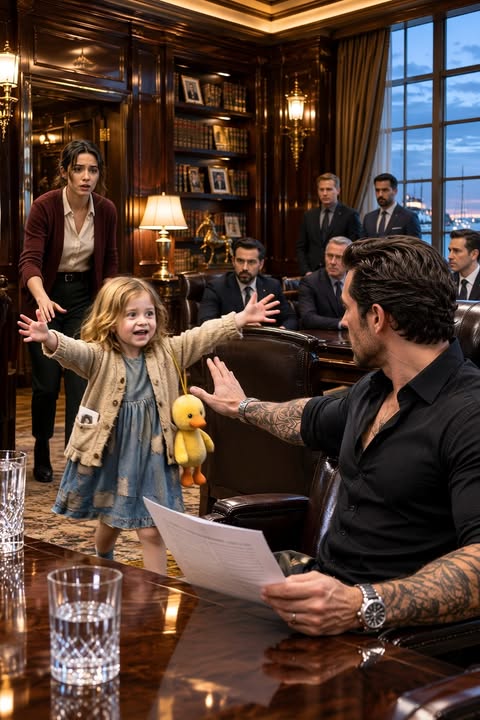
Vincent read the sentence at the bottom of the birth record again.
I did not leave because I stopped loving you.
The paper trembled—not from fear, he told himself, but from the effort of holding a life together with two hands while the past broke open in front of him.
Emma leaned against his chest, her eyes fixed on the document.
“Mommy wrote?” she asked.
“Yes,” Vincent said, his voice roughened by everything he could not explain to a two-year-old. “She wrote something for us.”
Rosa stood nearby, fingers intertwined, watching him with the careful patience of someone who had spent years protecting a secret and now feared what its unveiling might cost.
“You knew?” he asked her.
“I knew she loved you,” Rosa replied. “I didn’t know what she meant to do with that love.”
“You knew my name was on the record.”
“I did.”
“And you let me believe she had vanished without a reason.”
Her eyes lowered.
“I let you believe what Isabella asked me to let you believe.”
The answer was quiet, but it struck harder than an excuse would have.
Vincent folded the birth record with deliberate care and placed it beside the note.
“You could have told me the truth.”
“I could have,” Rosa said. “But then I would have broken my promise to her before Emma was old enough to come to you.”
“You made a promise about my daughter.”
“I made a promise about a child who had no one else to protect her.”
Emma’s small hand slid up Vincent’s lapel.
“Daddy sad?”
He looked at her, and the anger he had been gathering found nowhere to settle.
“I’m trying to understand,” he said.
She studied his face, then pressed the stuffed duck into his palm.
“Quack.”
Vincent let the toy bob gently.
“Quack.”
Emma smiled, satisfied that she had repaired something, even if she could not know what had cracked.
Rosa’s gaze softened.
“She’s always done that,” she murmured. “When she thinks someone is upset.”
For an instant, Vincent saw Isabella in the observation: the same instinct to notice what others hid, the same gentle insistence that pain be acknowledged rather than ignored.
He looked back at the note.
“You knew she still loved me,” he said.
“I knew she had never stopped.”
“Then why didn’t she come back?”
Rosa took a breath, but no answer came.
At the conference table, Marco had set aside his phone and was watching them.
The guards had returned to their posts, though their attention had shifted from the locked doors to the scene by the desk.
Vincent felt every one of them listening.
“Clear the room,” he said.
Marco hesitated.
“Vincent, we still haven’t established who sent the messages.”
“Then you can work outside the room.”
“I’d rather keep everyone together until we know—”
“Not in front of Emma.”
Marco glanced at the little girl, then nodded.
He directed the men toward the adjoining office, asking them to leave their phones on the desk.
As they filed out, one of the older guards paused beside Vincent.
“She’s safe here, boss,” he said.
“I know.”
The man gave a respectful nod and followed the others.
Marco remained at the doorway.
“I’ll be right outside,” he said.
Vincent looked at him, aware of the years between them: shared risks, hard decisions, and the many times Marco had been the only person willing to tell him what he did not want to hear.
“Stay where I can reach you.”
“I will.”
When the door closed, the office seemed suddenly too quiet.
Rosa sat on the sofa, and Vincent lowered himself into the chair opposite her with Emma still in his arms.
The birth record rested between them on the desk.
“Tell me everything Isabella told you,” he said.
“I don’t know everything.”
“Tell me what you do know.”
Rosa pressed her hands together.
“She said you had once promised each other that neither of you would disappear without explaining why.”
Vincent’s eyes lifted.
“That was years ago.”
“I know.”
“What else?”
“She told me you used to say that knowing the truth meant you could control what came next.”
He stared at her.
Rosa nodded faintly.
“She said she answered that you should listen first.”
The memory returned with painful clarity: the summer evening, the warm air, Isabella’s amused expression as she leaned against the railing.
He had thought it was only a teasing remark.
“Why would she write that on a birth record?” he asked.
“She didn’t,” Rosa said. “The record is official. The words at the bottom are hers, but she added them later.”
Vincent unfolded the paper again and examined the handwriting.
The message had been written in the margin, small and slanted, as if Isabella had needed to make the thought fit where it could.
“Did she tell you where she was going when she left?”
“No.”
“Did she tell you why she thought I was dangerous to Emma?”
Rosa’s face tightened.
“She didn’t think you would hurt her.”
“That isn’t what I asked.”
“She thought your enemies might.”
The distinction had the weight of a door opening onto a room he had avoided entering.
“Did anyone threaten her before she disappeared?”
Rosa looked toward the closed door.
“Not directly, as far as I know.”
“But she received those messages.”
“Yes.”
“Did she ever mention the harbor?”
Rosa shook her head.
“Did she mention someone in my organization?”
“No. She was careful never to speak names.”
“Careful because she feared I would ask questions?”
“Careful because she believed the wrong person might be listening.”
Vincent sat back, keeping his expression still.
“Who could have been listening to her?”
“I don’t know.”
“What did she tell you to do if the danger came?”
“Bring Emma to you only if I had no other choice.”
“She gave you my photograph.”
“Yes.”
“And told you to come directly here.”
“She wanted me to wait until I was certain the threat was real. Last night, there was no time to be certain.”
Emma had grown quiet, her fingers tracing the edge of Vincent’s cuff.
He felt her warmth against him and tried to keep the questions from becoming an interrogation.
“Did Isabella have anyone else she trusted?”
“Only a few friends from work. She kept her life small.”
“Family?”
“She wasn’t close with her relatives.”
“Did she ask you to keep anything else?”
Rosa hesitated.
“Not from you.”
The qualification unsettled him.
“What does that mean?”
“She asked me to keep Emma’s papers together. Medical records, the birth certificate, a few letters. She said if Emma ever came to you, I should give you the record and the note.”
“You’ve already done that.”
“Yes.”
“Then what are you holding back?”
“Nothing,” Rosa said, though her voice had thinned. “Nothing that would help find Isabella.”
It was not quite an answer.
Vincent’s gaze sharpened, but Emma had lifted her head, studying his face again.
He softened his expression for her.
“Can you show me where you and Emma were staying?” he asked Rosa.
“Her apartment?”
“Yes.”
“I can describe it.”
“I need the place itself. Anything the intruders touched, anything they left behind.”
Rosa’s eyes filled with fresh worry.
“Isabella told me not to go back.”
“Then you won’t.”
“I can tell you what the rooms looked like.”
“Do that.”
Rosa described the apartment carefully: the narrow hallway, the nursery at the back, a kitchen window that overlooked a courtyard.
She told him the door had not been forced, which meant Isabella might have opened it herself or someone had used a key.
She remembered no voices, only the faint sound of footsteps in the stairwell and Isabella’s sudden urgency as she entered the nursery.
“She had already packed a small bag for Emma,” Rosa said. “Not the one we took last night. It was tucked beneath the crib.”
“Had she packed it before?”
“I don’t know.”
“Was there anything inside?”
“Clothes, a bottle, a little cash. The kind of things she might have kept ready in case of an emergency.”
Vincent listened, fitting each detail against the others.
A woman who had received warnings for months.
A packed bag hidden beneath a crib.
A photograph entrusted to a babysitter with instructions to take the child to him only if danger came.
None of it sounded like a woman who had simply left because she no longer cared.
None of it told him who had made her afraid.
A knock sounded at the office door.
Vincent looked up.
Marco opened it only wide enough to show his face.
“We found something.”
“What?”
“The meeting location was accessed through an internal security account shortly before Rosa arrived.”
Vincent’s expression hardened.
“Which account?”
“We’re still checking the logs.”
“Close every external connection.”
“Already done.”
“Was the account authorized to see the schedule?”
“Yes.”
“And the four people who knew?”
Marco paused.
“Two of them have access to that system.”
Vincent glanced at Rosa, then at Emma.
“Not in front of her.”
“I’ll wait outside.”
Marco shut the door again.
Vincent stood, carrying Emma to the sofa and settling her beside Rosa.
“Stay here with her,” he said.
Rosa reached for Emma’s hand.
“Are you going to find her?”
“I’m going to find out who’s been following her.”
“That isn’t the same thing.”
“No,” he said. “It isn’t.”
He left the note and record on the desk, unwilling to let them out of sight, and stepped into the adjoining office.
The twelve men had been separated into smaller groups, with two guards checking the phones gathered on the table.
Marco stood near the far window, speaking softly to one of the security staff.
When he saw Vincent, he ended the conversation.
“The account belonged to the advance team,” Marco said. “It was used to confirm the arrival window at this office.”
“Who had access?”
“Me, the operations chief, and two members of the building security staff.”
“Did anyone outside the group know Emma might come here?”
“Not according to the original plan.”
“Then how did the sender know?”
“We’re checking the message metadata against the timing.”
Vincent studied Marco.
“What are you not telling me?”
Marco’s jaw flexed once.
“I’m not sure yet.”
“That isn’t an answer.”
“It’s the only honest one I have.”
The reply might have sounded evasive from anyone else.
From Marco, it sounded like a warning that the truth could be worse than a guess.
Vincent moved closer, lowering his voice.
“Did you give the meeting location to anyone?”
“No.”
“Did you discuss Isabella with anyone?”
“No.”
“Did you know she had been receiving warnings?”
Marco’s eyes changed.
“Not until Rosa said so.”
“You knew I’d been looking for her.”
“I helped you look.”
“You knew how much her disappearance mattered.”
“Yes.”
“Then you understand why I’m asking.”
“I do.”
There was no anger in Marco’s voice, only a weariness that made the distance between them more apparent.
Vincent had trusted him with the pieces of his life that he rarely named.
Now every answer seemed to carry a second meaning.
“Who were the other two?” Vincent asked.
“The operations chief and Leland from building security.”
“Where are they?”
“Here.”
“Keep them separated.”
“Already done.”
“Don’t let anyone leave.”
Marco studied him.
“Are you including me?”
Vincent’s answer came too slowly.
“I’m including everyone.”
For a moment, neither spoke.
Then Marco nodded.
“Understood.”
Vincent returned to the office.
Emma was sitting on the sofa, holding the envelope on her lap while Rosa kept a watchful hand near her.
The little girl had not opened it further.
“Did you find something?” Rosa asked.
“Someone used an internal account to access the meeting schedule.”
“Do they know who?”
“Not yet.”
Rosa looked down at Emma.
“Is Isabella in danger because of you?”
The question was asked without accusation, but Vincent felt it land as if she had struck the very center of him.
“I don’t know.”
“She was afraid your world would reach her.”
“I know.”
“She might not have wanted you involved.”
“She sent Emma to me.”
“Because she had run out of choices.”
“Or because she trusted me.”
Rosa looked up.
“I hope it was both.”
Vincent glanced at the birth record.
“For three years, I thought she had made her choice and moved on.”
“She thought you would believe that.”
“Why?”
“Because she knew how much it would hurt you.”
“That doesn’t explain why she did it.”
“No,” Rosa said gently. “It doesn’t.”
The honesty of it disarmed him.
He had spent so long searching for an explanation that could be turned into a clean answer.
Instead, he was learning that love, fear, and protection could occupy the same decision, leaving everyone wounded in different ways.
“Did she ever say she regretted leaving?” he asked.
“She said she regretted that you had to live without knowing.”
“That’s not the same.”
“No.”
Emma looked between them.
“Mommy come home?” she asked.
Rosa leaned toward her.
“We’re trying to bring her home.”
Vincent crouched in front of them.
“I promise I’ll find her.”
Emma touched his cheek.
“Promise?”
“Yes.”
The word carried more weight than it had before.
He had promised Isabella once that neither of them would vanish without explaining.
He had broken that promise in his own way by turning her silence into a verdict and refusing to question what it might conceal.
Now he was making a promise to a child who knew nothing of the old hurt, except that her mother was missing and the man she called Daddy looked sad.
Emma offered him the stuffed duck.
He took it.
“Quack,” he said.
She nodded gravely, then leaned into Rosa.
A second knock sounded.
This time Marco entered without waiting.
“We traced the message as far as the carrier,” he said. “It routed through two temporary relays, but one of the phrases may be useful.”
“What phrase?”
“‘Give us the girl, and the old promise stays buried.’”
Vincent stared at him.
The words seemed to drain the room of air.
Rosa noticed the change in his face.
“What old promise?” she asked.
Vincent did not answer at once.
He knew the phrase.
Not because it had been spoken in a meeting or written in a report, but because he and Isabella had once used it between them, years before Emma was born.
When one of them asked too many questions about a matter the other was not ready to discuss, Isabella would say, “Let the old promise stay buried.”
It had begun as a private joke, a way of delaying an argument until they could face it calmly.
No one in Vincent’s organization should have known it.
“Where did you hear that?” he asked Marco.
“It was in the message.”
“Exactly that wording?”
“Exactly.”
“Could it have come from an old recording?”
“We don’t know.”
“Who had access to anything from that time?”
Marco’s face was grave.
“Not many people.”
Vincent thought of old offices, storage rooms, archived calls and former associates who had drifted through the edges of his life.
He thought of Isabella receiving anonymous warnings for months, refusing to involve him, and using a phrase only the two of them had once shared.
Someone had not merely learned where he was today.
Someone had reached back into the years he had spent trying to forget her.
Marco’s gaze held his.
“This wasn’t about the meeting location,” he said. “Whoever sent that message knows something about your past.”
Vincent looked toward the desk, where Isabella’s note and Emma’s birth record lay side by side.
A new message appeared on the phone in Marco’s hand.
He read it in silence, then turned the screen toward Vincent.
Three words glowed beneath the sender’s number.
You remember, Vincent.
**–END OF PART 3–CLICK “NEXT” AT THE BOTTOM OF THE PAGE TO CONTINUE READING**
* * *
[PREVIOUS: PART 2](https://storyly.idolsgift.com/blog/part-2-the-name-on-the-record-056) | [NEXT: PART 4](https://storyly.idolsgift.com/blog/part-4-the-name-on-the-record-056)
✓ Lynn R. Adams
Part 3 – The Words They Shared Vincent read the sentence at the bottom of the birth record again. I did not leave because I stopped loving you. The paper trembled—not from fear, he told himself, bu…