PART 3: The Name on the Folded Paper 056
Part 3 – The Account Behind the Name
Richard said nothing.
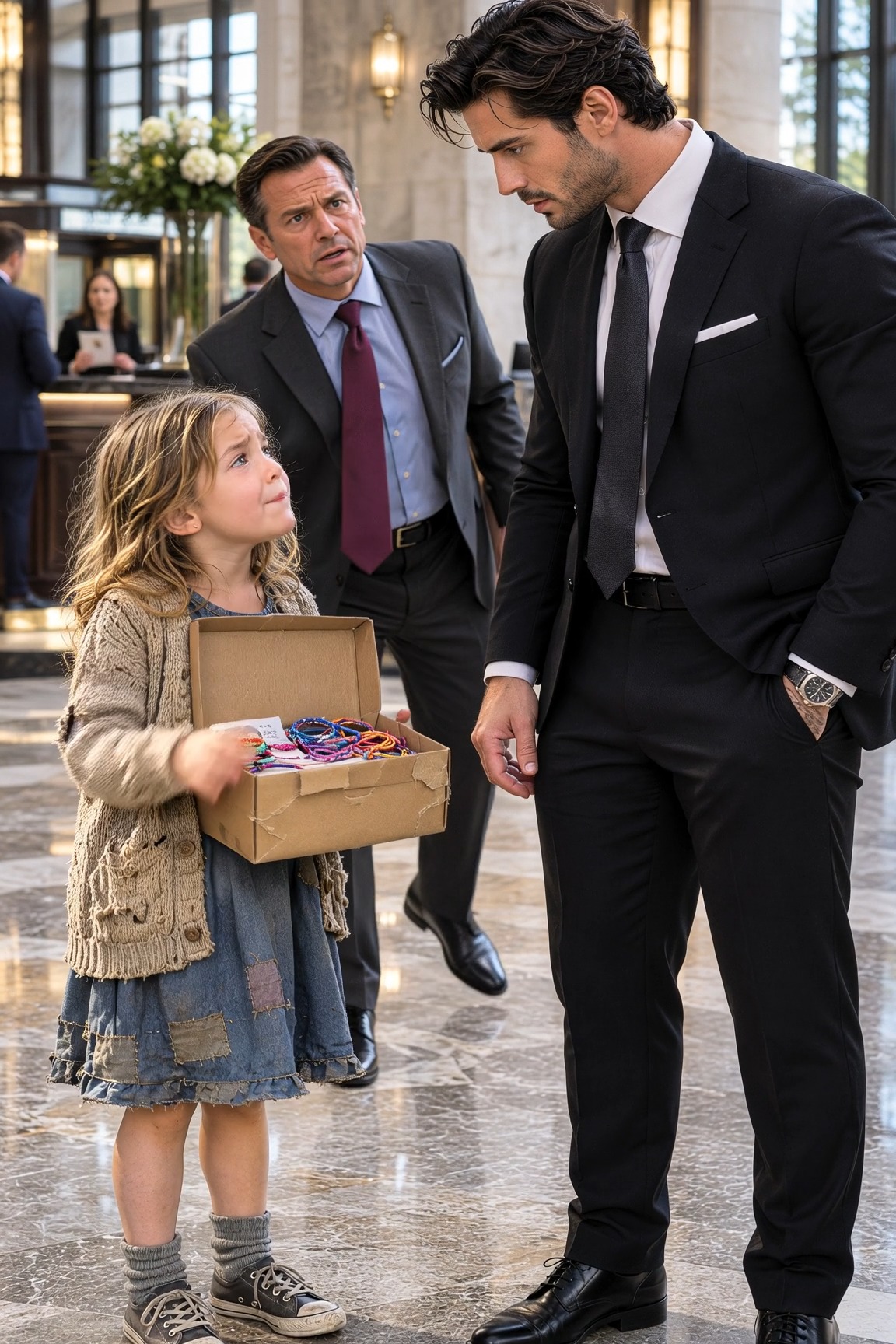
Chloe leaned closer to me, her voice dropping to a whisper.
“Mommy keeps letters with his name hidden under the sewing cloth.”
Richard’s hand tightened around the chair.
Before I could ask him what the letters said, the bank’s glass entrance opened, and a woman stepped inside with the hurried, watchful movement of someone who had spent the walk rehearsing what she would say.
She wore a dark green coat and carried a canvas bag against her side.
Her eyes found Chloe first.
“Mommy,” Chloe said, and the worry that had held her shoulders tight finally loosened.
Elena crossed the lobby and knelt in front of her daughter.
“Are you all right?”
“I’m okay.”
“Did you touch the paper?”
“No.”
“Good.”
Elena’s gaze flicked toward the clear sleeve on the manager’s desk, then to me.
The relief in her face gave way to something more complicated.
“Mr. Mercer,” she said.
“Ms. Elena.”
She stood, keeping one hand on Chloe’s shoulder.
“I’m sorry she got caught in the middle of this.”
“She didn’t cause anything,” I said. “The document was already in her box.”
“That’s what she told me.”
There was no accusation in her voice, but neither was there trust.
Ms. Patel introduced herself and explained what the bank had done so far: secured the paper, alerted its fraud officer, and requested the archived transaction records.
Elena listened without interrupting.
When Ms. Patel mentioned the Mercer Employee Family Fund, Elena’s fingers pressed more firmly against Chloe’s shoulder.
“That fund was supposed to help people,” she said.
“It still exists,” I replied. “It has been managed by the company since I started it.”
“Managed,” Elena repeated softly.
The word landed between us with the weight of an old argument.
I could have asked what she meant.
Instead, I asked, “Would you be willing to tell me how this paper came to be in your sewing basket?”
Elena looked at Chloe.
“Not here.”
“I understand.”
“I don’t mean I’m refusing to talk,” she said. “I mean I won’t explain it in front of my daughter, and I won’t do it while everyone is treating a guess as a fact.”
“I haven’t decided what it means.”
“Your company decided what I meant years ago.”
There was no anger in her expression, only a careful restraint that suggested anger had long ago become too expensive to carry.
Richard stepped forward.
“Elena—”
She looked at him, and he stopped.
“Not yet,” she said.
Richard lowered his eyes.
Chloe had begun gathering the bracelets, one by one, into the box.
Elena bent to help her, but Chloe held out the blue-and-yellow one she had sold to me.
“He’s wearing it,” she said.
“I am,” I told Elena.
She looked at my wrist, at the child-sized knots and the uneven thread.
“Then I’m glad she sold it.”
The bank’s fraud officer arrived a few minutes later, a composed man named Mr. Kim, carrying a slim briefcase and a laptop.
He examined the document through its sleeve without removing it, then asked Ms. Patel to confirm the time it had been found and who had handled it.
I answered as accurately as I could.
Richard said he had seen it only after I pulled it from the box.
Elena watched him as he spoke, her expression difficult to read.
When Mr. Kim finished recording the details, he explained that the bank could not determine whether the signature was forged from a photocopy alone.
They would compare it with archived versions of the authorization and with the original transaction file.
“How long?” I asked.
“Retrieving the file may take several days,” he said. “The account is old, but it is still within our archive.”
“And if the signature is not mine?”
“Then the bank will document that finding and coordinate with your company and the appropriate investigators.”
Elena glanced at the document sleeve.
“Is there anything else in the box?” she asked Chloe.
“Just the bracelets.”
“Are you sure?”
Chloe nodded.
Elena looked as if she wanted to ask more, but the teller offered to let them sit in a quieter corner while the adults spoke.
Chloe chose to stay near the teller.
“I want to finish putting them in order,” she said.
Elena kissed the top of her head.
“I’ll be right there.”
Ms. Patel opened the manager’s office again.
I invited Elena and Richard to join me.
Elena hesitated at the doorway.
“Will the bank keep the paper?”
“Yes,” Ms. Patel said. “It will remain secured here until the fraud officer completes the review.”
“And Chloe’s box?”
“It’s hers to take.”
Elena looked toward her daughter, then stepped into the office.
Richard entered last.
No one sat right away.
Outside the glass, Chloe arranged the bracelets by color while the teller found her a fresh cardboard box that would not bend.
The ordinary kindness of it made the office feel even more formal.
Elena finally took the chair nearest the door.
“I didn’t bring the paper here,” she said. “I want that understood.”
“I believe you,” I replied.
“Do you?”
“I have no reason to think Chloe or you brought it here deliberately.”
“That isn’t quite the same thing.”
“No,” I said. “It isn’t.”
Richard remained standing.
Elena turned toward him.
“Did you know it was in the basket?”
“No.”
“Did you know it existed?”
His answer came after a pause.
“I knew there had been an authorization.”
“That’s not what I asked.”
“I had seen a copy years ago.”
Her face changed, just slightly.
“You told me every copy had been accounted for.”
“I believed they had.”
“Did you tell Daniel?”
“No.”
“Why not?”
Richard looked at me, then back at her.
“Because I thought the file had been closed.”
“By whom?”
“I don’t remember.”
“You remember more than that.”
“Elena,” I said, “I need to understand what the document refers to before anyone draws conclusions.”
She looked at me.
“Do you?”
The question was quiet, but it made me aware of the distance between what I had known and what I had been willing to learn.
“I read the summary when you left the company,” I said. “It said you resigned after disagreements about recordkeeping.”
“I was dismissed.”
I had heard that in her voice before she said it, yet the words still struck me with the force of a correction made years too late.
“I’m sorry,” I said.
“I don’t need an apology for the paperwork,” she replied. “I need people to understand that I didn’t leave because I had a difference of opinion about filing.”
Richard’s gaze dropped to the floor.
“What happened?” I asked.
“I found discrepancies in the family fund.”
The name of the fund seemed to change the room.
Elena clasped her hands in her lap.
“Payments listed as emergency assistance were being approved and then redirected through vendor accounts. The records made it look as if the fund had paid families, but some of the money never reached them.”
“How much?”
“I don’t know the total. I only know what I could prove then.”
“And the authorization?”
“It was one of the documents I questioned.”
Richard shifted his weight.
“You didn’t know the signature was forged at the time,” he said.
“I knew Daniel hadn’t signed it.”
“I did too.”
“You said you couldn’t be certain.”
“I couldn’t prove it.”
“Neither could I, at first.”
Elena’s voice remained even, but her fingers had clasped together hard enough to whiten at the knuckles.
I looked at Richard.
“Why didn’t you tell me?”
“I was told the transaction had been reviewed.”
“By whom?”
“I don’t remember the name.”
“Who told you?”
“I can’t give you a name I’m not certain of.”
He sounded ashamed of the answer, but its caution only made it harder to accept.
Elena watched him.
“He knew I had raised the issue,” she said. “He helped me collect copies of the records before they were removed from the department.”
Richard’s head lifted.
“Not all the copies.”
“No,” Elena said. “Not all.”
“You told me you had only the letters.”
“I said I was keeping what I needed to protect myself.”
“That isn’t the same thing.”
“No,” she replied. “It isn’t.”
The silence that followed was not an empty one.
It held old conversations, unfinished explanations, and years of suspicion that none of us could yet separate from fact.
I turned to Elena.
“Why did you keep the paper?”
“I don’t know that I did.”
“You said the sewing basket held old records.”
“I said it held papers. Some are mine, some are letters, and some may have been put there by someone else.”
“Could Richard have placed this document there?”
“No,” she said, looking at him. “He never came to my apartment.”
Richard’s face tightened, though he did not object.
“Then how did it get from the basket into Chloe’s box?”
“I can’t tell you.”
Chloe’s words came back to me: she had put the bracelets in the box after she made them, and the paper might already have been there.
I had assumed the basket and the box were separate pieces of a mystery.
They might have been connected by something as ordinary as a shelf, a bag, or a child tidying her mother’s work.
“How long has your family been dealing with Noah’s medical needs?” I asked.
Elena’s guarded expression returned.
“Long enough.”
“I’m not asking so I can put the two things together.”
“Then why are you asking?”
“Because the fund was created for families in exactly that position.”
She looked toward the glass wall.
Chloe had begun counting bracelets under her breath, her small finger touching each loop of thread.
“Noah has a heart condition,” Elena said. “His medicine helps manage it, and we see a specialist when we can.”
The words made the five-dollar bills in my pocket feel strangely heavy.
“Has anyone from the company spoken with you about assistance?”
“Years ago, I applied once.”
“What happened?”
“My application was declined.”
“Why?”
“They said I was no longer an employee.”
“But the fund included families of former employees in certain circumstances.”
“It was supposed to.”
The phrase again carried the weight of a promise that had failed somewhere between intention and practice.
I turned to Richard.
“Did you know Elena had applied?”
“No.”
“Did you know she was caring for Noah?”
“I didn’t know about Noah.”
Elena’s expression softened by a fraction, not enough to absolve him but enough to suggest she believed that part.
“Chloe wasn’t born when I worked there,” she said.
“Still,” Richard replied, “I should have known you needed help.”
“You were not responsible for my life after I left.”
“No,” he said. “But I was responsible for more than I admitted.”
It was the closest he had come to a confession.
I wanted to ask what he meant.
Before I could, Mr. Kim returned to the office with Ms. Patel.
He had received a preliminary response from the bank’s archive team.
“The authorization number is confirmed,” he said. “The document in the sleeve appears to match a transfer processed from the family fund account.”
“Can you confirm the amount?” I asked.
“Two hundred and forty thousand dollars.”
“And the approval record?”
“The system record shows a credential assigned to Mr. Hale.”
The room seemed to narrow around Richard.
He did not flinch, but his expression went still.
Elena looked at him, then at me.
“Does that prove he approved it?” I asked.
“No,” Mr. Kim said. “It proves the credential was used. It does not tell us who used it, whether the credential was shared, or who ultimately received the funds.”
Richard let out a slow breath.
“I told you the bank’s records could be wrong.”
“They could be incomplete,” Mr. Kim replied. “We’ll need the full archive to determine what the entries mean.”
“What else can you see?” I asked.
Mr. Kim checked his notes.
“The transfer was later associated with a vendor payment. The account history is incomplete in this preliminary extract, but the vendor reference is available.”
“Which vendor?”
He gave us a name.
It was unfamiliar to me.
Richard knew it.
A small change passed over his face, there and gone before I could be certain I had seen it.
Elena saw it too.
“What is it?” she asked.
“Nothing,” Richard said.
“Richard,” I said.
“I recognize the name. It was a supplier the company used.”
“For what?”
“I can’t remember.”
“You recognized it immediately.”
“I said I recognize it. That doesn’t mean I know why it appears here.”
Mr. Kim added that the vendor had been paid from several company accounts over the years, and the archived entry did not establish whether the payment had been legitimate.
“The bank can provide the records through the formal process,” he said. “Anything beyond the initial account history will require further review.”
“Please start that process,” I said.
Richard glanced at me.
“Daniel, there may be a reasonable explanation.”
“Then the records will help us find it.”
“Not every old transaction needs to become a company investigation.”
“This one does.”
Elena stood.
“I won’t have Chloe questioned about a paper she didn’t know she was carrying.”
“She won’t be,” I said.
“And I won’t have you treat her need as evidence.”
“I won’t.”
“You understand why I’m cautious?”
“I do.”
“No,” she said, her voice still controlled. “You understand the sentence. You don’t yet understand what it cost.”
I had no answer that would not make the truth smaller.
Ms. Patel returned the shoebox to Elena, explaining that it was no longer needed by the bank.
Chloe came over and held it against her chest.
The new box the teller had provided was folded and secured with tape, sturdy enough that none of the bracelets would slip through.
“Did they find out who took the money?” Chloe asked.
“Not yet,” I said.
“Did they find out if Mr. Hale did it?”
“Not yet.”
She looked at Richard.
“Do you know?”
Richard crouched so that he was closer to her height.
“I know I used my account credentials for work,” he said. “I don’t know who used them for this transfer.”
“Did you take the medicine money?”
“No.”
Chloe studied his face with the same seriousness she had used to judge whether I would really buy the bracelet.
“I believe you,” she said.
Richard looked as though the words had hurt him more than doubt would have.
“Thank you,” he replied.
Elena put a hand on Chloe’s shoulder.
“Come on. We need to get Noah’s medicine.”
“I sold the blue one and the pink one,” Chloe said. “And Mr. Mercer bought the rest.”
“You sold them all?”
“He paid the right price.”
Elena’s eyes met mine.
“I’ll make sure the money goes to the pharmacy,” I said. “You don’t have to accept anything from me directly.”
“Good,” she replied. “Because I won’t take a private payment to make this easier for you.”
“I didn’t ask you to.”
“I know,” she said. “I’m telling you what I won’t do.”
I nodded.
The choice was hers, and it mattered that I not turn a child’s worry into a reason she had to trust me.
“I’ll ask the fund’s administrator to confirm the current application process,” I said. “If you choose to apply, the request will be reviewed like anyone else’s.”
“And if it’s denied?”
“Then I’ll find out why.”
“That sounds different from promising help.”
“It is,” I said. “I don’t want to promise what I haven’t verified.”
For the first time, Elena looked at me without the immediate barrier of the past between us.
It was not trust.
It was perhaps the possibility of a conversation.
She gathered the box and started toward the doors with Chloe beside her.
Richard did not follow.
At the lobby entrance, Elena paused.
“Daniel, if you want the truth, you need to read the letters before you decide what Richard did.”
“Will you bring them to me?”
“I’ll decide after I speak with my daughter.”
Then she left.
The glass doors closed behind her, and for a few seconds I watched her and Chloe walk toward the curb.
Richard remained in the lobby, standing beneath the bank’s pale stone archway.
“Did you approve that transfer?” I asked.
“I don’t know.”
“You don’t know whether you approved a payment with your own credentials?”
“I know I didn’t knowingly authorize money to be stolen.”
“That isn’t the same answer.”
“No,” he said. “It isn’t.”
He rubbed one thumb against the edge of his cuff, a gesture I had seen him make when a difficult meeting had gone badly.
“I should have told you Elena found discrepancies,” he said.
“When?”
“Before she left.”
“Why didn’t you?”
“Because I thought I could resolve it without hurting people who had done nothing wrong.”
“Did you resolve it?”
He looked through the glass at the street.
“I thought I had.”
The bank’s fraud officer promised to contact us when the archived records were ready.
I asked Ms. Patel to send copies to our company counsel and to an independent accountant, not to anyone in our finance department who might have been connected to the old transaction.
That evening, I returned to the office and asked for the original internal reports on Elena’s departure.
The first file contained the summary I remembered: a brief statement about process disagreements and an unremarkable separation.
The second file, attached behind it, contained a list of accounts reviewed during the same period.
One of them was the family fund.
The review had been marked complete two weeks after Elena was dismissed.
The next morning, the bank sent a partial archive record.
The credential used for the transfer belonged to Richard, just as Mr. Kim had said.
But the payment did not go directly to an account held by Richard or by the company.
It had been routed through a vendor account connected to an outside consulting firm.
The firm’s name was unfamiliar.
Its owner’s name was not.
It belonged to the company’s former chief financial officer.
I read the entry twice, then called our independent accountant.
“Can you tell whether Richard’s credential initiated the transfer,” I asked, “or whether it was entered later to approve a payment?”
“Not from this page,” she replied. “We need the underlying audit log and the receiving account.”
“So the credential alone doesn’t tell us who took the money.”
“No,” she said. “It tells us which identity the system recorded.”
I hung up and called Richard.
He answered on the second ring.
“I saw the vendor record,” I said.
“Which one?”
“The consulting firm owned by our former CFO.”
There was a pause.
“I remember that firm,” he said.
“Why was it paid?”
“I don’t know.”
“Did you tell Elena about it?”
“I don’t remember.”
“Did you know she was collecting records?”
“Yes.”
“Did you help her?”
“Yes.”
“Then you knew there was more to this than you told me.”
“I knew she had found things that needed explaining.”
“Why did you let the company report that she resigned?”
His breathing was audible through the phone.
“I didn’t write that report.”
“You didn’t correct it either.”
“No,” he said. “I didn’t.”
“Why?”
“Because I believed correcting it would destroy the evidence and hurt the people the fund was meant to help.”
“That makes no sense.”
“It made sense then.”
“Did you put the paper in Elena’s sewing basket?”
“No.”
“Did you know who did?”
“No.”
“Did you know it would end up in Chloe’s box?”
“No.”
The answers were immediate, but there was still a larger truth he was withholding.
“Richard, if the credential was yours and the money went to the former CFO’s firm, I need to know whether you were the one who approved it.”
“I know.”
“Can you prove you didn’t?”
“I don’t know.”
It was not a denial that could settle anything.
That afternoon, Elena called me.
She had found a letter in her sewing basket that she believed I needed to see.
“I’m not bringing it to the office,” she said. “I’ll meet you at the bank, where the document is being held.”
“I’ll be there.”
“Richard cannot come.”
“I won’t ask him to.”
“And I want Chloe with me.”
“That’s fine.”
At the bank, Ms. Patel gave us a private meeting room.
Elena arrived with Chloe and a large envelope tucked beneath her arm.
Richard was waiting outside the room, but when he saw Elena, he stepped back without speaking.
Chloe looked between them.
“Are you both coming in?”
“Not this time,” Elena said.
Richard bent slightly toward her.
“I’ll wait.”
Elena did not answer.
Inside the room, she placed the envelope on the table but kept one hand over it.
“This letter is why I know the transfer happened before I was dismissed,” she said.
“Who wrote it?” I asked.
“I did.”
She opened the envelope and removed a page folded into thirds.
At the top was a date, four days before the company’s internal review had begun.
Below it, in Elena’s handwriting, was a line that made me look up.
“The money was already gone before I reported the discrepancy.”
She turned the page toward me.
There was another note beneath the first, written in a different hand.
The signature at the bottom belonged to Richard.
Then Elena said, “He wrote that he had approved the transfer, even though he knew I hadn’t.”
**–END OF PART 3–CLICK “NEXT” AT THE BOTTOM OF THE PAGE TO CONTINUE READING**
* * *
[PREVIOUS: PART 2](https://storyly.idolsgift.com/blog/part-2-the-name-on-the-folded-paper-056) | [NEXT: PART 4](https://storyly.idolsgift.com/blog/part-4-the-name-on-the-folded-paper-056)
✓ Lynn R. Adams
Part 3 – The Account Behind the Name Richard said nothing. Chloe leaned closer to me, her voice dropping to a whisper. “Mommy keeps letters with his name hidden under the sewing cloth.” Richard’s …