PART 3: The Name on the Empty Chair 046
Part 3 – The Photograph in the Archive
The next trial began before I could ask Mrs. Bell what she meant.
An attendant called the candidates to the ballroom, and she stepped aside to let us pass.
“Afterward,” she said, holding my gaze for a moment.
I followed the others, though her promise stayed with me more stubbornly than the instructions for the day.
The morning’s first challenge required us to work in pairs, assembling a small table setting from a list of unfamiliar household rules.
The judges wanted to see whether we could listen, compromise, and keep our composure when the instructions contradicted one another.
I was paired with a candidate named Celia, who had a quick smile and a habit of tapping her fingers whenever she was thinking.
We managed the forks and glasses well enough, but disagreed over whether a place card belonged above the plate or beside it.
By the time the judges came to inspect our table, we had settled on a solution neither of us loved.
They marked us both down for taking too long.
“Next time, we’ll ask the judge which rule matters more,” Celia said as we moved away.
“Next time, we’ll put the place card wherever the guest can read it,” I replied.
She laughed, and the tightness in my chest eased a little.
The trials continued through the morning, each one designed to reveal some quality that was difficult to measure on a score sheet.
We were asked to identify the first signs of a wilting flower arrangement, to solve a series of riddles, and to plan a small charitable luncheon using a fixed budget.
I did well on the budget.
My mother had taught me how to make a little go further without making anyone feel they had been given less.
The riddles were harder, though I recognized a pattern in the last one just before time was called.
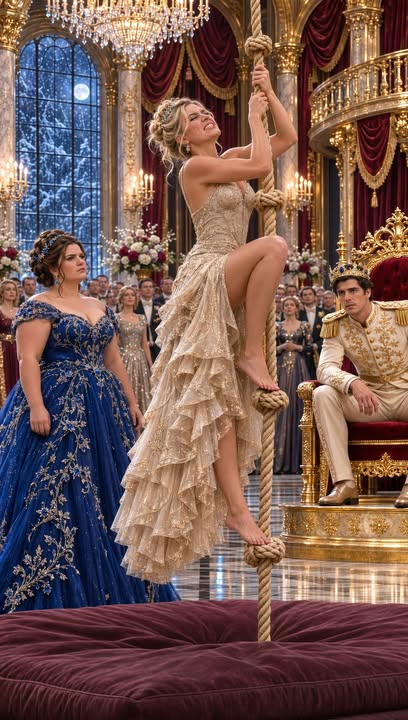
When the final bell sounded, my shoulders had begun to ache again, this time from holding myself carefully still rather than climbing.
I expected to find Mrs. Bell waiting near the doors.
Instead, Prince Adrian stood there with two attendants and a folder tucked beneath one arm.
He was speaking to the official who had timed the rope trial.
When he noticed me, the official finished his sentence and withdrew.
“Miss Williams,” Adrian said.
“Your Highness.”
“I wanted to ask how your hands are.”
I looked down at my palms.
The red marks were fading, though one still crossed the base of my thumb.
“Better than my shoulders.”
“Then the rope did its job.”
“I thought the point was to reach the platform.”
“That too.”
There was a brief, uncertain smile between us.
He glanced toward the ballroom, where the candidates were dispersing.
“May I walk with you?”
The question sounded ordinary, but I knew the room was watching.
I considered the people around us, the attendants who would repeat whatever they overheard, and the expectation that every conversation between us meant something.
“If you don’t mind that I’m going to the archives,” I said.
“I don’t.”
We walked through a corridor lined with tall windows.
The palace gardens showed through the glass in pale autumn colors, the last red leaves clinging to the trees.
Adrian kept an unhurried pace beside me.
“You seem to be having a more difficult week than the selection brochure promised,” he said.
“I didn’t read the brochure.”
“Then you missed the part where all the trials are described as ‘a gracious celebration of character.’”
“That sounds like something written by a person who has never had to climb a rope in front of a ballroom.”
He laughed, and the sound was quieter than I expected.
“I’ve never been asked to climb one.”
“I noticed.”
We passed a pair of guards who bowed to him and looked at me with polite curiosity.
Adrian waited until we were beyond them before speaking again.
“May I be honest with you?”
“I’d rather you were.”
“I dislike being treated as the prize at the end of these trials.”
I studied his face.
He did not seem embarrassed by the admission, only tired of carrying it.
“What would you rather be?”
“Someone a person can know before deciding whether she wants to stand beside him.”
The word someone landed between us with more weight than the rest.
“Then the selection is not a very good way to start.”
“No,” he said. “It isn’t.”
“Why keep it?”
“Tradition is good at surviving the people who no longer believe in it.”
He looked ahead as he spoke, as if the answer had been shaped through years of practice.
“My family thinks the ceremony makes the court feel open,” he continued. “The public gets to see the candidates. The candidates get a chance to be noticed. Everyone knows the rules.”
“Except the person expected to choose.”
He turned toward me.
“Especially the person expected to choose.”
I wasn’t sure whether he wanted me to understand him or simply needed someone to hear him.
“Do you want to choose a bride?” I asked.
“I want the chance to choose a partner.”
“That isn’t quite the same thing.”
“No,” he said. “It isn’t.”
We reached a narrow doorway, where the air smelled faintly of paper, polish, and old wood.
Mrs. Bell was waiting on the other side.
Her expression softened when she saw me, though her eyes lingered on Adrian.
“Your Highness.”
“Mrs. Bell.”
“I was about to take Miss Williams into the archive.”
“I’ll leave you to it,” Adrian said.
He looked at me once more.
“Perhaps we can speak again when there’s less of an audience.”
“Perhaps.”
He nodded, and I watched him walk back toward the corridor.
It occurred to me that I had spoken to him longer than I had spoken to any of the other candidates.
It also occurred to me that nothing about our conversation had felt like the beginning of a fairy tale.
That made it easier to trust.
Mrs. Bell led me into a small reading room, where a round table stood beneath a green-shaded lamp.
A box of archival materials rested on it, tied with a cotton ribbon.
“The records are incomplete,” she said. “I want to be clear about that before we begin.”
“Do you know why my name was beside Eleanor’s?”
“Not yet.”
“Do you know why the chair was there?”
“Only what I told you yesterday. The seating instruction came through the household office, and the staff were told to leave it empty until the ceremony began.”
“Then someone changed their mind.”
“That seems likely.”
She untied the ribbon and lifted the lid.
Inside lay a photograph, a folded program, and a paper envelope that had softened at the edges.
Mrs. Bell placed the photograph in front of me.
It showed a woman in a dark dress standing on the palace steps with one hand resting on the rail.
Her hair was pinned back from a kind face, and her posture was straight without being rigid.
Gold vines curved across the front of her dress.
I recognized the pattern immediately.
It was not identical to the embroidery on mine.
The leaves were smaller, the stems more closely spaced, and one branch turned at the collar in a way my mother’s design did not.
But the same pattern ran through both dresses, like a sentence written in different handwriting.
“That’s Eleanor?” I asked.
“Yes,” Mrs. Bell said. “The year was written on the back, but the ink has faded. We believe it was taken about thirty years ago.”
I leaned closer to the photograph.
“Was she a candidate?”
“No.”
The answer came quickly, and I looked up.
“Then why was she invited to the selection?”
“She wasn’t invited to this one.”
“Then why was her name on the chair?”
Mrs. Bell folded her hands on the table.
“That is one of the questions I hoped the archive might answer.”
The photograph showed Eleanor smiling at someone beyond the edge of the frame.
There was nothing mysterious in her expression.
She looked like a person who had just heard something kind.
“Who was she?” I asked.
“A royal adviser,” Mrs. Bell said. “She worked with the palace for many years, especially on community programs and charitable grants.”
“Was she important?”
“She was deeply trusted,” Mrs. Bell replied. “Those are not always the same thing.”
I thought of my mother’s voice on the phone, the way it had gone soft and guarded when I asked whether Eleanor had known her.
“Did Eleanor have children?”
Mrs. Bell looked down at the photograph.
“She had one daughter.”
My fingers tightened around the edge of the table.
“What was her name?”
Before Mrs. Bell could answer, the door opened behind us.
Vanessa stepped inside.
“I’m sorry to interrupt,” she said. “I was told Miss Williams might be here.”
Mrs. Bell’s expression sharpened, but Vanessa did not seem to notice.
“Can I speak with you?” she asked me.
“About what?”
Vanessa glanced at the photograph.
“About the palace knowing more about you than you do.”
Mrs. Bell covered the picture with a thin sheet of protective paper.
“This is an archive, Miss Whitmore.”
“I know.” Vanessa’s voice was quieter than it had been during the trial. “I’m not here to snoop.”
“What are you here to do?” I asked.
She looked directly at me.
“Tell you what I noticed.”
I glanced at Mrs. Bell.
She hesitated, then said, “I’ll give you a moment. Please don’t touch the documents.”
When the door closed behind her, Vanessa pulled out the chair across from me.
“I heard someone mention that the chair was meant for Eleanor,” she said. “Then I saw you asking Mrs. Bell about it this morning.”
“People talk.”
“They do. Especially when they think a story is forming.”
“What story?”
“I don’t know yet.” Vanessa’s gaze flicked to the covered photograph. “But your invitation was handled strangely, your gown carries a pattern that belongs to someone the palace remembers, and a chair with your surname was placed beside you.”
“Those things could be coincidences.”
“They could.”
She said it without the sharpness I had expected.
“Why are you telling me this?”
“Because I know what it feels like when everyone else is deciding what your story means.”
The words were so unexpected that I forgot to answer.
Vanessa sat back, smoothing one thumb over the edge of her sleeve.
“When I fell from the rope, people looked at me as though the whole of me had been measured by those few seconds,” she said. “I’ve spent most of my life making sure nobody sees me hesitate.”
“Is that why you laughed at me?”
“Yes.”
She did not dress the answer up.
“I saw you asking for your turn, and I thought if I made you look foolish, no one would think about me.”
“That worked for a little while.”
“I know.”
We sat in silence, the covered photograph between us.
Vanessa looked different without the ballroom’s bright lights on her, but not kinder exactly.
More human.
“My father told me this was an opportunity,” she said. “My friends told me it was a competition. The palace told us it was a chance to be seen.”
“And what do you think it is?”
“I think it’s a room full of people trying to decide who they can afford to become.”
“That sounds bleak.”
“It’s also the first honest thing I’ve thought since I got here.”
The door opened, and Mrs. Bell returned with the paper envelope.
She noticed Vanessa, but did not ask why she was still there.
“This was kept with Eleanor’s photograph,” she said. “The note is too fragile to unfold without support, but the writing on the outside is clear.”
I leaned forward.
The envelope was addressed in a narrow, slanted hand.
For the family who kept the child safe.
The room seemed to narrow around those words.
“Was there a letter inside?” I asked.
“There is a folded sheet,” Mrs. Bell said. “But I cannot confirm whether the envelope and the note belong together.”
“Can you read it?”
“Not without the proper backing and a conservator’s help.”
“How long would that take?”
“Several days, at least.”
Vanessa’s eyes moved from the envelope to me.
“Did Eleanor have a daughter?” she asked.
Mrs. Bell did not answer.
“That’s not information I can release based on a damaged envelope.”
“I’m not asking you to release anything,” Vanessa said. “I’m asking you to tell us what you know.”
“What I know is that some records are incomplete and some stories belong to living people.”
The reply should have sounded like a refusal.
Instead, it sounded like a warning to be patient.
I thought of my mother’s promise to explain everything after the selection.
“Does the note mention a baby?” I asked.
Mrs. Bell’s eyes lifted to mine.
It was only a fraction of a second, but it was enough.
“You’ve seen something,” she said.
“No,” I replied. “I’m asking.”
Mrs. Bell sat down.
“There is a phrase visible through the fold,” she said. “It may say, ‘the baby entrusted to family.’ I can’t be certain until the document is examined.”
My breath seemed to stop halfway in.
A baby entrusted to family.
I tried to set the words beside what I knew, but there was too much space between them.
Eleanor had a daughter.
The envelope had been addressed to the family who kept a child safe.
My mother knew of Eleanor.
The pattern on my gown had come from Eleanor’s dress.
None of that proved anything.
Still, for the first time, I wondered whether the silence in my house had begun before I was born.
Vanessa drew a careful breath.
“Have you called your mother?”
“Yes.”
“And?”
“She said she would explain after the selection.”
“Perhaps she’s trying to protect you,” Mrs. Bell said.
“From what?”
Neither woman answered.
I pushed my chair back.
“I need to speak with her again.”
Mrs. Bell nodded.
“You can use the small sitting room at the end of the corridor.”
Vanessa stood too.
“Would you like me to come with you?”
The question was awkward, and she looked as though she expected me to say no.
I almost did.
Then I remembered the way she had met my eyes when she admitted why she had laughed.
“Yes,” I said. “But you don’t have to fix anything.”
“I wouldn’t know how.”
The sitting room was empty except for a low sofa and a vase of white flowers.
I called home, and my mother answered before the first ring had finished.
“Mara?”
“Mom, I saw a photograph of Eleanor.”
There was a long silence.
“Where did you find it?”
“In the palace archive.”
“What did it show?”
“Her in a gown with the gold vine pattern.”
I heard my mother sit down.
“She was wearing the same design as mine,” I continued. “Not exactly the same. But it came from the same pattern.”
“I know.”
The words left her quietly.
I stood very still.
“You know?”
“Yes.”
“Then why didn’t you tell me?”
“Because I never thought you would be there.”
“Mom, I’m here now.”
“I know, sweetheart.”
“There was an envelope in the archive,” I said. “It said something about a family keeping a child safe.”
My mother did not speak.
“Was it about you?”
A faint sound came through the phone, like a breath caught behind a closed door.
“I told you I would explain after the selection.”
“You did.”
“Please, Mara.”
“Is Eleanor my family?”
Another silence.
This one was different.
It carried the weight of an answer being chosen and then put away.
“I can’t do this over the phone,” my mother said.
“Then tell me when I come home.”
“I will.”
“Did Eleanor know me?”
“I don’t know.”
The answer sounded true, and that frightened me more than a lie would have.
“Did you know her?”
My mother’s voice softened.
“I knew enough to remember her.”
“What does that mean?”
“It means I need you to hear the whole story before you decide what it means.”
“I’m not trying to decide anything.”
“You are,” she said gently. “You’re trying to make the pieces fit before you know where they came from.”
I closed my eyes.
“I don’t like being the only person in the room who doesn’t know what everyone else is talking about.”
“I’m sorry.”
“I need more than that.”
“I know.”
The line went quiet for a moment.
Then my mother said, “After the selection, I promise.”
I wanted to believe her.
I also wanted to demand that she tell me now.
Instead, I asked, “Why did you never say the palace had contacted you?”
My mother made a small sound of surprise.
“What?”
“The archive note mentions a baby. The chair was marked Eleanor Williams. Mrs. Bell said she had a daughter. You said you knew of Eleanor.”
“I didn’t say the palace contacted me.”
“You said you knew enough to remember her.”
“Mara, I can’t keep answering questions one at a time.”
“Then stop making me ask them.”
I heard her whisper my name, and the hurt in it almost made me take back my words.
But I couldn’t.
“I love you,” she said.
“I love you too.”
“I didn’t keep quiet because I was ashamed of you.”
“Then why?”
“I wanted you to have a life that belonged to you.”
The call ended before I could ask what she meant.
I held the phone in both hands.
Vanessa was standing near the window, looking out at the garden.
She had heard enough to understand that something had changed.
“I’m sorry,” she said.
“I don’t know what I’m supposed to think.”
“You don’t have to think anything yet.”
“That sounds like something the palace would say.”
She turned around.
“Then think this: you’re allowed to ask questions even if the answers make someone uncomfortable.”
I gave a tired laugh.
“You sound like you’ve been practicing.”
“I have a younger sister. It’s a useful skill.”
For the first time, her smile reached her eyes.
A quiet knock sounded at the door.
Mrs. Bell entered with another sheet of paper.
“I’m sorry to interrupt,” she said. “I thought you should see this.”
The sheet was not from the archive box.
It was a copy of an old palace program, the paper yellowed and the edges softened.
Mrs. Bell set it on the table.
Eleanor Williams’s name appeared near the top, followed by the words Special Adviser to the Household and Director of Community Grants.
Below that, in smaller print, was a handwritten note that had been added after the program was made.
Invited as an honored guest. Her chair is to remain open until the ceremony begins.
I read it twice.
“Does this explain why the chair was beside mine?”
“No,” Mrs. Bell said. “It explains why Eleanor’s name appeared on a chair at a palace ceremony. It doesn’t explain why that instruction was used for this selection.”
“Or why it was placed beside me,” Vanessa said.
Mrs. Bell’s gaze moved to the program.
“There may be a more recent seating list in the household files. I’ll look.”
“Who requested the invitation?” I asked.
“I don’t know yet.”
“Was it the prince?”
“No,” she said. “The prince was not involved in the arrangement.”
The answer left another question behind it.
Mrs. Bell gathered the papers, careful to keep the envelope flat.
“I’ll continue looking for the original note,” she said. “For now, I’d advise you not to draw conclusions from fragments.”
I glanced at the gold vines on my sleeve.
“I’m trying not to.”
Mrs. Bell gave me a look that seemed to understand how little control I had over that effort.
Vanessa accompanied me back to the corridor.
At the end of it, Adrian was waiting near a window.
He had clearly been there long enough to know we were coming, but he did not ask what we had found.
“May I walk with you again?” he said.
Vanessa raised one eyebrow.
“I can leave you both to it.”
“You don’t have to,” I told her.
“I think I do,” she replied. “I’ve just become the third person in a conversation that hasn’t started.”
She walked toward the ballroom before either of us could answer.
Adrian watched her go, then looked back at me.
“I heard you were in the archive.”
“Palace news travels quickly.”
“Only when people are worried.”
“Are you worried?”
“I don’t know yet.”
I studied his face.
“That’s the first answer anyone here has given me that sounds honest.”
“I’m glad.”
He waited, leaving enough silence for me to decide whether I wanted to tell him what the archive held.
I wasn’t ready to explain the envelope or the call with my mother.
“There was a photograph of Eleanor,” I said at last. “She worked at the palace.”
“I know.”
The ease of the answer unsettled me.
“You know?”
“I’ve seen the photograph before.”
“Why didn’t you tell me?”
“I didn’t realize you didn’t know who she was.”
“How would I have known?”
He looked down briefly.
“That was careless of me.”
The apology seemed genuine, though incomplete.
“Did your family know the empty chair was for her?”
“I was told there would be a place for a former adviser who had been invited posthumously.”
“Then you knew it was Eleanor.”
“I knew the name on the seating plan. I didn’t know it would be placed beside yours.”
“Who changed it?”
“I don’t know.”
He said it plainly, without reaching for a softer explanation.
“Why was she invited?”
“Her work was part of the selection’s history. She helped create the charitable program the finalists will visit tomorrow.”
“She died?”
“Several years ago.”
“Why invite her to the selection now?”
Adrian’s expression changed.
Not enough to reveal an answer, but enough to make me see that he had asked himself the same question.
“I was told the program was meant to honor her service.”
“By whom?”
“My mother’s office handled the guest list.”
“Did your mother know my name was on the chair beside hers?”
“I don’t believe so.”
“Do you believe she knew who I was?”
He held my gaze.
“I don’t know.”
It was the same answer my mother had given about whether Eleanor knew me.
A thread connected those uncertainties, though I could not yet see where it led.
“Did your family arrange my invitation?” I asked.
Adrian did not answer immediately.
“I believe the invitation came through the selection committee,” he said. “The finalists are chosen from a large pool.”
“That isn’t what I asked.”
“No,” he said. “It isn’t.”
He glanced down the corridor, where an attendant was passing with a stack of papers.
“I should find out.”
“I’d appreciate that.”
“I’m sorry the palace has made you feel as if you walked into a story everyone else had already read.”
“Did it?”
He looked at me, then toward the closed archive door.
“I don’t know,” he said.
I left him there with the unanswered question.
That evening, the finalists gathered in the west dining room for supper.
The tables were set in smaller groups, and the conversations felt less formal than they had the previous night.
Vanessa sat across from me.
She had returned to the careful posture of a young woman raised to be observed, but when our eyes met, she gave me a small nod.
I returned it.
Adrian was seated near the far end of the room, speaking to a candidate named Celia.
He glanced toward me once, and I looked away before anyone could decide the glance meant more than it did.
When supper ended, Mrs. Bell was waiting outside the dining room.
“I found the more recent seating record,” she said.
My stomach tightened.
“Was the chair assigned to Eleanor?”
“It was.”
“Beside mine?”
“No.”
She opened a folder and showed me a photocopy of the original plan.
Eleanor’s chair had been placed at the center of the first row, between two former advisers.
My seat had been farther down, beside Vanessa.
“Then someone moved it.”
“Yes.”
“Do you know who?”
“Not yet.”
I looked at the copy again.
A blue line had been drawn through the original arrangement, and a second place had been marked beside mine.
The handwriting was neat and unfamiliar.
At the bottom of the page, beneath the revised seating plan, someone had written a short instruction.
Keep Eleanor’s name beside Mara Williams.
I read it once.
Then again.
“Who wrote this?” I asked.
Mrs. Bell’s face had gone pale.
“That is what I’m trying to find out.”
I looked toward the dining room doors.
Across the corridor, Prince Adrian had stepped out and was speaking with one of the household officials.
He noticed me, then saw the paper in my hand.
For the first time since I had met him, he seemed genuinely uncertain.
And in the quiet between us, a question took shape that none of us had yet dared to ask aloud.
Who, in this palace, had known my name before I ever arrived?
**–END OF PART 3–CLICK “NEXT” AT THE BOTTOM OF THE PAGE TO CONTINUE READING**
* * *
[PREVIOUS: PART 2](https://echoesofstories.idolsgift.com/blog/part-2-the-name-on-the-empty-chair-046) | [NEXT: PART 4](https://echoesofstories.idolsgift.com/blog/part-4-the-name-on-the-empty-chair-046)
✓ Lynn R. Adams
Part 3 – The Photograph in the Archive The next trial began before I could ask Mrs. Bell what she meant. An attendant called the candidates to the ballroom, and she stepped aside to let us pass. “A…