PART 3: The Name I Remembered 035
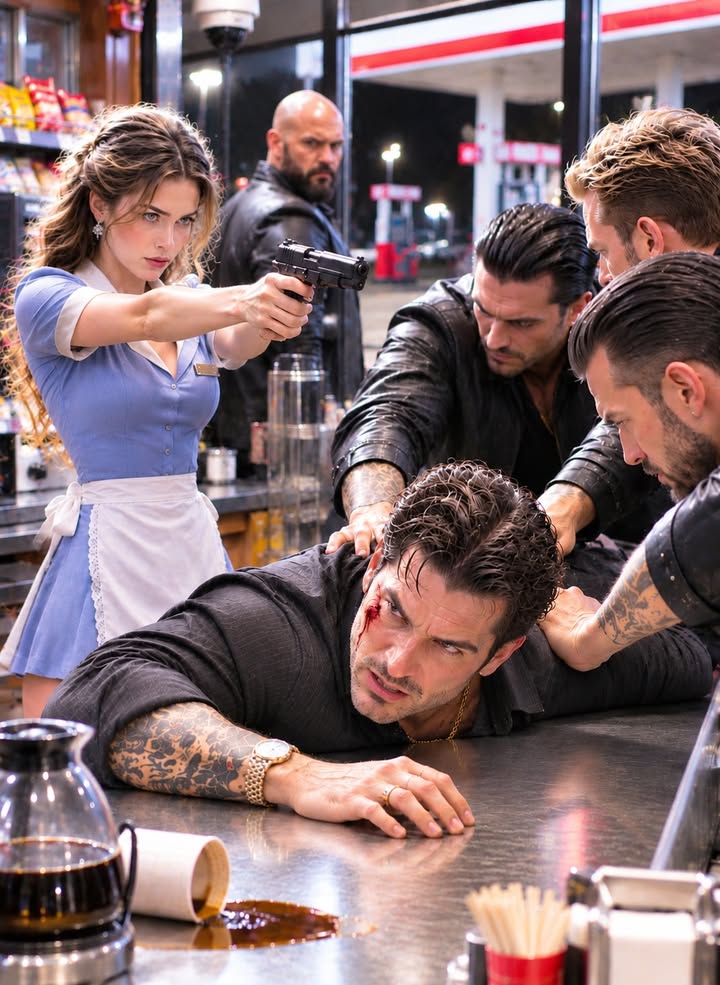
Part 3 – The Sheriff’s Mark
“Gemma?”
My manager’s voice came through the steel door, thin and uncertain.
I looked at the leader, still standing between me and the office.
“Please,” my manager called. “Are they still there?”
“They’re here,” I said.
A silence followed, and I heard the faint scrape of something against the other side of the door.
“Can you open it?”
The leader’s expression remained unreadable.
“You said you had a phone in there,” I told my manager.
“I do.”
“Then call for help.”
“I tried.”
The words landed with a dull weight.
I glanced at the office window, but the glass showed only darkness and the reflection of the fluorescent lights.
“Did anyone answer?” I asked.
“I don’t know. I couldn’t get through.”
The leader looked toward the front of the station, listening.
Carmine’s voice came from behind me, quiet enough that only those nearest could hear.
“Could be the line is busy.”
“Or he didn’t call,” I said.
My manager heard me.
“I did call.”
I wanted to believe him, but belief had become an expensive thing to give away.
“Then keep trying,” I said.
The leader moved one step toward the office.
I stayed where I was, my hands open and visible.
“Don’t make me choose between you and him,” he said.
It was not a shouted warning, but it held the same steady weight as the gun at his side.
“I’m not asking you to choose,” I replied. “I’m asking you to let him call for help.”
The leader studied me, then looked at Carmine.
“And what does he want?”
“An end to this without anyone else getting hurt,” Carmine said.
The leader gave a thin smile.
“That’s easy to say from where you’re standing.”
“It’s easy to say because it’s true.”
For a moment, neither man moved.
Then the leader took out Carmine’s phone and checked the screen again.
The message he had received remained hidden from us.
He slid the phone back into his pocket.
“Your manager can call,” he said. “But if he tries anything clever, we’ll know.”
I turned toward the office door.
“Open it.”
“Gemma, I can’t,” my manager said.
“Why not?”
“I’m locked in.”
“You locked yourself in.”
There was another pause.
“I thought they would leave if they couldn’t get to me.”
I stared at the steel door.
The plainness of the answer hurt more than an excuse would have.
“You thought they’d leave us here?”
“I thought—”
“You thought you’d be safe.”
“I’m sorry.”
The apology came too late to ease anything.
Behind me, one of the truckers shifted his weight.
The leader’s head turned at once.
The gray-bearded man raised his hands, palms open.
“I’m only trying to get comfortable,” he said.
“Stay where you are.”
The trucker settled back down.
I felt the room shrinking around all of us, not because the walls had moved, but because every person in it had chosen a different kind of fear.
My manager had locked himself behind a door.
The truckers were trying to keep their families in their minds, as if that could help them endure the next minute.
Carmine stood still, refusing to make a move that might put anyone else in danger.
And I was beginning to understand that staying calm did not mean I had to forgive anyone.
“Call again,” I told my manager.
I heard a button press through the door.
The men waited.
The rain continued to brush the windows, and somewhere beyond the station a truck passed along the highway with a long, distant rush.
“Nothing,” my manager said.
“Try the emergency number.”
“I did.”
“Then try again.”
He did not answer.
I looked at the dark office window.
“Can you see us through there?”
“No.”
“Why not?”
“The blinds are down.”
I glanced at the narrow slats, tightly closed on the other side.
A light flickered beneath the office door.
“I can’t see you either,” he added.
That was probably true.
It did not make me feel better.
The leader’s attention returned to Carmine.
“We have wasted enough time.”
“What do you want?” I asked.
He looked at me as if I had finally asked the right question.
“His phone and what he brought with him.”
“He already has the phone,” I said.
“I’m talking about the metal case.”
Carmine’s shoulders tightened.
It was slight, but I noticed.
So did the leader.
“Where is it?” the leader asked.
“I don’t know what you mean.”
The leader looked at Carmine’s coat.
“You came to meet someone who promised evidence, and you didn’t bring anything?”
“I was supposed to receive it.”
“Then why are you guarding the inside pocket?”
“I’m not.”
“Show us.”
Carmine’s expression remained composed, but his eyes moved briefly toward me.
That was enough to make me realize the coat was still lying open where the men had forced him against the counter.
The holster was visible beneath the fabric.
The area beside it was not.
“Don’t put your hand in there,” I said.
The leader turned his attention to me.
“I didn’t ask you.”
“You’ve already searched his coat once.”
“And I missed something.”
“Maybe there’s nothing to find.”
“Maybe.”
Carmine spoke before the leader could move closer.
“The case is small.”
The admission startled me.
The leader’s face did not change.
“Where?”
“Inside the lining.”
“Which side?”
Carmine said nothing.
The man holding him reached for his coat.
“Slowly,” Carmine said.
The gunman paused.
“Do it carefully,” I added.
The leader regarded me, then gave a short nod.
The searcher used two fingers to feel along the inner seam, keeping his movements cautious and deliberate.
His hand found a hard rectangular shape.
He looked toward the leader.
“Got it.”
“Take it out.”
Carmine’s jaw worked once.
The gunman loosened a hidden stitch near the inner pocket and drew out a metal case no larger than a cigarette tin.
It was dull silver, worn at the corners, and marked with a small emblem that seemed familiar.
My breath caught.
I knew that insignia.
I had seen it in my father’s study, on a keepsake he kept in the top drawer of his desk.
A simple shield with a star above a narrow river line.
The mark of the county sheriff’s office from before the department had changed its design.
I had seen it often enough as a child to remember tracing its outline with one finger while my father worked at the kitchen table.
The leader held the case beneath the overhead light.
“Where did you get this?”
“It belonged to a deputy,” Carmine said.
“Which deputy?”
“Daniel Voss.”
The name stirred no memory in me, but the metal insignia did.
“That was my father’s,” I said.
Carmine looked at me.
“Your father knew Voss?”
“I don’t know.”
“You recognize the mark?”
“I saw it on my father’s desk.”
The leader turned the case over.
A small catch held it shut, and a narrow strip of discolored tape crossed the seam.
It had been handled many times, or kept for years in a place where no one could see it.
My father’s desk had been a landscape of ordinary things: old pens, bills, a photograph of my mother, a stack of case folders he had never quite managed to throw away.
I had never searched its drawers.
I had never had a reason to.
“Why would you carry this?” I asked Carmine.
“I told you. It belonged to a deputy who vanished after the investigation into my brother.”
“You knew him?”
“I met him once.”
“When?”
“Before Rafael was charged.”
The leader’s eyes remained on the case.
“Why didn’t you say any of that before?”
“Because I didn’t know who had sent me the message, and I didn’t know whether the case was real.”
“You came here for evidence.”
“I came here hoping to receive it.”
“That’s not the same thing.”
“No,” Carmine said. “It isn’t.”
The leader turned the case in his hands.
“Is it locked?”
“I don’t know.”
“Then why haven’t you opened it?”
“Because the person who left it with me said not to.”
The leader gave a brief, disbelieving laugh.
“You follow instructions now?”
“I’m trying not to destroy the only thing that might explain what happened.”
The words were measured, but the last few carried an ache he did not quite conceal.
I looked again at the insignia.
My father had kept one of those on his desk.
Not a replica from a store, but the same worn mark, fixed to a small wooden stand beside his lamp.
I remembered asking him about it once.
He had said it belonged to someone who taught him that doing the right thing could take longer than doing the easy thing.
I had been a child and had accepted that as a complete answer.
Now I wished I had asked who.
“Daniel Voss,” I repeated. “Was he a sheriff’s deputy?”
“He was a deputy,” Carmine said. “He disappeared before Rafael’s case went to trial.”
“Did my father investigate?”
“I don’t know.”
“You were there.”
“I wasn’t part of the department.”
The leader watched our exchange with growing impatience.
“Enough,” he said. “Open it.”
Carmine looked at the case.
“I don’t have the key.”
“Use the catch.”
“It may be sealed.”
The leader pressed his thumb against the latch.
The case did not open.
He tried the other side.
Nothing.
“Is there a trick?” he asked.
“Not that I know of.”
The gray-bearded trucker spoke from the floor.
“Could be a clasp that slides.”
Every man looked at him.
The trucker swallowed.
“I used to repair toolboxes,” he explained. “Some old ones had a little catch under the lip.”
The leader lowered his eyes to the case and examined its edge.
The trucker had given him nothing he could not have discovered himself, but the brief exchange seemed to remind everyone in the room that the men on the floor were people, not props.
“Don’t touch it,” the leader said.
“I wasn’t going to.”
The leader found a narrow indentation and pressed it with his thumb.
The catch shifted but did not release.
He tried again, pressing on the opposite side.
The case opened with a soft metallic click.
Inside lay a folded piece of paper and a small photograph.
The leader lifted neither.
He looked down at the contents.
The photograph showed two men standing near the entrance of a brick building, their faces slightly washed out by age and sunlight.
One was younger than I remembered my father being in most of my childhood photographs, with dark hair and an expression that looked almost startled by the camera.
The other man was older, broad-shouldered, wearing a sheriff’s uniform.
I leaned toward the picture.
The older man was my father.
My hand went to the edge of the counter.
The room seemed to pull away from me.
“Is that him?” Carmine asked.
I nodded, but I could not yet make myself speak.
The leader set the photograph on the counter.
My father stood beside a man I did not recognize, their shoulders almost touching.
The man’s uniform bore the same old sheriff’s insignia as the case.
A date had been written on the back in faded ink.
I turned the photograph over.
The handwriting was my father’s.
I knew the slight slant of the letters, the way he crossed his sevens, the way the last stroke of his name dipped beneath the line.
The date was eleven years earlier.
My father had been sheriff then.
Beneath the date, he had written four words.
“Daniel Voss. Before he vanished.”
I read them twice.
The second time, the words did not become less strange.
“Your father wrote that?” Carmine asked.
“Yes.”
“Did he tell you he knew Voss?”
“No.”
“Did he tell you anything about this case?”
I looked at the photograph.
“No.”
It was the truth, though not the whole truth.
My father had mentioned the old investigation once or twice, but never with details.
He had told me there were cases that stayed unfinished even after the paperwork said they were closed.
I had thought he meant the ordinary ones: missing persons, unsolved thefts, families who never got a clear answer.
I had never thought he was speaking about Carmine’s brother.
The leader picked up the folded note.
Carmine’s voice sharpened.
“Don’t open it.”
The leader held the note between two fingers.
“Why not?”
“It’s addressed.”
“To whom?”
“I don’t know.”
The leader glanced at the paper.
A name was written across the outside.
The ink was faint, but visible.
Sheriff Boon.
My throat tightened.
“My father.”
The leader looked at me, then at the note.
Carmine stared at the name.
“Your father left this with Voss?”
“I don’t know,” I said again.
The words were beginning to feel useless.
The leader turned the note over.
The seal was intact, though the edges had softened with age.
“Should we open it?” I asked.
Carmine shook his head.
“Not without knowing who it was meant for.”
“It says Sheriff Boon.”
“That doesn’t make it yours.”
The answer surprised me.
The leader gave him a look.
“You came here expecting evidence. Now you’re telling us not to read it?”
“I’m telling you not to tear it open without thinking.”
“Why?”
“Because if it was sealed for a reason, breaking it may make it harder to know when or by whom it was opened.”
The gray-bearded trucker raised his head slightly.
“He’s got a point.”
The leader ignored him.
I studied the envelope.
The paper was old but not brittle.
My father’s name was written carefully, each letter deliberate.
I wondered whether he had ever seen the note.
Whether he had written it.
Whether someone had written it for him.
Whether he had kept the case at home, placed it on his desk, and then chosen not to tell me.
“What does the deputy have to do with Rafael?” I asked.
Carmine looked down at the photograph.
“He was one of the first people to question the account of what happened.”
“Whose account?”
“The report said my brother had arranged a meeting with men from another crew. It said the exchange turned violent, and that Rafael had been working with them.”
“Was he?”
“No.”
The certainty in Carmine’s voice was immediate.
“People can be certain about the people they love and still be wrong,” I said.
“I know.”
“Then what makes you sure?”
He took a measured breath.
“Because I knew what he had been trying to do before he died.”
“Which was?”
“To leave.”
The answer left me unsettled.
I had expected him to deny the accusations or claim his brother had been innocent without explanation.
Instead, he spoke about a choice Rafael had made that Carmine had not been able to stop.
“He wanted out,” I said.
“He wanted a different life.”
“Did he have one?”
“Not yet.”
The case sat open between us.
The photograph showed my father beside the missing deputy.
The note carried my father’s name.
Carmine’s story had moved from the newspaper pages into the one place I had never expected to find it: the private corners of my family.
I wanted to believe there was a simple explanation.
A reason the photograph had been kept.
A reason my father had never mentioned the deputy.
A reason he had not told me that the case involving Carmine’s brother had followed him home.
But each possible explanation opened another question.
The leader’s phone buzzed again.
He pulled it out and glanced at the screen.
This time, he did not look surprised.
His eyes moved from the message to the opened case, then to me.
“What did it say?” Carmine asked.
“Nothing that concerns you.”
“You’re here because of what’s in that case.”
“I’m here because I was told to retrieve it.”
“By whom?”
The leader did not answer.
The phone buzzed again.
He looked down.
For a moment, he seemed caught between two instructions, one spoken and one arriving through the screen.
I recognized that hesitation because I had felt it myself all night.
What did a person owe the truth when the truth could put everyone in danger?
What did a person owe a stranger when that stranger had once frightened half a city?
And what did I owe my father, when I had no idea what he had carried in silence?
“Call whoever sent you,” I said.
The leader raised his gaze.
“You think I’m taking orders from someone?”
“Your phone has been buzzing all night, and you keep checking it.”
“That doesn’t mean anything.”
“It means somebody knows what you’re doing.”
He looked at Carmine.
“Maybe they just want the case.”
“Then let’s hear it from them,” I said.
The leader’s attention stayed on me.
“You’ve got a lot to say for someone who was asking us to let her manager make a phone call.”
“I still want him to call.”
From behind the steel door came a sudden click, followed by the low sound of a lock turning.
I looked toward the office.
The leader turned sharply.
Carmine’s posture changed, alert but restrained.
The door opened a few inches.
My manager’s face appeared in the narrow gap.
He looked pale, his eyes moving from the leader to the open case on the counter.
“I’m sorry,” he said.
“Not now,” I told him.
“I couldn’t get through on the store line. I used my own phone.”
“Did you reach someone?”
He glanced at the leader.
“I called emergency services.”
The leader took one step toward him.
My manager started to retreat behind the door.
“Wait,” I said.
The leader stopped.
The manager’s face was flushed with shame.
“I should have done it earlier,” he said.
“Yes,” I replied.
“I know.”
“Then stay there and keep the door open.”
He hesitated.
“Gemma—”
“Please.”
The manager left the door ajar.
His gaze returned to the case.
“I’ve seen that symbol before,” he said.
I turned toward him.
“Where?”
“On your father’s old pin.”
The words struck harder than they should have.
“You saw my father’s pin?”
“He came in here once, years ago. I was working an evening shift. He had a small metal badge with that same shield. He said it belonged to a deputy who helped him on a case.”
“Did he say the deputy’s name?”
My manager’s brow creased.
“I don’t remember.”
“You remember the pin?”
“I remember the conversation because he was here a long time. He sat at the table near the window and waited for you to finish your shift.”
I pictured my father waiting in the station, his coat folded over his arm, his hands wrapped around a paper cup.
I had no memory of that evening.
“Was I working?” I asked.
“Your first year here, I think.”
I tried to place it.
A cold night.
A late bus.
My father offering to drive me home.
The ordinary details returned without the moment itself.
“He told you it belonged to a deputy?” I asked.
“Something like that. He said the man had been a good officer.”
The leader closed the metal case.
The latch clicked into place.
“Enough,” he said. “We’re leaving.”
“No one is leaving with that,” I replied.
His eyes narrowed.
“You don’t decide that.”
“I know.”
My voice shook, but I kept it steady enough to continue.
“That note is addressed to my father, and the photograph is his. Whatever this is, you can’t just walk out with it.”
“I can take the case.”
“Then the truth will disappear again.”
“You don’t know what the truth is.”
“Neither do you.”
The leader looked to Carmine, as though waiting for him to challenge me.
Carmine did not.
“My brother’s name is in this,” he said. “That matters to me.”
“And my father’s name is on the note,” I replied. “That matters to me too.”
“Then we have the same problem,” Carmine said.
“We don’t have the same stake.”
“No,” he said. “We don’t.”
The admission was quiet, but it made me trust him a fraction more than a denial would have.
I still did not trust him.
A fraction was not enough to make a decision for me.
The gray-bearded trucker lifted his head.
“Listen,” he said. “If somebody called for help, there’s no reason to make this worse by walking out with anything.”
The leader looked at him.
The trucker remained on the floor, hands in view.
“I’m not telling you what to do,” he said. “I’m saying everyone in here has enough trouble already.”
The leader’s expression had lost its earlier amusement.
The taller trucker spoke from beside him.
“My daughters are waiting for me back in Ohio. I would like to get home.”
The leader did not reply.
The man looked at me instead.
“You said we’d get through the next few minutes.”
“I said I hoped we would.”
He gave a tired nod.
“Still appreciate it.”
Something in my chest tightened.
The station’s alarm panel was behind the register, near the small shelf where the store phone sat.
I had seen the red emergency button dozens of times without thinking about it.
It was meant to alert the monitoring service if someone tried to force their way into the building.
The panel also had a separate silent alarm, installed after a robbery years ago.
My hands were close enough to reach it.
But the leader was watching me.
The truckers could not move.
The manager stood behind the open office door, ashamed and frightened.
Carmine was looking at the case.
I had no clear plan, only the knowledge that the next choice belonged to me.
The leader lifted the case.
I stepped forward.
“Don’t.”
He paused.
I could hear the rain, the refrigerator, and the faint hiss of the coffee machine beginning another cycle.
“Gemma,” Carmine said.
I looked at him.
“Let him take it,” he said.
“You told me it might clear your brother.”
“It might.”
“Then why?”
“Because I don’t know what he’ll do with it.”
The leader’s eyes flicked between us.
“You’re both making this more complicated than it needs to be.”
“It already is,” I said.
I reached for the emergency panel.
The leader did not grab me.
He did not have to.
His gaze held mine, warning me that he understood what I was doing.
I placed my fingertips against the panel’s cover.
Then the lights above us flickered.
The station went dark for half a second.
When they returned, the lock on the metal case had shifted open.
The note had slipped free of its fold.
A strip of writing showed through the paper, visible in the bright fluorescent light.
My father’s handwriting was on it.
Carmine leaned closer, but the leader held the case away.
I could read only a few words.
“If I am unable to finish this…”
My mouth went dry.
The note slid farther open, revealing the line beneath.
“Rafael was framed by someone inside the department.”
For a heartbeat, nobody spoke.
Then Carmine looked at me, and in his face I saw the question I had been trying not to ask since I recognized the insignia.
What else had my father known?
**–END OF PART 3–CLICK “NEXT” AT THE BOTTOM OF THE PAGE TO CONTINUE READING**
* * *
[PREVIOUS: PART 2](https://puretales.idolsgift.com/blog/part-2-the-name-i-remembered-035) | [NEXT: PART 4](https://puretales.idolsgift.com/blog/part-4-the-name-i-remembered-035)
✓ Lynn R. Adams
Part 3 – The Sheriff’s Mark “Gemma?” My manager’s voice came through the steel door, thin and uncertain. I looked at the leader, still standing between me and the office. “Please,” my manager call…