PART 3: The Message She Carried 052
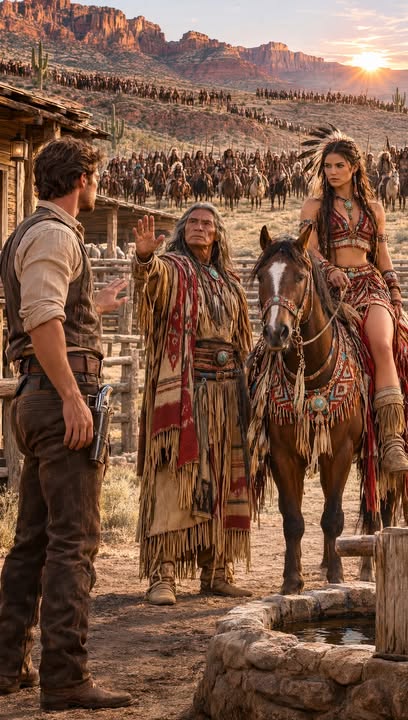
Part 3 – The Token in the Dust
The name of the old token seemed to hang between them longer than the words themselves.
Corvin looked toward the house, where the ledger lay beside the window, and felt the morning’s heat pressing against the back of his neck.
“What did your scout find?” he asked.
“A paper near the crossing,” Nantan said. “And a token like the one you keep.”
“I haven’t kept it with me.”
“Then where is it?”
“In a box inside.”
Her gaze rested on him, not accusing, but searching.
Corvin had learned to recognize the difference, and it unsettled him that he cared which one she chose.
“It was issued to a patrol I guided years ago,” he said. “I kept it because I was told to.”
“Who told you?”
“The officer in charge.”
“And what did the patrol do?”
Corvin looked toward the western ridges.
“I’ll explain when I understand what Voss is doing with my name.”
Nantan’s expression tightened.
“You have asked me to trust your silence twice now.”
“I’m not asking you to trust it.”
“Then what are you asking?”
“Time.”
She looked away first, though her face gave him no comfort.
Taza had been listening from beside the well.
“We should not leave a question unattended when it may lead danger to the people we are protecting,” he said.
“I agree,” Corvin replied.
“Then show us the token.”
Corvin hesitated only long enough to feel the hesitation become its own answer.
“All right.”
He led them inside.
The room was spare, with a table, a cookstove, a narrow bed, and shelves crowded with tools he had repaired rather than replaced.
Sunlight fell in a bright rectangle across the floorboards.
Corvin crossed to a small wooden chest beneath the bed and pulled it out.
He had not opened it in years.
The brass latch resisted him, then gave with a dry click.
Inside lay a folded map, two letters tied with twine, a tarnished pocket watch, and a small oval of darkened metal.
Corvin lifted the token.
Its edge had been scorched, leaving one side rough and black.
He held it out to Taza.
The old warrior examined it without taking it from his hand.
Nantan stepped closer.
“You carried this during the raid?” she asked.
“I carried it while guiding the patrol.”
“Which raid?”
Corvin looked down at the blackened metal.
“The one near the eastern ridge. Years ago.”
A shadow crossed Nantan’s face.
Her hands remained still at her sides, but Corvin saw the small change in her posture, the way she drew her shoulders inward as though bracing against a remembered wind.
“My family lost people in that raid,” she said.
Corvin’s grip tightened around the token.
“I’m sorry.”
“You don’t know yet what you are sorry for.”
The truth of it struck harder than anger would have.
Taza accepted the token at last, turning it carefully in the light.
There were faint stamped marks on its face, almost erased by heat and time.
“This belongs to a patrol,” he said.
“Yes.”
“Was it yours?”
“No. It was issued to the patrol’s guide as proof he had permission to travel with them.”
“Then why keep it?”
“The officer said I might need it to pass their checkpoints on the return journey.”
Nantan’s eyes moved to the letters in the chest.
“And did you return with them?”
“No.”
The word came out too quickly.
For a moment, the room seemed to lose its air.
Corvin set the lid of the chest down, though the token remained in Taza’s hand.
“I led families away from the eastern ridge,” he said. “There was confusion in the night, and the patrol took a different route.”
“Did you know they would reach the settlement?” Nantan asked.
“I was told the route was clear.”
“By whom?”
Corvin’s gaze dropped to the table.
“Captain Mercer.”
“Was Voss there?”
“He was nearby. He wasn’t part of the patrol.”
“But he knew you.”
“Yes.”
Nantan’s eyes held his.
“What did he want from you?”
“Information about the trails. He said he was trying to prevent a conflict over land.”
“And you believed him?”
“I believed the officer who hired me.”
“That is not what I asked.”
Corvin could not look away from her.
“I believed Voss wanted the same thing I did.”
“And now?”
“Now I don’t know what he wanted.”
The old warrior handed the token back.
Corvin placed it on the table beside the open chest.
The metal made a small, dull sound.
Outside, a horse stamped near the fence.
The ordinary noise seemed almost indecent beside the weight of the conversation.
Nantan stepped away from the table.
“I need to speak with my people.”
“I understand.”
“No,” she said, with no sharpness in her voice. “You do not.”
She went out before he could answer.
Taza remained in the doorway.
“Some stories take years to speak,” he said.
“Some take longer to believe.”
“Then what will you do?”
“Help you protect the people by the river.”
“And after?”
Corvin glanced toward the token.
“After depends on what the truth is.”
Taza followed his gaze.
“Truth is not always a single road.”
“No,” Corvin said. “Sometimes it is a trail with tracks laid over each other.”
The old warrior gave a slight nod and stepped outside.
Corvin remained in the house, staring at the token.
He had imagined that seeing it again might loosen something inside him, some knot he had tied so long ago that he had forgotten the shape of the rope.
Instead, it seemed to draw the past closer.
He could still remember the night of the raid: the cold air, the frantic calls, the uncertain light of lanterns moving through the scrub.
He remembered walking a group of frightened families west, promising them the patrol would pass beyond the ridge.
He remembered Voss beside a map, tracing a route with one gloved finger.
He remembered the officer’s order to lead the families away from the settlement before the patrol went through.
Most of all, he remembered the smoke rising behind him when he reached the dry wash.
He had not seen the attack.
He had not heard who ordered it.
He had returned after dawn and found only ruins, and the blackened token in the dust.
Corvin had told himself the metal had been left behind by a patrolman.
He had not asked why it was scorched.
A rider called from outside.
“Corvin!”
He put the token into his pocket and went to the door.
The scout from the crossing had returned, his horse dark with sweat beneath the saddle.
Taza spoke with him first, then translated for Corvin.
“Voss’s group has stopped near the western creek,” Taza said. “They are sending riders ahead to examine the valley.”
“How many?” Corvin asked.
“Six seen clearly. More may be behind them.”
“Are the families warned?”
“Two riders have reached them. The others are on their way.”
Nantan was standing beside her horse at the far end of the yard, listening to a young woman from the party.
When their conversation ended, she came toward Corvin.
“We will leave a small group here,” she said. “The others will watch the approaches and help the households move what they can.”
“Who stays?”
“I will.”
The answer was immediate.
Corvin glanced at the bandage visible beneath the edge of her sleeve.
“You should go with the people who have a healer.”
“I am the healer.”
“Someone else can tend to you.”
“Someone else will.”
“That isn’t the same as resting.”
“I did not come here to rest.”
He knew better than to argue with that tone.
Instead, he said, “I’ll show the scouts the dry wash.”
“Then I’ll show them the northern cut.”
“You’re not riding far.”
“I said I would stay near the ranch.”
“You also said you would go only as far as the first ridge.”
“I kept my word.”
“Barely.”
“Barely is still kept.”
Against his will, Corvin felt the corner of his mouth lift.
It faded when he noticed her watching him with the same measured attention she had given the token.
“Do you think I was part of the raid?” he asked.
Nantan did not answer at once.
“I think you were part of something you have not fully explained.”
“That isn’t the same thing.”
“No,” she said. “It is worse in some ways.”
He looked toward the ridge.
The answer had no cruelty in it, but it carried a weight he could not brush aside.
They rode out with four scouts and followed the ranch’s western fence to the dry wash.
Corvin pointed out where the sandy banks would hold a wagon and where the ground narrowed into rock.
He showed them the high path that ran behind the cottonwoods and the shallow ford where a horse could cross without making much noise.
Nantan remained close enough to hear but not close enough to lean on him.
The distance was small.
It still felt deliberate.
By late afternoon, the scouts had chosen two places from which they could watch the western approach without being seen.
Nantan’s people moved with quiet purpose, setting no traps and making no effort to provoke the intruders.
Their plan was to warn, watch, and keep the families beyond the river’s bend from being surprised.
Corvin respected the care in it.
He also understood how easily a single mistake could turn a guarded meeting into a fight.
When they returned to the ranch, the sun had begun its descent toward the western hills.
Taza was waiting by the well with a folded blanket over one arm.
“Your side needs another dressing,” he said to Nantan.
She frowned.
“I have already tended it.”
“You have tied a cloth over it,” he replied. “That is not the same.”
A healer from the party came forward, carrying a small leather case.
Nantan looked at Corvin.
“You may go inside,” she said.
“I can make myself scarce.”
“That would be helpful.”
He took the hint and stepped onto the porch.
From there, he watched the sky turn the color of old copper.
A few minutes later, the healer finished and packed her supplies.
Nantan remained seated on a low stool beside the well, her wounded side protected by a fresh bandage.
Corvin brought her a cup of water.
She accepted it without comment, then drank.
“Better?” he asked.
“Some.”
“You could have told me the old cut was serious.”
“You could have told me the patrol was part of your story.”
Corvin sat on the porch step.
“That’s fair.”
She studied the cup in her hands.
“Who else was with the patrol?”
“Captain Mercer. Voss was nearby. There were twelve soldiers.”
“And the families you led away?”
“Seven people. An older couple, two women, and three children.”
“Did they survive?”
“As far as I know.”
The cup lowered slightly.
“Did one of the children have a scar on her left hand?”
Corvin stared at her.
“I don’t know.”
“She would have been small. About five years old.”
He tried to summon a clear memory of the night.
One child had carried a rag doll.
Another had been wrapped in a blue blanket.
He remembered the older woman holding a little girl close as they moved west through the scrub.
“I don’t remember a scar,” he said.
Nantan looked past him toward the fading light.
“My aunt had a daughter who was about that age.”
The space between them seemed to shift.
Corvin stood slowly.
“Was she in the settlement?”
“Yes.”
“Did she survive?”
“We believed she did not.”
Nantan’s voice was careful, but the grief beneath it was not.
“After the raid, our people searched the homes and the surrounding ground. We found those who had been killed, and we found others who had escaped into the hills. My cousin was missing.”
Corvin’s mouth felt dry again.
“What was her name?”
“Luta.”
He repeated it softly, trying the name against the fragments of memory he had carried for years.
“I’m sorry.”
Nantan’s eyes turned toward him.
“You keep saying that before you know what happened.”
“Because I know something happened.”
“Not enough.”
“No,” he said. “Not enough.”
The two of them watched a pair of horses nose along the corral fence.
Corvin wanted to ask whether Luta had truly died, whether anyone had seen her after the raid, whether Nantan believed he had led her away or abandoned her.
But he understood that she could not answer questions whose answers she did not have.
“I was told every person we led out was counted,” he said. “The older couple knew the families. I trusted them to take the children farther west.”
“Did you see them again?”
“No.”
“Did you try?”
The question did not accuse him.
That made it harder.
“I went back to the ridge at dawn,” he said. “The settlement was gone. Captain Mercer ordered me to leave before the patrol returned.”
“And you left.”
“I thought more soldiers would come.”
“You thought about what might happen to you.”
“I thought the families I had led away needed someone to keep them moving.”
“Did they?”
“I don’t know.”
Nantan looked down at her cup.
“That is the trouble with the past,” she said. “It keeps the questions and loses the people who could answer them.”
Corvin sat again.
“I should have looked for Luta.”
“You did not know her name.”
“I knew there were children.”
“You were one man in the dark.”
“I was still one man.”
She did not tell him he was right.
She did not tell him he was wrong.
The space she left for his own judgment felt more difficult than either answer.
A quiet voice called from near the gate.
An Apache scout had returned from the creek, carrying something wrapped in a strip of cloth.
He spoke to Taza, who listened with his hands resting on his belt.
Then Taza came toward Corvin and Nantan.
“The scout found this near the place Voss’s men stopped,” he said. “It was caught beneath a wheel rut.”
He unfolded the cloth.
Inside lay a small brass disc, blackened at one edge.
Corvin recognized the stamp before he recognized the shape.
The same military mark that appeared on the token in his chest.
Nantan looked from the disc to Corvin.
“Was this also issued to your patrol?”
“I don’t know.”
“You recognize the mark.”
“Yes.”
“Where have you seen it?”
“On the token I showed you.”
Taza turned the disc over.
A few letters had been scratched into its reverse.
Corvin leaned closer.
The writing was faint but still legible.
His name.
Not merely the initials he used on his ranch ledger, but the full name, stamped carefully into the brass.
Corvin Torne.
Nantan stood.
“Why would Voss have something belonging to you?”
“I don’t know.”
“Why would he bring it to the valley?”
“I don’t know.”
The answers sounded thinner each time he gave them.
Taza handed the disc to Corvin.
It was warm from the scout’s palm, and heavier than it looked.
Corvin turned it over and found a line of small marks along the rim, nearly hidden beneath the soot.
He rubbed them with his thumb.
The first was a number.
The second was a date.
He knew the date.
It was the day the patrol had ridden toward the eastern ridge.
His fingers went still.
Nantan watched him.
“What does it mean?”
Corvin could not answer.
The date was the same one he had written beside the route entry in his old ledger.
The entry he had never shown anyone.
And below it, where the brass had been scorched nearly smooth, someone had added two words in a narrow hand.
**Route corrected.**
Corvin looked up at Nantan.
“I didn’t write this,” he said.
“Then who did?”
“I don’t know.”
Taza’s gaze moved toward the western ridge, where the last light was slipping away.
Corvin held the brass disc between his fingers, feeling the old date press into his palm.
Then Nantan asked the question neither of them had wanted to ask aloud.
“If your route was corrected, Corvin, who changed it before the raid?”
**–END OF PART 3–CLICK “NEXT” AT THE BOTTOM OF THE PAGE TO CONTINUE READING**
* * *
[PREVIOUS: PART 2](https://storyly.idolsgift.com/blog/part-2-the-message-she-carried-052) | [NEXT: PART 4](https://storyly.idolsgift.com/blog/part-4-the-message-she-carried-052)
✓ Lynn R. Adams
Part 3 – The Token in the Dust The name of the old token seemed to hang between them longer than the words themselves. Corvin looked toward the house, where the ledger lay beside the window, and fel…