PART 3: The Message Hidden in the Hem 069
Part 3 – The Ledger of Absence
Alexander looked down at the delicate paper, then at the handkerchief his wife had entrusted to a young maid.
For the first time since Eleanor’s death, he wondered whether the silence surrounding her final days had been chosen by her—or imposed by someone else.
And when he raised his eyes to Sophia, he saw that she was wondering the same thing.
“Would you remain near Lily for a while?” he asked.
The request emerged before he had decided whether it was wise.
Sophia looked from him to the Queen, still holding the handkerchief with careful fingers.
“If you believe it would help her, Your Highness.”
“I do,” Alexander said, though he could not yet explain why.
His mother watched him closely.
“Then let it be for Lily,” she said. “Not because the court expects a story from us.”
Alexander understood the warning beneath her words.
The princesses had been sent away, but the palace would already be turning the afternoon into rumor.
He looked at Sophia.
“You will not be asked to answer questions from anyone else, and you will not be made part of any public decision about my future.”
A flicker of relief crossed her face.
“Thank you.”
“And I will not ask you to tell me anything Eleanor did not want shared,” he continued. “But we need to understand why she gave you that message, and why you were removed from the nursery.”
Sophia’s gaze fell to the handkerchief.
“I can try to help.”
Lily, drowsy in her arms, pressed her cheek against Sophia’s shoulder.
The sight made Alexander’s chest ache with gratitude and unease in equal measure.
He could not pretend the child’s trust meant Sophia was blameless in every matter.
Nor could he pretend the tenderness between them was something he had imagined.
The Queen folded Eleanor’s note and placed it in a small envelope.
“We should have it examined and preserved,” she said. “No one is to handle it without my permission.”
“Your Majesty,” Sophia began, “please don’t let this become a spectacle.”
“It will not,” the Queen replied. “At least not because of me.”
Alexander glanced at her, hearing the regret in her voice.
The Queen had spent much of her life believing that order was a form of protection.
Now she seemed to be questioning what that order had cost.
A palace attendant appeared at the ballroom door, looking uncertain.
“Your Highness, the guests are asking whether the presentation will resume.”
“There will be no presentation,” Alexander said.
The attendant bowed and withdrew.
His decision settled the matter for the room, but not for the palace.
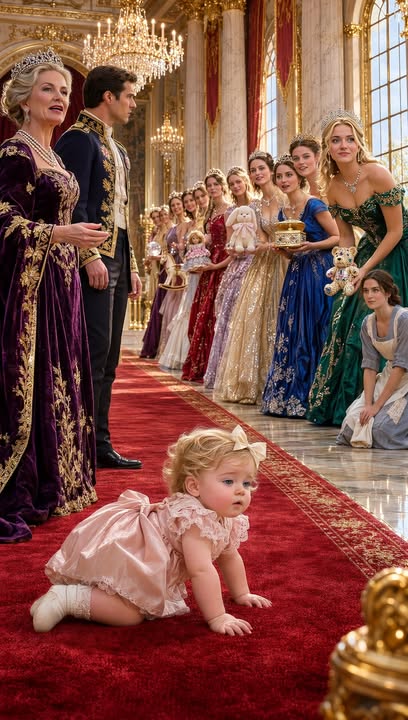
By supper, every servant would know that the prince’s daughter had crawled past twelve princesses and reached for a maid.
By morning, people would have invented reasons.
Alexander feared most of all the stories that would turn Sophia into either a schemer or a miracle.
She was neither.
She was a person who had once been trusted by his wife and had come back to the palace because her mother needed care.
“Let us take Lily to the nursery,” he said. “We can speak privately there.”
Sophia nodded, but she did not move until the Queen had returned the handkerchief to her.
Then she tucked it inside the pocket of her apron, where the ivory cloth disappeared from view.
The walk to the nursery passed through quieter corridors, but even there, servants lowered their voices as the small group went by.
Alexander noticed every glance.
He had spent his life learning how to ignore the palace’s curiosity.
Today, he could not ignore it because Lily was in Sophia’s arms, and the curiosity was settling on the woman holding his child.
At the nursery door, the head attendant, Mrs. Bell, rose from her desk.
She had served the royal family for many years and wore her silver hair pinned beneath a neat cap.
Her expression was warm when she saw Lily, then uncertain when she noticed Sophia.
“I thought you were assigned to the west gallery today,” she said.
“I was,” Sophia replied. “His Highness asked me to remain with the princess.”
Mrs. Bell’s eyes shifted to Alexander.
“Of course, Your Highness.”
“Mrs. Bell,” he said, “did you know Sophia worked in Lily’s nursery after Eleanor gave birth?”
“I knew she was assigned here for a time.”
“For how long?”
Mrs. Bell considered the question.
“Several weeks, perhaps. The household was busy, and there were changes to the staff.”
Sophia held Lily more securely.
“Do you remember why I left?”
Mrs. Bell’s face tightened with the effort of searching old memories.
“I remember being told you had been dismissed from the nursery.”
“I was told my services were no longer needed,” Sophia said.
“That is not quite the same thing,” the Queen observed.
Mrs. Bell’s eyes lowered.
“No, Your Majesty.”
Alexander felt his attention sharpen.
“Was there a complaint?”
“I don’t remember one,” Mrs. Bell said. “It was a long time ago.”
“You keep the nursery records,” he said.
“I oversee them now. The older ledgers are stored in the archive.”
“Then I would like to see them.”
Mrs. Bell glanced at the Queen.
“Certainly, Your Highness.”
The Queen’s voice softened.
“Do not feel you must find a particular answer, Mrs. Bell. We are trying to understand what happened, not assign blame before we know.”
The attendant bowed, but a crease remained between her brows.
“I’ll bring the relevant volume.”
While she went to the archive, Sophia settled into a chair near Lily’s crib.
The baby immediately reached for her, then reconsidered and turned toward Alexander, who had come to kneel beside her.
He smiled.
“Do you want me to read to you?”
Lily made a pleased sound.
Alexander picked up the little cloth book beside the crib, though he could not keep his eyes from returning to Sophia.
She sat as if she were still waiting for permission to take up space in the room.
“You needn’t sit there like a stranger,” he said.
“I am a stranger to you, Your Highness.”
“Not to Lily.”
“That doesn’t make me family.”
The words were quiet, but they carried a boundary he respected.
“No,” he said. “It doesn’t.”
Sophia looked at him, perhaps surprised that he had not argued.
He turned a page in the book.
“I don’t know what Eleanor told you,” he said. “I don’t know what I failed to notice. I’m trying to learn without asking you to become the answer to everything.”
“That is all I can ask.”
The reply was gentle, though something tired lived beneath it.
Alexander recognized that tiredness from his own grief.
The palace had expected him to recover in a way that made the household comfortable.
Sophia, it seemed, had learned long ago to carry her hurt quietly so that others would not be inconvenienced by it.
Before he could say more, Mrs. Bell returned with a thick ledger bound in dark green leather.
She set it on the nursery table and opened it to a page marked with a narrow ribbon.
“These are the records from the year Lily was born,” she said.
The Queen stood beside her.
Alexander came to the table, while Sophia remained near the crib, listening.
Mrs. Bell traced a line with one finger.
“Here is Sophia’s temporary nursery assignment, beginning two days after the princess’s birth.”
The ink was brown with age, the handwriting precise.
Beside Sophia’s name was a date several weeks later.
“Here,” Mrs. Bell said. “Her assignment ended on this date.”
The note in the margin was short.
“Removed from nursery duties by order of the household.”
“Whose order?” Alexander asked.
Mrs. Bell turned the page slightly, searching for a signature.
“There is none.”
“Is that usual?”
“No,” Mrs. Bell said. “A change of assignment would normally be authorized by the nursery steward or the Queen’s household secretary.”
The Queen’s face became still.
“Who was household secretary at the time?”
“Mr. Harcourt,” Mrs. Bell replied.
The name was familiar to Alexander.
Harcourt had been a senior adviser in the royal household for decades, responsible for correspondence, staff appointments, and the careful machinery behind palace life.
He was not the Queen’s personal secretary, but he had often acted on her behalf.
“Was he responsible for nursery assignments?” the Queen asked.
“Not ordinarily,” Mrs. Bell said.
Alexander looked down at the ledger.
The note was too sparse to explain anything, and the lack of a signature made it more troubling than a clear accusation.
“What happened to Sophia after her nursery assignment ended?” he asked.
Mrs. Bell turned another page.
“She was listed among the general household staff for a short time.”
“Then?”
“Her position ended the following month.”
Sophia stood.
“I left because I was accused of taking something,” she said.
The words seemed to stop the room.
The Queen looked at her.
“What was taken?”
“A small keepsake from the nursery. A silver rattle, I think. I never saw it.”
“You were accused of theft?” Alexander asked.
“No one used that exact word to my face,” Sophia said. “I was told an item was missing and that there were questions about who had been near it. Then I was told it would be best if I left quietly.”
“Why didn’t you tell us that before?” the Queen asked.
Sophia’s fingers curled around the edge of her apron.
“Because I was ashamed, even though I had done nothing. And because Her Highness was already unwell. I thought if I spoke, someone might question her or bring more worry into her room.”
“Did Eleanor know you were being dismissed?” Alexander asked.
“I don’t know. I tried to see her, but I was told she needed rest.”
The Queen turned back to the ledger.
“Was the missing item recorded?”
Mrs. Bell searched the pages, then shook her head.
“Not in this volume.”
“Perhaps it is in an inventory,” Alexander said.
“I’ll look,” Mrs. Bell replied.
Sophia stared at the old record.
“I never took anything,” she said. “I had no reason to.”
“I believe you,” Alexander answered.
She looked at him, searching his face for qualification.
He did not add one.
“I believe that you cared for Eleanor and Lily,” he continued. “I also need to know why someone chose to remove you, and whether that decision was connected to what happened afterward.”
Sophia’s expression softened, but the relief did not last.
“If the answer makes the family look foolish, will you still want it?”
Alexander thought of Eleanor’s note, hidden for nearly a year in a hem.
“I don’t know what the answer will make us look like,” he said. “I only know we cannot ask Lily to inherit a silence that was never hers to carry.”
The Queen looked at him with a trace of pain.
“You sound like your wife.”
“I hope so.”
For a moment, the room held a quiet tenderness.
Then Lily began to fuss in her crib.
Sophia reached for her before anyone else could move, but stopped halfway.
She looked to Alexander.
He nodded.
She lifted the baby, who settled against her at once.
The Queen watched the familiar motion, her mouth pressed into a thin line.
“I thought Eleanor had all the help she needed,” she said. “I thought there were enough people around her.”
Sophia rocked Lily slowly.
“People can be surrounded and still feel alone.”
The Queen accepted the words without defending herself.
“I wish I had understood that sooner.”
Alexander wanted to comfort his mother, but he knew comfort would be empty if it asked her to set aside what she had just heard.
He turned instead to the ledger.
“Mrs. Bell, do you remember the silver rattle?”
“I remember one kept in the nursery cabinet,” she said. “It was not especially valuable. It belonged to the family, but I don’t recall when it went missing.”
“Could it have been misplaced?”
“Certainly.”
“Then why was Sophia asked to leave?”
Mrs. Bell looked uncomfortable.
“I don’t know, Your Highness.”
The answer was plain, and so was the attendant’s unease.
The Queen closed the ledger gently.
“Could you search the archive for the inventory and any correspondence from that month?”
“I will.”
“Thank you.”
Mrs. Bell bowed and carried the ledger toward her desk, leaving the room quieter than before.
The afternoon light had begun to fade.
Outside the nursery window, the palace gardens were turning blue with evening.
Alexander took Lily from Sophia when she began rubbing her eyes.
The baby gave a small protest, then rested against his chest.
Sophia folded her hands in her lap.
“I’m sorry,” she said.
“For what?” Alexander asked.
“For bringing this back into your home.”
The Queen looked at her sharply.
“You did not bring it back. It was already here.”
Sophia met her gaze.
“Perhaps. But I kept silent.”
“You kept a promise to someone who was afraid,” the Queen said. “I am not prepared to call that wrong.”
There was no complete forgiveness in the words, but there was an effort to understand.
Sophia seemed to recognize it for what it was.
“Thank you, Your Majesty.”
The door opened, and Mrs. Bell returned with a narrow file of papers.
“I found the inventory,” she said. “It records a silver rattle as missing from the nursery cabinet on the same date Sophia’s assignment ended.”
“Who filed the report?” Alexander asked.
Mrs. Bell looked at the page.
“The nursery attendant on duty was Mrs. Lorne.”
“Is she still in the palace?”
“She retired several years ago,” Mrs. Bell said. “She lives in the village beyond the east gate.”
The Queen leaned toward the page.
“Does the report name Sophia?”
Mrs. Bell shook her head.
“No. It says only that the rattle could not be located and that the matter was referred to the household office.”
“Then there is no evidence she took it,” Alexander said.
“Not in this record,” Mrs. Bell agreed.
Sophia’s face had gone pale again.
She seemed less concerned for herself than for what the discovery might mean.
“If they believed I had stolen something, why didn’t they question me?” she asked.
The Queen had no answer.
Alexander looked at the date on the report.
It was less than a month after Lily’s birth, during the same period Eleanor had been struggling.
The possibility that Sophia’s dismissal and Eleanor’s declining health were connected was still only a possibility.
But it was no longer easy to dismiss.
“Mrs. Bell, would you ask Mrs. Lorne to come tomorrow?” he said. “Gently, and only if she is willing.”
“Of course, Your Highness.”
The Queen moved toward Sophia.
“You should return to your quarters tonight and rest. You have been carrying this alone for a long time.”
“I’m accustomed to it,” Sophia said.
“That is not the same as being obliged to continue.”
Sophia seemed unsure how to answer.
Alexander held out the handkerchief, which the Queen had placed beside the note.
“You should keep this with you,” he said. “Eleanor gave it to you.”
Sophia accepted it.
“Thank you.”
“I’d like you to be with Lily again tomorrow,” he added. “If you wish.”
“I do.”
The simplicity of her answer brought a quiet warmth to his face.
“Then I’ll see you in the nursery.”
Sophia bowed to the Queen and left the room.
Alexander watched her go, aware that his daughter’s trust had begun to alter the shape of his own caution.
Not erase it.
Not replace it with certainty.
Only make room for a different question: what if the person he had treated as a stranger had been one of the few who truly knew Eleanor?
That evening, he asked the palace physician, Dr. Mercer, to meet with him and the Queen.
Dr. Mercer had attended Eleanor during her pregnancy and after Lily’s birth.
He was a careful man, respected for his steady manner and his reluctance to claim more certainty than his knowledge allowed.
They met in the Queen’s private sitting room, away from the nursery and the public rooms.
“I want to ask about Princess Eleanor’s health after Lily was born,” Alexander said. “Not to challenge the care you gave her, but to understand what we may have missed.”
The physician lowered his eyes.
“I understand.”
The Queen sat beside the window, hands folded in her lap.
“Was she frightened?” she asked.
Dr. Mercer took a slow breath.
“Yes.”
Alexander’s fingers tightened against the chair.
“About her health?”
“About her health, and about what others would think if she admitted how difficult the recovery was. She was exhausted. She had moments when she felt unwell, though the signs were not always clear.”
“Did you believe she was in danger?” the Queen asked.
“Not at first. We monitored her closely, but her condition changed over time. I should have insisted on more rest and less interruption.”
The admission was measured, but it carried weight.
“Was Sophia with her?” Alexander asked.
Dr. Mercer looked surprised.
“Miss Sophia? Yes. She was often in the nursery. I remember her bringing Lily to Eleanor when the princess was too tired to sit up.”
“Did Eleanor trust her?”
“I believe she did. Sophia had a calming effect on her.”
Alexander thought of the way Lily had quieted against Sophia’s shoulder.
“Did anyone tell you Sophia was dismissed?”
“No. I recall hearing that she had left the household, but I was not involved in staffing.”
“Could she have been dismissed because a keepsake went missing?”
The physician’s brows drew together.
“I never heard of such a matter.”
“Do you remember the household secretary, Mr. Harcourt, being involved in Eleanor’s care?”
The physician was silent for a moment.
“Mr. Harcourt handled many of the palace arrangements. He sometimes brought messages or helped coordinate appointments. I cannot say more than that.”
“Did he ever prevent Eleanor from seeing you?”
“No.”
“Did he ever tell you she was too tired to receive a visitor?”
Dr. Mercer’s expression shifted.
“There was one occasion when I was asked to delay a visit. I was told she had fallen asleep.”
“By whom?”
“I believe the message came from the household office. I cannot remember who delivered it.”
The Queen’s face had gone very still.
“Did you confirm that with Eleanor?”
“I should have. I did not.”
The physician did not try to excuse himself.
“I thought I was respecting her rest. I now understand that I may have mistaken a message about her for a message from her.”
Alexander looked away.
That distinction was small in words and immense in consequence.
He could not know whether one delayed visit had mattered.
He could not know whether anyone had intentionally kept information from Eleanor, or whether the palace had simply allowed its routines to become more important than the people they were meant to serve.
He only knew his wife had been afraid, and he had not known it.
“Thank you for being honest,” he said.
Dr. Mercer lowered his head.
“I am sorry, Your Highness.”
After the physician left, the Queen remained by the window.
“You must be careful,” she said. “A name mentioned in an old ledger is not proof of wrongdoing.”
“I know.”
“People can be careless without being cruel. Records can be incomplete without being altered.”
“I know that too.”
She turned to him.
“Do you?”
He could hear the question beneath the question.
Was he prepared to learn that the household had failed Eleanor without deciding too quickly who deserved blame?
Was he prepared to learn that the person most responsible was someone he trusted?
“I don’t want to punish anyone for a possibility,” he said. “But I won’t let the possibility disappear because it is uncomfortable.”
The Queen’s gaze softened.
“That is fair.”
He stepped toward her.
“Mother, did you know Sophia had been accused?”
“No.”
“Did you approve her dismissal?”
“No. I was told she had left after a routine change in the staff.”
“And you accepted that?”
The Queen looked down at her hands.
“I accepted the report because I believed the people who prepared it knew what they were doing.”
“That isn’t the same as asking what happened.”
“No,” she said. “It isn’t.”
For a while, neither spoke.
Then the Queen reached for his hand.
“I loved Eleanor,” she said. “But love does not make me innocent of neglect.”
Alexander clasped her hand.
“I know.”
He did not tell her that he, too, was trying to learn the difference between loving someone and truly listening to them.
The next morning, the nursery was quiet except for the soft sounds of Lily playing with a wooden horse.
Sophia sat beside her on the rug, helping her fit one colored block atop another.
Alexander watched from the doorway.
Lily reached for a blue block, then placed it in Sophia’s hand as if inviting her to build.
Sophia accepted the offering with a smile.
“You’re very generous with your supplies,” she told the baby.
Lily gave a bubbling laugh.
It was an ordinary moment, and its ordinariness moved Alexander more than the spectacle of the previous day.
He had spent months trying to protect Lily from the absence left by her mother.
Perhaps he had mistaken protection for keeping every difficult thing out of reach.
Sophia looked up and saw him.
“Your Highness.”
“Good morning.”
Lily looked over her shoulder.
“Da,” she said, then returned to her blocks.
Alexander smiled.
He was grateful she knew him.
He was grateful, too, that her affection did not have to be rationed.
“Mrs. Bell has sent for Mrs. Lorne,” he said. “She is expected this afternoon.”
Sophia’s hands paused over the blocks.
“I hope she remembers what happened.”
“So do I.”
“And if she doesn’t?”
“Then we keep looking.”
Sophia studied his face.
“You sound more certain than you did yesterday.”
“I am certain we should ask.”
“That isn’t what I meant.”
He understood.
“I’m still wary,” he admitted. “I don’t want you to think I have decided everything about you because Lily reached for you.”
“I wouldn’t ask you to.”
“But I don’t want my caution to become another reason you have to stay silent.”
Sophia looked down at the child.
“Eleanor never asked me to lie,” she said. “She asked me to wait until Lily needed the truth. I thought the truth was the handkerchief and the message. Now I’m not sure what else there is.”
“Neither am I.”
Their eyes met.
For the first time, the uncertainty between them felt shared rather than divided.
Mrs. Lorne arrived shortly after noon.
She was a small, careful woman with silver spectacles and a cane, and she seemed nervous to be summoned back to the palace.
The Queen greeted her in a modest sitting room adjoining the nursery.
Alexander sat nearby, while Sophia waited by the window with Lily.
“We’re grateful you came,” the Queen said. “We want to ask about a nursery report from the year Lily was born.”
Mrs. Lorne looked toward Sophia.
Recognition moved across her face, followed by uncertainty.
“I remember you,” she said. “You were kind to the princess.”
Sophia stepped closer.
“Do you remember why I left?”
Mrs. Lorne clasped both hands over the head of her cane.
“I remember there was trouble over the silver rattle.”
“Did you believe I took it?”
“No,” Mrs. Lorne said immediately.
The room went quiet.
Sophia’s face changed, but she did not speak.
Alexander leaned forward.
“Then why was she asked to leave?”
Mrs. Lorne swallowed.
“I was told to record the rattle as missing. I never saw Sophia take it, and I didn’t think she had. I was told the household office would handle the matter.”
“Who told you that?” the Queen asked.
“Mr. Harcourt’s clerk.”
“Did the clerk say Sophia was responsible?”
“No. He said it would be better if the nursery staff did not discuss it.”
Mrs. Lorne looked ashamed.
“I thought it was a small matter and that I had no business interfering. I was wrong.”
“Did you ever find the rattle?” Alexander asked.
“No.”
“Do you remember anything else from that time?”
Mrs. Lorne’s gaze moved to the child in Sophia’s arms.
“There was a sealed packet,” she said. “Princess Eleanor asked Sophia to take it from her room.”
Sophia went still.
“A packet?” she repeated.
Mrs. Lorne nodded.
“It was small, wrapped in pale cloth. I saw it when Sophia came into the nursery one evening. She put it away in her work basket.”
Alexander looked at Sophia.
“Did you have it?”
“I don’t remember a packet,” she said, her voice faint. “I remember carrying linens, and sometimes letters to the Queen’s rooms, but I don’t remember anything sealed.”
Mrs. Lorne’s brows knit.
“Perhaps it was not you. I was tired, and this was long ago.”
“What happened to it?” the Queen asked.
“I don’t know. A day or two later, I heard that Sophia had been sent away.”
Sophia pressed one hand to the pocket where she kept Eleanor’s handkerchief.
“I never received anything from her except that,” she said.
Mrs. Lorne looked troubled.
“I would not want to accuse you of anything. I only remember that Eleanor asked someone to put a packet somewhere safe. I thought it was you.”
“Did you tell anyone at the time?” Alexander asked.
“I told the clerk I had seen the princess pass something to a nursery maid. He said he would make a note of it.”
“Did he?”
Mrs. Lorne shook her head.
“I never saw a note.”
The Queen’s face had lost its color.
Alexander felt the room shift around this new piece of the past.
The missing rattle had not been the reason Sophia was sent away, not if no one believed she took it.
And the sealed packet might have been connected to Eleanor’s request, or it might have been an ordinary piece of household business remembered imperfectly years later.
He would not let suspicion outrun proof.
Still, he could not ignore the timing.
“Do you remember what the packet looked like?” he asked.
“Only that it was wrapped in pale cloth and tied with a narrow ribbon,” Mrs. Lorne said. “It was small enough to fit in one hand.”
Sophia shook her head slowly.
“I’m sorry.
**–END OF PART 3–CLICK “NEXT” AT THE BOTTOM OF THE PAGE TO CONTINUE READING**
* * *
[PREVIOUS: PART 2](https://storyly.idolsgift.com/blog/part-2-the-message-hidden-in-the-hem-069) | [NEXT: PART 4](https://storyly.idolsgift.com/blog/part-4-the-message-hidden-in-the-hem-069)
✓ Lynn R. Adams
Part 3 – The Ledger of Absence Alexander looked down at the delicate paper, then at the handkerchief his wife had entrusted to a young maid. For the first time since Eleanor’s death, he wondered whe…