PART 3: The Message Beneath the Warning 047
Part 3 – The Photograph in the Chapel
The number thirteen seemed darker than the rest of the ink, as though someone had written it long after the photograph was taken.
I turned the picture toward the light, searching the woman’s partly hidden face for a feature I might recognize.
Her dark hair fell across one cheek, and the angle of the image concealed her eyes.
Still, something in the line of her jaw tugged at my memory.
“Dean?” Marcus called from the doorway.
I lowered the photograph.
He had come inside without making a sound, his gaze moving from my face to the flowers and then to the picture.
“Is it her?”
“I think so.”
I turned the image over and showed him the message.
You remember the wrong day.
Marcus read it twice.
“What day do you remember?”
“The day I was attacked.”
“And she’s saying that’s wrong?”
“Or the day I believe I met her.”
I studied the faded date beneath the photograph.
It had been taken three days before the ambush.
The discovery did not make sense.
I had spent twelve years believing the woman had appeared in the smoke and vanished before I could learn her name.
But this photograph showed her standing beside me before the attack, close enough that her hand rested lightly on my arm.
There was no smoke in the image.
No shattered glass.
No blood.
Just the two of us beneath the shade of a tree, both looking toward someone outside the frame.
“Do you remember being photographed?” Marcus asked.
“No.”
“Do you remember her?”
I wanted to answer with certainty.
Instead, I found myself looking at the image and feeling the strange ache of almost-recognition.
“A little,” I said.
The admission unsettled me more than the photograph itself.
Marcus moved toward the table, careful not to disturb the flowers.
“Someone left this for you to find.”
“Someone who knew I’d come.”
“Or someone who wanted to see how you’d react.”
I slid the photograph into the inside pocket of my jacket.
“Either way, we’re leaving.”
He glanced toward the side aisle.
“Before we do, I want to check the grounds.”
We stepped outside together.
The garden was quiet in the afternoon light, its narrow paths bordered by rosemary and low desert grasses.
A fountain murmured beside the chapel wall, and the ceramic birds along its edge looked as if they might lift off when the breeze touched them.
There was no sign of Elena.
Marcus spoke into his phone, requesting a review of the nearest traffic cameras, while I walked to the gate and looked down the street.
A woman in a pale blouse was crossing at the far corner.
For one suspended instant, I thought it was her.
Then she turned, and I saw a stranger’s face.
The disappointment came with such force that I stopped walking.
Marcus noticed.
“We’ll find her,” he said.
“You don’t know that.”
“No,” he admitted. “But she left you a trail. That means she wanted you to look.”
“Maybe she wanted me to follow it.”
“That’s not the same thing as trusting you.”
I glanced at him.
“You think she’s using me.”
“I think we should allow for that possibility.”
The words were sensible, and I resented them for being sensible.
Mia’s trust had made me want to believe Elena trusted me too.
A part of me knew I had no right to make that assumption.
“We go back to the safe house,” I said. “Then we find the clinic she may have visited.”
Marcus frowned.
“Why the clinic?”
“The chapel isn’t the only place she’s left a mark.”
I took the note from my pocket and showed him the faint writing on its reverse.
“WEST BELL. WAIT.”
“That could mean she expected you here.”
“She might have left another clue nearby.”
“Or she might have moved on.”
“I don’t want to arrive after everyone else has decided where she went.”
Marcus considered me for a moment.
“Then we do it carefully.”
At the safe house, Mia was awake and sitting cross-legged on the couch, carefully lining up pieces of apple on a small plate.
Bibi rested beside her.
The woman from our team had left a picture book open on the table, but Mia seemed more interested in the doorway than the illustrations.
When she saw me, she stood.
“Did you find Mommy?”
“Not yet.”
Her face fell, though she tried to hide it.
“But I found something she left for me.”
I took out the photograph and held it where she could see.
Mia leaned close, her expression suddenly bright.
“That’s Mommy.”
“Are you sure?”
She touched the edge of the picture with one careful finger.
“Her hair was shorter when I was a baby, but it’s Mommy.”
I looked again at the woman’s obscured face.
“You’ve seen this picture before?”
“No.”
“Then how do you know?”
“She has her little moon necklace.”
Mia pointed to the small shape at the woman’s throat, barely visible against her coat.
“She wears it when she wants to be brave.”
Something inside me tightened.
“Does she still have it?”
Mia nodded.
“She wears it under her shirt.”
Marcus glanced at me, then back at Mia.
“Did your mother ever talk about this place?” I asked.
Mia thought for a moment.
“Mommy said the chapel was where people went when they needed to be quiet.”
“Did she say she would meet me there?”
“No.”
“Did she tell you to wait there?”
Mia shook her head.
“She said I should stay where people could see me, and that you would understand the paper.”
She looked from the note in my hand to the photograph.
“Did you understand?”
“Not yet.”
Mia’s small brow furrowed.
“Maybe you have to remember.”
I sat across from her.
“Your mother thinks I remember something wrong.”
“Maybe you do.”
There was no challenge in her voice, only the calm confidence of a child who had never learned to pretend not to notice what adults tried to hide.
I wanted to ask her what else Elena had said about me, but her attention had drifted to the photograph.
“Mommy looks different there,” she said.
“Different how?”
“She’s not scared.”
I could not look away from the picture.
Mia had put into words what I had felt but could not name.
The woman beside me appeared relaxed, even familiar.
Her hand rested on my arm as though she had been there before.
I had no memory of the moment, but the photograph insisted that I had once stood close to her without fear.
“Do you remember the place in the picture?” Marcus asked me.
“No.”
“Any idea who took it?”
“No.”
Mia looked up.
“Maybe it was the man who was waiting.”
A silence settled in the room.
“What man, sweetheart?” I asked.
“The one Mommy said she had to talk to.”
Mia twisted Bibi’s worn ear between her fingers.
“She said she would go to the flowers, and a man might be waiting. I didn’t see him, though.”
“You told me that at the café,” I said gently.
“I know.”
“Did your mother tell you what he looked like?”
Mia shook her head.
“She said if I saw someone with a bird, I should stay where I was and give you the paper.”
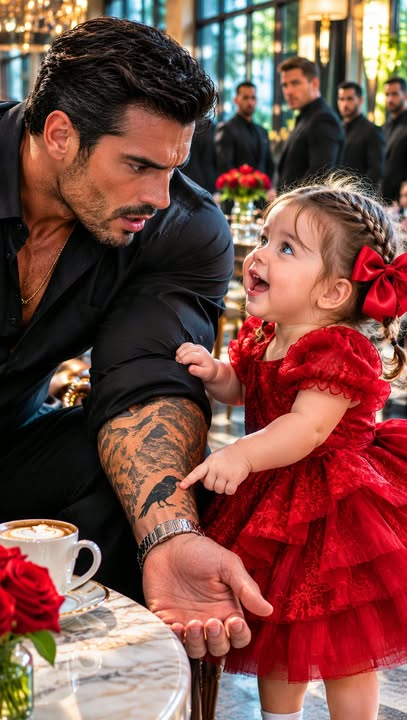
My gaze dropped to the raven ink on my wrist.
Marcus’s eyes sharpened.
“You think the man in the photograph could have been the one waiting?”
“I don’t know.”
The possibility unsettled me.
If Elena had arranged the meeting, why had she sent Mia away alone?
If she had not arranged it, who had waited for her at the flowers?
And why had I been with her, three days before the ambush, without remembering any of it?
Marcus’s phone rang.
He stepped into the next room to answer, leaving me with Mia and the photograph.
She had stopped arranging the apple slices.
“Are you going to leave again?” she asked.
“I need to find your mother.”
“Then you’ll come back?”
The question carried no accusation, but I heard the fear beneath it.
“I will.”
She looked at my face for a long moment.
“Mommy says you always leave when things get hard.”
I felt the words like a hand pressing on an old bruise.
“Did she say that about me?”
“She said you used to.”
I didn’t know what I could honestly tell her.
I had built my life around leaving first, before anyone could ask me to stay.
When my father died, I had buried his name beneath the company he left and convinced myself that work was the same as loyalty.
When people disappointed me, I replaced them with guards, contracts, and rules.
It had taken only a few hours with a child to realize how much of my life had been organized around not being needed.
“I can’t change what I did before,” I said.
Mia waited.
“But I can choose what I do now.”
She seemed to consider that answer.
Then she picked up a piece of apple and held it out to me.
I accepted it.
Her fingers brushed mine, soft and warm.
“We’ll find her,” I said.
This time, the promise did not feel like currency.
It felt like a decision I would have to keep making.
Marcus came back with the phone still in his hand.
“The camera footage shows Elena leaving the chapel garden before we arrived,” he said. “She went south, toward the old clinic district.”
“Did you get a clear image?”
“Clear enough to confirm it was her. She was alone.”
“How long before we got there?”
“About forty minutes.”
“She knew we’d come.”
“Or she was already heading somewhere else.”
“Can you trace her route?”
“Not completely. There’s a gap in the cameras near the market.”
“Then we start with the clinic.”
Marcus gave me a questioning look.
“That’s a guess,” he said.
“It’s better than waiting.”
I turned to the woman from our team.
“Stay here with Mia, and don’t let anyone in unless Marcus confirms it.”
Mia grabbed the hem of my coat.
“I want to come.”
I crouched beside her.
“You’re safer here.”
“But what if Mommy comes back?”
“Then you’ll be here, and she’ll know you’re safe.”
“What if she thinks I left?”
“I’ll tell her you waited.”
She swallowed, blinking hard.
“Tell her I kept Bibi.”
“I will.”
Mia leaned forward and rested her forehead against mine.
“Don’t forget,” she whispered.
“I won’t.”
The rural clinic lay well beyond the central streets, in a low building that had once served the farming communities on the edge of the city.
Its sun-faded sign was barely visible from the road.
A row of mesquite trees cast narrow shadows across the parking area.
Marcus parked beside an old pickup truck, and I looked through the windshield at the building.
“Do you want me to go in first?” he asked.
“No.”
“Dean, if she’s there—”
“If she’s there, she should see me.”
He studied my expression, then nodded.
We entered through a glass door with a handwritten notice asking visitors to check in at reception.
The waiting room was almost empty.
A young receptionist looked up from her computer.
“Can I help you?”
“I’m looking for Elena,” I said.
The woman’s hand hovered above the keyboard.
“Which Elena?”
“Elena with dark hair, a silver moon necklace, and a daughter named Mia.”
The receptionist’s face changed before she answered.
“She left a while ago.”
“How long?”
“She signed out about an hour ago.”
“Was she alone?”
“Yes.”
“Did she say where she was going?”
“She said she needed to find someone.”
The answer could have meant anything.
“Was she hurt?”
“No.”
“Did anyone come to see her?”
The receptionist glanced at Marcus.
“Why are you asking?”
“Because I’m trying to make sure she’s safe.”
The receptionist held my gaze, then lowered her voice.
“She seemed frightened, but she wasn’t being forced to leave.”
“Did she say she was afraid of someone?”
“No. She just asked if the rear door was still open.”
That was enough to set my instincts on edge.
“Did you see anyone waiting outside?”
“I saw a man by the road. He didn’t come in.”
“What did he look like?”
“I can’t remember. He had a cap, maybe.”
“Did Elena recognize him?”
“I don’t know.”
The woman turned her eyes toward a closed office door.
“Was she treated here?”
“She spoke with the nurse.”
“Could we speak with the nurse?”
The receptionist hesitated.
“We’re not supposed to share a patient’s information.”
“I’m not asking for her medical record.”
Marcus stepped forward just enough to make his presence known, then stopped when he saw the receptionist stiffen.
I lifted a hand, signaling him to stay back.
“We’re not here to pressure you,” I said. “If Elena gave you a message for me, I need to hear it. If she didn’t, we’ll leave.”
The receptionist studied me, perhaps trying to decide whether my words were true.
After a moment, she picked up the phone and asked the nurse to come out.
The nurse was an older woman with silver hair and a patient’s careful way of moving.
She listened while I explained who I was, leaving out the criminal empire and the stranger at the café.
When I finished, she folded her hands.
“Elena didn’t ask me to give you anything,” she said.
“Did she mention me?”
The nurse’s eyes narrowed slightly.
“She asked whether the clinic still had the west entrance.”
“Why?”
“I didn’t ask.”
“Was she alone?”
“Yes.”
“Did anyone follow her?”
“I didn’t see anyone.”
The answer was firm but not entirely reassuring.
“She chose to leave?” I asked.
“She was nervous, but she was clear about what she wanted. I offered to call someone for her, and she declined.”
“Did she say why?”
The nurse took a breath.
“She said she didn’t know who she could trust.”
The words struck harder than I expected.
“Did she mention me specifically?”
“No.”
“Did she leave a note?”
The nurse looked toward the reception desk.
The receptionist shook her head.
“She did, though,” the nurse said after a pause. “A few words on the appointment card. I thought they were meant for a family member.”
“May I see it?”
She returned to the office and came back with a small white card.
The handwriting on it was Elena’s.
I knew it before I read the words.
For one moment, I was back in the hospital bed, the taste of blood and medicine in my mouth, listening to a nurse tell me a woman had left something beside the lamp.
On the card, Elena had written:
“West bell. Not the first time.”
I stared at the phrase.
“What does ‘not the first time’ mean?” Marcus asked.
“I don’t know.”
The nurse studied my face.
“Did she tell you she was afraid of someone?”
“She said she didn’t know whom she could trust,” I replied.
The nurse nodded, as if that matched the woman she had seen.
“She wasn’t panicked. She was careful. There’s a difference.”
I looked down at the card again.
“Did she say where she was going?”
“No.”
“Did she leave anything behind?”
The nurse shook her head.
“She asked about the west entrance, signed out, and left on foot.”
Marcus thanked the nurse, and we stepped back outside.
The afternoon had begun to cool, but the sun still pressed warm against the pavement.
I stood beside the car, holding the appointment card between my fingers.
“Not the first time,” Marcus said. “The photograph said you remembered the wrong day. Now this.”
“I know.”
“You could have seen her before the ambush.”
“I would remember.”
“Would you?”
I looked at him sharply.
Marcus didn’t flinch.
“I’m not saying you wouldn’t,” he continued. “I’m asking whether you have any memories from that period you don’t trust.”
“I remember the convoy.”
“That isn’t what I asked.”
I looked down at the ink on my wrist.
The raven had been put there when I was younger, though the details of its origin had never been explained to me.
My father had called it a mark of loyalty.
He had told me it represented the network that protected our family.
After the ambush, I had believed the same network had betrayed us.
“What are you suggesting?” I asked.
“Only that someone may have wanted you to remember a simpler story.”
The words left me cold.
“Your father?” I asked.
Marcus’s face changed.
“I didn’t say that.”
“You were thinking it.”
“I’ve been thinking about what we don’t know.”
I stepped closer, keeping my voice low.
“Have you found something?”
“Not yet.”
“Then don’t turn suspicion into fact.”
“I’m not.”
“You’ve been with me long enough to know the difference.”
“Yes,” he said. “And I know you’re more likely to blame yourself than ask what other people kept from you.”
I looked away.
For years, Marcus had been the one person who could speak to me without dressing his thoughts in flattery.
I trusted him because he had never asked me to pretend I was better than I was.
Now I found myself wondering what he knew and had not told me.
“Why are you questioning me now?” I asked.
“Because if Elena has left these clues, she wants us to ask.”
“Or she wants us to distrust one another.”
He met my eyes.
“Then we should be careful not to give her that.”
The answer was reasonable.
It did not make the unease disappear.
We returned to the safe house shortly before dusk.
Mia was on the floor with the woman from my team, sorting the ceramic birds from a small decorative bowl into a neat line.
She looked up as soon as I entered.
“Did you find Mommy?”
“Not yet.”
She pressed her lips together, then went back to the birds.
“I’m sorry,” I said.
“She knows where the west bell is,” Mia replied. “Maybe she went there.”
“Maybe.”
“Did you see the white birds?”
“At the chapel.”
“Then she was there.”
“She had already left.”
Mia considered this, then looked at the photograph in my hand.
“Mommy came to the chapel before?”
“It seems so.”
“With you?”
I glanced at the image.
“Yes.”
Mia’s eyes moved between my face and the picture.
“Did you know her?”
“I thought I didn’t.”
“That’s not the same as no.”
The quiet certainty in her voice made me smile faintly, though my thoughts were too tangled to feel amused.
“No,” I said. “It isn’t.”
Marcus took a call in the hall.
Mia shifted one of the little ceramic birds toward me.
“This one’s yours.”
“Why?”
“Because it’s the biggest.”
I picked it up.
Its painted wings were uneven, and a tiny crack ran through the glaze along its back.
“Does that mean it’s the strongest?”
Mia shook her head.
“It means it needs help flying.”
I turned the small bird in my palm.
The words reached somewhere I had not meant to leave open.
“You think I need help?”
“I think everybody does.”
She returned to her line of birds, satisfied with the answer.
Marcus came back into the room.
“That was the security team,” he said. “They checked the chapel and the streets around it. No sign of Elena.”
“Anyone else?”
“Nothing conclusive.”
He hesitated.
“Dean, there’s something I should tell you.”
I looked at him.
The room seemed to grow quieter around us.
“What is it?”
“I’ve been in contact with someone from the old Raven Circle.”
Mia glanced up at the words.
Marcus lowered his voice.
“Not a member now,” he said. “An informant.”
“How long?”
“Several months.”
“You’ve been speaking to a former Circle operative for months, and you didn’t tell me?”
“I was trying to confirm whether the organization still had people operating in Arizona.”
“Without telling me?”
“I thought I could keep it contained.”
“Did you speak to this person before the man came to the café?”
“Yes.”
“Did the informant know Elena was alive?”
“I don’t know.”
“Did you tell them about Mia?”
“No.”
“Did they know we were searching for the chapel?”
“No.”
The answers came quickly, but they did not make the omission smaller.
“Why keep it from me?”
“Because I had no proof, and because I didn’t want to send you after a rumor.”
“You don’t decide what I’m allowed to know.”
“I know.”
The bluntness of his agreement unsettled me more than an excuse would have.
“I made the wrong choice,” he said. “I should have told you.”
“Who is the informant?”
“I can’t give you a name yet.”
“Why not?”
“Because I don’t know whether they’re safe.”
“You said they were an informant.”
“I said they claim they are.”
“You’ve been risking my organization on an unverified contact.”
“I thought the information might keep us ahead of the Circle.”
“And did it?”
Marcus looked down.
“I didn’t know they’d found Elena.”
Mia had gone very still beside the line of birds.
I saw the fear in her face and felt ashamed of the argument.
“Not here,” I said quietly.
Marcus understood.
He turned to the woman from the team.
“Would you take Mia into the kitchen for a little while?”
Mia looked at me.
“Are you angry with Marcus?”
“I’m upset that he kept something from me.”
“Are you angry at me?”
“No,” I said, and reached for her hand. “Never for asking a question.”
She leaned against me briefly before following the woman into the next room.
When the door closed, I faced Marcus.
“If the informant is connected to the man from the café, I need to know.”
“I’ll find out.”
“And if you already know more than you’ve told me?”
“I don’t.”
I searched his face for the lie I had expected to find.
Instead, I saw weariness and the quiet shame of someone who understood that good intentions did not undo a broken confidence.
“You have one chance to tell me everything before I make decisions based on half the truth,” I said.
“You’ll have it.”
The certainty in his voice sounded almost like a promise.
I could not tell whether it reassured me.
Later, when Mia had fallen asleep on the couch with Bibi tucked beneath her chin, I returned to the photograph.
I set it on the table beside the clinic card.
The woman beside me wore a pale coat and a small moon necklace.
Her hand rested on my arm.
I had no memory of the picture being taken, but the image carried a familiarity I could not dismiss.
I looked closely at the background.
Behind us stood a stone wall and the edge of a bell tower.
The chapel.
The same place where I had found the yellow flowers.
The same place with the west bell.
A date was written in the corner.
Three days before the ambush.
And underneath it, someone had added one last line, so faint that I had overlooked it the first time.
I tilted the photograph toward the lamp.
The words emerged beneath the inked thirteen.
“Dean and Elena, after the west bell.”
I read the line again.
Then I noticed the date on the clinic card, and the words Elena had left beneath it.
Not the first time.
Perhaps the photograph was not proof that I had known her before the ambush.
Perhaps it was proof that I had met her afterward, too.
A memory stirred—an empty chapel, rain tapping against the windows, a woman’s hand reaching for mine as she asked me to stay.
But before I could grasp the scene, another thought arrived, sharper and more troubling.
If I had been with Elena after the ambush, why did I remember only the day she disappeared?
**–END OF PART 3–CLICK “NEXT” AT THE BOTTOM OF THE PAGE TO CONTINUE READING**
* * *
[PREVIOUS: PART 2](https://echoesofstories.idolsgift.com/blog/part-2-the-message-beneath-the-warning-047) | [NEXT: PART 4](https://echoesofstories.idolsgift.com/blog/part-4-the-message-beneath-the-warning-047)
✓ Lynn R. Adams
Part 3 – The Photograph in the Chapel The number thirteen seemed darker than the rest of the ink, as though someone had written it long after the photograph was taken. I turned the picture toward th…