PART 3: The Message Behind the Mirror 047
Part 3 – The Phrase in the Margin
For Dante.
The two words seemed to hold the room in place.
I kept my thumb pressed against the scrap, careful not to smudge the faded ink, though I knew the handwriting as well as I knew the lines in my own palm.
My father’s letters had always leaned slightly to the right, as if each one were trying to get somewhere before the thought behind it could change.
“This belongs to him,” I said.
Isabella’s eyes moved from the paper to my face.
“Your father?”
“Yes.”
“Then it may be the reason the records were kept together.”
“Or it may be a coincidence.”
I heard the doubt in my own voice and hated how much I wanted to believe it.
Raphael took the scrap from me only after I nodded.
He examined the cut edge, then held it beneath the bathroom light.
“This came from a larger page,” he said. “The tear isn’t accidental. Someone removed it carefully.”
“Can you tell when?”
“Not from this alone.”
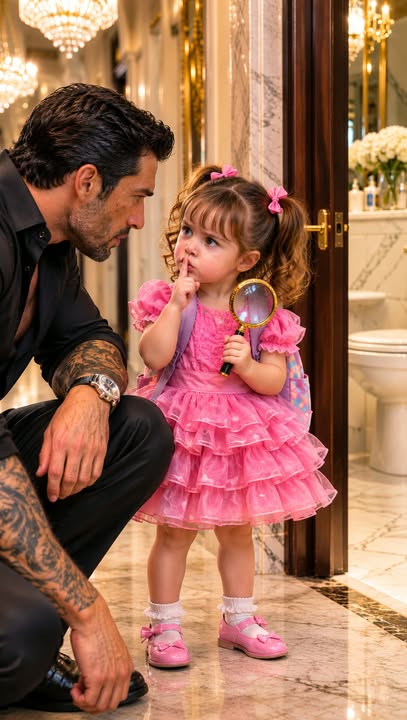
Sophie had drifted closer to Elena, watching Raphael’s hands.
“Did I do bad?” she asked.
“No,” I said at once. “You did exactly right by showing me.”
She seemed relieved, though she kept her eyes on the paper.
Elena crouched beside her and smoothed one of her pink ribbons.
“Let’s give Mr. Dante and Miss Bella a little room, sweetheart.”
Sophie considered Isabella, then me.
“Ask nice,” she reminded me.
“I will.”
Elena led her back toward the sitting room.
The soft patter of Sophie’s shoes faded down the hall, and with it went the one uncomplicated thing in the room.
Raphael set the scrap on the counter beside the envelopes.
“Marcus should see this,” he said.
Isabella looked at him sharply.
“Not yet.”
Raphael’s expression stayed calm.
“Why not?”
“Because we don’t know what it means, and because he may have access to the records.”
“You think he’s involved?”
“I think the company in those payment records is connected to his operation. That’s all I know.”
“That’s not all you suspect.”
She glanced at me, and I understood the choice she was making.
She could say what she thought plainly, or she could leave me to imagine the worst.
“I suspect someone is using Marcus’s system,” she said. “I don’t know whether Marcus knows.”
Raphael folded his arms.
“Then we verify before we accuse.”
“Agreed,” I said.
The quickness of my answer surprised Isabella.
It surprised me too.
A year ago, I might have taken the paper downstairs, called Marcus, and demanded that he explain every mark on it.
I might have mistaken certainty for strength and called it action.
Now I looked at the envelopes, at the scraps of my father’s handwriting, and wondered how often the first answer was simply the one I had been prepared to accept.
“Where did you find these copies?” I asked Isabella.
“The storage room at the security office.”
“Which one?”
“The archive room beneath the west wing.”
Raphael’s brow furrowed.
“That room’s been locked since the office renovation.”
“Not locked,” she replied. “The electronic access panel has been disabled, but the door still opens with a manual key.”
“How did you get in?”
“Marcus gave me a temporary access card last winter. He said he wanted me to feel comfortable moving around the estate and the office.”
The fact that she remembered the exact promise seemed to cost her something.
I remembered Marcus handing her the card at dinner, smiling as he told me he’d made sure she wouldn’t feel like a guest in my life.
I had thanked him.
“He gave you access to the archive?” Raphael asked.
“No. The card opened the general office areas. The archive door was already ajar when I found it.”
“When was that?”
“Three weeks ago.”
“You said you were looking for records connected to the company that arranged your introduction.”
“I was looking for my own name.”
I turned to her.
“What?”
Isabella rested both hands on the edge of the sink.
“After I found a payment with Northline’s name on it, I saw a note beside the account number. It referenced an expense category I recognized from the paperwork Marcus had shown me when we first met.”
“What paperwork?”
“Nothing confidential. He told me the organization had a small fund for community contacts and introductions. He asked me to sign a standard disclosure saying I wasn’t being compensated to spend time with you.”
The room seemed to grow quieter.
“You signed that?”
“Yes.”
“Why didn’t you tell me?”
“I didn’t think it mattered. I wasn’t being paid.”
“Did Marcus give you money at any point?”
“No.”
“Gifts?”
“Not from him.”
Her answer came without hesitation, but I watched her all the same.
She met my eyes without flinching.
“I signed because I wanted to be sure nobody could later claim I had been paid to approach you,” she continued. “Once I saw the expense category, I wondered whether there was a record of that disclosure in the archive.”
“And you went looking.”
“Yes.”
“By yourself?”
“Yes.”
“Why didn’t you ask me to come with you?”
“Because I didn’t know if there was anything to find.”
“And because you didn’t trust me.”
“Because I didn’t know whether it was safe to tell you yet.”
The distinction sounded thin, but it was not the same.
I could hear how carefully she chose her words.
“Did you find your name?” I asked.
“I found a folder with a list of introductions. Mine was there.”
I waited.
“It didn’t say I’d been paid,” she said. “It listed the date Marcus first contacted me, the restaurant where we met, and a note that I had agreed to attend.”
The memory came back in pieces: a reservation in a quiet room, Marcus inviting us both, Isabella arriving in a blue coat with rain on her shoulders.
I had thought the meeting was chance, or at least Marcus’s harmless matchmaking.
“What did the note say?”
“Something ordinary. ‘Candidate agrees to meet.’”
“Candidate?”
Her mouth tightened.
“That was the word he used in the folder.”
“And you still came to see me.”
“Yes.”
“Why?”
“Because the note didn’t tell me what it would be like to meet you.”
She said it plainly.
There was no attempt to turn the answer into a declaration of love, and I was grateful for that.
It would have been too easy to accept tenderness as proof and too cruel to demand it as evidence.
“What made you start looking into the payments?” Raphael asked.
Isabella looked at him, then back at me.
“One of the messages in the envelopes mentioned a dinner you had with a shipping broker. The message was timestamped before you had confirmed the meeting.”
“I changed that dinner twice,” I said.
“I know. The copies include both changes.”
“Who was told about it?”
“Marcus had the original date. Raphael knew the final one.”
Raphael stepped closer to the counter.
“I didn’t receive any message about changes.”
“Neither did I,” I said.
The first page of the envelope seemed suddenly too small to hold the possibility it represented.
“What else did you find?” I asked.
“A ledger showing payments from Northline to two subcontractors. One of the subcontractors provided temporary staff during the security office renovation.”
“Did the payments correspond with my movements?”
“Some did. Some didn’t.”
“Did you copy the ledger?”
“I copied the pages that included the account numbers and dates.”
“Where are the originals?”
“Still in the archive, as far as I know.”
Raphael looked at me.
“If the room was accessible, we should secure it and document what’s there before anyone moves it.”
“Agreed.”
Isabella’s shoulders eased slightly, but only slightly.
I wondered what she had expected from me.
Perhaps she had imagined I would call her a liar, or demand the papers and send her away until I was sure.
I was still angry.
The hurt had not disappeared simply because her explanation made sense.
“You should have told me you were going into the office,” I said.
“I know.”
“You should have told me when you found the folder with your name.”
“I know.”
“Instead, you kept going.”
“I thought I could prove what the records meant before I made you choose between me and Marcus.”
“Was that your decision to make?”
“No.”
The answer came again, quiet and immediate.
I leaned my hands against the counter.
“I don’t want you deciding what I can bear.”
“I understand.”
“Do you?”
“I’m trying to.”
That honesty kept me from raising my voice.
It also made it harder to hide behind my anger.
I had wanted her to be wrong in a clean, simple way.
A lie would have given me something solid to push against.
Instead, she stood before me admitting that she had made a choice I could not forgive merely because she believed it was careful.
From the hall, a phone rang.
Raphael checked his screen.
“Marcus.”
“Answer it.”
Raphael accepted the call and placed it on speaker.
“Dante,” Marcus said, his familiar voice filling the bathroom. “You’re home.”
“I am.”
“I’ve been trying to reach Elena.”
“Why?”
“Because you said you were leaving town, and now your car is at the estate.”
“I changed my plans.”
“Why didn’t you tell me?”
“Why were you asking Elena whether I’d returned?”
A pause followed.
Not long enough to be an admission.
Long enough for me to notice.
“I wanted to make sure the house was covered,” Marcus said. “There’s been an access anomaly in the camera system.”
Isabella’s eyes flicked to me.
“What kind of anomaly?” I asked.
“We’re still checking. An outside connection attempted to access an upstairs feed.”
“Do you know who?”
“Not yet.”
“Why didn’t you call me directly?”
“I did. You didn’t answer.”
I remembered the calls I’d missed while watching the monitors and riding back to the mansion.
“Did you message me?”
“Yes. I told you we had a problem.”
“You told me Isabella knew I was watching.”
Another pause.
“Because she did,” he replied. “That seemed like the immediate problem.”
Isabella’s expression changed.
It was subtle, but I saw the hurt before she hid it.
“Did you know she was inside the house?” I asked.
“No.”
“Did you know she was sending Elena a warning?”
“No.”
“Did you know she had copies of messages and payment records?”
The silence on the line lasted longer this time.
Marcus gave a brief, disbelieving laugh.
“What?”
“You heard me.”
“Dante, what is this?”
“I’m asking if you knew.”
“No. I don’t know what she’s talking about.”
Isabella looked at the papers on the counter.
I saw how much she wanted to believe him.
I saw how much she was afraid that wanting to believe him would make her foolish.
“Do you know a company called Northline Protective Services?” I asked.
“Yes. It’s one of the contractors we use.”
“Do you know whether it made payments to subcontractors around the dates in these records?”
“I’d need to see the records.”
“You don’t know?”
“Not off the top of my head.”
“Could someone access the archive beneath the west wing?”
“The door’s supposed to be sealed.”
“Is it?”
“Last I checked.”
“When was that?”
“Two weeks ago.”
Isabella’s gaze sharpened.
“Why were you checking the archive?” I asked.
“I was checking the office after someone reported a misplaced access card.”
“Whose card?”
“Isabella’s, actually.”
Her face drained of color.
“You said my card had been returned,” she said.
Marcus’s voice shifted.
“You told me you’d left it in the desk drawer.”
“I did.”
“We found the drawer empty.”
“I gave the card back to you.”
“You may have, but it wasn’t there.”
“You told me it had been recovered.”
“Maybe I confused it with another card.”
The words sat between us, apparently ordinary and entirely wrong.
Isabella looked at me.
I could almost see her reviewing every conversation she’d had with Marcus, searching for the moment when he might have asked for the card or learned where it was.
“Marcus,” I said, “when did you find that it was missing?”
“About three weeks ago.”
“Before or after Isabella found the archive?”
“Before.”
“You never told me.”
“It wasn’t a security concern. The card had limited access, and it was deactivated.”
“Was it?”
“Yes.”
“Can you verify that?”
“I can check.”
“Do that.”
He exhaled, sounding more tired than irritated.
“Dante, I know how this looks, but don’t let a few copied pages turn into a conspiracy. People make routine payments every day. That doesn’t mean anyone is tracking you.”
“What does it mean that messages about my movements were copied?”
“It means someone had access to your schedule, which isn’t surprising. You have a staff.”
“Some of the movements weren’t on my schedule.”
“We’ll look into it.”
“Good.”
“I’ll come over.”
“No.”
The word came out too quickly.
I felt it land between us.
“Dante, this needs to be handled in person.”
“It will be, after Raphael checks the archive and the system logs.”
Marcus was silent.
When he spoke again, his tone had lost its ease.
“Are you sure Raphael is the right person to do that?”
Raphael’s face remained still.
“Why wouldn’t he be?”
“He worked for your father, not for the current security operation. He doesn’t know every change we’ve made.”
“He knows how to preserve a record without altering it.”
“I’m not saying he doesn’t.”
“Then we have no problem.”
Another pause followed.
“Fine,” Marcus said. “I’ll send over the recent access report.”
“Send it to me and Raphael.”
“Of course.”
“And don’t come to the estate until I call you.”
“Understood.”
The call ended.
For a few seconds, no one spoke.
Raphael lowered the phone.
“He sounded concerned,” he said.
“He sounded surprised that I wouldn’t take his explanation.”
“Those can be the same thing.”
Isabella turned the envelope over in her hands.
“Did you ask him about the handwriting?”
“No,” I said.
“Why not?”
“Because he hasn’t seen the note.”
“He knows there’s a note.”
“I haven’t told him about the scrap.”
She looked at the paper bearing my father’s words.
“Then we shouldn’t let it out of our sight.”
Raphael put on a pair of thin gloves from the kit he carried in his coat.
“I’ll photograph each page and record where it was found. Then I’ll check the archive.”
“Can you do that without going through Marcus’s office?”
“I can document the room. I can’t tell you who made the payments without the ledgers.”
“Could the records be changed?”
“Any digital records can be changed. That’s why we make copies of the current data and preserve the original access logs before anyone knows what we’re examining.”
I turned to Isabella.
“Can you take me to the archive?”
She studied me for a moment.
“Now?”
“Yes.”
“I can.”
“Then we’ll go with Raphael.”
A small crease appeared between her brows.
“Do you trust me to show you the right room?”
“I trust you to show me where you found the papers.”
It was not the same as trust.
We both knew it.
She nodded anyway.
At the door, Elena appeared with Sophie’s sketchbook tucked under one arm.
“Sophie wanted to know if you were finished talking.”
“Almost,” I said.
Elena glanced at Isabella.
“Are you all right?”
“I’m all right.”
It was a polite answer, and a false one.
Elena did not challenge her.
She simply touched Isabella’s shoulder, then gave me a look that asked more than she wanted to say in front of the child.
I had promised I would remember that people hid things because they were afraid.
I had not promised that I would always know what to do with the fear once I found it.
“I’m going to the office with Raphael and Isabella,” I told Elena. “You and Sophie stay here. The security team will keep the front entrance watched.”
“Will Marcus be coming?”
“No.”
Elena’s gaze moved to the envelope in Raphael’s hands.
“I hope you find what you’re looking for.”
“So do I.”
Sophie emerged from behind her mother and held up a drawing.
It showed a square room with three stick figures standing together beneath a yellow sun.
One figure had pink ribbons.
One had a dark blue coat.
The third was very tall.
“Is that me?” I asked.
She nodded.
“Who’s the tall one?”
“Raphael.”
He smiled, a rare and gentle thing.
“Then who is that?” I asked, pointing to the figure with the pink ribbons.
“Me.”
She had drawn herself taller than Elena, though she seemed pleased with the proportions.
I gave the drawing back.
“Keep being our detective,” I said. “But next time, tell your mother before you go exploring.”
“I did.”
Elena sighed.
“She told me after.”
Sophie shrugged, entirely untroubled by the distinction.
The trip to the security office took twelve minutes.
Isabella sat in the back beside me, her hands folded over her knees, while Raphael drove.
None of us spoke for the first few blocks.
The city moved past the windows in the late afternoon light, and I watched the familiar streets as if I were seeing them through someone else’s eyes.
“How long have you known Marcus?” Isabella asked at last.
“Since I was sixteen.”
“That’s a long time.”
“He was my father’s closest aide then. More than that, he was the person who made sure I got home when I didn’t know how to ask for help.”
She looked down.
“I didn’t know that.”
“I didn’t tell you.”
“I thought you had told me everything about him.”
“I thought I had.”
I turned toward her.
“Do you believe he’s involved?”
“I don’t know.”
“You believe he might be.”
“Yes.”
“Does that frighten you?”
“It frightens me that I don’t know what to believe about any of us.”
The answer was quiet enough that it seemed intended only for me.
I wanted to tell her I understood.
I wasn’t sure I did.
The office building stood behind a low brick wall, unremarkable among the warehouses and repair shops on the block.
The rooms beneath the west wing were accessed through a narrow stairwell at the rear.
Raphael had brought a camera, a small document kit, and a portable scanner.
The archive door was closed.
Isabella stopped at the bottom of the stairs.
“This is where I found it.”
Raphael checked the lock.
“No damage.”
He pressed the handle.
The door opened.
Inside, metal shelves lined both walls, with cartons stacked from floor to shoulder height.
The air smelled faintly of dust and old paper.
A single overhead light flickered when Raphael turned it on.
“Which shelf?” I asked.
Isabella walked to the far wall.
“Here.”
One shelf sat slightly crooked, its boxes marked with dates and department names.
She pointed to a space where a narrow carton had been removed.
“The folder was there,” she said. “The payment ledger was in the gray box beneath it.”
Raphael photographed the shelf, then the labels on the nearby cartons.
“Did you move anything else?”
“No.”
“Did you leave the room unlocked?”
“I closed the door, but I didn’t have a key.”
“Who did?”
“Marcus. The facilities manager. Maybe someone in administration.”
I looked at the empty space.
“Could anyone have removed the folder since you found it?”
“Yes.”
“Could anyone have put the copied pages in the file before you found them?”
“I suppose.”
“Did you see the original handwriting?”
“No. The notes were loose, tucked into the folder.”
Raphael opened the gray box without moving its contents more than necessary.
He lifted each paper sleeve and photographed the label.
“Northline,” he murmured.
The name appeared on several folders.
Isabella stepped closer but did not touch them.
“Those are the payments I copied.”
Raphael read the date on one.
“Same period as the messages.”
“Some of them,” she said.
I leaned over his shoulder.
The ledger listed routine vendor payments, equipment rentals, and temporary staff fees.
Nothing on the page openly suggested that the money had been used to follow me.
But in the margins, a few entries carried short notations: route coverage, schedule review, evening watch.
“What does ‘route coverage’ mean?” I asked.
“Could be ordinary security planning,” Raphael said. “We need the corresponding job records.”
“Are those stored here?”
“Possibly.”
He checked the adjoining boxes, photographing each before opening it.
A folder bearing my father’s name sat on the lowest shelf.
I hadn’t expected to see it.
The label was handwritten in black marker: MORETTI, VINCENZO — PERSONAL.
My throat tightened.
“Was that here when you found the other papers?” I asked Isabella.
“No.”
Raphael glanced at the folder.
“You’re certain?”
“It wasn’t on this shelf. I looked here for the introduction records.”
I reached toward it, then stopped.
Raphael noticed.
“You want me to handle it?”
“No.”
The folder was thin, with a faded elastic band around it.
I lifted it carefully.
Inside were four documents, two old photographs, and an envelope that had been opened and resealed.
The first photograph showed my father standing beside Marcus outside the old family house.
Marcus looked younger than I remembered him, though not by much, his hand resting on my father’s shoulder.
On the back, someone had written a date.
The year before my father died.
The second photograph showed the same two men beside a car.
I recognized the car.
It had been mine for a short time, though I had never known my father had arranged it.
“You knew this folder existed?” I asked Raphael.
“No.”
“Could it have belonged to my father?”
“Of course.”
“Why was it kept here?”
“I don’t know.”
The opened envelope contained a short inventory in my father’s handwriting, listing several documents by date.
One entry read: For Dante, when he is old enough to ask.
I felt something shift inside me.
The note on the scrap, For Dante, might have been cut from this page.
I held the inventory closer to the light.
The words beneath the last entry were smudged, but legible.
Guardian arrangement — Marcus.
I read it twice.
Marcus had been my father’s guardian arrangement.
I had always understood that he was my father’s closest friend and my protector.
I had never known my father had written it down.
Raphael stood at my shoulder.
“Dante.”
I looked at him.
“Did you know my father wanted Marcus to protect me?”
“I knew he asked him to look after you.”
“Was that all?”
“I don’t know.”
The answer sounded sincere.
I turned back to the folder.
The final document was a typed summary, unsigned and undated, containing only a few lines.
It stated that Marcus would manage certain security expenses and keep me informed of any material risk.
The phrase at the bottom was not in my father’s handwriting.
Neither was the signature beside it.
I studied the name.
“Who signed this?”
“Someone named Calder,” Raphael said. “I don’t recognize it.”
“Does the name mean anything to you?” Isabella asked.
I stared at the paper.
“No.”
I put the document down.
The guardian arrangement sounded like care.
The typed summary sounded like an office interpreting that care.
A small difference, perhaps.
A difference that might matter.
Raphael continued photographing the contents.
“I’ll copy these and check the records against the payment dates,” he said. “We shouldn’t draw conclusions from one old folder.”
“I know.”
Isabella had gone very quiet.
I turned to her.
“What?”
“Nothing.”
“Isabella.”
She looked at the shelf where she had found the first folder.
“The handwriting on the notes in my envelopes,” she said slowly. “I thought I recognized it, but I couldn’t remember from where.”
“What handwriting?”
“The person who wrote the movement lists.”
“You said you didn’t know.”
“I didn’t. Not when you asked.”
“And now?”
She leaned toward the folder in my hand, careful not to touch it.
“I think the writing on the list looks like the writing on the envelope you just opened.”
I looked down.
The old inventory page bore my father’s handwriting.
The movement list in the envelope bore a sharper, more upright hand.
They were not the same.
But the typed summary had a handwritten notation across its bottom margin.
Three words in dark blue ink.
Quiet harbor confirmed.
The handwriting matched the message list.
Raphael saw it too.
For a long moment, no one spoke.
My father’s private phrase had been written in the margin of an office document, in handwriting connected to the records tracking my movements.
The phrase had not simply survived in a scrap hidden behind my bathroom.
Someone had carried it forward.
Someone knew what it meant.
I stared at the old signature again, the one I had dismissed as unfamiliar.
Then I turned the page over.
There, beneath the typed summary, was a handwritten note in the same precise lettering.
It contained a name.
Marcus Carrera.
**–END OF PART 3–CLICK “NEXT” AT THE BOTTOM OF THE PAGE TO CONTINUE READING**
* * *
[PREVIOUS: PART 2](https://echoesofstories.idolsgift.com/blog/part-2-the-message-behind-the-mirror-047) | [NEXT: PART 4](https://echoesofstories.idolsgift.com/blog/part-4-the-message-behind-the-mirror-047)
✓ Lynn R. Adams
Part 3 – The Phrase in the Margin For Dante. The two words seemed to hold the room in place. I kept my thumb pressed against the scrap, careful not to smudge the faded ink, though I knew the handwr…