PART 3: The Mark in the Oak 046
Part 3 – The Ledger in the West Wing
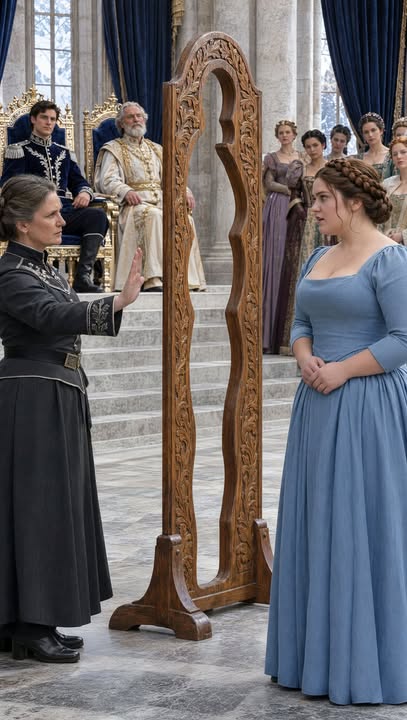
The steward’s answer left the hall quieter than it had been when the candidates stood before the frame.
“Who requested it?” Alexander asked.
The steward folded his hands behind his back.
“The order came through the household office, Your Highness, but the name attached to it was not included in the copy I saw.”
“That is an unusual omission.”
“It is not unheard of.”
The king looked toward the oak frame, its carved flower nearly hidden in the grain.
“Then find the original order.”
“I will, Your Majesty.”
The steward’s gaze met mine for an instant before he turned away.
There was nothing openly suspicious in his expression, but I had the uncomfortable sense that he knew more than he intended to say.
Alexander waited until the steward had left the hall before speaking again.
“I’m sorry,” he said. “I thought we might find an answer today.”
“I didn’t expect one.”
I folded the handkerchief along its old creases and returned it to my bag.
“I only hoped the flower meant something.”
“It does,” he said. “Even if we don’t yet know what.”
The certainty in his voice was kind, but it could not erase the look that had passed between him and his father when I first mentioned my mother’s name.
I had noticed it.
I suspected he knew I had.
“Will you be here tomorrow?” he asked.
“I’m not sure.”
“I understand.”
He did not press me to stay, and I was grateful for that.
The candidates were being gathered in the west salon, where attendants had promised tea and warm rooms before the carriages were called.
I collected my case and turned toward the doors.
At the threshold, I looked back once.
Alexander stood alone beside the frame, one hand resting on the oak just below the mark.
The posture made him look younger than he had on the dais.
For a moment I imagined him as a child, trying to stand tall enough to please his mother while she made him start again.
Then the doors closed between us.
The journey home passed in a blur of gray fields and snow-bright hedgerows.
I sat with my mother’s handkerchief in my lap, turning it over and over as the carriage rocked beneath me.
I had gone to the palace to be considered as a candidate for a prince’s marriage.
Instead, I had come away with a question about my mother, an old flower carved in oak, and the uneasy impression that the king had recognized her name.
None of it made sense yet.
When I reached home, I put the handkerchief beside my sewing basket and tried to make supper.
I burned the bread.
The next morning, a letter arrived from the palace.
It was written in the king’s secretary’s neat hand, asking whether I would return to speak with the royal steward about my mother’s employment.
The letter did not mention Alexander.
I read it twice before answering.
Then I wrote that I would come.
I told myself I was going for the records, not for the prince.
The distinction seemed important, though I could not have explained why.
The palace looked different in daylight, its high windows reflecting a pale winter sun.
A footman led me through a side entrance and along a corridor I had not seen the day before.
The old west wing lay beyond a set of doors at the end, closed off from the main residence during renovations.
Its rooms smelled faintly of dust, beeswax, and stone warmed by old fires.
The steward was waiting in a small office lined with cabinets.
He introduced himself as Mr. Vale, though he had been present the previous day and had never given me his name.
“I have served the household for thirty-six years,” he said as he offered me a chair.
“I’m glad you’re willing to help.”
“I wish I could promise the records will answer your questions.”
He opened a ledger on the desk, its dark leather cover softened by years of handling.
“They are incomplete,” he added. “Some were moved during the renovations. Others were damaged or lost.”
“Could you tell me whether my mother worked here?”
“I believe she did.”
He turned several pages, tracing a column with one finger.
“Margaret Carter appears in the household register for a short period, though the dates are difficult to read.”
My throat tightened.
“Do you know what she did?”
“Seamstress, initially, I believe. She was later assigned to the laundry rooms.”
“Why did she leave?”
Mr. Vale paused over the page.
“That is less clear.”
He slid the ledger toward me.
The faded ink had blurred in places, but I could make out my mother’s name.
Beside it, someone had written a date, then a short note in a different hand.
“Dismissed following loss of royal property,” I read.
The words seemed to turn the room colder.
“Loss of what property?”
“I don’t know,” Mr. Vale said. “There is no item listed beside the note.”
I looked up.
“Was she accused of stealing?”
His face tightened, though his voice remained measured.
“The record does not say that.”
“But she was dismissed because something went missing.”
“That is what the entry suggests.”
I lowered my eyes to the page again.
The ink was faded, but the word dismissed was clear.
For years, I had understood my mother’s silence as a private sorrow she did not wish to share.
Now the ledger made that silence feel like evidence of something she had never been allowed to explain.
“She never told me.”
“Perhaps she hoped to spare you,” Mr. Vale said.
“Or perhaps she was ashamed.”
“I cannot know.”
He did not offer comfort he could not support.
I appreciated that more than I wanted to.
“May I see the full file?”
Mr. Vale closed the ledger gently.
“I’ll have to ask permission.”
“From the king?”
“From the household office.”
The answer came too quickly.
I thought of the steward’s pause the day before, and of the missing name on the order that had brought the frame out of storage.
“Is there a reason I can’t see it?”
“Not one I can give you.”
He stood and carried the ledger to a cabinet.
I watched him fit it into a narrow space between two volumes, careful to keep the spine aligned with the others.
“Mr. Vale, did you know my mother?”
“I may have seen her.”
“That isn’t the same as knowing her.”
“No,” he said. “It isn’t.”
He shut the cabinet and turned the key.
Before I could ask anything else, a familiar voice came from the open doorway.
“Emily?”
Beatrice stood there in a dark green gown, one hand resting on the doorframe.
Her expression brightened when she saw me, though the brightness did not last.
“I’m sorry to intrude,” she said. “I was told you might be here.”
“Have you come to look at the records too?”
“Not exactly.”
She glanced toward Mr. Vale, who gave a slight nod and stepped out into the corridor.
When he had gone, Beatrice came farther into the room.
“I wanted to speak with you before anyone else did.”
A quiet unease rose in me.
“About the frame?”
She nodded.
“I heard you came back to ask about your mother.”
“How did you hear that?”
“There are very few secrets in a palace, though people often pretend otherwise.”
She looked down at her gloved hands.
“I thought you should know the frame was not chosen by chance.”
Mr. Vale had said the same thing in different words.
“Someone insisted it be used,” I said.
“Yes.”
“Who?”
“I don’t know. I only heard that it had been brought out of storage a few weeks ago, and that the test had to include it.”
“How did you hear that?”
“My aunt knows one of the women who manages the household schedules.”
Beatrice lowered her voice.
“She said there was some disagreement about using it. The palace has plenty of other ways to test poise.”
“Did she say who insisted?”
“No.”
“But you think it was someone trying to make me look foolish.”
“I don’t know what they intended.”
She met my eyes.
“I do know the frame was not put there because it was useful.”
The carved flower came back to me, its small crooked petals partly hidden in the oak.
“Do you think they knew about my mother?”
“I can’t be sure.”
Her honest uncertainty steadied me more than a confident guess would have.
“Why tell me this?”
“Because you were kind to me yesterday.”
“I barely said two sentences to you.”
“You noticed I was nervous, and you didn’t make a joke of it.”
She gave a small, almost embarrassed smile.
“I’m not very good at pretending I don’t notice when people are being treated unfairly.”
I thought of the women who had laughed behind their handkerchiefs, then of Beatrice standing among them with concern in her face.
“You were one of the only people who spoke to me as if I belonged there.”
“I wanted to say more,” she admitted. “But there were enough people in that room eager to decide what you were. I didn’t want to add to the noise.”
I understood that.
There were moments when silence was a kindness.
There were others when it became a choice.
“Did the prince know the frame had been brought out?”
“I don’t think so.”
“And the king?”
Beatrice’s expression shifted.
“I don’t know.”
She took a breath.
“I should tell you something else, though I wish I had a kinder way to say it.”
The ledger waited behind its locked cabinet.
I felt the words before she spoke them.
“My aunt said the old records mention a missing royal keepsake,” Beatrice said. “She didn’t know exactly what it was. Only that someone blamed a member of the staff, and that the matter was never properly settled.”
“Was my mother named?”
Beatrice did not answer at once.
“No,” she said finally. “Not in the story my aunt heard.”
I wanted to believe that distinction mattered.
But my mother’s name had appeared in the ledger beside a loss of royal property.
“Then perhaps there were two cases.”
“Perhaps.”
Beatrice’s face told me she did not believe it.
A knock sounded at the open door.
Alexander stood in the corridor.
He looked first at Beatrice, then at me.
“I’m sorry to interrupt,” he said. “I was told Emily had arrived.”
Beatrice stepped aside.
“I was just leaving.”
She paused beside me and touched my sleeve.
“Whatever you find, I hope you get the chance to hear it from someone who knows what happened.”
Then she was gone.
Alexander came into the office and closed the door partway behind him.
He had changed from his formal clothes into a dark coat and a simple wool shirt, though he still carried himself with the careful restraint of someone aware that servants might be listening beyond every wall.
“Have you spoken with the steward?” he asked.
“He showed me a ledger entry.”
“What did it say?”
I looked at him.
“Why are you asking?”
The question came out more sharply than I intended.
He did not take offense.
“Because I want to understand what happened.”
“Or because you want to know whether the record confirms what you already suspect?”
His brows drew together.
“I don’t suspect anything.”
“My mother was dismissed after royal property went missing.”
He went still.
“What property?”
“The ledger didn’t say.”
“Did the steward explain?”
“He said the records were incomplete.”
Alexander turned toward the cabinet.
“May I see the entry?”
Mr. Vale had not returned to the room, and I did not know whether I should answer.
“You can ask him.”
“I will.”
He crossed to the cabinet, but did not touch it.
“Emily, I’m not trying to make a judgment about your mother.”
“Not yet.”
The words sat between us.
He looked at me carefully.
“You think I might.”
“I think the ledger has already made one for you.”
“I haven’t seen it.”
“But you believe the palace records.”
“I believe they may contain useful information.”
“Then you believe my mother was dismissed because something went missing.”
His mouth opened, then closed.
The truth was plain enough that neither of us could soften it.
“I believe that is what the entry says,” he replied at last.
“And you think she was involved.”
“I did not say that.”
“You didn’t have to.”
I could hear my mother’s old restraint in my own voice, the way she might have stopped herself from saying more because she already knew how the words would be received.
Alexander moved away from the cabinet.
“I know what it is like to be judged before anyone asks your side.”
“Do you?”
His eyes held mine.
“I have spent years being told what kind of man I ought to become.”
“That isn’t the same as having your mother’s name written beside a missing possession.”
“No,” he said. “It isn’t.”
His answer was quiet, but I was too hurt to let it repair anything.
“You told me yesterday that you knew what it was like to be judged by people who had already decided what I was.”
“I meant it.”
“Then why are you asking what went missing before asking what happened to her?”
“I am trying to find the truth.”
“So am I.”
The door opened behind him.
Mr. Vale returned, carrying a small stack of papers.
He stopped when he saw our faces.
“Is everything all right?” he asked.
“It’s fine,” I said.
Alexander looked at me as though he knew the word was not true.
Mr. Vale set the papers down and glanced between us.
“I found the copy of the original transfer order.”
“Transfer order?” Alexander asked.
“The order that returned the frame from storage.”
He unfolded a sheet of paper and laid it flat on the desk.
The ink had faded to brown, but the writing remained legible.
“Here,” he said, pointing to the line at the bottom.
A name had been entered in the margin, then crossed through so lightly that it was almost invisible.
Alexander leaned closer.
“Can you read it?”
Mr. Vale studied the letters.
“I believe it says ‘Harrow.’”
“Lord Harrow?” Alexander asked.
The steward’s face altered.
“I cannot be certain.”
I had heard the name before.
Lord Harrow was a senior palace official, a man who had appeared briefly in the hall during the candidate proceedings and greeted the king with a deferential bow.
He had also stood near the attendant when she stopped me from approaching the frame.
“Why would he request that particular frame?” I asked.
Mr. Vale folded the order.
“I do not know.”
Alexander’s expression had grown guarded.
“Did Lord Harrow handle the old staff records?”
“Some of them,” Mr. Vale said. “He has overseen household matters for a long time.”
“Was he here when my mother worked at the palace?”
“I believe so.”
The room seemed to draw in around us.
For a moment, I could almost see my mother in this same corridor, carrying a basket of mending through the west wing.
I could almost hear the whisper of thread through cloth.
“Could he have been the person who blamed her?” I asked.
Mr. Vale’s face closed.
“That is not something I can confirm.”
“Could he have arranged for the frame to be used because he knew my name?”
“I don’t know.”
The answers were careful, but the shape of the mystery was becoming harder to ignore.
Alexander looked down at the transfer order.
“Father should see this.”
“Would he listen?” I asked.
“He should.”
“That’s not what I asked.”
His eyes lifted to mine.
For a moment, his expression was open and uncertain, the way it had been beside the carved flower.
Then the distance returned.
“I don’t know,” he said.
I had wanted him to say he would stand beside me.
Instead, he had given me the truth, and the truth felt colder than a promise.
Mr. Vale gathered the papers.
“I will speak to the king about the transfer order,” he said. “And I will continue looking for the missing-property file.”
“Please do.”
I turned toward the door.
Alexander followed me into the corridor but did not try to stop me.
“Emily.”
I paused without turning around.
“I’m sorry I made you feel I had already decided,” he said.
I looked back.
“Have you?”
He met my eyes.
“I don’t know what to think yet.”
It was an honest answer.
It was also not enough.
I walked away before he could say more.
Behind me, the old west wing held its quiet rooms, its locked cabinets, and a name written faintly in the margin of a paper that should not have been missing.
I had come back to learn who my mother had been in this palace.
Instead, I had found the beginning of an accusation, and a prince who had promised to listen but was already weighing a ledger against a life.
At the end of the corridor, Beatrice waited beside a window.
She looked at my face and understood that I had not found what I came for.
“Did the records give you an answer?” she asked.
“No.”
“Then what did they give you?”
I thought of the crossed-out name on the transfer order.
I thought of the entry beside my mother’s name.
“They gave me more people to ask.”
Beatrice nodded, but her gaze moved toward the office behind me.
“Emily,” she said softly, “I didn’t tell you everything.”
A chill passed through me.
“What else do you know?”
“My aunt said the keepsake wasn’t just missing.”
She glanced toward the closed office door.
“She said someone had been accused of taking it, and that the accusation was why your mother left.”
I felt the hallway tilt beneath my feet.
“Who was accused?”
Beatrice swallowed.
“Your mother,” she said. “And the record that names her is in Lord Harrow’s private archive.”
**–END OF PART 3–CLICK “NEXT” AT THE BOTTOM OF THE PAGE TO CONTINUE READING**
* * *
[PREVIOUS: PART 2](https://echoesofstories.idolsgift.com/blog/part-2-the-mark-in-the-oak-046) | [NEXT: PART 4](https://echoesofstories.idolsgift.com/blog/part-4-the-mark-in-the-oak-046)
✓ Lynn R. Adams
Part 3 – The Ledger in the West Wing The steward’s answer left the hall quieter than it had been when the candidates stood before the frame. “Who requested it?” Alexander asked. The steward folded …