PART 3: The Mark Beneath the Gold 046
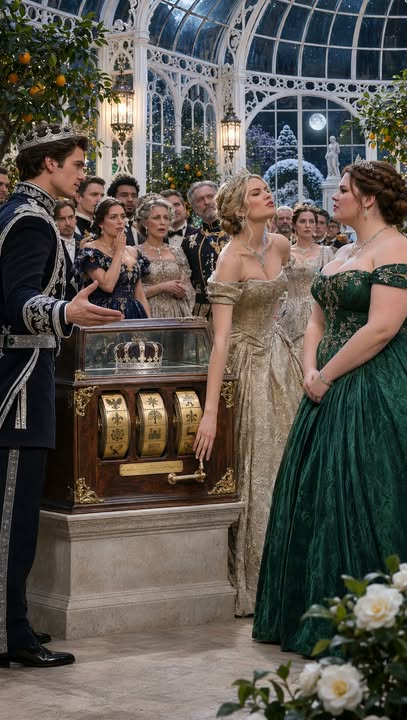
Part 3 – The Drawing in the Archive
“It’s my mother’s private mark,” Alexander said.
No one in the conservatory seemed to know what to do with the silence that followed.
The curator lowered the velvet tray, giving the prince room to consider the brass fragment without an audience pressing close.
Emma watched Alexander’s thumb move once along the edge of the tray.
“You said she used it on letters the court was never meant to see,” she said.
“Yes.”
“Then perhaps this one was never meant for the court, either.”
His gaze lifted to hers.
“That is what I’m trying to understand.”
A courtier cleared his throat behind them.
“Your Highness, perhaps the fragment should be examined in the archive.”
Alexander’s shoulders settled into their public alignment.
“Agreed.”
The guests began to stir, reluctantly dispersing as the palace attendants moved the chest toward a secure room.
Victoria stayed where she was, her eyes fixed on the brass fragment.
When Emma glanced her way, Victoria gave a small, thoughtful nod.
It was not quite an apology, but it was the first gesture between them that did not feel like a contest.
Alexander turned toward the curator.
“Please arrange for Miss Carter to have access to the relevant records.”
The request sounded generous, but Emma heard the uncertainty beneath it.
“Relevant records about the chest?” she asked.
“About the chest, the maker’s mark, and my mother’s family workshop.”
“Then I’ll need to see the original records, not just a summary.”
The curator’s expression brightened.
“An excellent instinct, Miss Carter.”
Alexander did not object.
“Of course.”
Emma held his gaze for a moment, trying to decide whether he trusted her or merely recognized that refusing would make him look foolish.
The difference mattered.
“Thank you,” she said, without pretending she had decided.
They left the conservatory by a side passage, accompanied by the curator and two attendants carrying the tray.
Beyond the glass, the snow had begun to gather on the garden paths.
The palace corridors were warm and quiet, lined with portraits whose painted eyes seemed to follow every passing conversation.
Emma walked beside Alexander, aware of the distance he kept between them and the attention that distance invited.
“Do you know what the initials were?” she asked.
“I do.”
He did not elaborate.
“Are you going to tell me?”
“Not here.”
She glanced toward the attendants.
“Because they might hear?”
“Because I don’t yet know what the initials mean.”
It was a reasonable answer.
It still left a small stone of doubt in her chest.
At the archive entrance, the curator unlocked a tall oak door and guided them into a long room scented with paper, wax, and old wood.
Tall shelves climbed toward a painted ceiling.
A set of green-shaded lamps illuminated several worktables, and at the far end, a narrow window revealed only the pale blur of the winter gardens.
Emma felt the same quiet excitement she had felt as a child in her father’s workshop, where every drawer held a tool and every tool suggested a question.
The curator set the brass fragment on a padded cloth.
“Most of the records from the old workshop are catalogued,” he said. “Some are kept in the family papers, but those are not always indexed.”
“Can we begin with the mark?” Emma asked.
He brought out a leather-bound volume.
“Here is a register of makers and royal suppliers.”
Alexander removed his gloves and turned the first page carefully.
Emma watched him handle the brittle paper with unexpected gentleness.
“He learned that from his mother,” the curator said. “Her Majesty insisted that old documents be treated as if they could feel.”
Alexander looked down at the register.
“She said paper remembered every careless hand.”
The words changed his expression, softening it.
Emma wondered what else his mother had taught him, and what the court had managed to turn into ceremony.
They spent the next hour following the sign through lists of workshops, restoration notes, and household accounts.
The mark appeared in a dozen places, though its form changed slightly across generations.
It was associated with a family of instrument makers whose work had served the palace for more than a century.
The name beside the earliest entry was Elowen.
“My mother’s great-grandmother,” Alexander said.
Emma leaned closer to the register.
The entry had been written in dark brown ink.
Beside the name, a small open circle had been drawn, intersected by a short stroke.
“That’s the mark,” she said. “The same one on the chest.”
The curator nodded.
“Your father’s recognition was extraordinary.”
Emma felt the familiar tug of grief at the mention of him, followed by a quiet pride.
“He would have liked to hear that.”
Alexander looked at her.
“What did he do after he left the workshop?”
“He never worked for the palace, if that’s what you mean.”
“I didn’t assume he did.”
“He repaired locks in a small shop near our apartment. Sometimes he worked on antique pieces for collectors, but he mostly helped people who had lost keys or inherited something they couldn’t open.”
She smiled despite herself.
“He believed people told the truth when they brought him a broken lock. They might leave out why it had broken, but they could never hide that it had.”
Alexander’s expression grew attentive.
“Did he ever work on anything from here?”
Emma hesitated.
“I don’t know.”
The curator turned another page.
“Miss Carter, would you recognize his handwriting?”
“Of course.”
“Then perhaps this will interest you.”
He opened a thin folder tucked into the back of the register.
Inside lay an old restoration ledger, its cover worn nearly smooth.
Several names had been entered in fading ink.
The last page held a note in a hand Emma knew as well as she knew her own.
She forgot the room.
The slant of the letters, the long tails on the y’s, the small gap between words where her father’s pen had paused to think—every detail brought him back so suddenly that for a moment she could almost smell the graphite and machine oil on his workbench.
She touched the page without quite resting her finger on it.
“That’s his,” she whispered.
Alexander stood beside her, silent.
The note was brief.
Repaired a similar lock for a traveling craftswoman.
Commissioner unknown.
Mechanism sound, though the maker had hidden a secondary catch beneath the lower plate.
The entry ended with her father’s initials.
Emma read it again, hoping a new detail would appear.
“Do you know what he meant by a similar lock?” Alexander asked.
“No.”
“Did he tell you about this commission?”
“Not that I remember.”
The words came out more sharply than she intended.
She closed the folder halfway, then opened it again, unwilling to shut the page away.
The curator spoke gently.
“The record appears to be decades old.”
“My father wrote it,” Emma said. “He would have been about my age when he made this entry.”
“Did he travel for work?” Alexander asked.
“Sometimes. Not often.”
She looked again at the phrase traveling craftswoman.
A woman carrying tools from place to place, bringing the shape of one mechanism into the hands of another maker.
The note revealed almost nothing, yet it altered the chest from a royal object into the end of a story that had passed through her father’s hands.
“Could the lock he repaired have been this one?” Alexander asked.
Emma examined the page.
“He says similar, not identical.”
“Could he have been protecting the commissioner’s name?”
“Possibly.”
“Or keeping a private record,” the curator added. “This was a workshop ledger, not a formal palace account.”
Emma felt Alexander’s attention on her.
“Do you think he knew who commissioned it?” he asked.
“I think he knew more than he wrote down.”
“Why wouldn’t he have told you?”
The question was quiet, but it landed too close to the small hurt she had already carried from his earlier uncertainty.
“I don’t know,” she said.
Alexander lowered his eyes.
“I’m sorry.”
“For asking?”
“For making it sound as though there must be a reason you can explain.”
Emma drew a slow breath.
The archive’s calm made every emotion feel louder.
“I don’t like finding out that my father kept things from me,” she said. “Even when I know there may have been good reasons.”
“I understand.”
“Do you?”
He looked at the record rather than at her.
“My mother kept a great deal from me.”
The answer held no accusation, only a weariness that Emma recognized.
“Was she secretive?”
“She was private. That is not quite the same thing.”
“What did she keep from you?”
Alexander’s fingers rested beside the open folder.
“I don’t know yet.”
The curator excused himself to retrieve another volume, leaving them alone at the table.
For several moments, neither spoke.
Emma studied her father’s handwriting.
“I thought the chest was only a puzzle,” she said. “Now it feels like he left me in the middle of a conversation.”
“Perhaps he did.”
“Or perhaps I’m trying to make a mystery out of a repair note because I miss him.”
Alexander’s voice was gentle.
“Those things can both be true.”
She looked at him.
“That’s a very careful answer.”
“I’ve had years of practice giving them.”
There was a flicker of humor in his eyes, gone almost as soon as it appeared.
Emma wanted to ask what he had practiced saying instead of what he felt.
Before she could, the archive door opened.
Victoria entered alone, carrying a small stack of books against her chest.
The sight of her in the quiet room seemed to surprise Alexander.
“I’m sorry to interrupt,” she said. “The curator said I could look at the public records.”
“He did?” Alexander asked.
“He did after I asked him twice.”
Victoria set the books down.
“I thought there might be a list of previous competitions.”
“Previous competitions?” Emma asked.
Victoria looked uncomfortable.
“I wanted to know whether the chest had been used before.”
“What made you think of that?”
“I saw the advisers speaking together after the challenge.”
Her gaze moved between Emma and Alexander.
“They looked less like men watching a success and more like men checking whether their plan had worked.”
Alexander’s expression became still.
“What plan?”
“I don’t know yet.”
Victoria pulled out a chair.
“The challenge may have been described as a tradition, but I have never seen a formal royal notice about it. I assumed there would be a record somewhere.”
“You entered it,” Emma said.
“Yes.”
“You knew what the prize was.”
“I knew what everyone told me it was.”
A faint color rose in Victoria’s cheeks.
“I had been told the prince would choose a bride from among the contestants. I believed that was an official arrangement.”
“And now?”
“Now I’m less certain.”
Emma considered the books she had brought.
“Why help us?”
Victoria’s mouth tightened.
“I’m not sure I’m helping you.”
“That’s honest.”
“I don’t enjoy being wrong,” Victoria said. “But I dislike being managed more.”
Alexander drew a chair out for her.
“Then let’s find out what was written.”
Victoria sat, her posture still elegant but less rigid than it had been in the conservatory.
They examined a collection of royal event ledgers and household announcements.
The oldest entry mentioning the chest was brief, describing it as an object commissioned for a private gathering by Queen Elara.
There was no reference to marriage.
No list of eligible women.
No instruction that the winner should become Alexander’s bride.
“Private gathering,” Emma read.
“Not a contest?” Victoria asked.
“Not in this record,” the curator said, returning with another ledger. “The chest was used during a winter reception. There is no indication that it selected a royal consort.”
Alexander’s face had become unreadable.
“Who revived it?”
The curator turned to a more recent file.
“The event was proposed last month by the royal household’s advisory council.”
“Under whose authority?” Alexander asked.
“Your council,” the curator replied carefully. “The notice was approved by the office of protocol.”
Alexander’s gaze shifted to Victoria.
She looked unsettled now, not triumphant.
“I was told the contest was part of your mother’s wishes,” she said. “That the chest had been designed to help you choose freely.”
The prince’s attention returned to the file.
“Who told you that?”
“One of the advisers. Lord Harrow, I believe.”
The name meant nothing to Emma, but something in Alexander’s jaw suggested it did to him.
“Did he tell the other contestants the same thing?” Emma asked.
“I don’t know,” Victoria said. “I thought everyone had received the same explanation.”
“We did,” Emma said. “At the entrance, an attendant called it a royal tradition.”
Victoria lowered her eyes to the page.
“I’m sorry.”
The apology was quiet and awkward.
Emma heard in it the effort required to give up certainty.
“I’m not sure you’re the person who owes me an apology,” she said.
Victoria glanced up.
“Still, I was unkind to you.”
“You were.”
“I was embarrassed after I failed, and I took it out on you.”
“That doesn’t make it all right.”
“No,” Victoria said. “It doesn’t.”
For a moment, the room held a tentative silence.
Then Victoria looked at the books.
“I don’t know what the advisers intended, but the competition was never in the official records as a marriage contract.”
Alexander read the file again, as if a different sentence might appear on the page.
“They told the court my mother wanted this.”
“Did they?” Emma asked.
“They said her wish was that I choose a bride through the chest.”
“Did you believe them?”
“I believed there was a private letter.”
His eyes moved to the brass fragment.
“I did not know they had invented the contest around it.”
The words settled over the table.
Emma felt her sympathy for him sharpen into something more complicated.
He had been pressured, but he had also announced a promise that could not be withdrawn as easily as a sentence.
“Why did you agree to the challenge?” she asked.
Alexander did not look away.
“I was told it would satisfy the council without binding me to a political match.”
“That sounds like a compromise someone else designed.”
“It was.”
“And you accepted it.”
“Yes.”
The honesty offered no comfort, but it made the answer easier to trust.
“Did you think a contest could give you a choice?” she asked.
“I thought it might give me time.”
“To decide what you wanted?”
“To resist what they had already decided.”
His voice had lowered.
“I should have questioned the arrangement sooner.”
Emma folded her hands on the edge of the table.
“I don’t want to become proof that the arrangement was fair just because I won.”
“You won’t.”
“You can’t know that yet.”
“No,” he said. “I can promise I won’t use you that way.”
She held his gaze.
“That is something you can control.”
“Yes.”
Victoria listened without interrupting.
For the first time, Emma saw her not as the polished woman who had approached the chest expecting the outcome to belong to her, but as someone who had also accepted a story because it had been presented as official.
The curator turned another page in the event file.
“There may be correspondence attached to the original proposal.”
He searched through the folder and drew out a narrow sheet.
“This is the council’s request for permission to revive the challenge. The authorization bears the prince’s seal.”
Alexander examined it.
“I didn’t sign this.”
The curator’s expression changed.
“Your office approved it.”
“My seal is not the same as my signature.”
The paper trembled slightly in Alexander’s hand, though his voice stayed controlled.
Emma leaned closer.
The authorization had been dated several weeks earlier.
“Could the seal have been applied by an authorized clerk?” she asked.
“It could,” Alexander said. “That is how administrative papers are sometimes processed.”
“Then someone may have approved it without asking you.”
“Or assumed that my office’s approval meant mine.”
“Would you have known?”
“I should have.”
The guilt in his voice was immediate, and Emma understood why he had learned to carry responsibility even for decisions made beyond his reach.
She also saw the danger in letting responsibility become a reason to trust no one.
“Could we check the other records?” she asked. “The notices, the instructions to the contestants, the correspondence about your mother’s letter.”
The curator nodded.
“There may be copies in the council archive.”
Alexander closed the folder.
“I’ll ask for them.”
“Ask,” Emma said, “or order?”
He looked at her, recognizing the distinction.
“Ask.”
Victoria’s mouth curved faintly.
“That may be the first time anyone has suggested he ask for something in this room.”
“Then the archive is improving me,” Alexander said.
It was the first time all evening that he sounded almost like himself.
The curator returned to the cabinet and began sorting through the files.
Emma stood and walked toward the narrow window.
Outside, the snow had softened the outlines of the garden paths.
Her father’s note lay open on the table behind her, his handwriting visible under the green lamp.
Alexander came to stand several feet away.
“I shouldn’t have questioned you before,” he said.
She kept her eyes on the snow.
“Which time?”
“When you told me your father had been a locksmith.”
“That wasn’t the only time.”
“No.”
He let the admission stand without defending it.
“I saw the mark and thought of what it could mean for the court,” he said. “I wondered whether you had known about the chest before tonight.”
“Because of my father’s work.”
“Because of the mark, and because the contest had already become something I did not understand.”
“You wondered whether I had come here with a purpose.”
“I did.”
The plainness of it stung more than the suspicion itself.
Emma turned from the window.
“You could have asked me.”
“I should have.”
“Do you think I came here to trick you?”
“No.”
“But you thought it was possible.”
“I thought everything was possible because I was afraid.”
“Of me?”
“Of being wrong about someone when the whole court would be watching.”
Emma’s expression softened, though the hurt did not disappear.
“I’m tired of being judged before anyone knows me.”
“I know.”
“No,” she said. “You understand the sentence. That isn’t the same thing.”
He absorbed the correction.
“You’re right.”
She looked down at her hands.
“I came here because I wanted to see whether I could do something difficult without first asking everyone else if I belonged.”
“You did.”
“I opened a chest. I still don’t know whether I belong.”
“Neither do I,” Alexander said.
The words held more loneliness than she expected.
For a moment, they stood together in the quiet, each looking at the same pale garden and finding different reasons to feel outside it.
Then the curator returned with a thin packet.
“I found a reference to the queen’s household correspondence,” he said. “The records are stored in the western archive.”
“Can we see them?” Emma asked.
“With permission from the keeper.”
Alexander straightened.
“I’ll speak with him.”
Victoria picked up the event file.
“Then I’ll continue looking through the council records.”
“You don’t have to,” Alexander said.
“I know.”
She gave him a level look.
“I’d like to.”
The following morning, Emma returned to the palace archive with Alexander, Victoria, and the curator.
The keeper had granted them access to a narrow section of the western records room.
It was less grand than the main archive, its shelves crowded with boxes and tied bundles of correspondence.
A cold draft moved through the room, bringing with it the smell of dust and old paste.
The keeper showed them the household catalogues, then left them to work under the curator’s supervision.
They found two references to Queen Elara’s correspondence with the old workshop.
Both pointed to a missing bundle.
One note listed its contents as private household letters, restoration requests, and several sketches related to the winter chest.
“Several sketches,” Emma repeated.
The bundle itself had been removed years earlier, possibly during a reorganization.
The curator made a note of the reference.
“Perhaps it was transferred to the queen’s personal papers.”
“Can we check?” Alexander asked.
“The personal papers are sealed in the royal collection.”
“Under whose authority?”
“The keeper of the collection.”
Alexander looked toward the shelves.
“Then we’ll ask.”
His answer sounded different from the command he might once have given.
They searched the remaining catalogues for references to the chest.
Near midday, Emma found a box of architectural and mechanical drawings.
A faded sheet had been folded between two inventories.
She opened it carefully.
The chest’s outline appeared in thin pencil strokes, with notes around the hinges and wheels.
The drawing was older than the contest by decades.
Emma could see the maker’s sign beside the middle wheel, copied with remarkable precision.
And beneath the lower edge, someone had sketched a second catch.
“The secondary catch,” Emma said.
Alexander bent over the drawing.
“The one your father mentioned.”
She followed the pencil line to the bottom of the page.
A short annotation had been written beside the mechanism.
The hand was faint, but the letters were distinct.
“Not visible until the lid is raised,” Emma read.
The curator leaned closer.
“That suggests the drawing predates the restoration.”
“Or that the chest was designed with a hidden compartment,” Victoria said.
Alexander’s eyes moved to the annotation.
“Can we tell who drew it?”
Emma examined the lower corner.
The initials were too faded to read.
But on the reverse side, a dark line showed through the paper.
She turned the drawing over.
A few words had been written there in a hand she recognized.
Not her father’s.
Her breath caught.
The note read:
The lower catch must remain untouched until the queen has made her choice.
Victoria looked from the paper to the chest’s outline.
“What choice?”
Alexander’s expression changed.
He stared at the words as if the archive had opened a door he had spent his life walking past.
At the bottom of the note, beneath a smudged date, someone had written a name.
Emma leaned closer.
It was her father’s.
**–END OF PART 3–CLICK “NEXT” AT THE BOTTOM OF THE PAGE TO CONTINUE READING**
* * *
[PREVIOUS: PART 2](https://echoesofstories.idolsgift.com/blog/part-2-the-mark-beneath-the-gold-046) | [NEXT: PART 4](https://echoesofstories.idolsgift.com/blog/part-4-the-mark-beneath-the-gold-046)
✓ Lynn R. Adams
Part 3 – The Drawing in the Archive “It’s my mother’s private mark,” Alexander said. No one in the conservatory seemed to know what to do with the silence that followed. The curator lowered the vel…