PART 3: The Mark Beneath the Frame 046
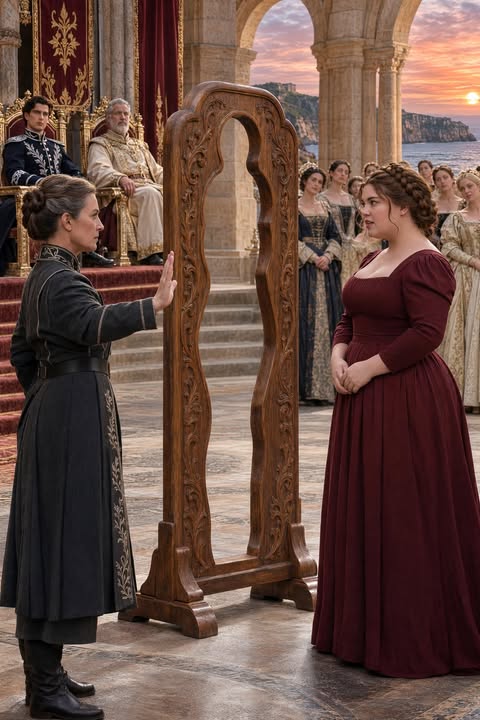
Part 3 – The Ledger in the Dust
The sentence stayed with me long after I read it.
My mother had not written, “I don’t know what you’re talking about,” or, “It must be someone else’s initials.”
She had written that the initials might be hers.
Then she had told me not to trust the palace’s version of the story.
I read the note again, searching for some softness hidden beneath the warning, but the words remained as firm as the crease down the center of the paper.
The palace’s version.
I folded the letter and slipped it into the pocket of my dress before the secretary could return to collect the tray.
For the rest of the morning, I found reasons not to speak of it.
I watched the other candidates gather in the west sitting room, where the paused competition had left us without a schedule and without a clear explanation of what would happen next.
Some were relieved to have a day without examinations.
Others seemed to feel that the unexplained halt had become another test, one with no instructions and no visible frame.
A woman with dark curls sat by the window, pretending to read.
The candidate in blue silk was mending a loose bead at her cuff.
When I entered, both glanced up, then quickly looked away.
The discovery had not been announced beyond the throne hall, but a secret in a palace had the peculiar quality of making every silence feel deliberate.
I took a seat near the fire.
The hem of my dress brushed my ankles, and I remembered my mother’s hands smoothing the wine-red fabric before she had stitched it.
She had worked with the same patience she brought to everything she cared about, including the things she claimed not to care about.
“Miss Carter,” the woman in blue said after a while.
I looked up.
“I hope the king explained what is happening.”
“Only that the competition is paused while they investigate.”
She lowered her voice.
“And the initials?”
“I’m not sure what they mean.”
That was true, though it was not the whole truth.
The woman studied my face, as if deciding whether there was more she was entitled to ask.
Then she returned to her bead.
I was grateful when a knock came at the door.
A palace messenger had brought a note from Alexander.
He asked if I would meet him in the small conservatory after lunch.
No explanation was given, but I could guess there was one.
The conservatory overlooked the inner garden, where late-season flowers bowed beneath a thin rain.
Alexander was standing beside a table of potted herbs when I arrived.
He wore no formal coat, only a dark waistcoat over a white shirt, and for the first time since we had met, he looked tired in a way he was not trying to hide.
“Did your mother reply?” he asked.
I had not expected him to begin with that.
“Yes.”
His expression sharpened.
“She recognizes the initials?”
“She said they may be hers.”
He waited, giving me room to continue.
“She also told me not to trust the palace’s version of the story.”
The rain tapped softly against the glass.
Alexander turned his face toward the garden.
“That is a serious thing to say.”
“She didn’t tell me what she meant.”
“Do you think she knows what the plate is?”
“I don’t know.”
I reached into my pocket and took out the folded letter.
“I’m not going to show you without her permission.”
“I wasn’t going to ask you to.”
His answer came without hesitation, and I felt some of the tension leave my shoulders.
“She has a right to her privacy,” he said. “So do you.”
“Then why did you want to speak with me?”
“Because the attendant has remembered something.”
He moved to the table and picked up a sprig of rosemary, rubbing it between his fingers.
“She was given a written instruction to move the frame, but she now thinks the person who brought it may have been the chief steward’s assistant.”
“The same person who works for the king’s chief adviser?”
“The assistant reports to the steward, who reports to the adviser.”
“That’s not quite the same thing as knowing who gave the order.”
“No,” Alexander said. “It isn’t.”
He set the rosemary down.
“The attendant was afraid she would be blamed for the confusion, so she didn’t mention the assistant at first.”
“Can you understand why?”
“I can.”
He did not try to defend the palace, and that mattered.
“I spoke with her this morning,” he continued. “She said she was told to reset the frame after each candidate passed, and that the final placement was arranged by Lord Harrow, my father’s chief adviser.”
The name sounded familiar from the formal introductions, though I had not yet spoken to him.
“Did she see him move it?”
“No. She saw him check its position before the round began. She assumed he was making sure it was safe.”
“And was it?”
“It did not fall.”
“That isn’t quite the same as safe.”
He gave a brief, reluctant smile.
“You’ve already made me wary of that word.”
The moment passed, and his face grew serious again.
“Lord Harrow says the frame was positioned according to the test instructions. He says the attendant’s recollection is mistaken.”
“Does he know about the plate?”
“He knows the frame is under examination. I have not told him what was engraved beneath it.”
“Why not?”
“Because I don’t know what he knows.”
“And if he arranged the final placement, he may know more than you do.”
“Yes.”
His willingness to admit that unsettled me more than a denial would have.
“Your father agrees with him?” I asked.
“My father says he has no reason to suspect Lord Harrow.”
“That’s not the same as saying he knows what happened.”
“No,” Alexander said. “It isn’t.”
The conservatory seemed to grow smaller around us.
“Have you spoken to your father about my mother’s letter?” I asked.
“No. It is yours to decide whether to tell him.”
I looked down at the folded paper.
“I don’t know what I should do.”
“You don’t have to decide today.”
That was what I had hoped he would say, though I had not known it until he said it.
For a few moments, we listened to the rain.
Then Alexander asked, “Do you want to stay in the competition?”
The question did not sound like a trap.
“I don’t know.”
“Do you want to leave?”
“I don’t know that, either.”
He nodded, as if uncertainty were an answer he could respect.
“I used to think that if someone had enough courage, she would always know what she wanted,” he said.
“And now?”
“Now I think courage may be staying long enough to find out.”
I wondered whether he meant the competition or the conversation.
Before I could ask, the conservatory door opened.
King William stood in the doorway.
His eyes went first to Alexander, then to me.
“Am I interrupting?”
“No,” Alexander said.
The king studied his son’s face.
“I need to speak with you.”
Alexander glanced at me.
“You may stay, Miss Carter, if you wish.”
I did not know whether that was an invitation or an attempt to keep nothing hidden.
The king answered for me.
“This concerns the frame and the adviser’s report. It does not concern Miss Carter.”
“Then I’ll go,” I said.
I walked past the king into the corridor.
As I reached the turn, their voices rose behind the closed door.
“Father, the attendant’s account deserves to be investigated.”
“She admits she did not see who left the instruction.”
“She says Lord Harrow chose the placement.”
“She says she saw him near the frame.”
“Why are you defending him before we know what happened?”
“I am not defending anyone. I am asking you not to mistake suspicion for evidence.”
I kept walking, though each sentence followed me.
At the end of the corridor, a footman stood with a bundle of fresh linen.
He gave me a courteous nod and continued toward the conservatory.
I wondered how many people in the palace knew that the king and prince were arguing.
I wondered how many of them had learned to recognize a disagreement by its carefulness rather than its volume.
That afternoon, I wrote to my mother again.
I told her the initials were engraved on an old brass plate fitted beneath a wooden frame.
I told her the palace had paused the competition and was looking into who had moved it.
I did not tell her that the king’s chief adviser had been named.
I did not mention Alexander.
I asked only what she had meant by the palace’s version.
Then I crossed out the question and wrote it again, more plainly.
What do you know about this place?
The letter felt too direct once I had finished it.
I considered replacing it with something smaller, something that would let her answer without exposing whatever she was trying to protect.
But I had spent enough of the day watching people make careful choices on behalf of others.
I sealed the letter and sent it.
By early evening, the palace secretary brought word that the king wanted to see me in the library.
I found Alexander already there, standing by the long table where the conservator had laid out the rubbing of the brass plate.
King William sat beside a lamp, his hands folded.
The chief adviser was not present.
The conservator had gone, leaving behind the tools he had used to inspect the engraving.
“Miss Carter,” the king said. “I wanted you to hear this directly from us.”
I looked at Alexander.
He seemed as uncertain as I felt.
“The attendant has confirmed that she was instructed to move the frame after each candidate,” King William said. “We have also learned that Lord Harrow arranged its final position before the test began.”
“Did he explain why?” I asked.
“He said the frame needed to be aligned with the floor marks.”
“Did it?”
“The conservator says the frame could have stood safely without being moved.”
The king’s gaze lowered to the rubbing.
“Lord Harrow maintains that the attendant misunderstood his instructions. He says the test has always required candidates to pass through the frame as it is set.”
“Then why are there marks on the floor?”
“That is what I asked him.”
“And what did he say?”
“He has not yet provided an answer.”
The king did not sound angry.
He sounded as though he had reached the edge of what he could accept without needing to admit that someone he trusted might have misled him.
Alexander leaned one hand against the table.
“Father, the instruction card has no signature. The attendant remembers the assistant carrying it. We should speak with the assistant before we accept Lord Harrow’s account.”
“I have asked the steward to locate him.”
“Then we should wait for his statement.”
“We have already waited two days.”
“And we have had two days to discover that the frame’s position was altered deliberately.”
The king drew in a slow breath.
“This is a competition for a queen, not a trial of the royal household.”
“Then we should make sure the competition is fair.”
“Fairness is not achieved by treating every instruction as evidence of deceit.”
“Nor by treating every familiar name as beyond question.”
The words fell quietly, but the king’s expression changed.
“Do you believe Lord Harrow is a liar?”
“I believe we have not asked the right questions.”
“That is not an answer.”
“It is the only honest one I have.”
The king looked away.
I stood with my hands clasped in front of me, wishing I could disappear into the shelves.
I understood Alexander’s frustration, but I could also see how much it cost him to speak to his father that way.
King William had spent years trying to guide his son toward a marriage he believed the kingdom needed.
Alexander had spent those same years trying not to let the kingdom make the choice for him.
Now they were standing on opposite sides of an old wooden frame, and neither seemed able to step across without losing something.
The king turned back to me.
“You have mentioned your mother’s initials. Has she told you anything about the plate?”
“She has not explained it yet.”
“Does she recognize the initials as her own?”
“She said they may be hers.”
Alexander looked at me, surprised.
I had not told him that detail before.
The king’s mouth tightened.
“May be?”
“She hasn’t given me a fuller answer.”
“Does she have any connection to the palace?”
“Not that I know of.”
“Has she ever been in the kingdom?”
“I don’t believe so.”
“Then I suggest we avoid creating a connection where none may exist.”
“I agree that we should be careful,” I said. “But caution can mean waiting for the answer, not deciding in advance that there isn’t one.”
The king’s face softened a little.
“You are right,” he said. “It can.”
He rose from his chair and walked toward the shelves.
“The court is not prepared for another rumor. If word spreads that an American candidate’s family is somehow connected to an old test, it will eclipse every question of whether the test itself was altered.”
“Then don’t let the court hear it as a rumor,” Alexander said. “Tell them only what we know.”
“And what do we know?”
“That someone instructed the attendant to move the frame. That Lord Harrow arranged the final placement. And that the plate was built into the frame long ago.”
“We know no motive.”
“Then say we know no motive.”
King William stopped beside a shelf of bound accounts.
“You speak as if disclosure carries no consequence.”
“It carries consequences either way.”
The king turned back to him.
“You think I do not know that?”
“No,” Alexander said, softer now. “I think you are trying to protect the household from the wrong consequence.”
For a moment, neither spoke.
I wished I could give them something to agree upon.
Instead, I looked at the rubbing on the table.
The engraved letters rested in the lamplight, their edges darkened by age.
“My mother is not part of the palace’s investigation,” I said. “She should not become one unless she chooses to be.”
King William gave a single nod.
“Agreed.”
Alexander looked relieved.
The king continued, “But the frame is the property of the palace, and the test belongs to the crown. We will investigate the handling of both.”
That seemed fair enough, although I could hear the limits of his promise.
When I returned to my room, the second letter to my mother had already been sent.
I sat beside the window, watching rain gather on the stone sill.
The days before the competition had been full of anticipation.
Now each hour seemed to add another question to the one I had written in my notebook.
Who had placed the frame where it was?
Why had the attendant been told to move it?
Why had my mother recognized the initials but warned me against the palace?
And why had King William’s first instinct been to contain the story?
I had no answer.
The following morning, a message arrived from the attendant asking if I would meet her in the service courtyard.
I went after breakfast.
She stood beneath the covered passage, where a row of potted lemon trees offered some shelter from the wind.
Her ledger was tucked beneath one arm.
“I’m sorry to ask you to keep meeting me,” she said.
“You don’t have to apologize.”
“I found the card’s wording in the ledger.”
She opened the book to a narrow page filled with notes about the hall.
Near the bottom, in a different hand, someone had written a line beside the date of the test.
Return frame to marked position after each candidate.
The ink was faded but legible.
The entry had no name.
“Is this your handwriting?” I asked.
“No. I wrote the names of the candidates above it, but the instruction was already there.”
“Did you see it before the test?”
“I thought it was part of the setup notes.”
“Who keeps the ledger?”
“I do. It stays in the hall unless the staff needs it.”
She looked uneasy.
“I remembered the card after you asked me about it, and then I checked the ledger. That instruction was written there days before the card arrived.”
“Did you tell Alexander?”
“Yes.”
“Does he know whose handwriting it is?”
“No. He asked the archivist to compare it with other household records.”
The attendant rubbed her thumb against the ledger’s worn edge.
“I don’t want you to think I was trying to hide anything.”
“I don’t.”
“I was told the frame should be put straight. I thought it was a matter of safety.”
“You believed you were helping.”
“I did.”
We stood quietly among the potted trees.
Beyond the passage, a servant crossed the courtyard carrying a basket of kindling.
The palace continued around us, steady and occupied, while a small instruction in an old ledger had started to rearrange everything I thought I understood about the test.
“Who had access to the book?” I asked.
“Any of the staff assigned to the hall.”
“That’s a lot of people.”
“Yes.”
She closed the ledger.
“I’ve been wondering whether I should have noticed that the frame was being moved to a different position every time.”
“You were told to correct it.”
“I was told to return it to the marked position. I didn’t think to check what the marks meant.”
“Neither did anyone else.”
She gave me a thoughtful look.
“Do you think the test was meant to catch people who followed orders?”
“I think it may have been meant to ask a question about following orders.”
“That’s not the same thing.”
“No. It isn’t.”
Before she could answer, Alexander came through the far arch.
He had a folded document in his hand and spoke with a palace clerk who walked beside him.
When he saw us, he excused himself and crossed the courtyard.
“The archivist found a note that may help,” he said.
The attendant opened her ledger again.
“What kind of note?”
“An old palace account mentions a craftswoman who worked in the workshops several decades ago. The name is Eleanor Carter.”
For a moment, I heard nothing except the rain dripping from the edge of the roof.
I had thought the name might appear in a letter from my mother, perhaps in a familiar memory or a story she had forgotten to tell.
I had not expected it to come from a palace archive.
“Eleanor Carter?” I asked.
“That is what the ledger says.”
“My mother’s name is Eleanor Carter.”
“I know.”
“Could it be a different person?”
“It could,” Alexander said. “The account is brief. It calls her an American craftswoman, and it says she worked in the palace workshops.”
The attendant looked between us.
“An American?”
“Yes.”
I pressed my fingers against the folded edge of my dress.
My mother had told me about the old woman who taught her to sew.
She had spoken of an apartment, a library, the careful arithmetic of a paycheck, and the neighbors who had helped when I was small.
She had never mentioned a palace.
Alexander unfolded the document.
“The archivist has not found anything else yet. He only sent me the reference.”
“Does it say what she made?” I asked.
“No. The account notes that she was paid for workshop labor, but the rest of the page is missing.”
“And the date?”
“Several decades ago.”
“That could be long before my mother was born.”
“It could.”
The answer did not comfort me.
The attendant closed the ledger.
“Could she have made the frame?”
“We don’t know,” Alexander said. “The conservator believes the plate was fitted when the frame was built, but he cannot tell us who built it.”
I tried to look at the name on the document, but my eyes kept returning to the first line.
Eleanor Carter.
It was the same name I had written on the envelope in my room, the same name my mother signed with a looped E.
“My mother told me not to trust the palace’s version,” I said.
Alexander’s face grew still.
“She said that?”
“Yes.”
“Did she explain why?”
“Not yet.”
“Do you think she knows about the workshop?”
“I don’t know what she knows.”
He folded the document again, more carefully than before.
“We should not assume the woman in the ledger was your mother.”
“I’m not.”
But I could hear the strain in my own voice.
The attendant gave me a sympathetic look.
“Would your mother have had a relative with the same name?”
“I don’t know.”
I had never asked.
Our family stories had always begun with my mother, as if the past had started when she was old enough to remember it.
She had never been secretive about her life, not in the way people meant when they said secretive.
She simply told stories in pieces, when they seemed to matter.
I had never thought there were missing pages.
“Do you want me to ask the archivist to look further?” Alexander asked.
“Yes,” I said.
Then I hesitated.
“Please don’t tell anyone in the court that the name belongs to my mother.”
“I won’t.”
“Not until we know whether the connection is real.”
“I understand.”
The attendant tucked her ledger beneath her arm.
“I should return this before someone notices it’s gone.”
She left through the covered passage.
Alexander and I remained beneath the roof while the rain moved across the courtyard in a fine gray veil.
“I’m sorry,” he said.
“For what?”
“For bringing you another question when you already have too many.”
“You didn’t create it.”
“No, but I know what it feels like when someone else’s past is suddenly treated as a matter the palace is entitled to examine.”
I looked at him.
“Is that what happened to you?”
“In a way.”
He turned toward the inner garden.
“My father has spent most of my life being told what the kingdom needs from me. My advisers say I should marry quickly, produce an heir, and make the court feel secure. They are not wrong about every part of it.”
“But?”
“But a person can be right about the need and wrong about the answer.”
I thought of the frame and the instruction card.
The attendant had followed an order because she thought it kept the test orderly.
The king wanted to protect the kingdom from a rumor because he thought it would prevent confusion.
The adviser may have thought he was preserving a tradition, or perhaps he had wanted something else.
Every choice had been made for a reason, but the reasons were hidden from the people who had to live with them.
“Do you think your father knows what the initials mean?” I asked.
“I asked him that yesterday.”
“And?”
“He said no.”
“Did you believe him?”
Alexander watched a drop of rain slide down a glass pane.
“I believe he believes he has no reason to know.”
“That’s not quite the same answer.”
“No,” he said. “It isn’t.”
The honesty between us felt more difficult now.
We were not simply two people trying to understand a test.
We were standing in the middle of a history that could change how each of us saw our family.
“Do you think the old Eleanor Carter could have been my grandmother?” I asked.
“I think the archivist should find more before either of us decides.”
“That sounds sensible.”
“It is also the answer I would give if I were afraid of being wrong.”
“Are you?”
“Yes.”
He did not look away from me when he said it.
A servant appeared at the far end of the courtyard, carrying a small brass tray.
“Your Highness,” he called. “The king asks for you in the council room.”
Alexander glanced at the tray, then at me.
“I should go.”
“Of course.”
He started toward the arch, then turned back.
“I’ll ask the archivist to continue the search. If you want to stop the inquiry where your family is concerned, you can tell me.”
“And if I don’t?”
“Then I’ll keep asking what the records say, and I’ll tell you what I find.”
He left before I could decide whether that was a promise or simply the most honest answer he could offer.
I returned to my room with the name still in my mind.
Eleanor Carter.
For the rest of the day, I waited for my mother’s reply.
It did not come.
In the evening, the secretary brought a small packet from the palace archives.
Inside was a copy of the ledger entry, its edges darkened by age.
The archivist had added a note beneath it.
The original is incomplete; further references may be held in the workshop accounts.
I set the paper beside my mother’s letter.
One told me the palace had once employed an American craftswoman named Eleanor Carter.
The other told me not to trust the palace’s version of the story.
I could not make the two statements fit together without imagining the person who had made them was someone other than my mother.
The next morning, I received no letter from home.
Instead, Alexander sent word that he would meet me in the library with the king and the archivist.
I arrived to find the two of them standing over an open ledger on the table.
The king looked as though he had not slept well.
Alexander’s expression was composed, but his hands were clasped too tightly behind his back.
The archivist was a thin, elderly man with ink stains on his cuffs.
“We have found another reference to Eleanor Carter,” he said.
I stepped closer.
“Another one?”
“In the workshop accounts,” he said. “The entry is dated several decades ago, though the exact year is difficult to establish.”
“What does it say?”
He turned the ledger toward me.
The writing was cramped, but clear enough to read.
Eleanor Carter, American craftswoman, paid for frame construction and fitting.
My eyes stopped at the last two words.
Frame construction.
I looked up at Alexander.
“Does it say which frame?”
The archivist placed one finger on the entry.
“The account identifies the commission by its location.”
He turned the page.
The next line was partly obscured by an old tear in the paper.
But the words that remained were unmistakable.
Throne hall.
The king drew in a breath.
Alexander did not move.
I stared down at the ledger, hearing once more the attendant’s quiet confession, the scrape of the frame across the stone, and the pale marks that had shown where it was meant to stand.
Then the archivist lifted the corner of the torn page.
Beneath it, written in smaller letters, was a note no one had mentioned before.
Frame to be retained as a test.
**–END OF PART 3–CLICK “NEXT” AT THE BOTTOM OF THE PAGE TO CONTINUE READING**
* * *
[PREVIOUS: PART 2](https://echoesofstories.idolsgift.com/blog/part-2-the-mark-beneath-the-frame-046) | [NEXT: PART 4](https://echoesofstories.idolsgift.com/blog/part-4-the-mark-beneath-the-frame-046)
✓ Lynn R. Adams
Part 3 – The Ledger in the Dust The sentence stayed with me long after I read it. My mother had not written, “I don’t know what you’re talking about,” or, “It must be someone else’s initials.” She …