PART 3: The Mark Beneath the Crown 057
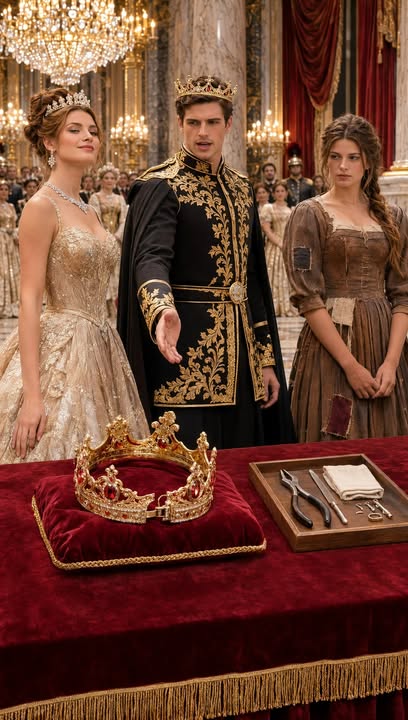
Part 3 – The Name Beneath the Band
Adrian’s fingers rested on the unfolded paper, though he did not lift it from the wooden box.
For several seconds, neither he nor Elara spoke.
The old mending cloth lay beside the letter, its stitched leaves turned toward the lamplight, and the sight of the two together made the past seem suddenly close enough to touch.
“May I read it?” Elara asked.
“Of course.”
Adrian moved the paper between them.
The note was brief, written in a careful hand that had faded to the color of weak tea.
It thanked Mara for her patient work and ended with the words Elara remembered.
You saved what others thought beyond repair.
Below the message was her mother’s name, written in full, and a date from more than twenty years earlier.
Elara read it twice.
The first time, she saw only the letters.
The second time, she noticed the tenderness in the handwriting, the deliberate care of someone who had wanted the words to last.
“My mother never told me who wrote this,” she said.
“Neither did my grandmother leave an explanation.”
“Perhaps she thought the note was enough.”
Adrian looked at the paper as if he wished it could answer him.
“Perhaps.”
The chamberlain shifted outside the open door.
The sound brought the room back into the present.
Adrian folded the letter along its old creases and placed it carefully beside the cloth.
“Thank you for telling me about it,” he said.
“I did not know it was connected to your grandmother.”
“Neither did I.”
Elara glanced at the old box.
It held no grand treasure, only a few tools and the evidence that her mother’s work had mattered to someone beyond their small home.
That was enough to make her feel as though she had crossed a threshold without knowing where it led.
Adrian did not ask her to explain more.
Instead, he returned to the page she had written about the crown and laid it over a fresh sheet.
“I would like you to help me compare the clasp with the palace records,” he said. “Not because of your mother’s note, but because you observed the hinge more carefully than anyone else in the room.”
Elara searched his face for the difference between courtesy and expectation.
She found no demand there.
“I can help describe what I saw,” she answered. “But I do not know the history of the crown.”
“Then we will learn what the records can tell us.”
The word we caught her by surprise.
She had been asked to assist with a task, not invited into a confidence.
Still, Adrian spoke as if he believed knowledge belonged to whoever could contribute to it.
Elara sat in the chair at last.
They worked for nearly an hour, comparing her description with an old inventory sheet and a maintenance ledger brought from the archive.
The records were tidy in appearance, but their neat columns concealed gaps.
The crown had been listed as inspected after the previous royal ceremony.
A line in the ledger noted that its fastening had been adjusted, though the name of the craftsperson was not written.
Instead, the entry bore the stamp of the royal jeweler’s workshop.
“Could that mean the jeweler did the repair?” Elara asked.
“It could,” Adrian said. “Or it could mean the work was recorded under the workshop’s account.”
“Those are not the same thing.”
“No.”
He looked at the blank space where a name should have been.
“My family has kept records for generations,” he said. “We seem to have been better at recording objects than people.”
Elara let her gaze rest on the old mending cloth.
“Sometimes people are remembered in ways that do not appear in ledgers.”
Adrian turned toward her.
“Is that what your mother believed?”
“I think she believed the work mattered, even when no one wrote down who had done it.”
He considered this, then reached for the ledger again.
“Would you come back tomorrow and examine the crown with the goldsmith?”
Elara felt the chamberlain’s attention from the doorway.
“If Mrs. Vale can spare me.”
“I will speak with her.”
“That is not necessary, Your Highness,” Elara said, perhaps more quickly than she intended. “I can ask her myself.”
Adrian paused, then nodded.
“You are right. I should not arrange your time without asking the person responsible for it.”
The admission eased the tightness that had begun to form in Elara’s chest.
She was grateful for the invitation, but she did not want her work to become an excuse for the prince to decide what her days should be.
“Thank you,” she said.
When she rose, Adrian returned the letter and mending cloth to the box.
He did not offer them to her, nor did he ask to keep her mother’s words.
He closed the lid gently.
“I will take care that these remain together,” he said.
Elara bowed and left the office.
Outside, the chamberlain fell into step beside her for a few paces.
“His Highness has a habit of becoming absorbed in old questions,” he said.
“Is that a warning?”
“Only an observation.”
Elara was not sure whether she liked it.
By morning, the palace had made a story of the crown.
The servants had heard that the clasp was broken, the nobles had heard that a maid had noticed what a lady had missed, and the kitchen had heard three different versions of how the file had been used.
Mrs. Vale ended the most extravagant account by setting a basket of folded linens on the counter.
“No one has repaired the crown,” she said. “No one should speak as if it has been repaired.”
The younger maids lowered their voices.
Elara took the basket from her.
“Thank you.”
“You may thank me by telling me what the hinge actually did.”
Elara described the pin and the way it had shifted.
Mrs. Vale listened with the thoughtful attention she gave any task that could not be undone.
“And you stopped when you did not know what came next,” she said.
“Yes.”
“Good.”
That was all.
It was not praise, but Elara knew it meant more from Mrs. Vale than a roomful of compliments.
The head housekeeper glanced toward the corridor leading to the royal offices.
“His Highness asked whether I could spare you for an hour today.”
“I told him I would ask you myself.”
“And you have.”
Mrs. Vale folded the corner of a linen sheet.
“I can spare you after the breakfast service, but not before.”
“I understand.”
“Then go when the kitchen is clear, and come back when the hour is over.”
Elara accepted the arrangement without protest.
It mattered that the decision had been made with her, rather than for her.
Across the palace, Celestine was receiving a different kind of attention.
Her family’s steward had arrived before breakfast, carrying a leather portfolio and a careful expression.
He waited until Celestine was alone in the small reception room adjoining her apartments.
“My lady, your father asked me to bring the latest correspondence from the northern estates,” he said. “There is also a note concerning the palace ceremony.”
Celestine looked up from the tea she had not touched.
“What note?”
The steward placed a folded page beside her cup.
It contained the official account of the previous royal ceremony and a list of repairs made to the regalia afterward.
Celestine had asked him for the information the night before.
She had told herself she was merely trying to understand the crown’s history.
But the request had followed her apology to Elara, and she could not entirely separate curiosity from unease.
“Who prepared this?” she asked.
“The archivist sent a copy from the public register.”
Celestine skimmed the list.
The crown’s fastening had been adjusted after the ceremony by the royal jeweler’s workshop.
The entry was presented as fact, with no further detail.
“Is there another account?”
“Not in the public register.”
“And the workshop records?”
“I do not know. They may be held with the jeweler’s family papers.”
Celestine set the page down.
The steward studied her face.
“Is something troubling you?”
“I do not know yet.”
She disliked how often those words had become necessary since the night before.
The crown’s damage had been her fault.
That did not mean every mystery surrounding it belonged to her.
Still, she had watched Elara identify the crooked pin without forcing it, and she had heard the maid speak of her mother as though careful work could outlast the person who performed it.
Celestine had been raised to notice things that could be used: a rival’s weakness, a family’s influence, a favor owed.
She was beginning to understand that not every discovery needed to be turned into an advantage.
“Thank you,” she said to the steward. “I will read the rest later.”
When he had gone, she unfolded the note from her father.
It asked whether the prince had shown serious interest in proceeding with the marriage discussions.
Celestine read it once, then folded it again without answering.
She had come to court with a clear idea of what was expected.
Her father wanted an alliance that would strengthen their family’s influence.
The court wanted a match that looked suitable.
Adrian, she had believed, wanted a wife who could move confidently among the powerful families gathered around him.
Celestine had thought she could meet all those expectations by being impressive.
The crown had exposed how easily confidence could resemble understanding.
A little later, Adrian met with her in the western gallery.
He had suggested they speak privately, and she arrived expecting a discussion of the damaged clasp.
Instead, he stood beside a tall window, watching the rain trace pale lines down the glass.
“I read the official record,” Celestine said. “The jeweler’s workshop is credited with the adjustment after the last ceremony.”
“That is what the register says.”
“Do you doubt it?”
“I doubt the register tells us everything.”
She took a moment before answering.
“Because of Elara’s mother?”
“Because of the old cloth, the note, and the missing name in the ledger.”
Celestine looked at him carefully.
“Did Elara tell you her mother worked on the crown?”
“No.”
“Did you ask her?”
“No.”
“Why not?”
“She did not know, as far as she could tell.”
Celestine turned toward the rain-streaked window.
There was no accusation in Adrian’s answer, but it left her aware of how quickly she had assumed Elara might be using the connection.
The thought had come so naturally that she had barely noticed it.
“Are you afraid she might have a claim to something?” she asked.
“I am afraid that we may have given credit carelessly.”
“That is not quite the same thing.”
“No.”
The quiet between them lengthened.
Celestine was accustomed to speaking first in a room.
It was how she controlled the pace of a conversation and how she kept others from mistaking hesitation for weakness.
Now she found herself searching for the right words rather than the most effective ones.
“I laughed at her because I thought she had nothing to offer,” she said.
Adrian did not turn from the window.
“Do you still think that?”
“No.”
The answer came readily.
Celestine looked down at her hands.
Her gloves were finely made, the seams narrow and nearly invisible.
She had never wondered who repaired them when a thread came loose.
“I thought people would respect me if I was certain,” she continued. “If I knew the right names, wore the right things, and never appeared uncertain.”
“And now?”
“Now I think certainty can be another kind of costume.”
Adrian looked at her then.
“I did not know you felt that way.”
“Neither did I, until I saw how quickly the room turned against me when I broke the clasp.”
“You were not turned against.”
“No one said anything unkind,” she replied. “They did not need to. I had failed in front of everyone, and every person who expected me to succeed seemed suddenly to be measuring what the failure meant.”
Adrian’s expression softened.
“That must have been difficult.”
“It was embarrassing.” She drew a slow breath. “It was also my doing.”
“You could have stopped when the metal resisted.”
“Yes.”
She did not try to excuse herself.
That seemed to surprise him more than any defense would have.
Celestine continued, “I want you to know that my interest in marrying you is not only about my family.”
The admission made her palms feel cold.
“My father believes the match would secure our position at court,” she said. “He is not wrong. But I also thought that being chosen by you would prove I was more than a polished name and a suitable gown.”
“Celestine—”
“I know how it sounds.”
“It sounds honest.”
She met his eyes, expecting pity and finding none.
“I do not want you to marry me out of gratitude for my honesty,” she said.
“Nor would I.”
“Good.”
A small, unsteady smile crossed her face.
“I would rather be disappointed by the truth than rewarded for pretending.”
Adrian’s attention returned to the rain.
“I have not decided whom I will marry,” he said. “And I should not have framed the crown as a test that could decide such a thing.”
Celestine followed his gaze to the silver window.
“You made it sound as if patience and judgment could be demonstrated in fifteen minutes.”
“I was wrong.”
“So was I, in a different way.”
The conversation did not resolve what either of them wanted.
But when Celestine left the gallery, she felt less like a contender who had lost a contest and more like a person who had finally admitted what the contest had meant to her.
That afternoon, Elara returned to the royal library with Mrs. Vale’s permission.
The goldsmith had not yet arrived, and Adrian was waiting beside a broad table where several old inventories had been spread.
The crown remained under its protective cloth.
“I hope I have not kept you from your other work,” he said.
“I have an hour.”
“Then we will make the hour useful.”
They examined the records from the previous ceremony.
Some pages were written in the same hand as the maintenance ledger.
Others had been copied later, their lines straighter and their words more polished.
Elara noticed that every mention of the crown’s fastening used the word adjusted, never repaired.
“It seems a careful distinction,” she said.
“Perhaps whoever wrote it wished to be precise.”
“Or perhaps they wished not to say who did more than an adjustment.”
Adrian looked at the line.
“Do you think that is what happened?”
“I do not know.”
She was careful not to make a possibility sound like a discovery.
He seemed to appreciate the distinction.
At the bottom of one page, a narrow column had been added in darker ink.
The entry stated that the crown had been inspected after the ceremony and returned to its case.
The name of the inspector was smudged.
Elara tilted the page toward the window.
The marks resolved into two letters and the beginning of a third.
“Could that say ‘Mara’?” Adrian asked.
“It could say something else.”
They leaned close, neither touching the old paper.
The first letter might have been an M, though the ink had blurred where the page had once been folded.
“Does the archive have the original work order?” Elara asked.
“I have requested it.”
“Then we should wait to see what it says.”
Adrian nodded.
Elara glanced at the crown beneath its cloth.
“May I look at the hinge again?”
“Only if the goldsmith agrees.”
“That is fair.”
The door opened, and the royal goldsmith entered with a leather case in hand.
He was an elderly man named Master Orin, whose fine white hair was tied neatly at the nape of his neck.
He greeted Adrian, then Elara, with the same courteous inclination of his head.
The courtesy mattered.
Elara had expected to be treated as an extra pair of hands, or perhaps as a curiosity.
Instead, Master Orin asked her to describe the pin before he uncovered the crown.
She explained its position and the way it had moved.
He listened without interruption.
Then he lifted the cloth.
The damaged clasp looked more delicate in the quiet library than it had beneath the ballroom chandeliers.
Master Orin examined the hinge through a small lens.
“It is seated more securely now,” he said. “Who moved the pin?”
“Elara did,” Adrian answered.
The goldsmith glanced at her, not with disbelief but with interest.
“You were wise to stop afterward.”
“I did not know whether moving it farther would help.”
“Good judgment often begins with knowing what you do not know.”
He examined the broken fragment Celestine had snapped.
The break was clean, but the shape of the missing fastener remained unclear.
“It will need a matching piece,” he said. “Not merely one that fits, but one that shares the proper weight and curve.”
“Can you make it?” Adrian asked.
“With time and the correct gold.”
Master Orin tested the hinge without closing it.
“Someone has worked on this clasp before,” he said.
Elara leaned nearer.
“Because of the scratches?”
The goldsmith looked up.
“You saw them?”
“They are very small, but they repeat along the pin.”
He adjusted the lens and examined the marks.
“Several times, perhaps. The pin has been guided into place and removed again.”
“Could that have been done when the clasp was adjusted after the last ceremony?” Adrian asked.
“It could. It could also be older.”
Master Orin returned the lens to his case.
“The marks are not careless. Whoever made them understood the hinge.”
The room seemed to grow quieter.
Adrian glanced toward the ledger.
“Would the scratches help identify the person who worked on it?”
“Not by themselves,” the goldsmith replied. “But if we can find a work order or a record of the repair, they might help confirm what we learn.”
Elara kept her hands folded behind her back.
She was pleased that the marks had been noticed, but the thought of her mother’s name being attached to the crown made her uneasy.
She did not know whether it would bring honor, trouble, or simply questions no one could answer.
Master Orin began describing the fastener that would be needed.
Elara listened, offering no suggestions beyond the details he requested.
When he finished, Adrian asked whether she had noticed anything else about the crown.
“I only saw the hinge from below,” she said.
“Would you like to look at the band?”
Elara looked toward Master Orin.
The goldsmith gave a small nod.
“From the outside only,” he said. “There is no need to handle it.”
Adrian lifted the crown and set it on a padded stand.
Elara leaned closer.
Its band was covered in delicate goldwork, dotted with red stones that seemed almost dark in the library’s softer light.
She looked first at the hinge, then along the lower edge, where the metal met the interior lining.
Something caught the light near the side of the band.
“May I have the lamp moved?”
Master Orin adjusted it.
A thin line appeared beneath the edge of the band, close to the place where the clasp was joined.
Elara did not touch it.
“Is that a mark?” Adrian asked.
“I cannot tell from here.”
Master Orin used a narrow mirror to examine the underside.
His expression changed.
“What is it?” Adrian asked.
“An old maker’s mark.”
He brought the mirror toward the light, then stepped aside so they could see.
A tiny shape had been stamped into the gold, nearly hidden by the band’s inner curve.
It resembled a three-leaf sprig.
Elara felt her throat tighten.
The mark looked like the one her mother had stitched into her cloth.
But it was not identical.
The little leaves were turned in the opposite direction, and beneath them sat a small crescent-shaped notch.
“Could it be the jeweler’s mark?” Adrian asked.
Master Orin shook his head.
“Not the mark used by the royal workshop.”
“Are you certain?”
“I have copied that mark into the workshop register myself. This is different.”
Adrian’s gaze moved from the gold to Elara.
She kept her eyes on the crown.
The mark was too small to prove anything by itself.
It might belong to another craftsperson, or to an earlier repair, or to someone who had simply worked beside the official jeweler.
The possibilities crowded her thoughts, each one fragile.
“Could the archive tell us who used it?” she asked.
“It may,” Master Orin said. “If the maker registered the mark.”
Adrian placed the crown back on its cushion.
“We will have the register brought from the workshop.”
His voice remained even, but Elara heard the effort it took to keep it so.
The record might lead nowhere.
It might reveal only a name belonging to someone unrelated to her mother.
Still, Adrian had promised not to decide what the clues meant before they had been examined.
Elara held on to that.
Master Orin packed his tools and left the crown open on the padded stand.
Adrian waited until the door closed behind him.
“Do you believe the mark belonged to Mara?” he asked.
“I do not know.”
“But it resembles her stitched sign.”
“It resembles it enough to make me wonder.”
“Would you want to know?”
Elara looked at the gold band.
The question was not whether the family history could be made to fit around her mother.
It was whether she wanted to discover what had actually happened, even if the truth brought no recognition, and no simple comfort.
“Yes,” she said. “But I do not want anyone to decide it is true because it would make a good story.”
Adrian nodded slowly.
“Neither do I.”
The archive delivered the workshop register late the next morning.
Elara was not present when it arrived.
She was helping the kitchen staff prepare for a luncheon, and by the time she finished, the register had been placed in the royal library beside the crown.
Celestine found Adrian there, comparing the old list of marks with the stamp beneath the band.
She had come to return the copied ceremony record and had not planned to stay.
“What have you found?” she asked.
“An unknown maker’s mark.”
Celestine came closer.
“Unknown to the royal workshop?”
“Yes.”
She examined the sketch Master Orin had made.
The three small leaves and crescent notch had been copied carefully onto a sheet.
“It could belong to a private goldsmith,” she said.
“It could.”
“Or someone who worked for the royal jeweler without being credited.”
“That is possible too.”
Celestine looked at him.
“You still think the official record may be incomplete.”
“I think it is incomplete. The question is why.”
A footstep sounded in the corridor.
Elara appeared in the doorway with a tray of fresh candles.
She paused when she saw Celestine.
“I can come back later.”
“No,” Celestine said. “You belong here as much as I do, at least for this task.”
The words seemed to surprise Celestine as much as Elara.
Adrian moved the papers aside to make room for the candles.
Elara set them down and noticed the sketch.
“What did the register say?”
“Nothing matching,” Adrian replied. “The mark does not appear in the royal workshop records.”
Elara studied the drawn sprig.
“That does not prove it belonged to my mother.”
“No,” he agreed.
“And the scratch marks do not prove she worked on the clasp either.”
“No.”
Celestine regarded the careful exchange.
“You both sound determined not to believe the answer you suspect.”
“I am determined not to mistake suspicion for proof,” Elara said.
For a moment, Celestine seemed unsure how to respond.
Then she nodded.
“That is fair.”
Adrian looked from one woman to the other.
“The public account credits the royal jeweler,” he said. “The private marks tell us someone else may have worked on the crown. We need another record before we can say more.”
Celestine drew the old ceremony list from her portfolio.
“I found a reference to a payment made to the jeweler’s workshop two days after the ceremony.”
“Was it for the clasp?”
“It does not say.”
“Can we see the full account?”
“I asked the steward to request it.”
She placed the paper beside the sketch.
The payment might have been routine.
It might have covered materials, labor, or an unrelated repair.
The two documents did not yet form an answer, but they had begun to point toward a question.
A soft knock sounded at the library door.
The chamberlain entered carrying a folded sheet from the archive.
“This was found attached to the original inventory,” he said. “The paper had been filed behind the work order.”
Adrian took it.
Elara watched his expression as he read.
His brow drew together.
“What does it say?” Celestine asked.
“It is a note from the royal jeweler’s office.”
Adrian unfolded the page.
The writing was plain, the ink dark and firm.
It recorded that the crown’s clasp had been adjusted following the ceremony, and that the work had been completed under the jeweler’s supervision.
A line beneath it stated that the assisting craftswoman had been paid privately and was not to be named in the public account.
The room seemed to hold its breath.
Adrian read the final line again.
Then he turned the paper so Elara could see the signature.
Mara.
Celestine’s hand rose to her mouth.
Elara stared at her mother’s name, set down in an unfamiliar hand.
For a moment she felt neither triumph nor sorrow, only the strange shock of seeing a life she had known from one side opened to another.
“My mother worked on the crown,” she said.
“She worked on it once,” Adrian replied carefully. “The note does not say what she did, or why her name was withheld.”
“But it says she was paid privately,” Celestine said. “And that she was not to be named.”
Adrian’s eyes remained on the old paper.
“Then the question is not only who repaired the crown.”
He lifted his gaze to Elara.
“It is why my family asked your mother to disappear from the story.”
**–END OF PART 3–CLICK “NEXT” AT THE BOTTOM OF THE PAGE TO CONTINUE READING**
* * *
[PREVIOUS: PART 2](https://storyly.idolsgift.com/blog/part-2-the-mark-beneath-the-crown-057) | [NEXT: PART 4](https://storyly.idolsgift.com/blog/part-4-the-mark-beneath-the-crown-057)
✓ Lynn R. Adams
Part 3 – The Name Beneath the Band Adrian’s fingers rested on the unfolded paper, though he did not lift it from the wooden box. For several seconds, neither he nor Elara spoke. The old mending clo…