PART 3: The Mark Beneath the Chair 057
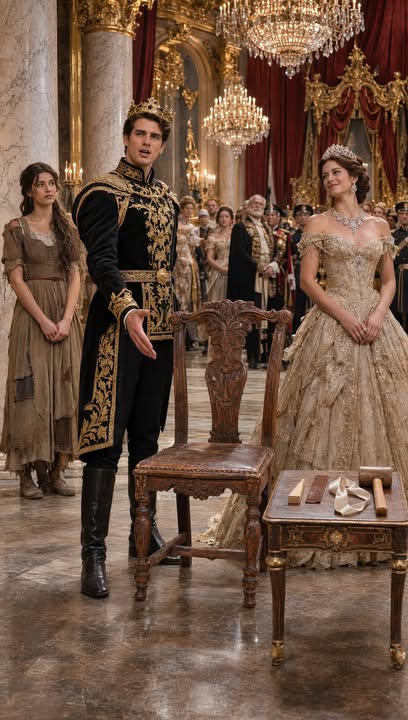
Part 3 – The Maker’s Mark
Mara touched the initials on her father’s gauge.
For the first time, she wondered whether the chair had been waiting all these years to be recognized.
The thought unsettled her more than she wanted to admit.
A hidden mark could be a coincidence, and a family inventory could record a delivery without knowing who had made the thing delivered.
But the two marks looked alike.
Julian kept his gaze on the chair.
“May I see the gauge?”
Mara hesitated, then held it out.
He accepted it with care, turning it so the light from the high windows fell across the carved initials.
“E. H.,” he said. “Do you know what they stand for?”
“My father’s name was Elias Hart.”
Eveline’s eyes remained fixed on the mark beneath the seat.
“Elias Hart,” she repeated, as though testing the name against a memory. “There’s a note about a Hart in my grandfather’s inventory, but it is not beside the chair entry.”
Julian looked up.
“What does the note say?”
“I don’t remember exactly,” Eveline answered. “Only that he was a palace carpenter, and that my grandfather considered him unusually careful.”
Mara’s fingers tightened at her sides.
“What else?”
“I don’t know yet,” Eveline said. “The book is an index, not the full inventory. The detailed records are kept at our family house.”
Julian handed the gauge back.
“Then we should find them.”
Eveline closed the book gently.
“I can ask my mother to send the old ledgers.”
“Can you ask without telling her why?”
“I can try.”
She glanced at Mara, then added, “I would rather not make a claim before we know more.”
Mara heard the caution in her voice, and it eased something inside her.
The chair was not yet proof of anything.
It was only a mark, a name, and a question that had been waiting longer than any of them had been alive.
Julian looked toward the palace doors.
“I will ask the archivist to search the royal records as well.”
“Your Highness,” Mara said, “I don’t want the palace to call it my father’s chair just because the mark resembles his initials.”
“Nor do I,” he replied. “That is why we will look.”
His answer was plain, without the polished certainty of a court announcement.
Mara realized she trusted it more than a promise.
Eveline opened the inventory again.
“The chair was delivered under my family’s name,” she said. “That may mean my grandfather purchased it, commissioned it, or simply accepted it as payment for something else.”
“Could it have been made in your household?” Julian asked.
“Possibly, though my grandfather did not keep a workshop of his own. He ordered furnishings from craftsmen throughout the city and the palace.”
“Would the maker have been recorded?”
“Usually,” Eveline said. “Unless the entry was incomplete, or the name was lost when a copy was made.”
She paused over the page.
“Or unless someone had a reason to leave it out.”
No one spoke.
The suggestion was quiet, but it changed the air around the chair.
Mara bent to study the concealed mark again.
It was not merely a pair of letters cut into the wood.
A narrow line extended beneath them, partly covered by the dark patch, as if the mark had once been longer.
She reached toward it, then stopped before touching the surface.
“May I bring the palace conservator?” Julian asked.
“Perhaps,” Mara said. “I don’t want anyone scraping at it before we know how it was covered.”
Julian gave a small nod.
“That is sensible.”
Eveline watched her carefully.
“You think the patch was placed there to hide the mark?”
“I think it might have been. But old repairs can cover marks by accident.”
“And you have seen that happen?”
“My father used to say that wood remembers every hand that works it, though it does not always tell you what the hand intended.”
Mara looked down at the gauge in her palm.
Her father’s words had seemed ordinary when he first taught them.
Now they felt like a door opening onto a room she had never known existed.
Julian stepped back from the chair.
“We will keep this quiet until we have something more than resemblance.”
Eveline’s shoulders relaxed by a fraction.
“I appreciate that.”
Mara looked from the prince to the noblewoman.
The previous evening, they had stood on opposite sides of a public contest.
Now they were gathered around a chair that might connect all three of them to a history they did not understand.
Eveline shut the inventory and tucked it beneath her arm.
“I will send for the ledgers this morning.”
“Thank you,” Julian said.
She turned to leave, then looked back at Mara.
“Would you come with me when they arrive?”
“If His Royal Highness agrees.”
“I do,” Julian said. “Mara has the experience to recognize a maker’s mark, and Lady Eveline has the family records. We should not separate the two.”
Eveline gave Mara a small, uncertain smile.
Mara returned it.
It was not friendship yet.
It was a choice to keep looking together.
Before noon, Julian sent a message to the palace archivist and asked that the chair be moved to a quieter room where it could be examined without drawing attention.
The servants carried it carefully, with Mara walking beside them to make certain they did not lift it by the loose support.
In the small music room, the chair was placed near a tall window.
A square of afternoon sunlight fell across its carved seat.
The room smelled faintly of beeswax and old sheet music.
Mara ran her gaze over the legs once more.
Without the uneven ballroom floor beneath it, the chair did not rock.
Its loose joint remained, but the structure seemed strong.
Julian stood at the far side of the room, watching as Mara examined the underside.
“Do you think it was made as ordinary furniture?” he asked.
“I don’t know.”
She leaned closer to the darkened patch.
“The carving is careful, but plain. It was built to be used, not displayed.”
Eveline stood by the window with her inventory open.
“That would fit with the way it was recorded,” she said. “My grandfather’s household bought useful furnishings for the palace as well as ornamental ones.”
Julian folded his hands behind his back.
“Why would an ordinary chair need a hidden maker’s mark?”
“Some makers marked every piece,” Mara replied. “It helped them remember what they had built, and it let others know who could answer for the work.”
“Then why hide it?”
“Someone may have repaired the chair and covered it without noticing.”
“Or noticed and chosen to,” Eveline said.
Mara glanced at her.
Eveline’s expression was serious, but not eager for a scandal.
She seemed to be asking the same question Mara was: what if the answer reflected poorly on someone they cared about?
The archivist arrived carrying a narrow packet of notes and a brass key ring.
He was a gray-haired man with a neat beard and spectacles that slipped down his nose when he bent to read.
After Julian introduced Mara and Eveline, the archivist examined the mark without touching it.
“The royal furniture registers are kept in the archive,” he said. “I found a reference to this chair, but it is brief.”
“What does it say?” Julian asked.
“‘Carved chair, received through the household of Lord Aveline, placed in the west ballroom.’”
Eveline’s fingers tightened around her ledger.
“Lord Aveline was my grandfather.”
“The entry does not name a maker,” the archivist continued. “Nor does it name a purchase price.”
“Is there a date?” Mara asked.
“Twenty-four years ago.”
The answer fell into the room with a quiet finality.
Mara had been born not long after that.
Her father had been working in the palace workshops then, but the date alone proved nothing.
“Are there records for repairs?” Julian asked.
The archivist consulted his packet.
“There are two notes. One records a repair to the seat, made several years after delivery. The other says the chair was moved from the west ballroom to storage, then returned during a later rearrangement.”
“Does either note name the person who repaired it?” Mara asked.
“The first names a workshop. The second does not.”
The archivist looked at the chair again.
“If the maker’s mark was covered during the repair, that may explain the dark patch.”
“May we see the original entry?” Eveline asked.
“Certainly. I will bring the ledger once I have verified that it can be handled safely.”
Julian thanked him.
After the archivist left, Eveline sat at the small writing desk and copied the date into her inventory book.
Mara remained beside the chair.
“Twenty-four years,” she said softly.
“Your father would have been working here then,” Eveline replied.
“Yes.”
“Do you remember him bringing furniture home from the palace?”
“Sometimes he brought scraps of wood, never a whole piece. He said palace work belonged to the palace.”
Mara brushed a fleck of dust from her skirt.
“He did bring home a small wooden box once, though. It had tools in it that he used for demonstrations.”
“Demonstrations?”
“Father taught apprentices in the workshop. He showed them how to judge a joint, how to listen for a wobble, how to tell when a floor was uneven.”
Julian had moved closer.
“What did he use to demonstrate the floor?”
“A small frame with four legs, I think. It was something he built himself.”
Mara searched her memory, seeing her father’s workshop in brief, sunlit pieces.
She remembered a wooden frame on a bench, two different lengths of leg, and her father kneeling beside it with a piece of chalk.
“He told me that a chair could be perfectly sound and still become dangerous if the floor beneath it was wrong.”
Julian’s face became still.
“Did he ever say why he built it?”
“Not that I remember.”
The archivist returned before Mara could summon another memory.
He carried the old ledger in both hands and placed it on the desk.
Its leather cover had faded to a soft brown, and the pages were the color of old cream.
He opened it to the year of the chair’s delivery.
Eveline leaned over the page.
There it was, written in a careful clerk’s hand: the carved chair had entered the palace under her grandfather’s account.
Below the entry, a smaller note had been added in darker ink.
“Maker’s name to be supplied after inspection.”
Mara read it twice.
“Was it?” Julian asked.
The archivist turned several pages.
“No.”
Eveline traced the margin with her eyes, careful not to touch the ink.
“Could the inspection have been about the chair’s condition?”
“It may have been,” the archivist said. “The record does not say.”
Mara looked at the hidden mark beneath the seat.
A maker’s name had been expected.
Then it had disappeared from the record.
Perhaps it had never been supplied.
Perhaps someone had meant to add it and forgotten.
Perhaps the mark beneath the chair had been concealed during the repair.
The possibilities were ordinary enough to be believable.
That did not make them easy to bear.
Eveline closed her eyes for a moment.
“My grandfather was meticulous about accounts,” she said. “If he knew who made it, he would usually have recorded the name.”
“Usually is not always,” Julian said.
“No.”
She looked at him.
“I don’t want my family’s name treated as proof of wrongdoing.”
“Neither do I,” Julian replied. “That is why we are looking at the records, not making accusations.”
Eveline’s face softened.
“Thank you.”
Her gratitude seemed to carry more than the words themselves.
Mara understood that feeling.
She had spent much of her life knowing that people might decide what she was before learning her name.
The archivist closed the ledger.
“I can search the workshop records next,” he said. “They are less complete, but they may tell us whether Elias Hart worked on the chair.”
“Please do,” Julian said.
When the archivist left, Julian looked toward Mara.
“You need not stay if you have other duties.”
“I would like to stay.”
“Then stay.”
Eveline remained by the desk, her inventory open to the copied date.
For a moment, no one spoke.
Then she said, “I have spent years being praised for knowing how to stand, what to say, and when to smile.”
Mara glanced at her.
“I used to think that was enough to make me capable.”
“What do you think now?” Julian asked.
Eveline turned one page in the book.
“I think it made me good at looking prepared.”
She gave Mara a rueful look.
“Yesterday, I noticed the loose joint and treated it as the whole answer because the room expected me to know what to do.”
Mara let the thought settle.
“I noticed the scrape because I had learned to look at the floor.”
“From your father.”
“Yes.”
Eveline’s gaze lowered to the old gauge in Mara’s hand.
“Could I see it?”
Mara passed it to her.
Eveline held the measuring tool lightly, her thumb resting well away from the initials.
“My grandfather owned several things marked this way,” she said. “Not furniture, but tools and shipping crates. I used to think it was a workshop emblem.”
“Do you remember where you saw it?”
“In one of the family inventories. There may have been a note describing the mark.”
She returned the gauge carefully.
“If the ledger comes, I will search for it.”
Mara thanked her.
For the first time, Eveline did not seem to be speaking from a place of apology.
She was offering what she knew.
The afternoon passed slowly.
Mara returned to her duties, but the chair’s hidden mark followed her through the palace.
She saw it when she carried a tray past the music room, when she paused to help a cook lift a heavy pot, and when she sat with Nell and Thomas that evening.
Her brother listened to the day’s news with the seriousness of someone receiving a report from a distant country.
“So Father might have made the chair?” Thomas asked.
“He might have.”
“Then why didn’t anyone know?”
“That is what we are trying to learn.”
Thomas frowned.
“Couldn’t you just ask the old records?”
“We are.”
“Then perhaps they’ll say.”
Nell turned their father’s gauge over in her hands, studying the initials.
“If he made it, do you think he wanted people to know?”
Mara thought about the way her father had worked.
He had never seemed hungry for praise.
He cared about whether a table stood level, whether a door opened easily, and whether a chair could hold the weight placed upon it.
“I don’t know,” she said. “He wanted his work to be honest.”
Nell handed the gauge back.
“Maybe that is why he marked it.”
The next morning, a footman brought word that Julian wished to see Mara and Eveline in the small music room.
Eveline arrived first, carrying a slim folder tied with a blue ribbon.
“My mother sent the family ledgers,” she said. “She also sent a note asking why the palace needed them.”
“What did you tell her?” Mara asked.
“That a chair delivered under my grandfather’s account had an unrecorded maker, and that we were trying to identify him.”
“Did she ask if it was about your mistake in the ballroom?”
Eveline’s mouth tightened.
“She did.”
“What did you say?”
“That the chair’s history mattered more than my pride.”
Mara looked at her, surprised by the firmness in her voice.
Eveline opened the folder on the desk.
“These ledgers are copies. The originals remain at our house, but this should include the household accounts from that year.”
Julian entered with the archivist a moment later.
The archivist set the royal register beside the family records.
For the next hour, they compared dates, payments, and delivery notes.
Eveline worked carefully, turning each page with a narrow paper strip so the old edges would not tear.
Mara read the entries aloud as she found them.
The chair appeared in one list as a carved seat for the west ballroom.
In another, it was noted as received from Lord Aveline’s household.
Neither entry named a carpenter.
Then Eveline found a brief line in the account book, written beside a payment to the palace workshop.
“Repairs and demonstration frame, Elias Hart.”
Mara stopped reading.
Julian leaned over the page.
“Is that the same date?”
“Two months later,” Eveline said.
She checked the opposite page.
“The payment is small. It says ‘for timber, pegs, and labor,’ but not what the frame was for.”
Mara bent closer.
“Demonstration frame.”
The words stirred a memory of uneven legs on a workbench, of chalk lines and her father’s hands turning a piece of wood.
“He made one to show how a level surface could make sound furniture seem faulty,” she said.
The archivist’s expression grew thoughtful.
“Would that have been connected to the chair?”
“I don’t know.”
Julian looked from the account to the chair.
“Could the chair itself have been the demonstration?”
Mara examined its construction again.
“It could have been, but there is no way to know yet.”
Eveline turned the page.
There was another entry, this one written in a different hand.
“Workshop recommendation submitted to the household office.”
Beneath it, someone had added a small mark that resembled a check.
No recommendation followed.
Eveline read the line again.
“Does the household office still have its papers?” Julian asked.
“The royal archive may,” the archivist replied. “The old office records were moved there when the department was reorganized.”
“Can you search them?”
“I can.”
He placed a narrow slip of paper between the pages and wrote down the date.
Eveline closed the family ledger.
“If my grandfather knew about a recommendation, he may have supported it.”
“Or it may have been a routine account note,” Julian said.
“Yes,” she replied. “We must not turn every missing line into a secret.”
Mara met her eyes.
It was the same caution she had asked for, now offered back to her.
Before the archivist could leave, another page caught Eveline’s attention.
“This entry is for the ballroom flooring,” she said.
The line was brief, listing a contract with a local supplier for repairs in the west ballroom.
Mara studied the date.
“Was that when the floor was laid?”
“I’m not certain,” Eveline said. “It may have been repairs after the room was refurbished.”
Julian’s gaze settled on the phrase.
“Does it mention whether the work was inspected?”
Eveline searched the surrounding lines.
“There is a note saying it was accepted by the household office.”
The archivist copied the reference.
“I will look for the inspection report.”
The mention of the ballroom floor made Mara think of the faint scrape beneath the chair and the way the leg had followed the dip.
Her father had taught her to look at the floor before blaming the chair.
What else had he noticed in that ballroom?
The question stayed with her after the meeting ended.
That evening, Julian asked Mara to walk with him through the west ballroom.
He had brought a narrow measuring rod from the palace stores.
The room was empty except for a row of covered tables and the chair, now placed near the center.
Mara preferred the quiet to the grand gathering.
Without the chandeliers blazing and the guests filling every corner, the ballroom seemed less like a stage and more like a place built by many hands.
Julian held one end of the rod while Mara checked the floor from one side of the chair to the other.
The slope was slight.
It was easy to miss unless a person knew to look.
“Your father noticed this?” Julian asked.
“He noticed something. I don’t know if it was this particular place.”
Mara shifted the rod a little farther along the marble.
“There is another dip here.”
Julian crouched to see.
“Could a person feel it underfoot?”
“Not unless they were looking for it.”
She moved to the far side of the chair.
The floor dipped again near the edge of the ballroom, though the difference was smaller.
Julian held the rod steady as Mara checked the line.
“You said your father taught apprentices,” he said. “Was he well respected?”
“He was.”
“Then what happened to him?”
The question was gentle, and still it found the part of Mara that had spent years arranging the past into a story small enough to carry.
“He lost his position when I was young,” she said. “People said a chair had failed at an event and that his work had been questioned.”
Julian’s face changed.
“Did a chair fail?”
“I don’t know. Father never spoke about it much.”
“Did he leave the palace because he was blamed?”
Mara measured the space between the rod and the floor.
“That was what people said.”
“Did he tell you it was true?”
“No. He told me not to let other people’s judgments stop me from learning.”
The words came out more softly than she expected.
Julian looked down at the floor.
“I should have asked what happened before I began a contest about fixing a chair.”
“You could not have known.”
“I should have wondered why the chair was here, who had made it, or why it had been kept.”
Mara studied him.
He looked troubled, but not in the way people looked when they had made a mistake and wanted someone else to ease it for them.
He seemed to be thinking about what the mistake meant.
“You asked us to understand the problem,” she said. “Now you are doing the same.”
Julian met her eyes.
“I am trying.”
They continued across the room, checking the marble in narrow intervals.
At the far end, the measuring rod showed a shallow low place beneath one of the tall windows.
Julian marked the location on a sheet of paper.
“If the floor was laid unevenly, the chair is not the only thing affected.”
“No,” Mara said. “Anything with short legs might rock here.”
He looked toward the ballroom doors.
“I will ask the building steward to check the room properly.”
Mara wondered how many years the floor had been telling the same story without anyone listening.
When she returned to the music room, Eveline was waiting beside the chair.
She had brought her grandfather’s household index again.
“I found the note about the mark,” she said.
Mara’s pulse quickened.
“What does it say?”
Eveline set the open book on the desk.
“It calls the mark ‘the Hart workshop sign.’ There is a reference to it beneath the entry for a demonstration chair.”
The room seemed to grow very still.
Julian came to stand beside them.
“Does it identify the chair?”
“Not directly,” Eveline said. “But the date matches the payment to the palace workshop.”
Mara looked at the chair.
“A demonstration chair,” she repeated.
“Perhaps,” Eveline said. “The family record says it was received from the palace workshop and delivered under my grandfather’s account.”
Julian’s brow furrowed.
“Then it was built in the palace, not purchased from an outside maker.”
“That seems likely,” Eveline replied. “But the record does not say why it was delivered to my grandfather’s household first.”
“Was your grandfather involved in the ballroom renovations?” Mara asked.
“According to this ledger, he helped arrange the furnishings when the west rooms were refurbished.”
She searched the page below the chair entry.
“There is a line about the ballroom floor as well.”
The archivist, who had returned to collect his notes, leaned in.
“What does it say?”
Eveline read the faded words slowly.
“‘Floor level requires further review before public use.’”
Mara looked at Julian.
“Who wrote that?”
Eveline followed the line to the small signature in the margin.
“My grandfather.”
The signature was followed by a second note, written in a later hand.
“Review deferred; room prepared for the royal gathering.”
Eveline’s lips parted, but she did not speak at once.
The words did not accuse anyone.
They did not explain what had happened.
They simply showed that someone had noticed the floor was not level, and that the review had been postponed.
Mara felt the old measuring gauge grow heavy in her pocket.
Julian read the note again.
“Was the chair delivered before or after this?”
Eveline searched the date.
“Three weeks before.”
“Then the chair may have been made to demonstrate the uneven floor.”
“Or to show how furniture behaved on it,” Mara said.
The possibilities began to align, not as certainty but as a shape.
The demonstration frame.
The chair.
The floor marked for further review.
Her father’s name missing from the official entry.
Eveline’s grandfather’s note.
Mara leaned closer to the page.
There was a faint line beneath the signature, nearly hidden in the binding.
She tipped the book toward the window.
A few more words came into view.
“Elias Hart requests inspection before the gathering.”
Julian’s expression sharpened.
Eveline read the line aloud.
Then she turned the page, looking for the rest of the note.
The next sheet had been cut close to the binding, leaving only a ragged strip where more writing might once have been.
The archivist examined the edge.
“This page was damaged long ago,” he said. “We would need the original ledger to know whether anything remains.”
Eveline stared at the torn margin.
“My family’s original is still at home.”
“Can you obtain it?” Julian asked.
“I can ask.”
Her voice was steady, but Mara could see the strain in the way she held the book.
Eveline had wanted to learn what her grandfather knew.
Now she had found a note that tied him to the floor, the chair, and Mara’s father.
Mara understood why she seemed afraid of what the next page might say.
Julian looked at the hidden mark beneath the seat.
“If Elias Hart built this chair as a demonstration, he may also have written a report.”
“Or a warning,” Mara said.
No one answered.
Outside the music room, the palace went on with its ordinary business.
Footsteps passed in the corridor.
A bell rang somewhere below them.
Inside, the chair stood in the sunlight, its maker’s mark half concealed beneath
**–END OF PART 3–CLICK “NEXT” AT THE BOTTOM OF THE PAGE TO CONTINUE READING**
* * *
[PREVIOUS: PART 2](https://storyly.idolsgift.com/blog/part-2-the-mark-beneath-the-chair-057) | [NEXT: PART 4](https://storyly.idolsgift.com/blog/part-4-the-mark-beneath-the-chair-057)
✓ Lynn R. Adams
Part 3 – The Maker’s Mark Mara touched the initials on her father’s gauge. For the first time, she wondered whether the chair had been waiting all these years to be recognized. The thought unsettle…