PART 3: The Mark Beneath the Carpet 046
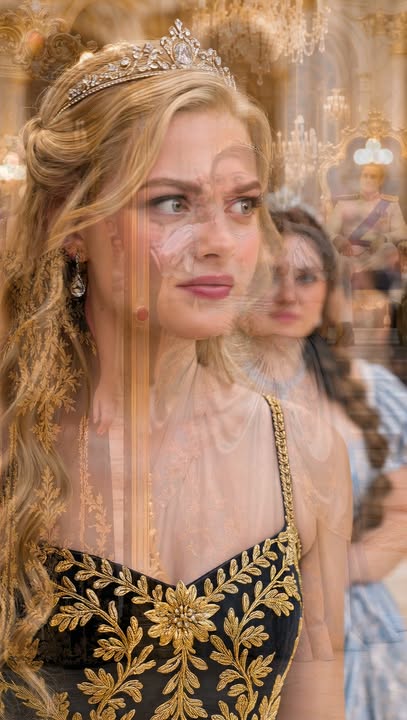
Part 3 – The Mark in the Ledger
The following morning, I found the sketch exactly where I had left it years ago, folded inside my grandmother’s old sewing tin.
The tin sat in the back of my mother’s linen cupboard, beneath a stack of mended tablecloths and a bundle of ribbon that smelled faintly of lavender.
My mother watched as I lifted the lid.
“Your grandmother kept everything,” she said.
“She kept things she thought might matter.”
“Sometimes she kept things because she couldn’t bear to throw them away.”
The distinction sounded small, but I knew my mother was asking me to consider whether the sketch belonged to the first kind of keeping or the second.
I unfolded the paper on the kitchen table.
Its edges had gone soft and yellow with age, and the pencil drawing was faded enough that I had to tilt it toward the window to make out the lines.
It showed a tall frame with two uprights and a crossbar, but unlike the polished apparatus in the palace, this one had a wide base and small marks running up each side.
Beneath it, in my grandmother’s familiar hand, were the words she had left me with for years.
The court’s measurements are wrong.
My mother touched the corner of the paper.
“I remember her drawing this,” she said. “She used to look at it whenever she was worried.”
“Did she ever tell you what it was?”
“She said it was a design she had seen while working for the royal household.” My mother paused. “But she never said she had made it.”
A chill moved through me that had nothing to do with the cool morning air.
“Do you think she did?”
“I don’t know, Mara.”
The uncertainty in her voice was more unsettling than an answer would have been.
I had grown up believing the royal frame was an old tradition, a beautiful object that had become a foolish test.
Now I wondered if its history was not foolish at all, but something someone had changed.
At the palace, the frame remained closed to candidates while the attendants checked its base and searched for the original plans.
Prince Adrian had arranged for me to see the records clerk that afternoon, though he had warned me that the archive held decades of copied notes and incomplete catalogues.
I brought the sketch with me in a leather folder my mother had used for her sewing patterns.
The palace archive occupied a long chamber beneath the eastern wing, where the stone walls held the cool scent of dust and wax.
Shelves rose almost to the ceiling, crowded with ledgers, rolled plans, and boxes marked in a careful succession of years.
The records clerk, Mr. Bell, greeted us at a broad table.
He was a narrow-shouldered man with half-moon spectacles and an expression that suggested he preferred documents to people.
“This is Miss Williams?” he asked Adrian.
“It is,” the prince replied. “She has a family sketch that may be relevant to the frame.”
Mr. Bell’s gaze settled on the leather folder.
“May I see it?”
I opened it and laid the paper on the table.
He leaned over without touching it.
For several seconds, he said nothing.
Then he adjusted his spectacles.
“This resembles a preliminary design,” he murmured.
“You’ve seen one before?” I asked.
“Not precisely this one.” He looked toward the shelves behind him. “The catalogue refers to several early drawings, although none are currently stored with the frame’s records.”
“Where were they taken?” Adrian asked.
“The catalogue gives no destination.”
“Who removed them?”
Mr. Bell pressed his lips together.
“The entry was altered more than once. I cannot say.”
Adrian’s shoulders stiffened, but he kept his voice even.
“Could we look at the catalogues?”
Mr. Bell nodded and led us to a cabinet of bound registers.
We spent the next hour comparing entries.
The oldest reference to the frame described it as a fitting arch, designed to help tailors and household craftspeople assess clearances for garments, chairs, and ceremonial robes.
A later entry called it a measure of proportion.
The next described it as an instrument for determining whether a candidate possessed the court’s ideal dimensions.
The words changed over time, one careful alteration at a time.
I ran my finger down the page without touching the ink.
“Someone made this into a test,” I said.
Mr. Bell glanced up.
“It appears the purpose changed gradually.”
“Or the records were copied from one another,” Adrian said.
“Either way,” I replied, “the frame did not begin as a judgment.”
Adrian looked at the sketch again.
“No,” he said. “It seems it did not.”
A voice sounded behind us.
“Perhaps it was meant to be a judgment after all.”
Vanessa stood at the end of the table, still dressed in the black-and-gold gown from the night before.
In daylight, the gold thread looked less like a crown and more like a pattern someone had stitched by hand.
She had come without an attendant, carrying a small notebook against her chest.
“I’m sorry to interrupt,” she said. “I asked Mr. Bell if I could see the records.”
“Why?” I asked.
Her gaze moved to the sketch.
“Because I wanted to know whether I failed because my dress touched the bar, or because the frame was not level.”
“You were told it registered contact,” the clerk said.
“I know what I was told.” Vanessa’s voice was controlled, but not sharp. “That does not mean I know what happened.”
Adrian drew out a chair.
“Please, sit.”
She looked at me before accepting it, as though unsure whether I would object.
I did not.
For a while, the four of us studied the old ledger together.
Vanessa’s notebook held notes about the dimensions of her gown, the position of the indicator, and the exact place her skirt had brushed the metal.
She had written everything down in neat, precise lines.
“You came prepared,” I said.
“I am accustomed to keeping records.” She set the notebook beside the ledger. “My family expects me to know the details of any arrangement they make.”
There was something in the word arrangement that made her glance quickly toward Adrian.
He noticed, but he did not ask.
“You may have been failed by a faulty apparatus,” I said. “But we don’t know yet.”
“I know.” Vanessa’s fingers tightened around the notebook. “I’m not asking you to decide for me.”
“I wouldn’t.”
Her expression softened, though only slightly.
“I thought you might.”
The clerk found another entry, this one from nearly forty years earlier.
It referred to a repair performed on the frame’s lower hinge by a craftswoman named Eleanor Williams.
My grandmother’s name.
I stopped breathing for a moment.
“Could I see that?” I asked.
Mr. Bell turned the ledger toward me.
The record was brief, written in a cramped hand.
E. Williams restored the lower hinge and reinforced the adjustable base; original purpose to be retained.
I read it twice.
My grandmother had not simply worked for the royal household.
She had repaired this very frame.
Adrian leaned closer.
“Does the date match her employment?”
“I don’t know the exact years,” I said. “She never spoke of the palace much.”
“Could the drawing be hers?” Vanessa asked.
“I think so.”
Mr. Bell searched the adjacent pages.
“There is a further notation,” he said. “The frame’s base was altered later, though the record does not identify the craftsperson.”
The next entry was dated six years after my grandmother’s repair.
Its description was sparse.
The adjustable base was secured for ceremonial use, and the upper indicators were recalibrated.
“Secured,” I repeated.
“Perhaps the wheel was locked in place,” Adrian said.
“Or perhaps it was meant to remain adjustable, and someone decided it should not,” I replied.
Mr. Bell studied the record.
“The wording is ambiguous.”
“Can we see the original repair notes?” Adrian asked.
“They are not in this volume.”
“Where are they?”
The clerk turned several pages, then looked through the index at the back.
“The entry says supporting documents were filed under household furnishing plans.”
He crossed to a different shelf and returned with a box of loose papers.
As he sorted through it, Vanessa’s gaze stayed fixed on the ledger.
“You told me you had spent six months preparing for the test,” she said quietly.
“I did,” I replied.
“Why?”
I thought of all the reasons I had rehearsed in my mind, none of them simple enough to say in one breath.
“Because I wanted to know whether my grandmother was right.”
“Right about what?”
“That the measurements were wrong.”
Vanessa lowered her eyes to her notebook.
“I used to think all of this was about winning.”
“Being chosen?”
“Being the best candidate.” She offered a small, self-conscious smile. “My parents call it a good match. They say my family and the prince’s household have similar values, similar expectations, similar plans.”
“And what do you call it?”
She took a moment.
“I call it a business arrangement with a beautiful dress code.”
Adrian remained quiet.
Vanessa glanced at him, then away.
“I don’t mean that as an insult,” she said. “I know you didn’t design the whole process.”
“I did agree to it,” he said.
“And I agreed to compete.”
Her hand moved over the edge of her notebook.
“My parents have spent years explaining what a suitable future should look like. I thought if I could succeed here, they might finally trust me to choose something for myself.”
“Would they?” I asked.
Vanessa gave a laugh without humor.
“I don’t know. That is probably the problem.”
I understood then that her confidence had not grown from certainty, but from having practiced its appearance for so long.
She was still my rival.
She had still laughed when I stepped forward.
But the memory no longer felt as simple as I had first made it.
“I’m sorry you thought I wanted to humiliate you,” she said.
“I didn’t think that.”
“You looked as if you did.”
“I thought you wanted the room to laugh with you instead of at you.”
Vanessa’s face changed.
For a moment, she looked younger than she had the night before.
“That may be true,” she said.
Adrian’s expression held no judgment, only attention.
The clerk returned with a thin folder.
“I found the repair notes,” he said. “They were misfiled under general household maintenance.”
The papers inside were tied with a faded blue ribbon.
One page included a small maker’s mark, a figure shaped like a bird with one wing raised.
My stomach tightened.
I had seen that mark before.
Not on my grandmother’s sketch, but in the picture she used to make for me whenever she talked about her mother.
A bird with one wing lifted, drawn beside a set of measurements.
“What is it?” Adrian asked.
“My grandmother used to describe the mark on her mother’s tools.”
“Your great-grandmother?”
“I never knew her,” I said. “But my grandmother told me she was a craftswoman.”
Mr. Bell leaned toward the paper.
“This mark is recorded as belonging to a workshop that supplied furnishings to the royal household.”
“Do the records say who owned it?” Adrian asked.
“Not in this file.”
The clerk turned the page over.
Beneath a stain and a line of faded ink was a name.
The letters were faint, but legible.
“E. Wren,” I read.
The room seemed to draw still around me.
“My grandmother’s family name was Wren before she married.”
Adrian looked from the document to the sketch.
“That would make the maker your great-grandmother.”
“It might,” I said. “But the court has no reason to accept that from a family sketch alone.”
Vanessa studied the bird mark.
“It is the same shape,” she said. “And the same kind of measurement marks.”
Mr. Bell shook his head carefully.
“A resemblance is not proof. The mark could have been used by several craftspeople in that workshop.”
“Could we find a record of E. Wren?” I asked.
The clerk checked the index, then another catalogue.
He found no full name, no contract, and no description of the woman who had signed the repair papers.
Adrian was silent for a long moment.
“The archive will keep looking,” he said. “No one should dismiss the possibility simply because it is inconvenient.”
Mr. Bell nodded.
“Of course, Your Highness.”
But the clerk’s answer carried the tired caution of someone who knew how easily a possibility could disappear among old papers.
Vanessa closed her notebook.
“If the frame was designed for a different purpose,” she said, “then the test has been wrong for a long time.”
“Possibly,” Adrian replied.
“And if someone altered it recently, we may never know why.”
“No,” he said. “Not yet.”
The word yet stayed with me.
When we left the archive, the palace corridors seemed quieter than before.
Adrian walked beside me while Vanessa followed several steps behind, speaking with Mr. Bell about copies of the records.
“I’m sorry about last night,” Adrian said.
“You already apologized.”
“I know.”
“Then why say it again?”
“Because I keep thinking about the difference between inviting people from different backgrounds and actually listening to what they have to say.”
I looked at him.
“You listened.”
“After the test had begun.”
“People learn when something goes wrong.”
He gave a faint smile.
“I would rather learn before.”
“That is probably true of everyone.”
We reached the gallery overlooking the ballroom.
Through the open doors, I could see the frame beneath its protective covering.
The attendants had removed the platform, but the golden uprights still stood in their place.
A court official stood beside them, speaking with a pair of household workers.
The official who had reached for the wheel was not there.
“Has he been removed from his duties?” I asked.
“Temporarily,” Adrian said. “Until the inspection is complete.”
“Do you think he moved it?”
“I don’t know.”
“Do you think he intended to?”
“I don’t know that either.”
His honesty did not make the uncertainty easier, but I preferred it to a convenient accusation.
Vanessa joined us at the gallery entrance.
“I should go,” she said. “My family will want to hear what I found.”
“Will you tell them?” I asked.
“I’ll tell them the records are unclear.”
“That sounds careful.”
“It is.” She tucked the notebook beneath her arm. “I have spent a long time saying what people expect to hear. I would like to try saying only what I know.”
She turned toward the corridor.
“Vanessa,” I called.
She stopped.
“If the frame’s position affected your attempt, I’m sorry.”
Her eyes met mine.
“I don’t know whether it did,” she said. “But thank you.”
It was not forgiveness, exactly.
It was a small space in which something different might begin.
She left us in the gallery.
For a few moments, Adrian and I watched the workers inspect the frame.
“Your grandmother must have known more than she told you,” he said.
“I think she knew the frame was important.”
“Why keep the sketch and not the plans?”
“Maybe she never had the plans.” I hesitated. “Or maybe she believed the sketch was enough to remind someone to ask the right questions.”
Adrian looked at me with quiet admiration.
“You have a way of making uncertainty sound useful.”
“I learned from my grandmother.”
An attendant approached carrying a narrow parcel wrapped in brown paper.
“Your Highness, this was delivered from the records office.”
Adrian accepted it.
The parcel bore my name.
My pulse quickened.
“I didn’t ask for anything else,” I said.
The attendant explained that it had been found in a drawer of uncatalogued household papers.
Adrian carefully untied the string and unfolded the paper.
Inside lay a small, delicate drawing of the frame, its shape unmistakable.
This sketch was more detailed than the one in my sewing tin.
It showed the width of the opening, the adjustable base, and the brass indicators, but the indicators were drawn facing outward rather than toward the person standing inside.
A line of handwriting ran along the lower edge.
The frame is not to measure the body, but the space the body requires.
Beneath it was the same bird mark, one wing raised.
I reached for the page, then stopped before touching it.
“Is there a name?” Adrian asked.
The paper had been folded over at the bottom.
I opened it carefully.
The name was written there in a firm, elegant hand.
Eleanor Wren.
My great-grandmother had not merely made the frame.
She had written what it was for.
But there, beside the name, someone had added a later note in darker ink.
The measurements are to be fixed before the next royal selection.
And below that sentence was a date from the year my grandmother had repaired the frame.
My grandmother had known the original purpose.
Someone had ordered it fixed anyway.
**–END OF PART 3–CLICK “NEXT” AT THE BOTTOM OF THE PAGE TO CONTINUE READING**
* * *
[PREVIOUS: PART 2](https://echoesofstories.idolsgift.com/blog/part-2-the-mark-beneath-the-carpet-046) | [NEXT: PART 4](https://echoesofstories.idolsgift.com/blog/part-4-the-mark-beneath-the-carpet-046)
✓ Lynn R. Adams
Part 3 – The Mark in the Ledger The following morning, I found the sketch exactly where I had left it years ago, folded inside my grandmother’s old sewing tin. The tin sat in the back of my mother’s…